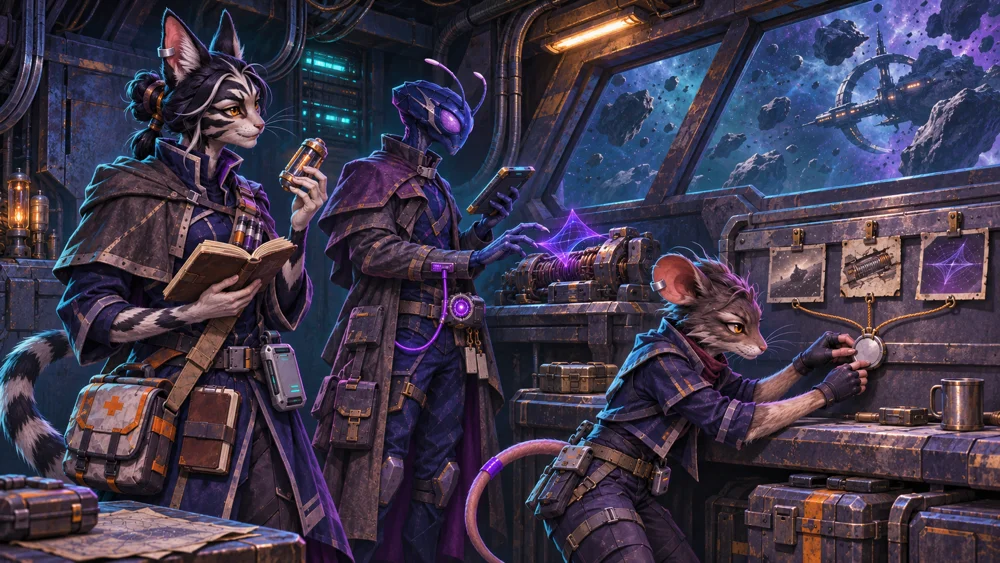
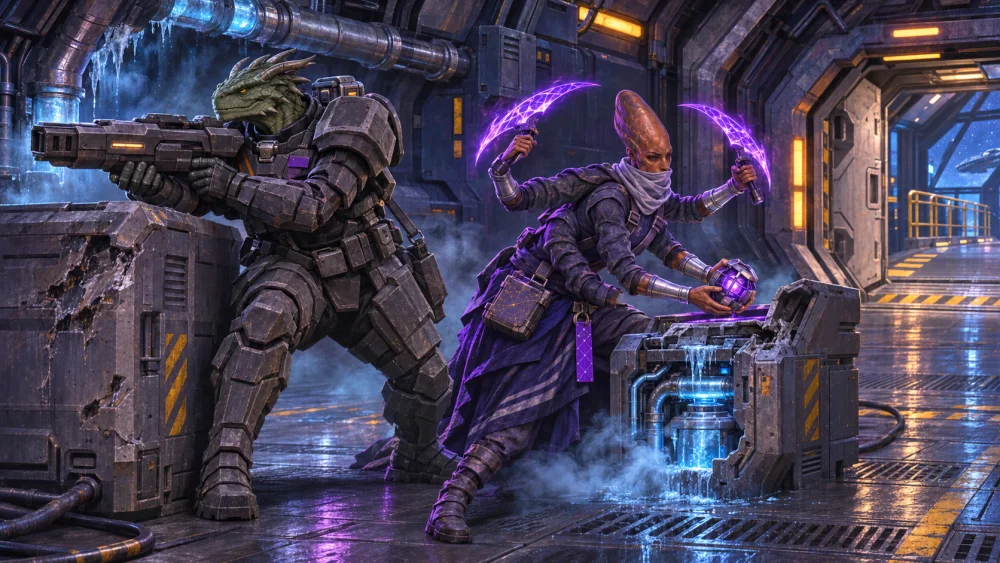
A Starfinder 2e hazard should create a decision before it creates a consequence. Give the crew something they can notice, a reason to care now, and more than one credible response. That turns a broken airlock, a cursed relic, or a collapsing route into a scene instead of a surprise damage roll.
The GM Core separates afflictions, environments, and hazards because they create pressure in different ways. Use this guide with the Starfinder 2e GM Guides, the Encounter Building Guide, and the Rules Guide when a dangerous situation needs to stay clear at the table.

Begin with a clue and a choice
A hazard works when the crew can connect a sign to a decision. A pressure door hisses before it fails. A cargo deck has fresh scrape marks near a weak section. A tomb's warning glyph is visible before someone reaches for the relic. The clue does not need to reveal every rule in the hazard, but it should tell the players that the situation deserves attention.
Then decide what the crew can do. It might change routes, search more carefully, use a tool, ask for help, spend time securing the area, or accept the risk because the faster path matters. A consequence still lands when the crew chooses poorly or cannot solve the problem in time. It should not feel like it arrived before anyone had a chance to engage with the scene.
The detection procedure supports that handoff. When a character enters a hazard's general area, the GM normally rolls a secret Perception check against the hazard's Stealth DC. Individual hazards can set further conditions for active search or magic detection. Use those details from the hazard entry rather than inventing a universal shortcut.
Use afflictions to change later decisions
Afflictions are not just delayed damage. They have potent, often escalating results, which makes them useful when an earlier exposure should matter again during travel, negotiation, or a later objective. A disease picked up in a flooded transit tunnel can make the group reconsider a rushed route. A curse on a recovered object can force a choice about who carries it and where the crew seeks relief.
Match the information to the scene. The GM Core calls out secret saving throws as especially effective for survival, horror, and mystery play. In a mission built around diagnosis or uncertainty, a hidden result can preserve the question of what is wrong. In a straightforward rescue, the same secrecy can hide information the players need to make a good choice.
Curses need a clear connection to their trigger. A curse usually has one effect after a failed save and lasts for the stated duration or until its listed removal condition is met. Some curses use affliction stages, but that is an exception. Tie the trigger to the object, place, or action that made the danger relevant.
Let environments shape the route
Environmental features usually do their work during exploration. Prepare the condition that changes the route, what makes it dangerous, and what the crew can do about it. A frozen loading rail may slow movement, a power outage can remove a reliable path, and a decompression warning can make a shortcut unacceptable until someone stabilizes the door.
Keep terrain categories distinct. Difficult terrain costs extra movement; greater difficult terrain costs more. Hazardous terrain creates an immediate risk when someone moves through it. Those are different pressures. A narrow catwalk can make the crew late without hurting anyone, while an exposed coolant spill can demand a faster choice.
Combine conditions when the location needs a richer problem. A snowbound service station can have difficult ground, low visibility, and a failing power relay. The point is not to stack penalties. It is to give the crew a changing route with consequences they can understand.
Hot Take: If the only thing a hazardous room does is hurt the first character through the door, it is not a memorable location. Give it a sign, a response, and a reason someone might still go in.
Pick the hazard's pace before its effect
Use a simple hazard for a single sharp moment: a panel discharges, a security measure reacts, or a weak bridge gives way. Its reaction is the whole threat unless the hazard resets. This makes simple hazards useful at a threshold, during movement, or as a consequence that changes the next choice.
Use a complex hazard when the danger needs its own turns. Complex hazards can roll initiative and act through an automated routine after the initial reaction. A lockdown system, an unstable reactor chamber, or a spreading haunt can keep asking the crew to decide whether to contain, escape, rescue someone, or complete another objective.
Do not make every obstacle complex. An ongoing routine earns the table time only if its changing state creates new choices. If the crew only repeats the same check until it succeeds, a simple hazard or a shorter environmental obstacle is usually the better fit.
Play Starfinder 2e, Not Just Read About It
You are already doing the reading. These Starfinder 2e tables are looking for players right now.
See Who's Running Starfinder 2eMake a response visible
The hazard's stat block names the skill and DC for disabling it. That is the starting point. Disabling a hazard commonly uses a two-action activity, and some hazards permit other answers, such as a physical attack or a counteract attempt. The particular hazard tells you which options apply.
Put the response in the fiction. If the crew can use Computers or Crafting on a security mechanism, show the access panel, relay box, or mechanical lock. If a haunt calls for an occult or religious answer, show what makes that nature apparent. A critical failure can trigger a hazard, so the crew should know what is at stake before it reaches for the wrong wire.
Avoidance counts too. The GM Core awards XP for overcoming a hazard by disabling it, avoiding it, or enduring it. A crew that seals a corridor, takes the long route, or spends resources to survive has solved the problem. It should not have to disable every threat to receive credit.
Keep pressure moving without hiding the stakes
Hazard pacing comes from the sequence of clue, response, and consequence. Let the crew see an alarm build, hear the pressure change, or learn that a cursed device reacts to a particular action. Give it enough time to commit to a response. Then follow through when the risk becomes real.
For a complex hazard, show what the routine changes from round to round. The air thins, a security system locks another door, or a containment field narrows the safe area. For an affliction, show the practical effect on travel, gear, or a social decision instead of announcing an abstract countdown.
The Starfinder 2e hub has the broader Player Core collection. This guide stays with GM Core hazard use. It does not build hazard statistics, construct creatures or items, reproduce hazard tables, or replace an individual hazard's instructions.
Frequently asked questions
What is the difference between a simple and complex hazard in Starfinder 2e?
A simple hazard has one reaction, then its threat is over unless it resets. A complex hazard can roll initiative and continue through a routine, which makes it suited to a danger that can shape several rounds of play.
How do characters detect hazards in Starfinder 2e?
When a character enters the general area, the GM normally makes a secret Perception check against the hazard's Stealth DC. Read the individual entry for its active-search and magic-detection details.
Can a crew avoid a Starfinder 2e hazard instead of disabling it?
Yes. Disabling, avoiding, and enduring are all ways to overcome a hazard. Do not award XP again for overcoming the same hazard repeatedly.
When should a GM use secret saves for an affliction?
Use secret saves when uncertainty strengthens a survival, horror, or mystery situation. If players need the result to make an informed choice in a different kind of scene, keep the relevant information visible.
GM Core source boundary
This guide is checked only against Starfinder Second Edition GM Core, especially Afflictions, Environment, Hazards, Detecting Hazards, Disabling Hazards, and Overcoming a Hazard. It explains scene preparation and pacing around published hazard procedures. It does not reproduce individual stat blocks, build hazards, creatures, or items, prescribe damage values, or replace the GM Core's full rules text.