A Starfinder 2e encounter starts with a purpose, then earns its difficulty with a budget. Decide what the crew and opposition want, choose the threat level that serves that situation, and spend the resulting budget on creatures, hazards, or pressure that creates a real choice.
The GM Core treats encounters as more than fights: a hazard, a negotiation under pressure, or a tactical confrontation can all work when the stakes are clear. Use this guide with the Starfinder 2e GM Guides, the Gamemaster Guide, and the Campaign Guide to turn a prepared scene into a meaningful part of the campaign. For player-facing support outside that scene, return to the Starfinder 2e Player Core hub.
Start with what the encounter is for
Before choosing a creature, name what changes if the crew succeeds, fails, delays, or chooses another approach. The answer can be a recovered relay core, a route held long enough for civilians to leave, a prisoner who will talk only under pressure, or a hazard that threatens something the crew needs.
Give the other side a goal too. A security team might be buying time, protecting evidence, escaping with a sample, or trying to force a negotiation. That purpose tells you whether it fights to the end, retreats, calls for help, or changes its offer once the crew reaches the objective.
An encounter does not need a combat map to have this structure. A social scene can have a deadline and an opponent with leverage. A hazardous crossing can have a valuable shortcut and a dangerous alternative. The question is always the same: what decision is the crew making, and why does it matter now?
Choose the threat budget
For a party of four characters, choose the threat level that matches the encounter's role in the current adventure. The budget is the total XP value of the creatures and hazards that make up the encounter, not an award to divide among the players.
| Threat | Base budget for four PCs | Use it when... |
|---|---|---|
| Trivial | 40 XP or less | The scene should establish the situation or let the crew demonstrate a clear advantage. |
| Low | 60 XP | The opposition is real but the crew should usually have room to recover and continue. |
| Moderate | 80 XP | The scene should demand attention and resources without being an exceptional peak. |
| Severe | 120 XP | The encounter is a major danger that calls for careful choices and strong preparation. |
| Extreme | 160 XP | The scene can be fatal and should be used only when that level of danger is deliberate and visible. |
The GM Core's creature values are based on each creature's level relative to the party: 10 XP at party level -4, 15 at -3, 20 at -2, 30 at -1, 40 at party level, 60 at +1, 80 at +2, 120 at +3, and 160 at +4. Spend the budget on a combination that supports the encounter's purpose instead of choosing the most creatures that fit.
Adjust for the actual party
The base budgets assume four PCs. For every character above or below four, add or remove the following amount from the chosen threat budget.
| Threat | Adjustment per PC |
|---|---|
| Trivial | 10 XP |
| Low | 20 XP |
| Moderate | 20 XP |
| Severe | 30 XP |
| Extreme | 40 XP |
For example, a moderate encounter for five PCs has a 100 XP budget: the 80 XP four-PC base plus 20 XP for the fifth character. Adjust the opposition or hazard pressure to reach the budget. Do not change the XP reward because the party has a different number of characters.
Play Starfinder 2e, Not Just Read About It
You are already doing the reading. These Starfinder 2e tables are looking for players right now.
See Who's Running Starfinder 2eMake the map create decisions
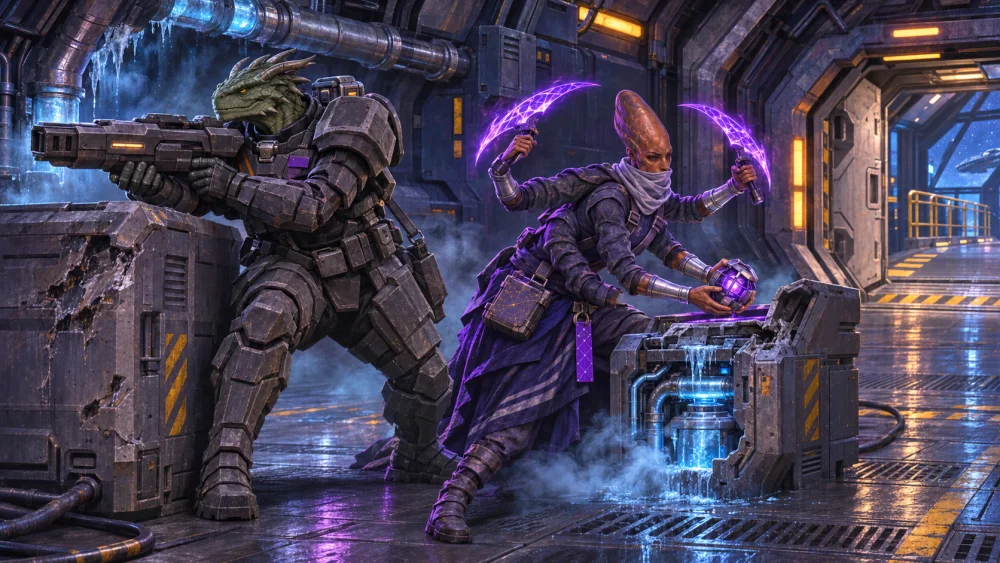
Terrain is part of the encounter when it changes what the crew can do. Use it to make movement, lines of sight, weapon range, cover, and occupancy matter. A damaged coolant line can force a route choice. A cargo gantry can give a shooter cover while exposing the person who crosses it. A narrow airlock can make holding a position more valuable than pursuing an enemy.
If terrain or a hazard makes the encounter harder, count that pressure against the budget. Do not let a scene become severe while its creature total still claims to be moderate. The same principle applies to environmental advantages the opposition can exploit from the start.
Hot Take: A good encounter map is not a decorative room with cover scattered across it. It is a place where choosing where to stand, what to protect, and when to move changes the answer.
Give enemies a reason to stay or leave
Opponents do not need perfect tactics, but they need a reason to be present. Decide what they know, what they fear, what they are protecting, and what result makes retreat sensible. A crew that understands those motives can make plans beyond dealing damage.
Use morale to keep a scene responsive. Enemies may withdraw when their leader falls, surrender when their escape route is cut off, or press harder when a held position is about to fail. Let the crew see clues to that behavior before it matters: a comms officer calling for extraction, guards watching a sealed crate, or a rival trying to reach a control console.
Use reinforcements without hiding the stakes
Combining nearby groups can make a location feel alive, but it can also turn a reasonable scene into an accidental spike. Decide whether a group is close enough to hear the conflict, whether it has a reason to intervene, and what warning the crew receives before that happens.
Reinforcements work best when they change the crew's decision. The party might silence an alarm, block a corridor, finish the objective before help arrives, or choose a faster but riskier route. If new opposition simply appears with no signal or choice, it is harder for the crew to understand what it could have done differently.
Frequently asked questions
What is a Starfinder 2e encounter budget for four characters?
For four characters, use 40 XP or less for trivial, 60 XP for low, 80 XP for moderate, 120 XP for severe, and 160 XP for extreme. Choose the threat level after deciding the encounter's purpose, then build within that budget.
How do I adjust a Starfinder 2e encounter for more or fewer PCs?
For each character above or below four, add or remove 10 XP for trivial, 20 XP for low or moderate, 30 XP for severe, or 40 XP for extreme. Keep the same XP reward and change the opposition instead.
How should terrain affect a Starfinder 2e encounter?
Use terrain to create choices about movement, sight lines, range, cover, and position. If it adds real difficulty, include that pressure in the encounter budget rather than treating it as free danger.
Should every Starfinder 2e encounter end in a fight to the defeat?
No. Give the opposition a goal and a morale point that can lead it to retreat, surrender, negotiate, or change priorities. A visible objective gives the crew more options than eliminating every opponent.
GM Core source boundary
This guide is checked only against Starfinder Second Edition GM Core, especially Encounters, Encounter Design, Creating Encounter Maps, Enemy Motivation, Dynamic Encounters, Combining Encounters, and Encounter Pitfalls. It summarizes encounter-building decisions and the printed encounter-budget procedure. It does not reproduce creature statistics, build creatures or hazards, teach afflictions, prescribe treasure, or replace the GM Core's encounter tables and examples.