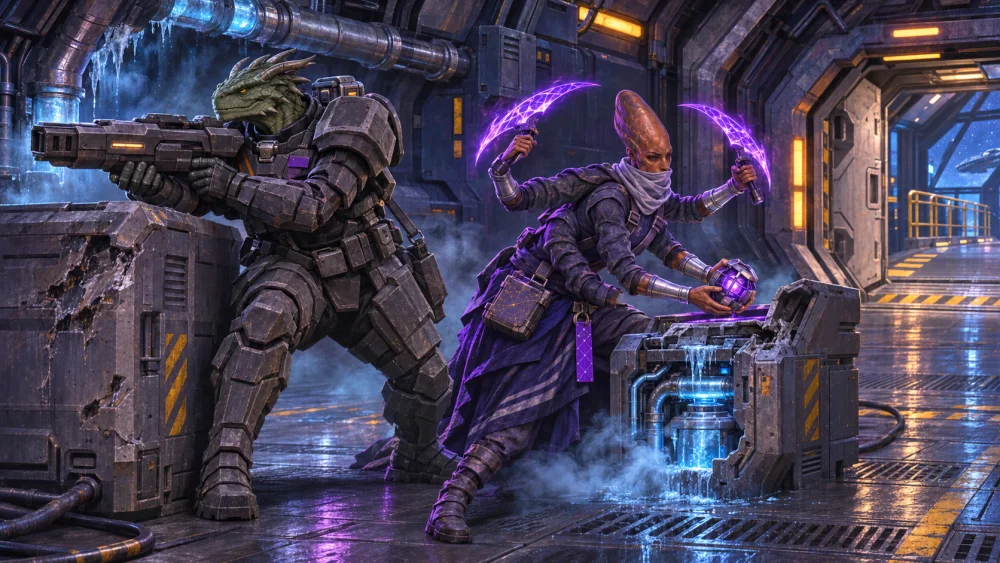
Choose Starfinder 2e armor for the work you need to do after you take the first hit. Confirm proficiency first, then weigh its AC and Dexterity limit against Strength, Speed, the environment, hands, and the upgrades you may want later. A suit that makes a routine harder to execute is not automatically better defense.
The Equipment Guide covers starting credits, access, Bulk, and first-loadout readiness. This guide narrows the defense-package decision without reproducing Player Core armor, shield, or upgrade tables.
Make the armor decision in five steps
Treat armor as a sequence of commitments rather than a search for the largest number in a catalog.
| Check | What it settles |
|---|---|
| Proficiency | Which armor categories the character can use as intended. |
| Mobility | Whether the AC bonus, Dexterity cap, check penalty, Strength threshold, and Speed penalty suit the character's normal work. |
| Environment | Whether its protection supports the places the crew expects to enter and whether its duration can be maintained. |
| Shield routine | Whether an active defense is worth a hand, an action, and eventual repair work. |
| Future capacity | Whether the armor's grade and limited upgrade slots support a job the character will keep doing. |
That order prevents an attractive final statistic from overruling the parts of the suit that matter every session.
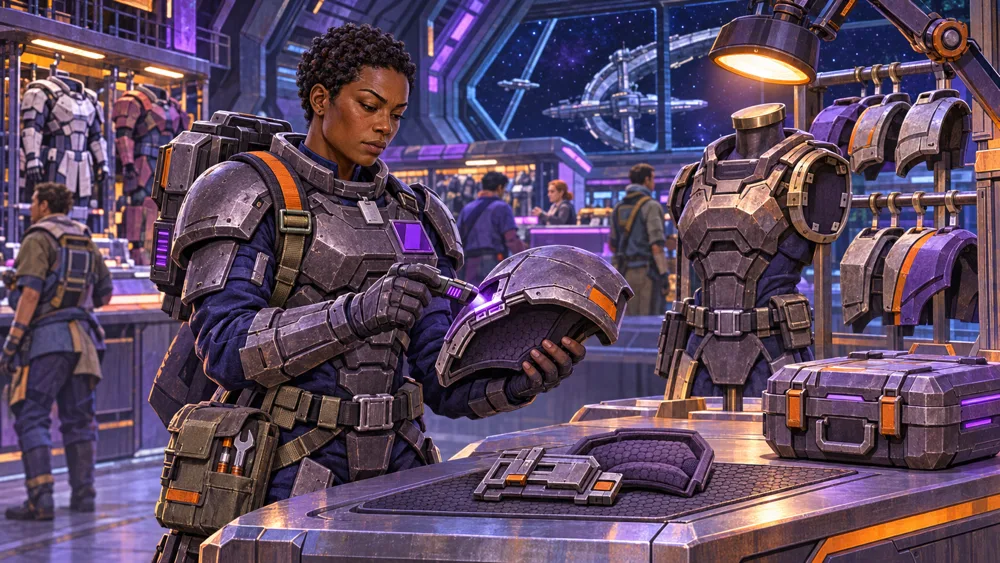
Confirm proficiency and the job before comparing suits
Your class establishes much of your armor training. Begin with the Classes Guide, then use the relevant class guide when a class feature changes how armor works for you. The General Feats Guide owns the Armor Proficiency and Shield Block decisions; it is the right place to decide whether a feat expands your options.
Then name the repeated job. A defender who needs to hold a corridor, a scout who must cross difficult ground, and a field specialist who handles tools under pressure can all want different armor even when their proficiency overlaps. Medium and heavy armor specialization effects also require the class feature that grants them, so armor group is a conditional build factor, not a free bonus for every wearer.
Hot Take: A larger AC bonus is not an upgrade if its Strength and Speed costs make your usual turn worse. Buy the routine you can actually run, then improve it.
Read armor statistics as a movement contract
AC bonus and Dexterity cap describe only part of the defense package. Check penalty, Strength threshold, Speed penalty, Bulk, slots, group, and traits determine what the suit asks of its wearer in return.
Meeting an armor's Strength threshold removes its check penalty and reduces its Speed penalty by 5 feet. The Speed penalty also applies to other movement types, with a minimum Speed of 5 feet. Check that consequence against the movement the character uses to reach cover, keep formation, or operate equipment; do not treat it as an afterthought once a mission begins.
Armor is also a preparedness decision. Donning light armor takes 1 minute, while medium or heavy armor takes 5 minutes; removing any armor takes 1 minute. Wearing it distributes its Bulk, but carrying it normally costs more. Plan the suit before the scene that needs it instead of expecting an encounter-time swap.
Treat environmental protection as a separate system
Modern armor can protect a wearer in thick or thin atmospheres, vacuum, and nonhazardous liquid when its environmental protection is active. That is substantial mission support, but it is not universal hazard immunity. It does not protect against damaging liquids, smoke inhalation, inhaled poisons, toxic atmospheres, or corrosive atmospheres, and armor with the exposed trait is an exception to the normal protection.
Activation and deactivation use the Interact action. Protection lasts a number of whole days equal to item level, with a one-day minimum, and a functioning starship or environmental recharging station restores it in 10 minutes. Put that recharge stop on the crew's logistics list before an extended mission.
Play Starfinder 2e, Not Just Read About It
You are already doing the reading. These Starfinder 2e tables are looking for players right now.
See Who's Running Starfinder 2eMake a shield earn its hand and action
A shield's circumstance bonus applies only after its user Raises a Shield, which takes an action and lasts until the start of that user's next turn. Most shields also require one hand, and a held shield's Speed penalty applies whether or not it is raised. Compare that routine with the hand your character needs for a weapon, reload, scanner, medical kit, or objective.
Shield Block is not automatic. A character needs access to that reaction through a class or feat. When it applies, the raised shield's Hardness reduces damage first, then both the character and shield take the remaining damage. A shield can become broken or destroyed, so a defensive plan that relies on it should include repair and replacement readiness.
Some shield designs are installed as armor or parry-weapon upgrades. That changes where the shield sits, not the core question: can the character afford its hand, action, movement, and maintenance commitments?
Reserve grades and upgrades for a proven platform
Most armor and shields have grades. Higher grades improve their listed defensive statistics and offer more upgrade slots, while an eligible item can also be improved through Crafting with the original item and UPBs. That makes a later grade an investment in a platform that already works for the character's job, not a reason to change plans every time a stronger entry appears.
Each armor upgrade uses one slot. Installing or removing one takes 10 minutes, a repair toolkit, and two hands, and it functions only while installed in armor worn properly. Some upgrades are continuous, while others require an action or have a daily limit. Reserve the finite slots for pressures the crew actually expects to face.
Class and ancestry exceptions belong with the routes that own them. For example, the Soldier Guide covers Walking Armory, and the Android Guide covers Mod Fanatic's personal upgrade-slot exception. Those are reasons to revisit your particular character, not generic promises every armor wearer receives.
A first-session armor check
Before putting a suit on the sheet, confirm these points:
- The character is proficient with the category, or has a specific class, ancestry, or feat reason to use it.
- The Strength threshold, check penalty, Speed penalty, and Dexterity cap fit the movement and skill work the character repeats.
- Environmental protection covers the expected travel conditions, and the crew has a place to recharge it.
- A shield fits the normal hand and action routine, with repair support if the plan depends on Shield Block.
- Any upgrade slot is reserved for a recurring mission need, not filled only because it is empty.
- The later grade still supports the same job rather than replacing a working plan with a new burden.
Use the Equipment Guide for the purchase and loadout groundwork, then return to the Starfinder 2e Player Core hub for the growing library. Open Player Core for exact armor entries, prices, traits, upgrade effects, and edge cases.
Player Core source boundary
This guide is checked only against Starfinder Second Edition Player Core, especially the Improving Equipment, Armor, Shields, and Armor Upgrades material in Chapter 6, plus the related class, ancestry, and general-feat entries. It does not import options from Starfinder First Edition, GM Core, Alien Core, Tech Core, Pathfinder, web summaries, or unsupplied books.