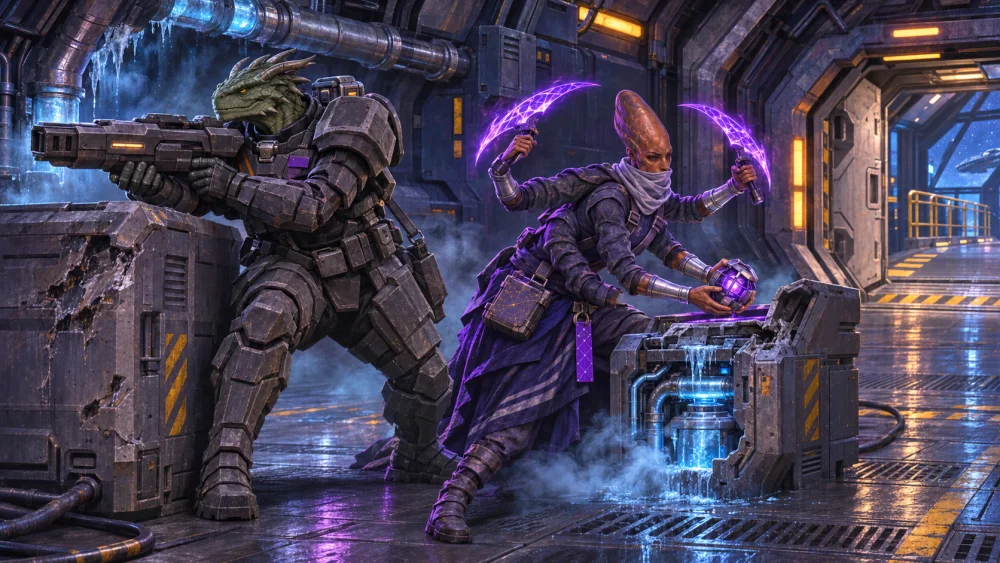
Choose a Starfinder 2e General feat for the pressure your character repeatedly has to handle outside their class routine. That might mean lasting through another hit, getting into position first, using a shield, covering a gap in gear access, or having a sensible contingency packed before trouble starts. The useful choice is the one that changes a recurring scene, not the feat with the broadest-looking benefit.
For most classes, General feats arrive at 3rd level and every four levels after that. Your class advancement table decides the actual schedule. Skill feats overlap with this category, but they have an additional skill trait and belong to their own selection cadence; use the Skill Feats Guide when the choice specifically grants a skill feat.
Start with the problem that returns to the table
General feats do not replace a class's defining actions. They make the rest of the character more dependable. Begin with the scene that keeps asking for a better answer.
| Recurring pressure | General-feat direction | Player Core examples to inspect |
|---|---|---|
| You need to stay standing through dangerous fights or recovery | Resilience and defensive progression | Canny Acumen, Diehard, Toughness |
| Position decides whether the crew can act | Movement and opening tempo | Fleet, Incredible Initiative |
| The party needs protection from a physical attack | Cover or shield use | Barricade, Shield Block |
| The concept needs training, equipment, ancestry access, or an implant | Build-access options | Armor Proficiency, Weapon Proficiency, Adopted Ancestry, Augmented Body |
| The campaign rewards having the right mundane answer ready | Preparation and broad coverage | Prescient Planner, Untrained Improvisation |
The table is a way to narrow the decision, not a ranking. A character who is regularly caught in the open may have a real reason to value movement or cover. A character whose role already puts them in a specific armor, weapon, or augmentation plan should first confirm whether that access is already handled elsewhere.
Hot Take: The strongest General feat often fixes the boring problem that otherwise keeps costing your character an action, a resource, or a clean plan.

Separate a General-feat choice from a skill-feat choice
General feats represent training and experience beyond a class's normal learning. Many of them are not skill feats at all. Fleet, Toughness, Shield Block, and Prescient Planner are General feats without the skill trait, so they cannot fill a choice that specifically says to select a skill feat.
The reverse can be true at a general-feat opportunity: a skill feat is still a General feat because it has both traits, provided the character meets its requirements. That does not make the two choices interchangeable in practice. A skill-feat slot narrows the available choices to the feats carrying the skill trait, while a General-feat slot can support a broader decision.
When the question is "which crew job should this character improve through training?", return to the Skills Guide and Skill Feats Guide. When the question is "what capability sits beside this class role?", stay here.
Play Starfinder 2e, Not Just Read About It
You are already doing the reading. These Starfinder 2e tables are looking for players right now.
See Who's Running Starfinder 2ePick a direction that fits actual play
Resilience and defensive timing
Canny Acumen, Diehard, and Toughness matter when a character is repeatedly exposed to saves, recovery pressure, or hard hits. Canny Acumen is a long-term proficiency choice for one saving throw or Perception. Diehard changes how far the dying condition can progress before death. Toughness adds maximum Hit Points as the character gains levels and lowers recovery-check DCs.
These options are not all doing the same job. Choose the one that answers the failure pattern you expect. A character who survives the first hit but struggles with recovery faces a different decision from a character who needs a better defense against a particular kind of effect.
Movement, initiative, and access to cover
Fleet and Incredible Initiative improve recurring positioning decisions. Fleet adds 5 feet to Speed, while Incredible Initiative gives a +2 circumstance bonus to initiative rolls. Both matter most when their benefit creates a repeatable tactical opportunity: reaching cover, claiming a useful angle, getting a support action in place, or keeping up with a faster crew member.
Barricade and Shield Block need more than a good intention. Barricade is a one-action manipulate option that turns nearby material into fragile cover. Shield Block is a reaction used while a shield is raised against physical damage, and the shield shares any damage it cannot prevent. If the character will not have the necessary material, action, shield, or habit of raising it, choose another solution.
Build access without accidental duplication
Armor Proficiency and Weapon Proficiency can supply training that a class does not otherwise provide. Both can be selected again for their listed progression, so inspect the exact feat rather than assuming one choice completes the plan. Augmented Body gives a route into an augmentation, but its level, implant-limit, cost, and upgrade details matter. Adopted Ancestry opens access to another ancestry's feats while preserving the entry's restrictions, including physiological limits.
These are build commitments. Compare them to the Character Creation Guide, the class's own features, and the equipment you actually expect to use. Taking a proficiency feat for gear that stays in a locker is not a plan.
Preparation and broad coverage
Prescient Planner supports the character who repeatedly needs a mundane answer after the mission has already begun. It takes 1 minute to produce a previously undeclared, common piece of adventuring gear, but the entry limits the item by category, level, Bulk, and the time since the character could buy goods. Treat it as a planned contingency, not permission to create any treasure on demand.
Untrained Improvisation improves the proficiency bonus for untrained skills as the character advances. It does not grant actions that require training. It fits a character who frequently has to attempt varied basic tasks, not a specialist who needs one trained procedure to work reliably.
Run the commitment check before reserving a feat
Before locking in a General feat, check these questions against the full Player Core entry:
- Will this scene recur? Name the travel, defense, recovery, gear, or skill problem that earns the choice.
- Does the character meet every gate? Confirm the feat level, prerequisites, repeat-selection rule, and any ancestry or equipment condition.
- What must happen at the table for the benefit to matter? A reaction needs its trigger; a shield option needs a raised shield; a preparation option has time and item limits.
- Is another feature already doing this work? Check class features, ancestry feats, background benefits, and the rest of the crew before duplicating access by accident.
- Can the party support the commitment? A gear-dependent choice is strongest when the character can buy, carry, maintain, and use that gear in the campaign.
The Starfinder 2e Classes Guide helps place this choice beside the character's normal role. Return to the Starfinder 2e Player Core Guide for the live library and source boundaries.
Player Core source boundary
This guide summarizes General-feat decisions from Starfinder Second Edition Player Core. It does not reproduce the book's feat table, supply a universal best feat, or import GM Core, Alien Core, Starfinder First Edition, playtest rules, or later supplements. Use Player Core for full feat text, action costs, triggers, traits, prerequisites, repeat-selection rules, equipment limits, and exceptions.