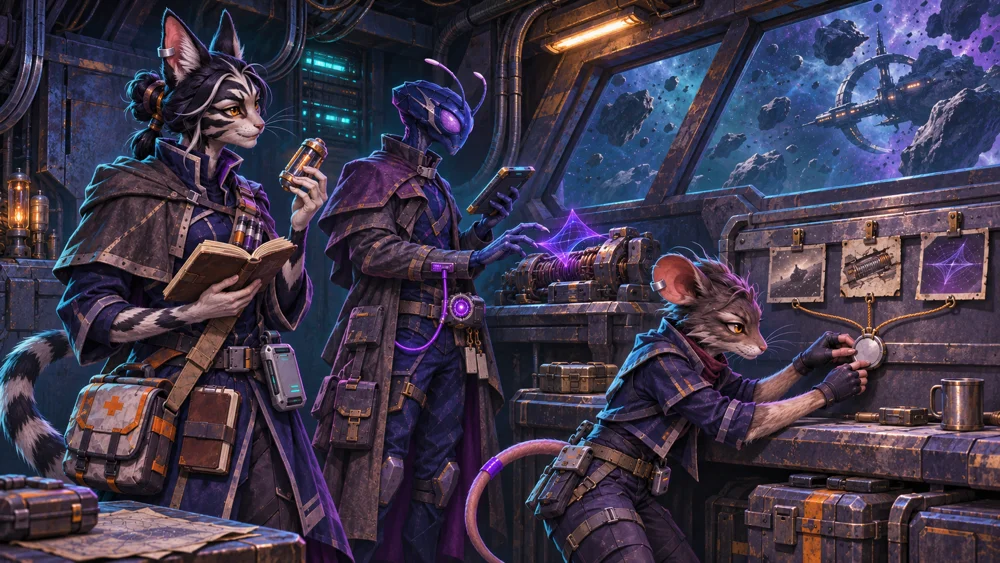
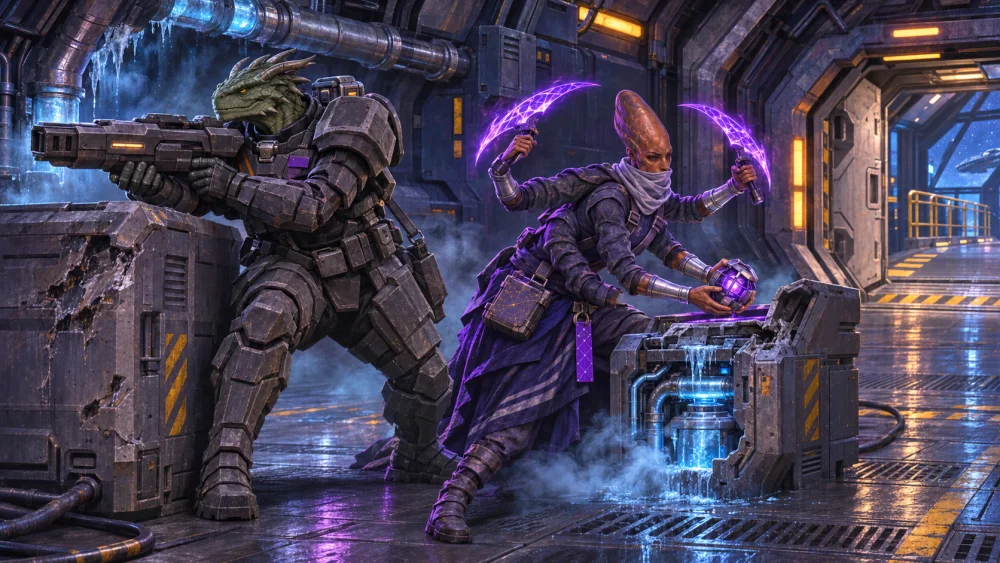
Take a Starfinder 2e archetype when another class's method, or the Starfinder Field Agent's organization-focused toolkit, will improve scenes your character expects to face repeatedly. An archetype is a commitment of class feats, not a free splash of every attractive feature. Pick one because it gives the crew a job you want to perform often, then make room for the follow-through it requires.
Player Core offers six multiclass archetypes matching its six classes, plus Starfinder Field Agent. The class options let you borrow a focused part of a different class without replacing your own core engine. Field Agent is different: it is for a character with Starfinder Society membership who wants Society knowledge, preparation, and exploration support.
Know the dedication commitment first
Most archetypes begin with a dedication feat. Once you take one, you cannot select a different dedication until you have selected at least two other feats from the first archetype. You also cannot retrain away the dedication while its other archetype feats remain.
That rule is what turns an archetype into a direction instead of a one-feat shopping trip. Before choosing one, identify three things:
- The recurring crew job. Name the scene the archetype improves: directing allies, field control, stealthy setup, close-range pressure, heavy protection, spell support, or Society work.
- The first three feasible feats. The dedication is only the beginning. Check that two later choices still fit the character and the campaign.
- The class feats you are not taking. A multiclass option competes with the feat choices that develop your own class's main loop.
If a feat grants another feat, Player Core counts it as one feat for this dedication rule. That can affect a plan, but it is not a reason to skip reading the complete entry and its prerequisites.
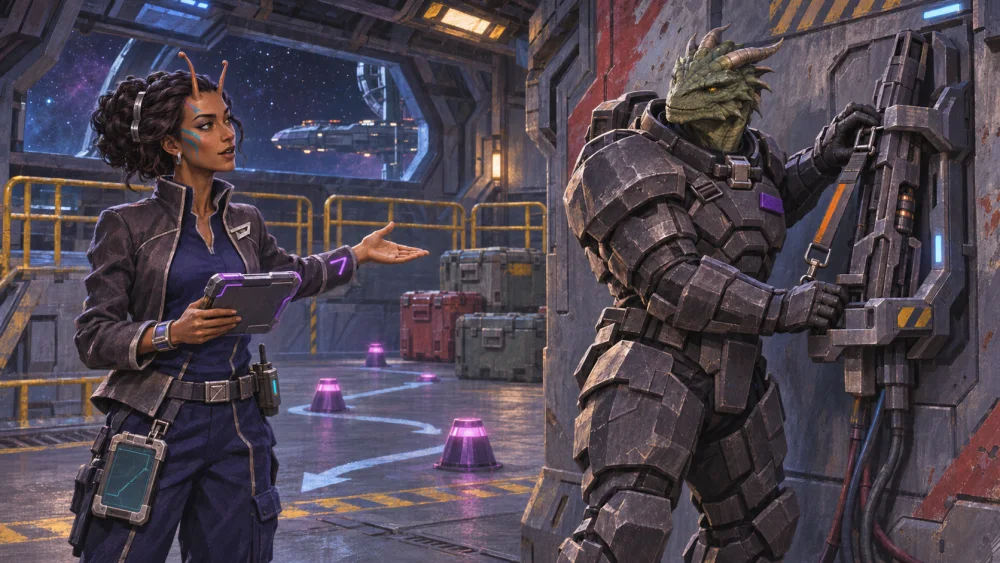
Choose the cross-training job, not the class name
The six Player Core multiclass archetypes are not replacements for their base classes. Use them to add one clear secondary job to the character you already want to play.
| Archetype | Start here when the character needs... | Check before committing |
|---|---|---|
| Envoy | coordination, directives, and a leadership-oriented support angle | Charisma requirement and whether allies will benefit from the new routine |
| Mystic | a connection-based support tool and eventual spellcasting | Wisdom requirement, connection, and delayed spellcasting investment |
| Operative | Aim-based setup, gun use, and agile precision | Dexterity requirement and a turn that has room to set up an attack |
| Solarian | stellar attunement and a constrained solar weapon | Strength requirement and whether close-range stellar pressure suits the build |
| Soldier | Bulk, battlefield pressure, and a route toward Soldier feats | Constitution requirement, the added Bulk, and whether later Soldier options overlap the build |
| Witchwarper | paradox-driven field control and eventual spellcasting | Intelligence requirement, paradox choice, and a plan for Warp Reality |
| Starfinder Field Agent | Society expertise, Starfinder Lore, mission preparation, and exploration utility | Starfinder Society membership and whether the campaign makes that affiliation meaningful |
The precise dedication benefits are different enough that the table is only a shortlist. Read the relevant Player Core feat before choosing. An Operative dedication grants Aim, but its damage does not use the standard class damage progression. A Solarian dedication's solar weapon has its own limits. A Witchwarper dedication gives a 10-foot Warp Reality field tied to the chosen paradox. Those details are why a strong theme alone is not enough.
For the primary class before you add a second job, use the Starfinder 2e Classes Guide. Its detailed class links are the better place to decide whether the original class's own feat plan already covers what you want.
Play Starfinder 2e, Not Just Read About It
You are already doing the reading. These Starfinder 2e tables are looking for players right now.
See Who's Running Starfinder 2eTreat archetype spellcasting as a long-term plan
Mystic and Witchwarper archetypes can provide spellcasting, but their spell access arrives in stages. The dedication grants cantrips. Basic Spellcasting normally opens the first limited spell slot at 4th level and adds higher ranks at later milestones. Expert Spellcasting normally begins at 12th level, and Master Spellcasting at 18th level.
That makes an archetype a poor answer when the character needs a full caster's options immediately. It is a better fit for someone who wants a small, deliberate magical toolset alongside their primary class. Check the relevant archetype feat for spell tradition, spell ranks, choices, and exceptions before reserving a spell in the character concept.
The Starfinder 2e Spells Guide explains the shared casting vocabulary. The class guides cover how a full Mystic or Witchwarper uses spells as their main engine; an archetype does not reproduce that progression.
Multiclass versus Starfinder Field Agent
Choose a multiclass archetype when the answer is "I want part of another class's play pattern." Choose Starfinder Field Agent when the answer is "I want this character's Society affiliation and field work to matter." Field Agent starts with Society expertise and Starfinder Lore, then develops mission preparation, knowledge, exploration, provisions, and equipment flexibility through later feats.
The Field Agent route has a specific entry condition: membership in the Starfinder Society and training in Society. Do not take it just because the character travels widely. It works best when the table recognizes that organization as a real part of the campaign, the character's background, or the party's ongoing work.
Human characters have one additional Player Core option to examine. Multitalented can grant a 2nd-level multiclass dedication while ignoring the usual dedicated restriction. It still grants a multiclass dedication, so the dedication's normal follow-through and all other prerequisites matter. It is a useful exception for a specific ancestry build, not a general rule for every character.
Run this check before you spend the first class feat
- Confirm the dedication's ability-score prerequisite and any training, membership, or class restriction.
- Read the dedication and two follow-up feats together. A good first feature does not rescue a plan with no useful continuation.
- Compare the action economy to the class's normal turn. A secondary routine that never fits into a round will not earn its cost.
- Check proficiencies, armor, weapon, Bulk, spellcasting, and equipment against what the character already has. Avoid paying for access that a class, ancestry, or background already supplies.
- Ask the GM whether the campaign will make an organization-focused or exploration-focused benefit meaningful before picking Field Agent.
For the rest of a character's choices, return to the Character Creation Guide, Skills Guide, Skill Feats Guide, and General Feats Guide. The Starfinder 2e Player Core Guide remains the live collection index.
Player Core source boundary
This guide covers the multiclass and Starfinder Field Agent archetypes in Starfinder Second Edition Player Core. It does not reproduce feat tables or full feat text, and it does not import special archetypes, organization material, class archetypes, or options from GM Core, Alien Core, Starfinder First Edition, playtest material, Starfinder Galaxy Guide, or later supplements. Use Player Core for exact feat effects, prerequisites, traits, spellcasting details, and exceptions.