Introduction
Explorer's Guide to Wildemount hands D&D 5e 2014 players and DMs a continent already at war. The Dwendalian Empire and the Kryn Dynasty are fighting over the Luxon Beacons, crystalline artifacts at the center of the Kryn's faith and reincarnation-based society, and that conflict touches nearly everything else in the setting without requiring every character to enlist.
Two new Dragonborn variants, three subclasses built around dunamancy, and a set of new backgrounds give players fresh build options, while thirteen factions and five distinct regions give DMs a full continent to run a campaign in. A player usually starts with character options; a DM starts from the opposite direction, picking a region, a faction, or a side in the war and letting the players' choices determine how deep the conflict runs.

Character Options
Wildemount's Character Options chapter is built almost entirely on cultural framing rather than new mechanics. Sixteen races the game already covers get a regional-flavor treatment describing how the Dwendalian Empire, the Menagerie Coast, and Xhorhas each see them differently. None of that changes a single ability score, trait, or feature.
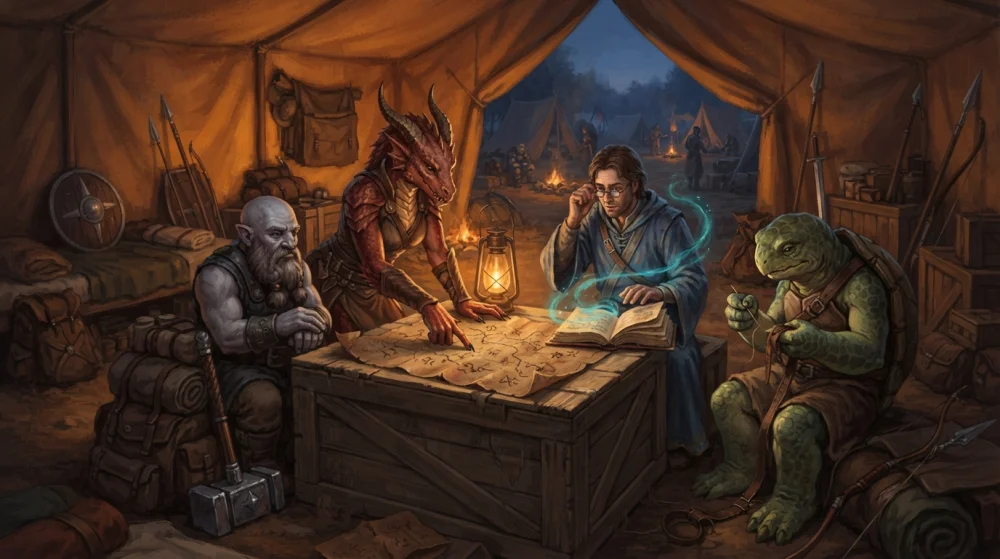
What Wildemount actually adds sits in three places: two new Dragonborn variants, three subclasses built around dunamancy, and a set of new backgrounds plus a backstory-generation subsystem. Every option here is just as playable in a Forgotten Realms, Ravnica, or homebrew campaign as it is in Wildemount itself.
Races
Instead of describing where each race lives, the book describes how a typical person from each of the continent's three major regions perceives that race, stereotypes and all. A dwarf reads as a greedy hermit to most imperial citizens, a foreign wanderer to coastal folk, and a duergar exile to most people in Xhorhas. None of those perceptions changes a trait, but they change how NPCs react to the character sitting at your table.
| Race | Where It Shows Up Most | Guide |
|---|---|---|
| Dwarf | All three regions - Grimgolir dwarves in the Dwendalian Empire, rare sailors on the Menagerie Coast, duergar in Xhorhas | Dwarf Race Guide |
| Elf | All three regions, rebuilding since the Calamity | Elf Race Guide |
| Halfling | All three regions, no shared origin myth | Halfling Race Guide |
| Human | All three regions - the continent's most populous race | Human Race Guide |
| Aasimar | All three regions, treated as a portent in every culture | Aasimar Race Guide |
| Dragonborn | Native to Wildemount - the ruined city-state of Draconia | Dragonborn Race Guide |
| Firbolg | Greying Wildlands, especially the Savalirwood | Firbolg Race Guide |
| Genasi | Rare everywhere - no elemental rifts on the continent | Genasi Race Guide |
| Gnome | Not native - immigrants from distant Issylra | Gnome Race Guide |
| Goblin | Xhorhas-rooted, tied to the goblinkin origin myth | Goblin section of the Monstrous Races Guide |
| Hobgoblin | Xhorhas-rooted, tied to the goblinkin origin myth | Hobgoblin section of the Monstrous Races Guide |
| Bugbear | Xhorhas-rooted, tied to the goblinkin origin myth | Bugbear section of the Monstrous Races Guide |
| Goliath | Cyrios Mountains, Penumbra Range, and Eiselcross | Goliath Race Guide |
| Half-Elf | All three regions, especially Uthodurn and the Kryn Dynasty | Half-Elf Race Guide |
| Kenku | Rare everywhere, kept to themselves | Kenku Race Guide |
| Orc | Dwendalian Empire (Bladegarden), Menagerie Coast, Xhorhas | Orc section of the Monstrous Races Guide |
| Half-Orc | Dwendalian Empire (Bladegarden), Menagerie Coast, Xhorhas | Half-Orc Race Guide |
| Tabaxi | Menagerie Coast (Ki'Nau people) and the Greying Wildlands | Tabaxi Race Guide |
| Tiefling | All three regions, broadly accepted | Tiefling Race Guide |
| Tortle | Menagerie Coast - almost unheard of anywhere else | Tortle Race Guide |
Dwarves, elves, halflings, and humans are Wildemount's four dominant races. Dwarves split hardest: Grimgolir dwarves in the empire read as clannish miners, coastal dwarves as foreign wanderers, and in Xhorhas most surviving dwarves are duergar who hold a deep enmity for the drow.
Dragonborn are the one race native to Wildemount. The ruined city-state of Draconia in the Dreemoth Ravine was built by draconblood colonizers and their ravenite kin, the former enslaving the latter, until the Chroma Conclave destroyed Draconia twenty years ago and the ravenite survivors rose up and reclaimed the ravine. Both lineages now exist as playable variants with their own ability score packages.
The rest each carry a distinct regional note. Aasimar are a blessing and a portent in every culture, though a family's reaction shifts sharply depending on whether they worship a state-approved god. Firbolgs are Savalirwood forest guardians living in small, introverted family units. Genasi are exceedingly rare, since Wildemount has no elemental rifts, and the ones who appear draw unwanted attention from the Cerberus Assembly. Gnomes aren't native either, tracing back to distant Issylra, and cluster defensively wherever they settle. Goblins, hobgoblins, and bugbears share a single dark origin myth: all three descend from the dranassar, an ancestor race twisted by the Betrayer God Bane into skirmishers, soldiers, and brutes during the war of gods and mortals. Goliaths keep to the high ground of the Cyrios Mountains, Penumbra Range, and frozen Eiselcross. Half-elves anchor two of the continent's most pluralistic societies, Uthodurn and the Kryn Dynasty. Kenku exist in scattered numbers, still carrying a fragment of an ancient curse that leaves them speaking only through mimicry. Orcs and half-orcs trace one major population to Bladegarden, incorporated into the empire after the Julous Dominion fell. Tabaxi cluster among the Menagerie Coast's Ki'Nau people. Tieflings face little of the old persecution anywhere on the continent. Tortles carry the strongest single-region identity of any race here, almost unheard of beyond the coast's jungles and beaches.
Build Your Dungeons & Dragons (5e, 2014) Character
The Dungeons & Dragons (5e, 2014) character builder is live - build a Beastkin, a Kobold, or whatever your table is missing, free, right now.
Start BuildingThree New Subclasses
All three are tied to dunamancy, the setting's magic of time and gravity, channeled through cosmic energy called dunamis.
| Subclass | Class | Built Around | Guide |
|---|---|---|---|
| Echo Knight | Fighter | A summoned, translucent echo of yourself for teleport-swaps and flanking | Echo Knight Guide |
| Chronurgy Magic | Wizard | Time manipulation - forcing rerolls and short-range foresight | Chronurgy Magic Guide |
| Graviturgy Magic | Wizard | Gravity manipulation - altering weight to control speed and Strength checks | Graviturgy Magic Guide |
Echo Knight is a Kryn Dynasty specialty in the fiction, built around Manifest Echo: a bonus-action summon that can teleport-swap places with you, threaten a second square at range, or take an extra attack alongside your own. The echo is fragile - one hit point, immunity to conditions, destroyed if it strays more than 30 feet - so it functions as a positioning tool rather than a second combatant to protect. It plays like a mobility-and-action-economy subclass rather than a straight damage boost.
Chronurgy's Chronal Shift lets you force a reroll on an attack, ability check, or saving throw you can see within 30 feet, twice per long rest. It works on allies and enemies alike, since you choose whether to use it after seeing the original roll. Graviturgy's Adjust Density halves or doubles a target's weight for up to a minute, trading Strength-check advantage and reduced speed for the reverse: faster movement, longer jumps, and disadvantage on Strength saves. Both traditions unlock a shared pool of dunamancy spells at higher levels - Dark Star, Gravity Fissure, Temporal Shunt, and a dozen others - gated specifically to Chronurgy and Graviturgy Wizards.
None of the three requires setting buy-in. An Echo Knight reads just as well as a battle-scarred mercenary in any campaign, and dunamancy can be reflavored as any other exotic school of magic without touching a mechanic. Pick based on what your table plays: Echo Knight for a martial who wants positioning tricks without spell slots, Chronurgy for a caster who wants to swing key rolls, and Graviturgy for one who wants direct control over who can move and how fast.
Backgrounds and the Heroic Chronicle
Every Player's Handbook background works without changes, and the setting layers faction-specific flavor on top in two forms. The two new backgrounds both come with a built-in secrecy hook: one ties to the Golden Grin, a bardic spy network, and the other to the Cerberus Assembly's trained enforcers, recruited from people reshaped by tragedy into loyal killers. Five reskins layer faction color onto familiar options: an Acolyte devoted to the Luxon, a Criminal embedded in the Myriad, a Sailor sworn to the Revelry, a Sage trained by the Cobalt Soul, and a Spy recruited into the Augen Trust. Full skill, tool, and feature breakdowns live in the D&D 5e Backgrounds Guide's Wildemount section.
The Heroic Chronicle is a separate subsystem: roll-based (or player-chosen) tables that generate a character's nation, home settlement, family relationships, and a trio of prophecy goals before a campaign starts. A player can roll through it from scratch or use the tables as a menu. It's backstory generation rather than a build option with mechanical weight of its own.
The Regions of Wildemount
Wildemount doesn't have a map that agrees with itself. Ask a Menagerie Coast trader where the continent starts, and they'll point past their own harbor cities toward a war they'd rather not think about. Ask a Righteous Brand soldier at Rockguard Garrison, and they'll draw a line at the Ashkeeper Peaks and call everything past it enemy territory. Ask a Kryn scout in the Wastes of Xhorhas, and the empire's "civilized" nations look like the invaders.
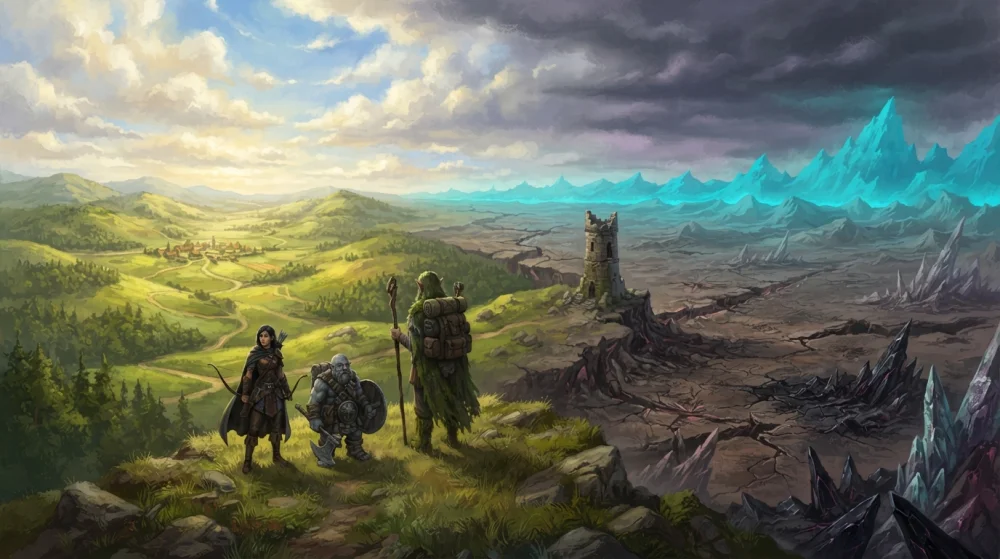
The book organizes the continent into seven named regions under four broader labels: the Menagerie Coast on its own; the Marrow Valley and Zemni Fields together as Western Wynandir; the Greying Wildlands and the islands of Eiselcross as the Biting North; and the Wastes of Xhorhas with the coastal Blightshore as Eastern Wynandir. This guide follows that shape, folding Eiselcross into the Greying Wildlands entry and Blightshore into the Wastes of Xhorhas entry, since each pair shares one throughline.
| Region | Character | Best campaign fit |
|---|---|---|
| Menagerie Coast | Tropical trade coast, city-state politics, piracy and organized crime | Urban intrigue, crime syndicates, pirate campaigns |
| Marrow Valley | Imperial farmland and the crossroads city of Zadash | First-campaign default, political intrigue, monster-hunting frontier |
| Zemni Fields | Cold northern plains and the imperial capital of Rexxentrum | High politics, arcane academy intrigue, capital-city campaigns |
| Greying Wildlands | Frozen frontier, dwarven-elven Uthodurn, lawless Shadycreek Run, arctic Eiselcross | Frontier survival, dungeon delving, arctic exploration |
| Wastes of Xhorhas | Kryn Dynasty homeland, war-scarred badlands, blighted Blightshore coast | War campaigns, Kryn/dark elf characters, apocalyptic scavenging |
Menagerie Coast
The Menagerie Coast runs the length of Wildemount's southwest shoreline and answers to no crown. Seven city-states govern themselves under the loose banner of the Clovis Concord, and the tone shifts hard from one to the next. Port Damali is the unofficial capital: a sprawling, corrupt port where the Myriad has its hands in nearly every guild, and the continent's only open skyport draws luxury travelers. Nicodranas sits at the empire's southern doorstep, an embassy city where Dwendalian nobles enjoy vices their own laws forbid. Feolinn is a wine-country town obsessed with its reputation. Gwardan is an elven city built by refugees of the coast's original Ki'Nau inhabitants, famous for a secret metalworking process called steamcasting. Port Zoon is the industrial center, Tussoa a relaxed river town still connected to its Ki'Nau roots, and Othe, the smallest, functions as the coast's spiritual center.
Piracy is a fact of life. The Revelry, a union of pirates who seized the fortified reef-town of Darktow decades ago, preys on shipping lanes throughout the Lucidian Ocean, and the concord's four-hundred-ship navy can't be everywhere. Inland, the region turns wild fast: the Cyrios Mountains hide dangers from lycanthrope-afflicted deserters to an eccentric beholder curating a museum of petrified victims, while the toxic Lushgut Forest and fey-haunted Doralle Woods keep travelers on marked trails.
A Menagerie Coast character is built around a city-state identity first and a relationship to the Myriad second, since almost nobody on this coast is entirely untouched by it. Reach for this region when a table wants urban crime, pirate raids, or trade-route intrigue without the war hanging directly overhead.
Marrow Valley
South of the Silberquel Ridge, the green grasslands of the Marrow Valley form the gateway between the coast and the rest of the empire, and most of what a new table needs sits inside one city. Zadash, former capital of the conquered Julous Dominion, is now a crossroads metropolis of nearly ninety thousand, run in practice by wealthy merchant guilds while Starosta Wyatt Fedar takes the blame for their corruption. The Myriad runs an entrenched thieves' guild out of a tunnel network called the Underworks, the Cerberus Assembly maintains a satellite academy at the Hall of Erudition, and the city's five districts give a party every kind of urban hook at once.
Outside Zadash, the valley is farmland with teeth. Felderwin is the heart of halfling agriculture, its Tillage feeding the war effort even as Kryn raids push its Crownsguard presence higher. Deastok, quietly Myriad-run and dominated by the wealthy Truscan family, plays like a noir campaign in miniature. Bladegarden, training ground for the Righteous Brand's orc-heavy eastern legions, sits closest to the front and carries the valley's most direct war stakes. The Amber Crossroads, where four major roads converge without a hint of Crownsguard oversight, draws mercenaries and con artists. The Darrington Brigade, founded in Deastok by a former member of Vox Machina, sponsors smaller parties across Western Wynandir, which makes it a natural patron or recruiter.
Marrow Valley is the strongest starting point for a table new to the setting. Zadash alone can sustain a campaign's first several sessions without requiring deep buy-in to the war.
Zemni Fields
North of the Silberquel Ridge, the Zemni Fields are colder, flatter, and far more directly under the Crown's thumb. Rexxentrum, the empire's capital and the largest city on the continent at over two hundred thousand people, sits at the region's heart, ruled directly by King Bertrand Dwendal with no starosta between him and his subjects. The Soltryce Academy trains the arcane elite, the eight members of the Cerberus Assembly keep private towers in a district called the Candles, and the Augen Trust keeps would-be reformers like the underground Locksmiths permanently off balance.
Beyond the capital, Blumenthal exists purely to feed Rexxentrum, its farmers salaried by the Crown rather than owning their plots. Bysaes Tyl, a forest city built by elves who fled the destruction of Molaesmyr, negotiated cultural autonomy in exchange for sharing arcane secrets recovered from their ruined homeland; the Ring of Three still governs elven affairs there under an imperial starosta chosen specifically for his prejudice against them. Rockguard Garrison anchors the empire's eastern defense alone, since Ashguard fell to the Kryn.
The region carries the war's cost more visibly than the Marrow Valley does even at a remove from the front. A party doesn't need Kryn agents in the city to find intrigue in Rexxentrum, just a noble house, a guild dispute, or a Locksmith recruiter willing to make an offer.
Greying Wildlands
North of the Dunrock Mountains, imperial control simply stops. The Greying Wildlands, together with the arctic islands of Eiselcross, are a desert of ice and thin forest the empire has never managed to hold. Uthodurn, a dwarven citadel built nearly eight centuries ago, is the closest thing to a capital: a diarchy shared between a dwarven queen and an elven king, the latter arrangement dating to when Uthodurn opened its gates to elven refugees from Molaesmyr. Dwarves and elves have intermarried there long enough that mixed-heritage children, called attalwen, are an accepted part of the city's identity, a level of cultural fusion found nowhere else on the continent.
Shadycreek Run is the region's opposite: a lawless shantytown split between four rival crime families known as the Tribes, a reform-minded merchant faction called the Greytrader Union, and the mercenary Grudge Gang that keeps the peace only when violence threatens everyone's business. Both settlements have a stake in the ruins of Molaesmyr, the corrupted elven city at the heart of the Savalirwood: Uthodurn's expeditions seek to reverse the curse, while Shadycreek's scavengers just want what treasure they can carry out.
The wider Wildlands are unforgiving country. The Crystalsands Tundra hides burrowing frost worms and the Mawcotters, a wildfolk cult who make an annual pilgrimage to harvest flesh from a frozen, still-living horror they worship. The volcanic Flotket Alps shelter warring frost giant clans and an androsphinx guarding a Calamity-era tomb. Eiselcross adds a second layer entirely: the flying city of Aeor, a pre-Calamity civilization of inventors whose weapons could reportedly kill gods, was hurled into the ice by a rare joint effort of the Prime and Betrayer deities, and recovered Aeorian artifacts now draw Dwendalian, Uthodurnian, and Kryn expeditions alike into its frozen ruins.
If a table wants Wildemount without the Dwendalian-Kryn war anywhere near the center of the story, the Greying Wildlands is the strongest pick on the continent. Uthodurn and Shadycreek Run give a party two fully realized, war-adjacent-but-not-war-driven home bases, and Eiselcross offers an entire secondary campaign's worth of dungeon-delving through Aeor's ruins that has nothing to do with either empire's politics.
Wastes of Xhorhas
East of the Ashkeeper Peaks, the Wastes of Xhorhas still bear the physical scars of the Calamity's final battles: broken earth, corrupted swamp, and storm-wracked plains that once hosted the strongholds of the Betrayer Gods. The Kryn Dynasty, dark elves who emerged from the Underdark generations ago and rejected Lolth in favor of the Luxon, has built the region's only real civilization out of that ruin. Rosohna, built atop the ashes of the old Betrayer city of Ghor Dranas and renamed "rebirth" in the Kryn tongue, is the capital: twelve ruling Dens answer to Bright Queen Leylas Kryn, dunamancers veil the sky in perpetual twilight so drow and duergar citizens can live comfortably under it, and the crystalline Lucid Bastion houses the first Luxon Beacon ever discovered.
The dynasty's reach extends through Asarius, the City of Beasts, a frontier hub built to unite Xhorhas's scattered wastefolk tribes under Kryn protection and a shared faith. Bazzoxan, a ruined pre-Calamity temple turned settlement, is locked in permanent siege against a demonic incursion that broke loose when dungeoneers stumbled into a sealed rift to the Abyss. The Ruins of Draconia, a fallen floating city that once enslaved its own tailless ravenite underclass before the Chroma Conclave brought it crashing into the Dreemoth Ravine, gave rise to the Draconblood and Ravenite Dragonborn variants. The Brokenveil Marsh remains the contested buffer zone between Kryn and Dwendalian forces, soaking up two decades of unrecovered dead from both sides.
Blightshore, along the continent's eastern edge, is what's left of the coastline the Betrayer Gods personally defiled during the Calamity: riddled with earth motes, gravity funnels, and rust rain that make ordinary travel a survival challenge. New Haxon, garrisoned by the Cerberus Assembly and commanded by an adult copper dragon, is the empire's only trusted foothold. Rotthold, a lawless port lit by luminous rust-colored moss, is the black-market capital of Eastern Wynandir, its uneasy peace held by a truce between Myriad and Revelry agents rather than any government. Farther out, the Tooth of Zehir peninsula holds Strathfell, a petrified forest ruled by a shadow dragon, and the drowned ruins of Sariss, where serpentfolk still serve the Cloaked Serpent. Blightshore is also the region most associated with the Hollow One, a Supernatural Gift born from prolonged exposure to the land's arcane corruption rather than a god's blessing - see the Supernatural Gifts section of the treasure and rewards guide for how it compares to other reward patterns.
The land carries the war's oldest scars. The Barbed Fields north of Rosohna are said to be the site of the Calamity's final battles, its cratered ground hiding both ancient relics and planar instability serious enough that seers track the rare alignments capable of tearing it open further.
Distant Lands
Wildemount isn't the whole of Exandria. The book closes its gazetteer with a short survey: Tal'Dorei, the neighboring continent to the west, home to Whitestone, Kraghammer, and Emon; Marquet, a desert continent centered on the ageless city of Ank'Harel; and Issylra, the oldest continent in Exandrian history, dominated by the theocracy of Vasselheim. None gets more than a page - they exist as trinket sources, rumor hooks, and the occasional NPC backstory - but a character with family, trade ties, or old grudges reaching across the water is well within the setting's logic.
Factions
Thirteen major factions drive Wildemount's politics, from the two nations at open war down to the smugglers, scholars, and pirates working the space between them. The Dwendalian Empire and the Kryn Dynasty anchor everything else, but their war isn't the only story worth running: the Cerberus Assembly plays a decades-long game against its own king, the Myriad is rebuilding a criminal network the empire thought it had crushed, and the Claret Orders hunt fiends in a valley that officially pretends they don't exist.
| Faction | Home base | Alignment lean | Best fit as ally or antagonist |
|---|---|---|---|
| Dwendalian Empire | Western Wynandir; capital Rexxentrum | Lawful, order-obsessed and increasingly paranoid | Institutional patron or oppressive antagonist |
| Kryn Dynasty | Xhorhas; capital Rosohna | Lawful neutral in structure, driven by faith in the Luxon | Reincarnation-and-faith-flavored ally or antagonist |
| Cerberus Assembly | Rexxentrum, nominally serving the Crown | Chaotic-to-lawful evil, unified by ambition rather than ideology | Long-game manipulator; a secret patron working against the Crown it claims to serve |
| Clovis Concord | Menagerie Coast, eight allied city-states | Mixed, city by city, unified by commerce | Trade-and-intrigue patron or rival |
| The Myriad | Originally Yrrosa, now a scattered continental network | Evil, patient and decentralized | Escalating criminal antagonist that resurfaces slowly rather than announcing itself |
| Children of Malice | Hidden cells throughout Xhorhas, infiltrating the Kryn Dynasty | Evil, driven by Lolth's vengeance | Sleeper-agent villain for a campaign built around Kryn political intrigue |
| Diarchy of Uthodurn | Subterranean city of Uthodurn, far north | Lawful good, isolationist | Distant, principled patron for polar exploration or Molaesmyr-curse mysteries |
| Tribes of Shadycreek Run | Shadycreek Run, in the Greying Wildlands | Neutral evil, fractious and self-interested | Noir-flavored criminal patron; four families in constant, exploitable competition |
| Library of the Cobalt Soul | Rexxentrum-based, archives across Wynandir and beyond | Lawful neutral, idealistic but politically constrained | Knowledge-broker ally; strongest tie-in to monk and lore-focused characters |
| Scars of Scale and Tooth | Dreemoth Ravine, city of Xarzith Kitril | Mixed, torn between competing councilors | Fragile nation-building patron; strongest tie-in to dragonborn characters |
| Claret Orders | Scattered keeps around the Marrow Valley and beyond | Neutral, self-sacrificing monster hunters | Shadow-ally for fiend and undead-hunting campaigns |
| Golden Grin | Clandestine cells within the Clovis Concord, spreading toward the empire | Chaotic good, anti-tyranny | Ambiguous, secretive ally; strongest tie-in to bard and folk-hero themes |
| The Revelry | Isle of Darktow, Dragshallow Reef | Chaotic, ranging from principled to outright evil captain by captain | Pirate antagonist or morally gray patron |
The Dwendalian Empire
For twelve generations, the empire has ruled Western Wynandir through a powerful military, strict religious licensing, and the uneasy backing of the Cerberus Assembly. King Bertrand Dwendal, sixty-eight and no less iron-willed for it, presides over a rigid caste system where mastery of the arcane marks the elite. Local government runs through a starosta in each city, while twice-yearly tithe collectors nicknamed "Reapers" audit every household's income.
Religion is tightly controlled rather than banned: only six deities are Crown-approved for public worship, all temples are government property, and private shrines carry fines or imprisonment. That policy dates to a short-lived religious rebellion called the Admonition. The military fields roughly 35,300 Righteous Brand soldiers and 5,200 Crownsguard, with the bulk now dug in along the Xhorhasian border.
Key NPCs: King Bertrand Dwendal is dark, paranoid, and dutiful, and his only living son has failed to produce an heir, driving the king toward increasingly desperate schemes to prolong his own life. Chamberlain Queselia Vir tries, mostly unsuccessfully, to soften his worst instincts. Crown Marshal Hayden Damurag commands the war from the besieged Rockguard Garrison. Prime Arbiter Sydnock Truscan enforces law with a personal grudge against religion, while his estranged daughter Lydia works as a civil-rights advocate in Zadash. Oliver Schreiber, the royal family's trusted head servant for three generations, is secretly the head of the Augen Trust.
Campaign themes: the empire works as an oppressive backdrop or a legitimate patron defending its people from real threats. Its internal fault line - mutual distrust between Crown and Assembly - gives a DM a built-in way to have the empire work against itself.
The Kryn Dynasty
The Kryn govern Xhorhas from Rosohna and have only revealed themselves to the wider world within the past century. Central to Kryn belief is the consecution: a soul bound to a Luxon beacon is reborn near it after death, gradually recovering memories of past lives through anamnesis, until a soul who has cycled enough becomes an Umavi, a "perfect soul." Twelve noble Dens answer to the first Umavi, Bright Queen Leylas Kryn.
The dynasty's darker secret is typhros: souls driven mad by the weight of too many lifetimes' memories, secretly removed from Kryn society and left in the wastes or mercifully killed. Signs of that madness are beginning to show in the Bright Queen herself, a fact her inner circle works hard to hide. The Aurora Watch numbers around 21,600 soldiers. With two of the dynasty's four recovered beacons stolen by Dwendalian operatives, the Kryn have mobilized fully, deploying a spy network called the Lens to recover them.
Key NPCs: Bright Queen Leylas Kryn has lived eight lifetimes since finding the first beacon, though her behavior has grown erratic in ways that worry those closest to her. Dusk Captain Quana Kryn, her partner across multiple lifetimes, privately hopes the Kryn might one day leave Xhorhas entirely. Shadowhand Essek Thelyss is a prodigy of dunamancy more interested in magical research than in the Luxon itself, secretly curious what the Cerberus Assembly has learned from the beacon it stole. Skysybil Abrianna Mirimm, an Umavi currently living as a goblin, is one of the few Kryn voices advocating for the wastefolk the dynasty is converting.
Campaign themes: the dynasty offers a faith-and-reincarnation angle no other faction matches, and plays as sympathetically or as unsettlingly as a DM wants depending on how much weight is put on typhros. It rewards a campaign that takes its cosmology seriously rather than treating it as empire-but-purple.
Cerberus Assembly
Nearly three hundred years ago, warring mage lords nearly destroyed Rexxentrum in a battle called the Eve of Crimson Midnight before agreeing to unify into a single conclave under the king's rule in exchange for official recognition. Since then the Assembly has ingrained itself into nearly every facet of imperial government, holding eight ruling offices filled by vote whenever a seat opens. It plays a long game: popular decisions get credited to the Assembly, unpopular ones get pinned on "the will of the Crown."
Its current obsession is dunamis. Assembly agents stole two Luxon beacons from the dynasty, subsequently losing one to a band of adventurers, and that theft is what triggered the war.
Key NPCs: Master Trent Ikithon runs mental-conditioning experiments on students he calls "awakening," producing zealot enforcers known as the Volstrucker or Scourgers. Martinet Ludinus Da'Leth, the oldest member, oversees imperial military infrastructure and nurses a deep hatred for the Kryn. Baroness Jenna Iresor is secretly a doppelganger who built an entire false human identity from scratch. Master Doolan Tversky studies aberrations, resents the Cobalt Soul for barring her from its libraries, and has covertly hired the Myriad to retrieve specimens from Xhorhas.
Campaign themes: built for slow-burn political intrigue. Individual archmages serve as patrons, rivals, or villains independently of each other, since the Assembly is less a unified faction than eight ambitious people sharing an uneasy alliance. A campaign that treats it as a monolith misses the point.
Clovis Concord
Founded roughly four hundred years ago by Ki'Nau islanders and Marquesian traders, the Concord is a democratic union of eight independent city-states along the Menagerie Coast, each ruled by its own marquis but bound by shared trade law and mutual defense. A standing military of 7,800 Shore Wardens, a fleet of 370 ships, and 5,200 Zhelezo guards protect the coast. Two long-running problems complicate its image: the Revelry, hunted without success for forty years, and the Myriad, which has infiltrated concord guilds through corrupt local politicians. The Concord has committed to staying neutral in the war.
Key NPCs: Olesya Lapidus, Marquis of Port Damali, only recently realized how deeply the Myriad has infiltrated her city's guilds. Zhafe Uludan, Marquis of Nicodranas and a distant relative of a Cerberus Assembly archmage, secretly fears the Assembly despite his public confidence. Alamads Hannou of Port Zoon, nicknamed "Ironpuss," is a legendary dwarven ironsmith and former Shore Warden. Portcaller Mazin Fahreed manages the vital trade junction of Brokenbank, chronically excluded from major decisions despite doing much of the coast's logistics.
The Myriad
Wildemount's largest criminal organization began about eighty years ago in Yrrosa, when a shipping company turned to smuggling and started absorbing competitors through blackmail rather than violence. Local cells operate semi-independently, expected to funnel information and profit to unseen leadership, with members sworn to keep even their own organization's existence secret.
Fifteen years ago the empire raided and destroyed the Myriad's central stronghold, scattering its leadership. The Myriad has leaned into the narrative of its own collapse to stay off the radar, but it never actually lost most of its power, and has since begun planting double agents inside rival factions - infiltrating Concord guilds unnoticed and supplying weapons to the Kryn Dynasty.
Key NPCs: Iris Bethelas, an elderly woman beloved for her gentle public persona, is one of the masterminds rebuilding the Myriad from Rexxentrum. Doctor Waldorf Perifeather trades on his access to wealthy patients as an information broker. The Gentleman, a water genasi crime lord, runs a network of cutthroats through Zadash's Underworks. Korshad Seddiki, the "debtkeeper" of Deastok, hides behind illusion magic while collecting Myriad debts.
Children of Malice
When the surviving drow of Xhorhas broke from Lolth, her fury curdled into a patient campaign of vengeance. She began seducing goblinoids, beastfolk, and drow who felt spurned by the Kryn Dens, weaponizing their fear and xenophobia against the dynasty's growing openness to outsiders. The Children aren't numerous, but they're patient and well-placed: Lolthite bugbears and hobgoblins raid outlying Kryn settlements, while drow agents have infiltrated even the highest levels of Rosohna.
Key NPCs: Zyn Daev'yana, a respected Den strategist, privately communes with Lolth and sows doubt among the Dens from the inside. Ereldra Icozrin, a gender-fluid harpist beloved throughout Rosohna, was turned into a spy after being betrayed by their own brother. Ironeye Jaglord Brukk leads a nomadic band of Lolthite hobgoblin raiders now settled near Rosohna awaiting orders. Head Matron Vivurk Tonn commands a stronghold of drow houses training forces to one day help Lolth strike the dynasty directly.
Diarchy of Uthodurn
When a curse ruined the Savalirwood and shattered Molaesmyr, survivors fled north and begged asylum from the dwarves of Uthodurn. Queen Judessa Fruunast eventually offered a diarchy, sharing rule jointly with the throneless elven king Imathan Talviel. Uthodurn keeps itself deliberately isolated from the war, treating outsiders - especially anyone connected to Shadycreek Run - with open suspicion, and focuses on two projects: uncovering the source of the Savalirwood's corruption, and expanding settlements outward including a research outpost across the Frigid Depths where explorers have begun turning up pre-Calamity relics.
Key NPCs: Queen Simone Fruunast is a compassionate, warrior-hearted leader who leans on King Imathan for political guidance. King Imathan Talviel, a former priest of Corellon, brings patience to a diarchy he has helped hold together for decades. Professor Gulrim Shalebrow convinced the crown to fund the expedition that found the northern outpost.
Tribes of Shadycreek Run
Four rival crime families - Mardoon, Uttolot, Trebain, and Jagentoth - have run Shadycreek Run for close to a century, controlling business through fencing, vice, and open intimidation while working against each other in secret. The Mardoons profit from brothels, jewels, and the slave trade, backed by a Myriad alliance. The Uttolots control the tolled gates through the Quannah Breach. The Trebains work from a stronghold deep in the Savalirwood, focused on relic-hunting in Molaesmyr. The Jagentoths have built their reputation on brutality.
Key NPCs: Ophelia Mardoon commands the Estate Sybaritic. Jagoda Uttolot is a master hunter who captures rare creatures for his family's trade. Lord Darko Trebain, obsessed with the Savalirwood's corruption, is convinced the Molaesmyr elves caused it themselves and hopes to weaponize whatever he finds. Ionos Jagentoth is secretly playing both sides of a Myriad negotiation.
Library of the Cobalt Soul
Under the teachings of Ioun, the Cobalt Soul is less a single building than a shared philosophy: truth and knowledge as the foundation of strength. It operates through archives run by a High Curator, staffed by monks who lead expeditions and expositors, the order's covert agents. The order survived the Julous Dominion's fall only because the Crown found it politically useful to preserve, a fact its archivists never forget.
Key NPCs: High Curator Loman Turray of the Zadash archive is slowly bending under Crown pressure. High Curator Yudala Fon of Rexxentrum has spent two decades resisting the same pressure and is locked in an escalating feud with Theolocrat Kon Bruda, a former Cobalt Soul monk now working for the Crown. Expositor Sia Kresh, Yudala's secret right hand, is swift and occasionally ruthless in rooting out infiltrators.
Scars of Scale and Tooth
For centuries the dragonborn nation of Draconia ruled the Dreemoth Ravine through a rigid caste system. Roughly twenty years ago the Chroma Conclave destroyed Draconia outright, and the ravenites, who now outnumbered their former masters, rose up and began building a freer society around the emerging city of Xarzith Kitril. That nation is still fragile: leadership is contested, construction has been slow and violent, and a shantytown of refugees called Talonstadt sits dangerously close to the Dwendalian border with no formal military.
Key NPCs: Druvis Koothalok, a former gladiator who refused to kill his opponents, has become an unlikely champion for the downtrodden. Vemosi Runek, a militant priest of the Storm Lord, demands retribution against surviving draconbloods. Troka, the Scoundrel King, infiltrates Dwendalian territory to sow chaos and watch over exiled refugees.
Claret Orders
Centuries ago a desperate high cleric of the Julous Dominion struck a devil's bargain trying to repel the empire, and it worked, at the cost of flooding the Marrow Valley with devils and undead. A priest of the Raven Queen named Trence Orman received the secrets of blood magic in answer to his prayers and trained his followers in hemocraft. They cleared the valley of the corruption they'd helped seal away, only to watch the empire march in and blame the Orders for inviting the fiends in the first place. Driven underground, they maintain small keeps where new hunters take the Hunter's Bane.
Key NPCs: Claret Director Jette Brashan reads patterns and hidden evil with unsettling precision. Elias de Corvo, a famed blood hunter now mentoring the next generation, carries the visible scars of a long career. Lilyana Cayd joined to gain control over her own lycanthropy.
Golden Grin
The Grin traces its roots to Tal'Dorei, where a hidden society of bards and folk heroes formed to oppose the tyrant king Drassig. That tradition followed trade routes to the Menagerie Coast and has spent a generation working into the Clovis Concord and, more recently, the empire. Each member, called a grinner, adopts a fabricated persona to gather information, believing every person has the power to change the world.
Key NPCs: Sir Linus Denwallop, a wandering minstrel with a self-invented knighthood, uses old smuggling contacts to undermine the Myriad sects he once worked with. Shakaste, known as "Hush," is a blind grinner guided by a hummingbird companion. Master Duasad Keef, a wealthy Concord noble and powerful empath, is increasingly aware the Concord has noticed the pattern of his clients' sudden life changes.
The Revelry
What began as protest against the Concord's rising taxes hardened into piracy four decades ago, when disenfranchised traders seized the sanctuary port of Darktow and never gave it back. They answer collectively to a council of captains deferring to a single Plank King, currently the goliath Wyatt Maranoss. Their goals have shifted from protest to permanent piracy, and more recently to chasing rumors of Age of Arcanum relics along the coast.
Key NPCs: Wyatt Maranoss balances brutal displays of dominance with warm leadership of his captains, until his hospitality is betrayed. Captain Alyson Paij, the "Screaming Knuckle," turned to piracy out of hatred for the Concord but holds to her own code, refusing to raid civilian vessels and reining in the Revelry's cruelest captains where she can. Because the Revelry is governed by a council rather than one voice, individual ships range from straightforwardly villainous to unexpectedly principled.
Skip the empire-versus-dynasty war as your opening arc and start with the Myriad instead. Every other rivalry here assumes the party already understands Wildemount's central conflict, but the Myriad's slow-motion return - a "crushed" syndicate rebuilding unseen through double agents planted inside the Cerberus Assembly, the Clovis Concord, and even the Kryn Dynasty's own weapons trade - lets a table discover the continent's politics organically instead of being handed a war brief on session one.
Cults and Secret Societies
Beyond the thirteen, Wildemount hosts smaller cabals useful as recurring villains or wildcards. The Remnants are scattered followers of Vecna, dedicated to restoring him to his promised godhood despite his sealing beyond the Divine Gate. The Caustic Heart serves Tiamat, working through social pressure, binding contracts, and seductive promises of power to free her from Avernus. The Harbingers of the Core are aberrant cultists gathered in Blightshore, worshiping the Elder Evils of the Far Realm and bearing the subtle physical marks of that contact.
Magic Items
Every prior age of Exandria left something behind. The Calamity buried archmages' most dangerous creations under ash, the Age of Arcanum's flying city of Aeor sank into the ice of Eiselcross with its libraries intact, and the Betrayer Gods armed mortal champions with weapons that still remember them. The treasure chapter collects 33 standard magic items spanning common to legendary, 7 sentient Vestiges of Divergence that grow alongside their wielder, and 8 artifact-tier Arms of the Betrayers built around a bound fiend.
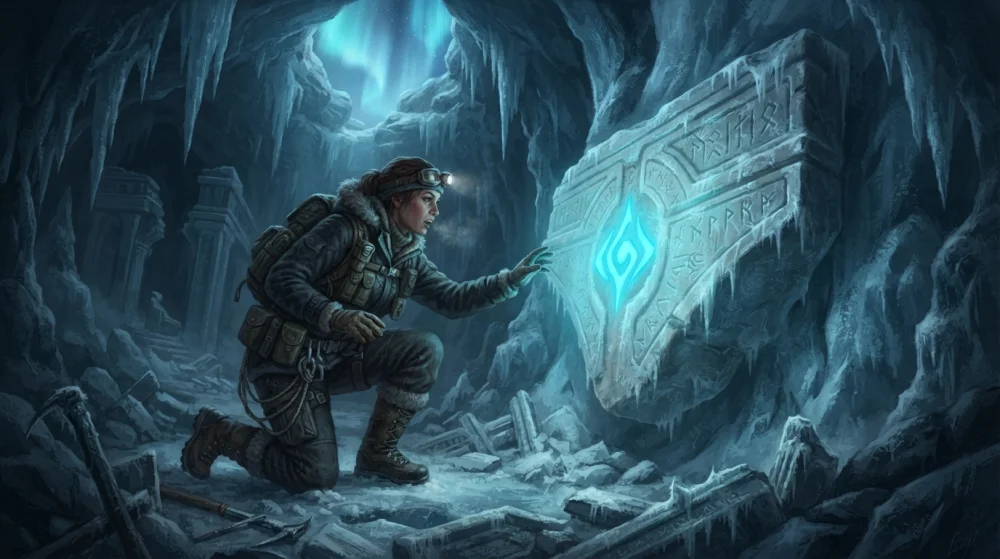
A notable chunk of the list leans on Aeor specifically. Anything with an arcane, almost overengineered feel - the Grimoire Infinitus among the Vestiges, the Staff of Dunamancy among the standard items - reads as a piece of that city's fallen infrastructure, and placing one in an Eiselcross dig site rather than a random hoard pays off the connection. For the general rules this sits on top of, see the D&D 5e 2014 Magic Items Guide.
Common and Uncommon
Five items land at common, the smallest tier, which tells you Wildemount doesn't lean on the magic-item-as-everyday-convenience premise nearly as hard as a setting like Eberron does.
Breathing Bubble (wondrous, common) is a translucent sphere worn over the head, holding an hour of breathable air and refilling at dawn. Coin of Delving (wondrous, common) is a copper coin that rings a distinct tone when dropped, its pitch telling a listener how far it fell. Ersatz Eye (wondrous, common, attunement) replaces a lost eye and functions as a normal one; only you can remove it. Prosthetic Limb (wondrous, common, attunement by a creature missing some or all of a limb) functions exactly like the limb it replaces, and multiple prosthetics count as a single item for attunement. Vox Seeker (wondrous, common) is a wind-up clockwork crab that beelines for the nearest voice it detects, ignoring every other target - a blunt way to flush out a hidden speaker or trigger a trap from a distance.
At uncommon: Amulet of the Drunkard heals a meaningful chunk of hit points the moment you finish a pint while wearing it, once per dawn. Brooch of Living Essence (attunement) makes creature-type detection read you as humanoid and alignment detection read you as neutral. Dust of Deliciousness transforms the flavor of any food, at the cost of dulling the eater's Wisdom for an hour - enough for six servings, and a fun way to drug an entire dinner table. Goggles of Object Reading (attunement) grant advantage on Arcana checks to read information about a creature or object in sight, plus a once-per-dawn identify. Ring of Obscuring (attunement) casts fog cloud centered on the wearer without concentration, 3 charges. Rod of Retribution (attunement) lets you spend a charge as a reaction when a creature damages you, forcing a Dexterity save or dealing lightning damage back.
Rare
Nine items sit here, the largest tier alongside very rare.
Acheron Blade (any sword, attunement) grants a weapon-attack bonus and immunity to turn-undead effects, plus temporary hit points once per dusk and lingering dread on a hit. Battering Shield (attunement) is an iron tower shield with bonus AC and 3 charges to shove a creature farther, knock it prone, or both. Butcher's Bib (attunement) lets you reroll melee weapon damage once per turn and crits slashing attacks on a 19 or 20. Corpse Slayer (any weapon, attunement) deals extra damage against undead and imposes disadvantage on their turn-undead saves. Needle of Mending (dagger, attunement) is a magic dagger disguised as a sewing needle that also casts mending. Potion of Maximum Power makes your next damage spell of 4th level or lower deal maximum damage on every die. Ring of Temporal Salvation (attunement) yanks you back into an adjacent space with hit points restored and a level of exhaustion shed if you die, then turns to dust. Staff of the Ivory Claw (attunement by a spellcaster) grants a spell-attack bonus and bonus radiant damage on a critical hit. Weapon of Certain Death stops any creature it damages from regaining hit points until the start of your next turn.
Very Rare
Ten items land here, tied with rare for the deepest tier.
Arcane Cannon is a Large siege-scale cannon needing no ammunition, firing once every two actions with a 5-minute recharge, the wielder picking from five area-effect blasts each time. Bloodaxe (greataxe, attunement), once wielded by Grog Strongjaw, deals extra necrotic damage to living targets and refunds temporary hit points on a kill. Dispelling Stone shatters on impact, ending any active spell of 5th level or lower in a 10-foot burst. Duskcrusher (warhammer, attunement) manifests a radiant hammer head on command, dealing radiant damage with bonus damage against undead and casting sunbeam once per dawn. Hunter's Coat (leather, attunement) grants AC plus 3 charges for bonus necrotic damage against a wounded creature. Last Stand Armor banishes every celestial, fey, and fiend within 30 feet if you die wearing it. Orb of the Veil (attunement) raises Wisdom and grants darkvision, but is cursed: you become unwilling to part with it, and it snuffs nearby nonmagical flames while halving fire damage you deal. Potion of Possibility grants two Fragments of Possibility over an 8-hour window. Reincarnation Dust functions as the reincarnate spell on a willing dead humanoid's remains. Staff of Dunamancy (attunement by a wizard) casts fortune's favor, pulse wave, or gravity sinkhole and converts one failed self-targeted save into a success once per dawn - the single most on-theme item in the book for a Chronurgy or Graviturgy wizard.
Legendary
Only three standard items reach legendary, since the book saves most of its highest-power budget for the Vestiges and Arms.
Luxon Beacon is a heavy crystal dodecahedron tied directly to Kryn faith. Concentrating on it grants a Fragment of Possibility once per dawn, and any consecrated follower of the Luxon who dies within 100 miles has their soul drawn into it. Treat it as a location or plot object tied to the war rather than something a party carries off. Nightfall Pearl (attunement) turns a 10-mile radius into artificial night for 24 hours - a campaign-scale environmental tool for staging a heist, ambush, or ritual. Spell Bottle (attunement) stores a single spell of up to 5th level for later release using the original caster's DC, and can be opened as a reaction to intercept an incoming spell of 3rd level or lower.
Vestiges of Divergence
Seven items aren't ordinary treasure at all. The Vestiges are legendary relics that survived the Calamity, and each evolves alongside its wielder: dormant at first, awakened around levels 9-15, and exalted around levels 16-20, with each state's benefits stacking. Hand one out only when you're ready to track that progression across the whole campaign; a Vestige given away casually and then forgotten is worse than not using the subsystem at all.
Danoth's Visor. Mithral goggles. Dormant, strong darkvision and advantage on sight-based Investigation and Perception. Awakened, true seeing against invisibility and the Ethereal Plane, plus limited see-through-walls and magnification. Exalted, auto-detects illusions and casts antimagic field once per dawn.
Grimoire Infinitus. An infinite-paged Age of Arcanum spellbook, pre-loaded with powerful spells. Dormant, it increases how many spells you can prepare. Awakened, it adds advantage on saves against spells plus another prepared-spell increase. Exalted, it doubles Arcane Recovery uses and grants a third increase.
Hide of the Feral Guardian. Studded leather said to be a gift from Melora. Dormant, AC bonus, bonus melee accuracy and damage while polymorphed, and a once-per-dawn self-polymorph into a giant owl. Awakened, both bonuses increase and a cave bear form unlocks. Exalted, both increase again and a unique guardian wolf form unlocks.
Infiltrator's Key. A mithral skeleton key forged from the blood of executed master thieves. Dormant, it functions as thieves' tools with advantage on lock-picking plus Stealth advantage. Awakened, it transforms into a magic dagger and casts alter self, invisibility, knock, and pass without trace once per dawn each. Exalted, it punches a temporary opening through a wall, floor, or ceiling and unlocks dimension door.
Stormgirdle. A leather belt branded with Kord's symbol. Dormant, lightning and thunder resistance, a Strength floor of 21, and a one-minute Storm Avatar form. Awakened, the Strength floor and lightning damage increase and the Avatar gains flight. Exalted, both rise again and it casts control weather once per dawn.
Verminshroud. A patchwork cloak stitched from Blightshore rat pelts. Dormant, smell-based Perception advantage, disease immunity, darkvision, and a giant rat self-polymorph. Awakened, poison resistance, insect plague once per dawn, and a giant wasp form. Exalted, a climbing speed, a poisonous bite, and a giant scorpion form.
Wreath of the Prism. A golden thorn circlet set with gems in Tiamat's five colors. Dormant, darkvision and an attempt to dominate monster a beast, dragon, or monstrosity of CR 5 or lower that you hit or grapple. Awakened and exalted raise the CR ceiling and save DC.
Arms of the Betrayers
Eight artifact-tier sentient weapons, each forged by a Betrayer God for a mortal champion and each housing a bound fiend with its own name, personality, and agenda. Like the Vestiges they advance through three states, gaining a beneficial and a detrimental property at each of the first two stages and a major beneficial property at the last. None can be destroyed by ordinary means - each has its own unique destruction ritual. Pick or roll that method before you introduce the weapon, so the eventual "how do we get rid of this thing" question already has an answer.
Blade of Broken Mirrors. A jagged stone dagger of Tharizdun housing an insane glabrezu named Ragazuu who pushes its wielder toward chaos and reckless revolution. It returns to your hand after a ranged attack and lets you shapeshift into any humanoid it has killed. At its peak it grants illusion spellcasting and on-demand invisibility.
Grovelthrash. An obsidian warhammer of Torog housing a covetous ultroloth named Ciria obsessed with treasure and inflicting pain. Bonus bludgeoning damage at a small self-inflicted psychic cost, plus advantage detecting lies. At its peak, a burrowing speed through solid rock, a damage-reflection reaction, and earth-shaping spellcasting.
Lash of Shadows. A snakeskin whip touched by Zehir, tipped with animated serpent heads and housing a short-tempered marilith named Sizlifeth. A rotating menu of poison effects on a hit, escalating from blinding poison to paralysis and, at its peak, incremental petrification.
Mace of the Black Crown. A ruby-headed iron mace of Asmodeus housing a greedy erinyes named Xartaza who nudges her wielder toward lawful evil deal-making. An ignitable flaming head and a once-per-dawn devil summon escalating from imp to bearded devil to barbed devil.
Ruin's Wake. A gold-dragon-bone spear carved with an Orc hymn to Gruumsh, housing a slaughter-loving balor named Yarrowish. A returning throw and a reaction attack against anyone who hits you in melee. At its peak, a battle-cry advantage buff and life-drain on a killing blow.
Silken Spite. A spider-silk rapier blessed by Lolth housing a murderous yochlol named Sinnafex who pushes its wielder toward paranoia. Darkvision, poison-and-unconsciousness on a hit, and a climbing speed with web immunity. At its peak, a spell list including cloudkill and a short-range teleport usable in dim light.
The Bloody End. An adamantine morningstar of Bane housing a tyrannical pit fiend named Izeelzee who pushes its wielder to demand fealty. A charm/fear/domination spell list and Intimidation advantage. At its peak, a fear-on-kill burst and a reflexive psychic counterattack.
Will of the Talon. A gem-studded gold war pick channeling Tiamat, housing a bone devil named Ashtyrlon obsessed with treasure and decisive leadership. A fear aura and a choice of five elemental breath weapons. At its peak, heavier breath damage and resistance to all five damage types.
Running a War Campaign
Wildemount opens with a blunt admission: the continent is "a powder keg about to explode," and the two nations have just tipped it into open war. The book calls the conflict the War of Ash and Light, and hands a DM levers for how much that title should matter.
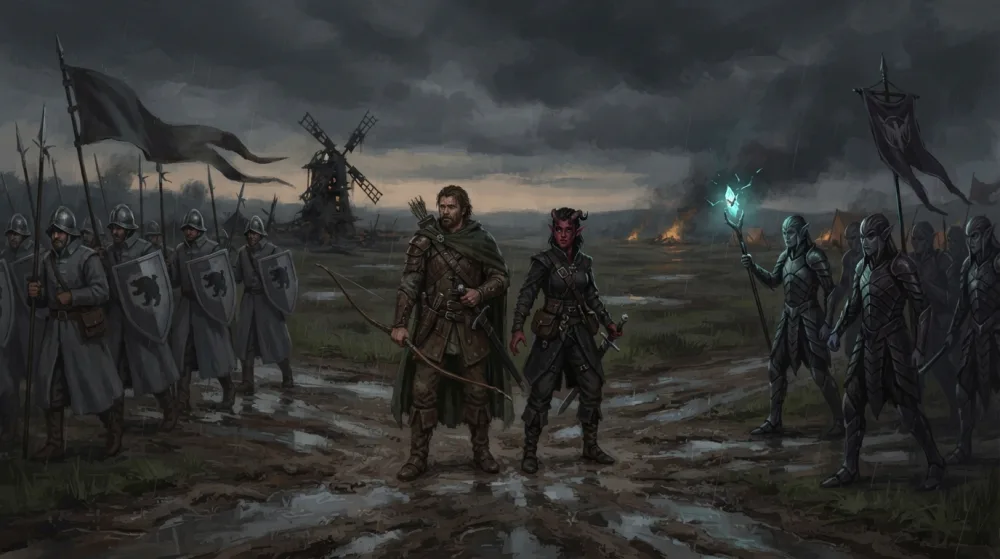
The War Is a Dial, Not a Switch
The most important piece of guidance in the campaign-building section is also the simplest: the war is only as important as you decide to make it. Push the battles and their consequences into the foreground and the war becomes the campaign's chief concern. Keep both at arm's length and your characters stay free to engage with it or ignore it entirely. Nothing stops you from adjusting that dial mid-campaign either.
Getting buy-in starts with an out-of-character conversation, not an in-fiction cue. Ask your players directly how large a role they want the war to play before you build a single session around it. A table that finds war compelling should build characters with real ties to the conflict; a table that would rather explore can leave it as scenery, present and occasionally felt but never the reason a session exists.
If you want the war gone entirely, the book's own fix is a timeline shift: set your campaign a year or so earlier, before tensions tipped into open conflict. Every region, faction, and piece of political tension still applies, but the fighting stays simmering. This is a legitimate way to run the entire published gazetteer without ever staging a battle.
Adventuring Options That Don't Require a Uniform
Because D&D's combat rules are built around a small party rather than thousands of combatants, the book steers most campaigns away from mass warfare even when the war sits front and center. Characters don't have to be active combatants for the war to shape their story:
- Crime. Lax wartime law enforcement is a gift to smugglers. The Myriad needs help moving goods across the border, and Revelry pirates need crews willing to raid towns left undefended while regular forces are tied up.
- Disaster. When artillery levels a town or triggers a landslide, survivors need help escaping through contested territory, or carving a new settlement out of the wilderness.
- Law. Conscription pulls officers into the army, leaving local lawmasters short-staffed and desperate for mercenary help.
- Military. Characters can enlist and take orders, a good fit for an episodic structure where sessions open with an objective and close with a reward and the next assignment.
- Upheaval. Artillery and marching armies spook wildlife, and a large enough invasion can drive giants and dragons out of long-held lairs.
- Trade. War creates opportunity for traders bold enough to move high-value goods across contested land, and adventurers make convenient escorts.
These are a menu, not a checklist. A single campaign can rotate through several: early levels running Crime-flavored sessions in a border town's black market, drifting into Disaster work once a settlement takes artillery fire, and only picking up a Military thread much later.
Marking Time and Running Battles
Aligning sessions to specific in-world dates makes the conflict feel like it's happening on a clock rather than idling until convenient. Wildemount runs on the eleven-month Exandrian calendar, and several holidays already carry wartime weight. Barren Eve, winter's longest night, is traditionally a day of mourning for those lost in war. A monster attack or a beacon skirmish lands with more weight when it interrupts a festival your players recognize. Picking two or three recurring dates and checking in on how the war has changed them is enough without turning prep into a spreadsheet.
If you do send them to the front, the book is candid about a structural problem: D&D adventurers hate being told what to do, and army service is built around following orders. Make sure players understand what they're signing up for, and if the party later wants self-directed adventures, have that conversation out of character.
Simulating a battle with thousands of combatants is impractical, so break a mass battle into a series of cinematic encounters instead. Pick a defensible objective the party can capture or hold, and stage the larger battle as a sequence that guides them from flashpoint to flashpoint the way a dungeon guides a party room to room. When a scene calls for depicting large numbers of combatants fighting around the characters, you can skip individual dice rolls and decide outcomes narratively - but use this sparingly, since leaning on it constantly undercuts the sense that outcomes are actually determined by the dice.
Hot Take: Resist the urge to make your war campaign entirely about the war. The dial framing is the book's strongest advice, and the non-military options above exist precisely because a party that never enlists can still have a war-shaped campaign. A refugee escort, a black-market smuggling run, or a hunt for a dragon spooked out of its lair by advancing artillery tells you just as much about what the War of Ash and Light costs Wildemount as a pitched battle does, usually with a lot less bookkeeping.
What They're Actually Fighting Over
The war's immediate trigger was a beacon raid gone wrong: agents tied to the empire made off with beacons the Dynasty considers irreplaceable, and the Dynasty mobilized for open war rather than pursuing them quietly. That flashpoint sits on top of decades of older tension - two expansionist powers sharing one continent, neither trusting the other, both convinced their cause is righteous.
Neither side is the clear hero, and running it well means letting players see both nations' real grievances rather than treating either as a faceless enemy army. The empire runs propaganda against a nation it has never bothered to understand and enforces a rigid religious caste system at home. The Kryn expand through conversion and force and hide typhros at the heart of their own faith.
Both governments are also fighting a second, quieter war for their own people's loyalty, and that fight is arguably the more interesting one to put in front of a party. The Crown needs its citizens to keep believing the war is righteous and the enemy inhuman, because too much doubt at home threatens the social order the throne relies on to keep the Assembly in check. The Dynasty needs its outlying villages and newly converted tribes to keep believing the Dens have their best interests at heart. A party that starts pulling on either thread is playing in territory neither nation's official story accounts for.
Don't let your players meet the Kryn Dynasty only through Dwendalian propaganda, and don't let them meet the empire only through Kryn suspicion. The single most useful thing this war does for a campaign is put two full, unreliable narrators in front of your party at the same time. Let the empire's soldiers actually believe the Kryn are monsters. Let the Kryn actually believe the empire is irredeemably corrupt. Then let your players figure out, region by region and faction by faction, how much of either story holds up.
What This Guide Leaves Out
Explorer's Guide to Wildemount ships with pre-built starting adventures in its later chapters, and this guide deliberately doesn't summarize their plots, twists, or encounters. That's consistent with how this site treats every published adventure module: the campaign-building framework here is yours to use freely, but the book's own written adventures stay something you buy and run from the source.
Common Mistakes
- Assuming Wildemount's races play differently here. Sixteen of them are mechanically identical to their existing coverage. The setting adds regional perception, not traits.
- Requiring setting buy-in for the subclasses. Echo Knight, Chronurgy, and Graviturgy all drop into any 2014 campaign without adjustment, and dunamancy reflavors as any exotic school of magic.
- Treating the Heroic Chronicle as a build option. It generates backstory, not mechanics. It has no weight on a character sheet.
- Starting a new table anywhere but the Marrow Valley. Zadash carries a campaign's first several sessions without forcing an immediate stance on the war.
- Treating the Cerberus Assembly as a monolith. It's eight ambitious people in an uneasy alliance. The real material is one archmage's scheme colliding with another's.
- Assuming the Kryn are the villains because the empire says so. Both sides are unreliable narrators, and that's the setting's best engine.
- Handing out a Vestige of Divergence as loot. It's a campaign-length progression commitment, not a treasure roll.
- Introducing an Arm of the Betrayers without picking its destruction ritual. None can be destroyed by ordinary means, and improvising that later becomes a dead end.
- Making the party enlist. Six non-military adventuring frames exist precisely so a war-shaped campaign doesn't require a uniform.
- Running a mass battle with standard combat rules. Break it into a sequence of cinematic objectives instead, and use narrative resolution sparingly.