Introduction
Elves are among the most complete racial packages in the 2014 Player's Handbook. Where other races ask you to choose between ability scores, utility, or flavor, Elves arrive bundled with a Dexterity bonus, Darkvision, Perception proficiency, Fey Ancestry, and a subrace system that meaningfully differentiates your character's mechanical identity. The three core subraces (High Elf, Wood Elf, and Drow) each carve out a different niche, and Mordenkainen's Tome of Foes adds three more: Shadar-kai, Eladrin, and Sea Elf.
The catch is consistency. Elves are best when you build with them rather than around them. The +2 Dexterity is non-negotiable, Perception proficiency is always valuable, and Fey Ancestry's charm resistance is quietly excellent, but the subrace choice determines whether you are building a precision striker, a stealth-focused woodsman, or an underground shadow caster. This guide breaks down every option and makes the decision clear.

Disclaimer
Ratings use the following color system throughout this guide:
- ● Red - Poor or avoid. This option underperforms or conflicts with the race's strengths.
- ● Orange - Situational. Useful in specific builds or campaigns but not a default pick.
- ● Green - Good. A reliable choice that works well in most contexts.
- ● Blue - Excellent. A top-tier option that significantly enhances your character.
Ratings reflect the 2014 rules only.
Base Racial Traits
● Ability Score Increase: Dexterity +2 Dexterity is one of the two most universally useful ability scores in the 2014 game. It governs AC (via Dexterity-based armor), attack rolls (finesse weapons, ranged attacks), initiative, a common saving throw, and several important skills. +2 Dexterity is a top-tier racial bonus.
● Darkvision (60 ft.) Darkvision treats dim light as bright light and darkness as dim light, effectively removing the attack roll disadvantage in darkness. In many dungeon-crawling or nighttime scenarios, this is one of the strongest utility traits in the game.
● Keen Senses: Perception Proficiency Perception is the single most rolled skill in D&D 5e. Having proficiency at character creation means your Passive Perception is at least 10 + proficiency bonus + Wisdom modifier: the early-game tripwire your GM tests constantly.
● Fey Ancestry Advantage on saving throws against being charmed and immunity to magical sleep. Charm effects such as Charm Person, Dominate Person, and Hypnotic Pattern are some of the most dangerous effects in the 2014 rules. Hold Person is not one of them: it paralyzes rather than charms, so Fey Ancestry does not help against it. Advantage on charm saves prevents the nightmare scenario of your character attacking their own party.
● Trance Elves meditate for 4 hours instead of sleeping for 8 hours. This provides the same benefit as a full long rest. The 4 free hours per night are a roleplaying and logistics boon.
● Speed: 30 ft. Standard movement. Wood Elf improves this; High Elf and Drow do not.
● Languages: Common + Elvish Elvish is a relatively common language in most campaign settings. The fixed language choice is less flexible than Human's free choice, but Elvish is rarely a wasted pick.
Subraces
● High Elf
Ability Score Increase: Intelligence +1 Weapons: Longsword, shortsword, shortbow, longbow proficiency Cantrip: One Wizard cantrip of your choice (uses Intelligence) Extra Language: One language of your choice
High Elf is the strongest subrace for Wizards and Intelligence-adjacent builds, but the free Wizard cantrip makes it broadly excellent for almost any character. Booming Blade and Green-Flame Blade add melee damage for martial builds. Minor Illusion is an enormous utility pickup for anyone. The flexibility of the Wizard cantrip list makes this trait excellent for every class.
● Intelligence +1 For Wizards and Arcane Trickster Rogues, this is a primary stat bonus. For others, a nice secondary.
● Cantrip (Wizard list) The headline trait. The open Wizard cantrip list includes both powerful damage options and excellent utility. This is better than most fixed-cantrip racial traits.
● Weapon Proficiencies For Wizards and other classes that normally only have simple weapons, this unlocks higher-damage weapon options including the longbow.
● Extra Language Useful for roleplaying and investigation; not a mechanical driver.
● Wood Elf
Ability Score Increase: Wisdom +1 Weapons: Longsword, shortsword, shortbow, longbow proficiency Fleet of Foot: Speed increases to 35 ft. Mask of the Wild: Can attempt to hide when only lightly obscured by natural phenomena
Wood Elf is the premier Ranger and Rogue subrace. Wisdom +1 feeds Ranger and Druid spell saves. 35 ft. speed makes you one of the fastest base-race characters in the game. Mask of the Wild is the strongest stealth utility trait available to any 2014 core race.
● Wisdom +1 Wisdom drives Perception (already proficient), Ranger spellcasting, Druid spellcasting, and Cleric spellcasting. Also a common saving throw.
● Fleet of Foot (35 ft. Speed) Five extra feet of movement matters in combat. For Rogues, it enables easier Dash + Hide combos. Combined with Cunning Action, a Wood Elf Rogue is one of the most mobile characters in the game.
● Mask of the Wild You can hide in light obscurement from natural phenomena: foliage, heavy rain, mist, falling snow. For Rangers and Rogues operating in wilderness settings, this is a top-tier trait.
● Weapon Proficiencies Same as High Elf, relevant for classes that want longbows without multiclassing.
● Drow (Dark Elf)
Ability Score Increase: Charisma +1 Darkvision: 120 ft. (extended) Sunlight Sensitivity: Disadvantage on attack rolls and Perception checks in direct sunlight Drow Magic: Dancing Lights (cantrip), Faerie Fire (1/long rest at level 3), Darkness (1/long rest at level 5) Weapons: Rapier, shortsword, hand crossbow proficiency
Drow is a fascinating subrace with a fatal conditional penalty. In dungeon-heavy or underdark-focused campaigns, Drow's 120 ft. Darkvision and innate spell list are excellent. In outdoor campaigns, Sunlight Sensitivity can impose disadvantage on every attack roll your character makes.
● Darkvision 120 ft. Double the standard Darkvision range. In pure darkness, you operate where most races are effectively blind.
● Sunlight Sensitivity Disadvantage on attack rolls in direct sunlight is a crippling penalty. In outdoor campaigns, this is game-defining in the wrong direction.
● Faerie Fire (level 3) Faerie Fire grants advantage on attack rolls against all creatures in its area who fail the save. As a 1/long rest use, it benefits your entire party. Excellent for Charisma casters.
● Darkness (level 5) Darkness combined with the Devil's Sight Warlock invocation creates one of the most notorious exploit setups in 2014 rules: attacking through Darkness at no penalty while enemies are effectively blind.
● Charisma +1 Good for Warlocks, Paladins, Bards, and Sorcerers. The most viable Elf subrace for those classes.
● Dancing Lights A utility cantrip for scouting and signaling. Weaker than High Elf's open cantrip selection.
● Shadar-kai
Source: Mordenkainen's Tome of Foes Ability Score Increase: Constitution +1 Necrotic Resistance: Resistance to necrotic damage Blessing of the Raven Queen: Bonus-action teleport of up to 30 feet, once per long rest; from 3rd level, resistance to all damage until the start of your next turn
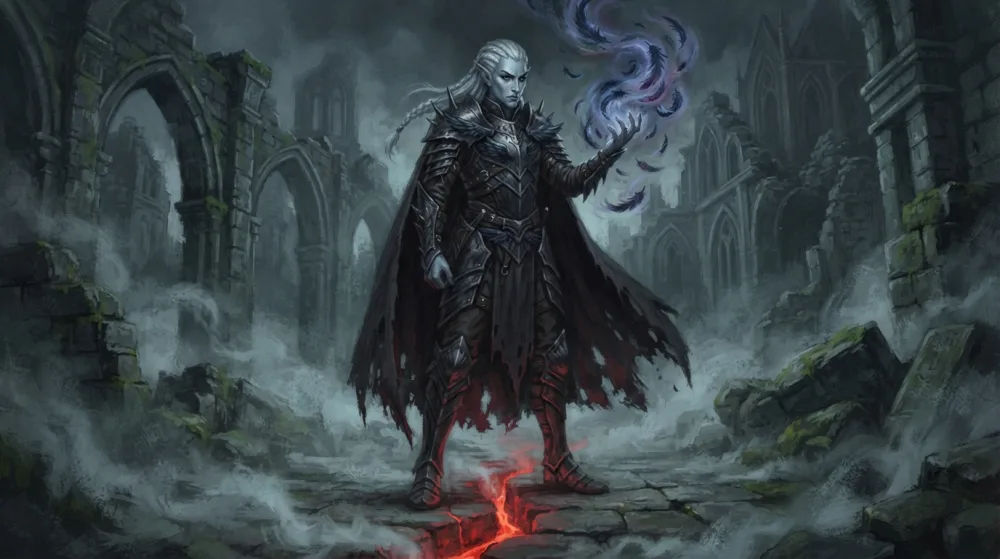
Shadar-kai are elves bound to the Raven Queen and the Shadowfell. They keep every base Elf trait and add a defensive package built around one idea: step out of danger and briefly stop being worth attacking.
● Blessing of the Raven Queen At 1st level this is a solid escape: a 30-foot teleport to an unoccupied space you can see, once per long rest. From 3rd level the same teleport also gives you resistance to all damage until the start of your next turn. That upgrade is the reason to pick the subrace. Teleport out of a grapple or an enemy's reach, and whatever still reaches you before your next turn deals half damage.
The trait costs your bonus action. It does not stack with Cunning Action, Step of the Wind, or any other bonus action on the same turn, so a Shadar-kai Rogue chooses between Dash and teleport rather than taking both. It is still better than Cunning Action's Disengage in two situations: when you are grappled or restrained, and when the resistance matters more than the distance.
Compared with Misty Step, the trait is not a spell, so it cannot be counterspelled and needs no spell slot, but it cannot be repeated with slots either. The Fey Touched feat grants Misty Step once per long rest plus casting with slots, at the cost of a feat. A Shadar-kai who takes it gets two teleports a day.
● Constitution +1 More hit points and better concentration saves, but no mental stat. This is the only Elf subrace in this guide that boosts neither Intelligence, Wisdom, nor Charisma, which points it at Dexterity martials.
● Necrotic Resistance Narrow. It answers undead, some fiends, Chill Touch, and necromancer enemies, and does nothing against most weapon and elemental damage. Resistances from two sources do not stack; you halve necrotic damage once.
Best fits: Rogue (the Assassin and Phantom share the death theme), Monk (Way of the Long Death especially), Dexterity Ranger, and Dexterity Fighter, a class with no built-in escape before high levels. A Warlock with the Undead or Undying patron is a strong thematic match but gets no Charisma. Avoid Strength and Charisma builds.
Feats that fit: Fey Touched for the second teleport, Shadow Touched for free Invisibility, Alert so you act before you need the escape, and Mobile for a melee skirmisher.
Hot Take: Blessing of the Raven Queen is sold as a mobility trait, but the teleport is the least interesting part of it. From 3rd level it is a once-a-day "take half damage from everything this round" button that also frees you from a grapple. Judge Shadar-kai on that, not on the 30 feet.
Mordenkainen Presents: Monsters of the Multiverse reprints the Shadar-kai with flexible ability scores and lets you use the teleport a number of times equal to your proficiency bonus per long rest, which makes it a far stronger subrace if your table uses that book.
● Eladrin and Sea Elf
Mordenkainen's Tome of Foes adds two more subraces.
Eladrin get +1 Charisma and Fey Step, a short-rest teleport whose extra effect depends on the eladrin's season. It is the Elf subrace for Charisma casters who do not want Drow's Sunlight Sensitivity, and it has its own guide.
Sea Elf get +1 Constitution, a 30-foot swimming speed and the ability to breathe air and water (Child of the Sea), and proficiency with the spear, trident, light crossbow, and net. Friend of the Sea lets them share simple ideas with beasts that have a swimming speed, and they speak Aquan. The subrace is only worth taking in a campaign that spends real time underwater, where it removes the need for water breathing magic entirely.
The Astral Elf from Spelljammer is a separate race rather than an Elf subrace.
Ability Scores
All Elves start with Dexterity +2. Subrace determines your secondary bonus:
| Subrace | Secondary Bonus | Best Stat Targets |
|---|---|---|
| High Elf | Intelligence +1 | INT, DEX |
| Wood Elf | Wisdom +1 | WIS, DEX |
| Drow | Charisma +1 | CHA, DEX |
| Shadar-kai | Constitution +1 | DEX, CON |
| Eladrin | Charisma +1 | CHA, DEX |
| Sea Elf | Constitution +1 | DEX, CON |
For point buy, invest heavily in the subrace's secondary stat alongside Dexterity. Constitution should be your third priority for HP and Concentration saves.
Best Classes for Elves
● Wizard (High Elf)
High Elf is arguably the best race for Wizard in the entire 2014 PHB. Intelligence +1 boosts your primary stat, the free Wizard cantrip gives you Booming Blade or Green-Flame Blade for Bladesinger builds, Darkvision keeps you operational at night, and Perception proficiency covers the party's most critical sense.
● Ranger (Wood Elf)
Wood Elf and Ranger are nearly purpose-built for each other. Dexterity +2 boosts attack rolls and Initiative. Wisdom +1 feeds spell DCs. Fleet of Foot makes kiting easier. Mask of the Wild is custom-fitted for the wilderness Ranger fantasy.
● Rogue (Wood Elf, High Elf, or Shadar-kai)
Dexterity is everything for Rogues: it powers attack rolls, damage, AC, Initiative, and Stealth. Wood Elf adds Mask of the Wild and 35 ft. speed for the ultimate stealth Rogue. High Elf adds a cantrip and Intelligence for Arcane Trickster. Shadar-kai adds a daily teleport with damage resistance for a Rogue who ends up in melee.
● Fighter (High Elf or Wood Elf)
Dexterity-based Fighters and Archery Fighters love the +2 Dexterity. High Elf adds weapon proficiencies and a combat cantrip. Strength-based Fighters gain little from the Elf package.
● Warlock (Drow)
The Drow Warlock with Devil's Sight is the most famous Warlock race combination in 2014. Cast Darkness, retreat into it, attack with Eldritch Blast at no penalty, since enemies cannot see you without magical means. Faerie Fire adds party-wide attack advantage.
● Druid (Wood Elf)
Wisdom +1 boosts spell DCs. Dexterity helps AC in Wild Shape. Mask of the Wild adds mechanical stealth benefit alongside the nature-connected theme.
● Monk (Wood Elf)
Monks run entirely on Dexterity and Wisdom, exactly what Wood Elf provides. Fleet of Foot extends Monk's already impressive movement speed. Wood Elf Monk is one of the fastest characters in 2014 D&D.
Build Your Dungeons & Dragons (5e, 2014) Character
The Dungeons & Dragons (5e, 2014) character builder is live - build a Beastkin, a Kobold, or whatever your table is missing, free, right now.
Start BuildingWorst Classes for Elves
● Barbarian
Barbarians want Strength and Constitution. Elves give neither. The Dexterity bonus conflicts with Barbarians who need Strength for attack rolls and damage. Elf Barbarian means you are working against your racial package from session one.
● Paladin
Paladins are Strength and Charisma builds. Only Drow offers Charisma +1, and Sunlight Sensitivity is a risk in many campaigns. The lack of Strength or Constitution bonuses is a deficit.
● Sorcerer (Non-Drow)
Sorcerers want Charisma. Only Drow Elves provide Charisma. High Elf and Wood Elf Sorcerers waste their secondary stat bonus.
Best Feats for Elves
● Elven Accuracy (Xanathar's Guide to Everything)
For: High Elf or Wood Elf; any class using Dexterity or Intelligence for attack rolls
+1 to Dexterity, Intelligence, Wisdom, or Charisma. When you have advantage on an attack roll using one of those stats, reroll one die, effectively rolling three dice and taking the highest. Dramatically increases critical hit frequency. For High Elf Rogues, Arcane Trickster builds, and Wood Elf Rangers, this is among the best feats available.
● War Caster
For: Any Elf spellcaster maintaining Concentration
Advantage on Constitution saving throws to maintain Concentration, cast spells as opportunity attacks, and perform somatic components with occupied hands. Essential for any Elf Wizard, Druid, or Ranger.
● Sharpshooter
For: Ranger, Fighter (Archery)
The -5/+10 trade that defines ranged damage optimization. Wood Elf Rangers with Elven Accuracy + Sharpshooter create one of the most reliable damage expressions in 2014 D&D.
● Alert
For: Any Elf, especially Rogues and Wizards
+5 Initiative on top of Dexterity-fueled Initiative rolls. A Wood Elf Rogue with Alert has an Initiative modifier approaching +9-+10 at mid-levels. Acting first is priceless for Rogues who need to hide before enemies can react.
● Drow High Magic (Xanathar's Guide to Everything)
For: Drow, especially Charisma-primary casters
At-will Detect Magic plus once-per-long-rest Levitate and Dispel Magic, all cast with Charisma. No ability score increase, so this is best on a Drow Warlock or Sorcerer who wants free utility spells without spending slots on their known-spells list.
● Wood Elf Magic (Xanathar's Guide to Everything)
For: Wood Elf, especially Wisdom-primary casters
A free druid cantrip plus once-per-long-rest Longstrider and Pass without Trace, all cast with Wisdom. No ability score increase, so it fits a Wood Elf Druid or Cleric better than a Ranger who needs the stat more than the spells.
● Sentinel
For: High Elf Fighter or Paladin melee builds
Battlefield lock for melee controllers. Less synergistic for Dexterity-first builds that rely on ranged attacks.
Multiclassing Considerations
- High Elf Wizard / Rogue (Arcane Trickster): Intelligence-based multiclass that makes natural use of both the Intelligence bonus and free cantrip. Arcane Trickster Rogues want Intelligence, and High Elf removes the stat split problem.
- Wood Elf Ranger / Rogue: Stack Mask of the Wild with Cunning Action: Hide for near-permanent stealth in wilderness environments. Sneak Attack + Hunter's Mark on the same target is devastating.
- Drow Warlock / Sorcerer: Charisma-based gish with Darkness/Devil's Sight setup and Quickened Spell via Sorcery Points. One of the most powerful darkness-exploitation builds in 2014 rules.
Example Build: Level 1-10
Shadow Archer: Wood Elf Ranger (Hunter)
| Level | Class | Key Feature | Notes |
|---|---|---|---|
| 1 | Ranger 1 | Favored Enemy, Natural Explorer | Favored: Humanoids; Terrain: Forest |
| 2 | Ranger 2 | Fighting Style (Archery), Spells | Hunter's Mark + Archery (+2 to attack) |
| 3 | Ranger 3 | Hunter: Colossus Slayer | +1d8 on attacks vs. injured targets |
| 4 | Ranger 4 | ASI: +1 DEX, +1 WIS (18, 16) | Even scores on both key stats |
| 5 | Ranger 5 | Extra Attack | 2 attacks; double Hunter's Mark procs |
| 6 | Ranger 6 | Favored Enemy improvement | Second favored enemy/terrain |
| 7 | Ranger 7 | Hunter: Escape the Horde | Opportunity attacks at disadvantage |
| 8 | Ranger 8 | Feat: Sharpshooter | -5/+10 trade fully online |
| 9 | Ranger 9 | 3rd Level Spells | Lightning Arrow, Conjure Barrage |
| 10 | Ranger 10 | Hide in Plain Sight | +10 to Stealth while motionless |
Ability Scores (Point Buy): STR 8, DEX 15 (+2 from Wood Elf = 17), CON 15, INT 10, WIS 14 (+1 from Wood Elf = 15), CHA 8.
FAQ
Which Elf subrace is best in D&D 5e 2014?
High Elf is the most broadly powerful due to the free Wizard cantrip. Wood Elf is best for Ranger and Rogue builds. Drow is strongest in dungeon-heavy campaigns where Sunlight Sensitivity never triggers.
Is Drow playable despite Sunlight Sensitivity?
Sunlight Sensitivity imposes disadvantage on attack rolls and Perception checks in direct sunlight. Drow is best in dungeon-heavy or underdark settings. Discuss campaign setting with your GM before committing.
Can an Elf Wizard get Booming Blade as their free cantrip?
Yes. Booming Blade (from Sword Coast Adventurer's Guide) is on the Wizard spell list. High Elf can select it as their free cantrip.
Do Elves need to sleep?
Elves trance for 4 hours rather than sleeping for 8; they gain the same rest benefit and are immune to magical sleep effects.
Why do so many Ranger builds use Wood Elf?
Wood Elf provides Wisdom +1, Dexterity +2, 35 ft. speed, and Mask of the Wild: four traits that align almost perfectly with Ranger's class needs.
Does Blessing of the Raven Queen give a Shadar-kai Rogue a second bonus action?
No. The teleport uses the same bonus action as Cunning Action. Its value is escaping a grapple and, from 3rd level, resistance to all damage until your next turn.
How does Blessing of the Raven Queen compare to Misty Step?
Both are a bonus-action teleport of up to 30 feet. Misty Step is a spell that can be recast with slots; the Shadar-kai trait is not a spell, works once per long rest in Tome of Foes, and from 3rd level adds resistance to all damage.
Final Notes
Elves are a well-designed race in 2014 D&D because their base traits are all useful. The subrace system adds a clear second dimension: High Elf for intelligence and cantrip utility, Wood Elf for speed and wilderness stealth, Drow for extended Darkvision and innate spellcasting at a conditional cost, and Shadar-kai for a daily escape that doubles as a defensive button.
The mistake players make with Elves is building against the Dexterity bonus. The race rewards you for leaning in: Dexterity-based Fighters, Rangers, Rogues, and Monks all feel natural and powerful. Know what the race gives you, build toward it, and Elves consistently perform above expectation.