Introduction
Spelljammer: Adventures in Space hands D&D 5e 2014 players and DMs a premise the game had never fully mechanized before: the space between worlds is navigable, breathable in the right conditions, and full of ships, cities, and people. Six new player races call Wildspace home, two backgrounds grant a free PHB feat each, a full ship-to-ship combat subsystem covers sixteen vessel types, and one detailed location, the asteroid city of the Rock of Bral, gives a party somewhere to make port.
The boxed set is thin on setting content: three 64-page books, one fully detailed city, and no gazetteer of wildspace systems to travel between. That absence is the single most-discussed thing about the release, and it shapes this guide, which spends more time on how to build what the box didn't ship than on summarizing what it did.
The setting frame is simple even where the mechanics get involved. Wildspace is the space inside a crystal sphere surrounding a single star system, and the Astral Sea is the connective ocean between crystal spheres, the plane a ship crosses to travel from one system to another entirely. A spelljamming helm, installed on a ship weighing at least a ton and manned by an attuned spellcaster, is what makes any of it move. That single item, more than any race or location, is the mechanical backbone the whole setting runs on.

Character Options
Spelljammer's character-creation material is compact: six new playable races, two backgrounds that each double as a free feat, and an explicit statement that none of it is required to play in the setting at all.
You don't need any of this to play in Wildspace, and the book says so directly. A standard Player's Handbook character, any race, any class, any background, works in a Wildspace or Astral Sea campaign with zero modification. If your table adds a Spelljammer campaign on top of an existing character roster, nobody needs to reroll.
The Six Races Compared
All six use the same floating +2/+1 (or +1/+1/+1) ability score format, so none is a poor fit for any class purely on stats. What separates them is the specific build question each one answers.
| Race | Creature Type | Distinct Build Question | Best For |
|---|---|---|---|
| Astral Elf | Humanoid | Is the daily-rotating Astral Trance a real advantage or a bookkeeping tax? | INT/WIS/CHA casters, mobility-focused martials |
| Autognome | Construct | Is being a Construct a trap? | Unarmored-AC martials, tables with a lenient DM |
| Giff | Humanoid | Does Astral Spark carry the race without firearms? | Strength martials regardless of table rules |
| Hadozee | Humanoid | Is Hadozee Dodge the best defensive racial trait in the game? | Front-line martials taking repeated hits |
| Plasmoid | Ooze | What does squeezing through 1 inch actually let you do at the table? | Infiltration-focused Rogues and scouts |
| Thri-kreen | Monstrosity | Do Secondary Arms break two-weapon fighting? | Low-social-interaction scouts and skirmishers |
Astral Elf is the mobility-and-flexibility pick: a free cantrip with a free ability-score choice, a slot-free 30-foot teleport capped at your proficiency bonus per long rest, and a daily-rotating skill-and-tool proficiency that rewards a player willing to re-plan every morning.
Autognome has the single best raw trait list in the book, a free AC floor matching starting armor, a see-the-roll-first bonus die, and a healing carve-out that keeps you from being locked out of the party's cleric, bundled with the largest DM-dependency swing of any race here.
Giff is the safe, high-floor pick: Astral Spark's flat force damage and Hippo Build's Strength advantages work regardless of table rules, while Firearms Mastery raises the ceiling to best-in-book if your DM allows firearms and does nothing at all if not.
Hadozee is the strongest pure defensive option: a reaction that reduces any incoming damage with no type restriction, plus a real escape-and-reposition tool in Glide. Build this race from its current, post-errata text only, for reasons covered below.
Plasmoid offers the most distinctive infiltration trait in the 2014 catalog: a 1-inch squeeze that costs you every scrap of gear to use, which makes it a planned-heist tool rather than a reactive escape button.
Thri-kreen trades a strong unarmored AC floor and a permanently free hand for a hard, unconditional inability to speak any non-native language without magic, a real roleplay and mechanical constraint rather than a flavor footnote.
Build Your Dungeons & Dragons (5e, 2014) Character
The Dungeons & Dragons (5e, 2014) character builder is live - build a Beastkin, a Kobold, or whatever your table is missing, free, right now.
Start BuildingPower Level and DM-Dependency, Side by Side
Six races drafted from the same book invites an obvious question: which is actually strongest? The honest answer is that "strongest" splits into two axes that don't move together.
Table-independent power measures how strong a race is regardless of DM ruling or campaign type. Hadozee and Giff sit at the top. Hadozee Dodge and Astral Spark both work identically no matter how strictly a DM interprets an edge case, and neither depends on an optional subsystem to deliver its core value. Astral Elf and Plasmoid sit in the middle: both have a strong headline trait that requires either daily bookkeeping or specific tactical setup to realize fully.
DM-dependency measures how much a race's payoff swings on a single ruling outside the printed text. Autognome tops this axis by a wide margin. Healing Machine's five-spell whitelist fixes the most obvious Construct problem, but everything else Construct type touches is an open question a table has to resolve on its own. Plasmoid's Ooze type raises a smaller version of the same question. Thri-kreen's Monstrosity type barely registers, since comparatively few rules interact with it either way; its real cost, Thri-kreen Telepathy, is printed and certain, not DM-dependent.
The practical takeaway: if your table runs rules strictly, Hadozee and Giff are the safest picks. If your table extends printed exceptions generously, Autognome's full trait list becomes one of the strongest in the entire 2014 catalog. Ask your DM which kind of table you're at before assuming any one race is best in the abstract.
Which Race Fits Which Class
- Barbarian: Giff (Astral Spark plus Hippo Build stacks cleanly with Rage) or Hadozee (Hadozee Dodge plus Rage's resistance produces an exceptionally hard-to-drop front-liner).
- Fighter: Any of the six work, but Hadozee and Giff get the most mileage from a class that takes and lands the most hits per round.
- Paladin: Giff (Astral Spark stacks with Divine Smite for burst) or Hadozee (reinforces front-line tanking).
- Monk: Hadozee (climbing speed and Glide reinforce existing mobility) or Autognome (a strong AC floor for a class with low starting hit points).
- Rogue: Plasmoid is the clear standout, since Amorphous and Natural Resilience both reinforce an infiltration build directly. Thri-kreen is a strong second for a skill-and-stealth build that doesn't need to talk its way past anyone.
- Ranger: Thri-kreen (low reliance on verbal social interaction, strong Stealth) or Giff (a firearm-focused build, table rules allowing).
- Cleric or Druid: Astral Elf (the free cantrip and rotating proficiencies both reinforce a support caster) or Autognome (Healing Machine's thematic tie).
- Sorcerer, Warlock, or Wizard: Astral Elf is the strongest fit across all three, since the free INT/WIS/CHA cantrip lands cleanly on any of them and Starlight Step adds slot-free mobility a squishy caster values highly.
- Artificer: Autognome, for the tie between a construct character and a class built around infusing constructs with magic.
How Each Race Interacts With the Setting's Own Subsystems
Every one of the six was designed alongside Wildspace's travel and combat rules, and a few interactions matter before you commit.
Falling and gravity planes. Hadozee's Glide is the standout: a reaction that zeroes out fall damage and repositions you horizontally is unusually strong on a ship whose gravity plane can flip or oscillate mid-encounter, since falling in Wildspace is something your party will actually trigger rather than a rare hazard. No other race here interacts with those rules the same way.
Air quality. None of the six grants innate air independence outright, though Autognome's no-breathe half of Mechanical Nature comes closest, sidestepping the air-envelope subsystem entirely for that one character while the rest of the party tracks it normally. Plasmoid's 1-hour Hold Breath is a buffer, not a solution.
Ship-to-ship combat. Giff's Firearms Mastery interacts with shipboard weapons if your table treats mounted weapons as firearms-adjacent; confirm this ruling, since the book doesn't state it explicitly. Thri-kreen's Secondary Arms fit managing a ship's controls and a weapon simultaneously during boarding, since the permanent free hand applies to any two-handed task.
Boarding and zero-gravity melee. Plasmoid's Amorphous grants advantage on grapple checks, which matters more during a boarding action than in a standard dungeon fight. Astral Elf's Starlight Step works identically in zero gravity, giving a caster a slot-free way to reposition across a deck without accounting for weightlessness's movement penalties.
The Two Backgrounds: A Free Feat Is the Real Draw
Astral Drifter and Wild Spacer both grant a full PHB feat automatically, a stronger baseline than any core PHB background offers on its own. Full detail lives on the D&D 5e Backgrounds Guide's dedicated Spelljammer section.
| Background | Skills | Feature | Free Feat |
|---|---|---|---|
| Astral Drifter | Insight, Religion | Divine Contact | Magic Initiate, locked to cleric |
| Wild Spacer | Athletics, Survival | Wildspace Adaptation | Tough |
Astral Drifter suits a build that wants two cleric cantrips and a slot-free 1st-level cleric spell (typically cure wounds or guidance) regardless of class, plus the Longevity flavor trait. It's the more build-narrow of the two, since Magic Initiate's value depends on which cleric spell you pick and whether your class already has better coverage.
Wild Spacer suits literally any class, since Tough's extra hit points apply the same way to a Barbarian, a Wizard, or anything in between, and the weightlessness melee immunity is pure bonus value in a Spelljammer campaign specifically. If you're not building around a specific cleric-cantrip use case, Wild Spacer is the safer default.
Neither requires the new races. A PHB Human Fighter with the Wild Spacer background gets the same free Tough feat as a Giff with the same background.
Githyanki Are From Here, the Playable Race Isn't
The book is explicit: githyanki are natives of the Astral Plane, and the lore treats them as part of the backdrop. But the playable githyanki race option is presented in Monsters of the Multiverse, not this boxed set. Do not source a githyanki character build to Spelljammer; see the githyanki race guide for the correct mechanics. The same applies to githzerai.
A Note on the Hadozee
The hadozee's originally printed origin story was retracted by Wizards of the Coast, who issued a public apology on September 2, 2022, and replaced it with an official errata describing a natural evolutionary history instead. The Hadozee race guide builds entirely from that current text, including a mechanical change to the Glide trait, not just a lore change. If you're researching this race from an older printing or a summary written before the errata, confirm you're working from current information before building a character.
Wildspace: Air, Gravity, and Travel
Wildspace turns two things every ground-based campaign takes for granted, air and gravity, into resources a party has to actually track. This is the subsystem that makes space feel like space instead of a reskinned dungeon.
Air Envelopes
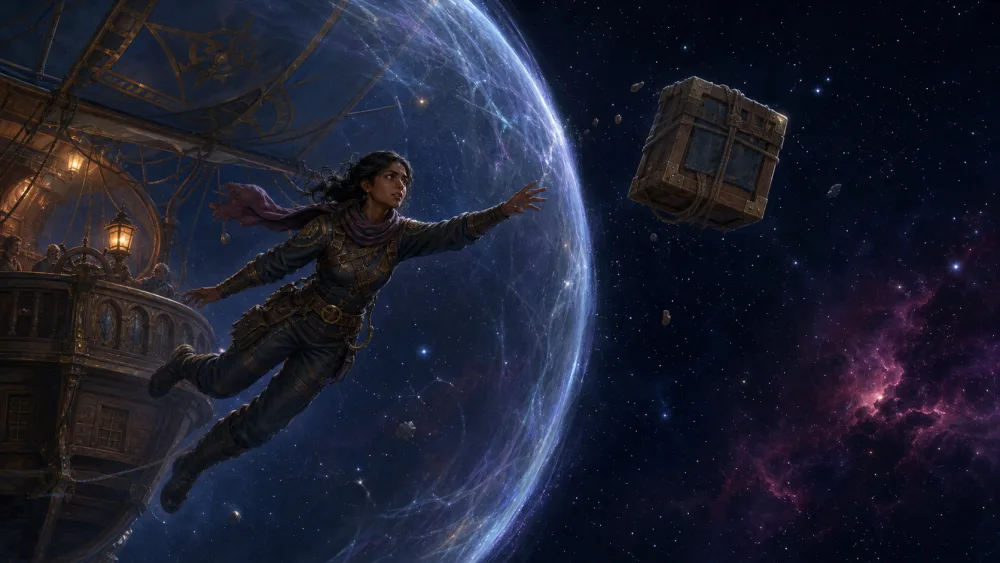
When a creature or object leaves a planet's atmosphere and enters Wildspace, an envelope of breathable air forms around it automatically and lasts until that air is depleted.
Creature envelopes take the shape of a cube centered on the creature, sized by the creature's own size category:
| Creature Size | Air Envelope |
|---|---|
| Tiny | 2.5-foot cube |
| Small or Medium | 5-foot cube |
| Large | 10-foot cube |
| Huge | 15-foot cube |
| Gargantuan | 20-foot cube |
A creature that needs to breathe exhausts the air in its own personal envelope in 1 minute, barely enough time to get anywhere, which is exactly why most Wildspace travel happens aboard a ship.
Object and ship envelopes extend outward from the object's surface a distance equal to its longest dimension. A 5,000-mile-diameter planet has a 15,000-mile-diameter atmosphere. A ship's envelope is ovoid and extends outward a distance equal to its own keel length in every direction, so a 180-foot nautiloid carries an envelope extending 180 feet on every side. A planet or moon's atmosphere is a special, self-replenishing envelope that never runs out on its own, which is why entering one is the standard way to refresh a depleted supply.
Air Quality: Fresh, Foul, Deadly
This is the actual clock a long voyage runs against:
- Fresh. Completely breathable. A ship's air envelope stays fresh for 120 days under a normal crew complement. Carrying more creatures than that complement burns through the fresh-air window faster.
- Foul. Stale, humid, and bad-smelling. Any creature that breathes foul air becomes poisoned until it breathes fresh air again. A ship's air degrades from fresh to foul on day 121.
- Deadly. Unbreathable. A creature that tries to breathe deadly air begins to suffocate on standard PHB rules. Foul air turns deadly 120 days later, around day 241.
Overlapping envelopes merge. When two bodies come close enough, their air envelopes combine, and the smaller body's air quality changes to match the larger body's. When they separate, each reclaims its own envelope at whatever quality it had before. A ship with foul air that enters a planet's fresh atmosphere becomes fresh again; that same ship merging with a deadly derelict's envelope afterward would turn deadly in turn. This is the fastest way to refresh, or ruin, a ship's air supply.
A worked timeline, using a normal-complement ship departing on day 0. Days 0-120, air is fresh, no mechanical effect. Day 121, air degrades to foul, and every creature aboard becomes poisoned the moment they next breathe it, staying poisoned until they reach a fresh source. Days 121-240, air stays foul unless refreshed. Day 241, air turns deadly and everyone aboard begins suffocating.
The obvious play is to place at least one port call within a normal voyage's first 120 days and treat the fresh-to-foul transition as a pacing valve rather than a punishment. A party that keeps pushing past day 121 without restocking is choosing that risk, not getting ambushed by an untelegraphed rule.
Gravity Planes
A planet or moon pulls everything toward its center, the same as a normal world. A smaller object, a ship above all, generates gravity from a horizontal plane cutting through it, extending as far as its air envelope reaches.
The two-directional quirk: a ship's gravity plane lets a creature stand upright on the underside of the hull, upside-down relative to everyone on the top deck, and walk around exactly as easily as someone standing on deck normally would.
Oscillation: an object or creature that falls off the side of a ship doesn't simply drop. It crosses the gravity plane, reverses direction, crosses back, and keeps oscillating until something stops it. Crossing a gravity plane this way deals no fall damage at all, a meaningfully different outcome from falling toward a solid surface.
Overlapping gravity planes stay independent until the two objects actually touch. At that point the ship with more current hit points overrides the other's plane entirely, suppressing it for as long as contact continues, and that ship's definition of "up" becomes the shared one. When a ship lands on a planet, its own plane is suppressed outright in favor of the planet's gravity, which means any deck on the underside needs its crew and cargo secured before landing, or they fall the moment the plane shuts off.
Drifting, Falling, and Weightlessness
Drifting. An unanchored creature or object floating inside a ship's air envelope is weightless and drifts toward the edge of that envelope at 10 feet per minute, until it exits and gets left behind as the ship moves on. An unconscious sailor who falls off the deck follows this same slow, quiet drift, which is Wildspace's understated version of a horror beat: nothing dramatic happens for several minutes, and then the ship is simply gone.
Falling. A floating creature that enters the air envelope of a larger body is immediately pulled by that body's gravity or gravity plane, falling to the nearer of the surface or the plane. Landing on a surface deals normal fall damage. Crossing a gravity plane deals none. Check what's actually beneath the falling creature before resolving.
Weightlessness brings two rules. Impeded Melee: a creature without a flying or swimming speed has disadvantage on melee attack rolls made with a weapon, unless that weapon deals piercing damage. A slashing or bludgeoning weapon doesn't connect the same way with nothing to brace against; a piercing thrust still works close to normally. Movement: a weightless creature can use an action to push off something heavier than itself and move up to its speed in a straight line, and keeps moving along that line on every subsequent turn until something stops it or changes its trajectory. There is no coasting to a stop.
Fire, Time, and the Astral Sea
Nonmagical fire cannot exist in the vacuum of Wildspace at all. No torch, no campfire, no burning oil. Magical fire does burn in a vacuum, so a cast fireball deals its damage as normal, but it does not ignite unattended objects, because there's no air to sustain that kind of spreading combustion. Magical fire in Wildspace is a direct, contained threat; it is never the start of a wildfire.
Time abandons the concept of a year almost entirely, since local orbital periods vary wildly and mean nothing to someone who spends most of their life on the Astral Plane. Astral travelers use a standard day of 24 hours, a standard week of 7 days, and a standard month of 4 weeks. Track a voyage against this convention rather than importing a home-world calendar.
The Astral Sea is the connective plane between Wildspace systems, which drift through the multiverse "like corks bobbing in water" so that no map can plot a fixed course between two of them. No ship is required to move through it: a creature can propel itself by pure will, flying at a speed in feet equal to 5 times its Intelligence score. Navigation is automatic, since thinking of a named destination immediately reveals the most direct route, though that says nothing about how safe the route is. A creature can survive indefinitely there without eating, drinking, or aging, the same rule that lets an Astral Elf or an Astral Drifter character plausibly be centuries old. Temperature stays at roughly a moderate summer day everywhere, though individual Wildspace systems can run hotter or colder near their own star; Krynnspace, home to Dragonlance's Krynn, is described as unusually cold with ice particles swirling in its vacuum.
Astral fishing is a minor downtime activity worth knowing: basic gear costs 1 sp at a Wildspace settlement and doesn't work aboard a ship moving faster than its flying speed. Once an hour, a DC 15 Wisdom (Survival) check determines a catch, rolling on a d10 table running from a Tiny inedible fish that poisons anyone who eats it up through edible fish feeding several people, a hostile space eel, and a hostile gray scavver.
What You Need to Survive Out Here
Three magic items and two spells cover the practical side, and none is strictly required.
Spelljamming Helm (wondrous, rare, attunement by a spellcaster). The item the entire setting runs on. See the ships section below; nothing else here moves without one.
Fish Suit (wondrous, very rare). A bulky full-body suit, 1 minute to don or doff, that lets you breathe in an airless environment and grants immunity to harmful gas effects. It also grants a swimming speed equal to your walking speed underwater, or a flying speed equal to your walking speed in zero gravity, a direct answer to the Impeded Melee and Movement rules above.
Wildspace Orrery (wondrous, uncommon). A portable arcane device that automatically tracks every sun, planet, moon, and comet within its current Wildspace system, projecting a live display with a pulsing light marking its own location. The practical navigation tool this subsystem doesn't otherwise provide.
Air Bubble (2nd-level conjuration; Artificer, Druid, Ranger, Sorcerer, Wizard). A 24-hour globe of fresh air around one willing creature's head, no concentration required, upcasting to two additional globes per slot level above 2nd. The cheapest slot-based answer to a failing air envelope. Full rating in the Best Conjuration Spells guide.
Create Spelljamming Helm (5th-level transmutation; Artificer, Wizard). Consumes a crystal rod worth 5,000+ gp to transform an unoccupied Large-or-smaller chair into a spelljamming helm. The cheapest legitimate way for a party to own a helm outright instead of buying one for roughly 7,500 gp. Full rating in the Best Transmutation Spells guide.
How This Compares to Overland Travel
A DM who's only run the PHB's overland travel rules will find Wildspace replaces almost all of it. There's no travel pace choice; a ship simply moves at its stated speed, up to 100 million miles in 24 hours while cruising, with automatic minor course corrections around debris. Foraging doesn't apply either, since a crew provisions before departure and there's no wilderness to hunt along the way.
What carries over conceptually is a resource clock running against the party regardless of what they're doing turn to turn. Overland travel tracks food and water; Wildspace tracks air quality. A DM comfortable narrating a supply countdown on a hex crawl has most of the instincts needed; the 120/120 numbers are the only new thing to internalize.
Hot Take: Track the air. Wildspace turns two things most tables never think about, breathable atmosphere and which way is down, into resources with numbers attached, and that is the whole reason a spelljamming voyage plays differently from an overland one. A DM who treats air as flavor is running a normal campaign with a ship-shaped set dressing.
Spelljamming Ships
A ship is the single item that makes the rest of the setting possible.
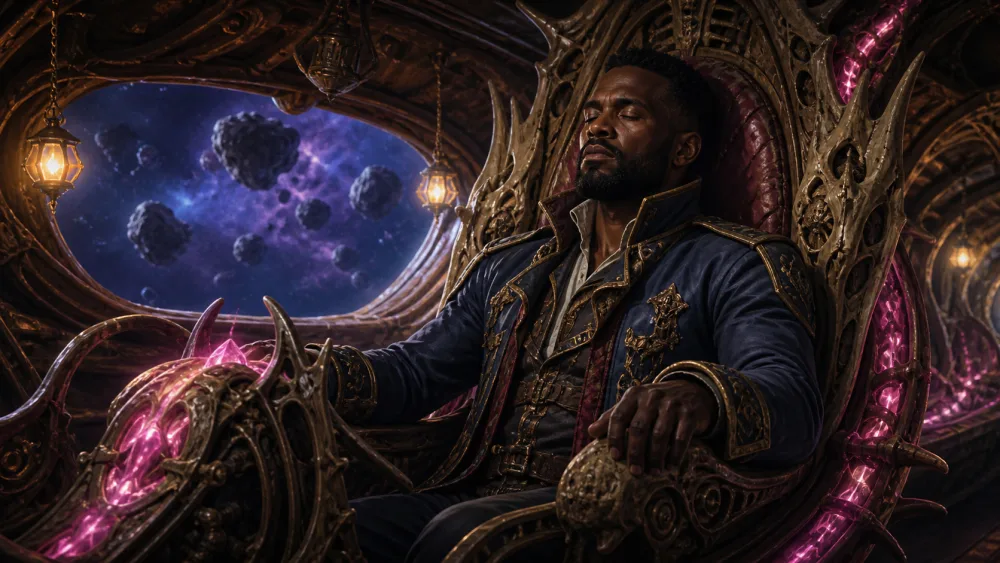
The Spelljamming Helm
A spelljamming helm is an ornate chair that propels and steers a ship of 1 ton or more through space, air, or water. While a spellcaster is attuned to a helm and sitting in it, maintaining concentration as if concentrating on a spell, they can move the ship up to its speed, steer it, and see and hear anything happening on or around the vessel from anywhere aboard. In open space with no ton-plus object within a mile, a ship under helm covers 100 million miles in 24 hours. Attunement transfers to a different willing spellcaster with an action, no ritual required.
Getting one costs real money. Buying from a Wildspace merchant (dohwar and mercane traders are the usual source) typically runs around 7,500 gp, more in a seller's market, sometimes 10,000 gp or higher for a desperate buyer. The cheaper route is Create Spelljamming Helm, which consumes a crystal rod worth 5,000+ gp. Keep those two numbers straight; conflating them mid-campaign creates an economy that doesn't hold together.
Only one helm operates a ship at a time, even if a ship carries several. If a second spellcaster tries to seize control using a different helm aboard the same ship, a spelljammer duel breaks out: both make a Constitution check, the loser takes 1d4 levels of exhaustion, their attunement ends immediately, and they can't attune to any helm again until every level of exhaustion clears. It's a single check with no attack rolls or damage, a fast tense moment rather than a multi-round fight.
Crew and hiring. A standard complement is one captain, one spelljammer to pilot, and one or more crew to work the weapons. Extra troops, backup spelljammers, or passengers beyond that complement all count against the ship's air supply, degrading its envelope faster than the baseline above. Hiring a spellcaster to sit the helm typically costs at least 50 gp per day.
Ship-to-Ship Combat
The combat rules are built to be simple rather than exhaustive, and they bypass several assumptions from standard PHB combat.
Starting distance is set by the DM from three standard options: 250 feet (long range for most ranged weapons including ballistae and crossbows), 500 feet (beyond ballista and crossbow range, still long range for longbows and mangonels), or 1,000 feet (beyond the range of most ranged weapons entirely). A shorter start gives crews less time to load and prepare.
Initiative uses the DMG's side initiative variant, one roll per side rather than tracking every individual crew member.
Moving and steering costs the spelljammer nothing. On their turn the attuned spellcaster decides how far the ship moves and whether to close or open distance, without spending their own action or movement. A ship can also turn freely on its turn so every weapon can bear on any target in range, regardless of where it's mounted.
Boarding requires maneuvering within 5 feet of the target ship, at which point creatures can move freely between decks until one ship pulls away. A boarding party that took the Ready action can disembark the instant a ship pulls alongside and then departs again.
Crashing is a deliberate ramming action: the spelljammer makes a special attack roll (1d20 plus proficiency bonus) against the target's AC. A hit means both the ramming ship and whatever it struck take bludgeoning damage scaled to size (4d10 Large, 8d10 Huge, 16d10 Gargantuan), or damage applies only to the ship if it hit something with no hit points, like a planet. A miss means the target dodges. After a crash, check whether the struck ship's gravity plane gets suppressed per the overlapping-planes rule above; creatures aboard fall if it does.
Shipboard weapons are a last resort, not a first option. Ballistae and mangonels are slow to load and fire, and the book states plainly that player characters are almost always better off using their own weapons and spells. Reserve shipboard weapons for a target too far away to reach any other way. This single line changes how a table should actually run a space battle.
Repairs cost 20 gp and 1 day per hit point for a berthed hull, or 10 gp per hit point for shipboard weapons at the same pace. The mending spell is the fast alternative: 1d8 plus the caster's spellcasting modifier restored, capped at once per hour per target.
A Worked Engagement
- The DM sets starting distance. A hostile ship appears at 500 feet, close enough that longbows and mangonels are in long range, far enough that ballistae can't reach yet.
- Roll side initiative. One roll for the party's ship, one for the hostile ship.
- On the party's turn, the spelljammer closes distance for free. Closing to 250 feet puts both sides' ballistae in range.
- Player characters act within their side's turn, using their own weapons and spells rather than waiting on a slow-loading mangonel.
- The hostile spelljammer decides whether to crash. A hit means both ships take damage scaled to size, and the DM checks whether either gravity plane gets suppressed. If it does, anyone standing on the affected side may start falling.
- If the ships close within 5 feet, boarding becomes possible. Anyone who took the Ready action crosses immediately, shifting the fight into normal PHB combat.
- After the fight, repairs happen at a berth or immediately via mending if a caster is available and the ship needs to move.
Two initiative rolls instead of a dozen, movement that costs the pilot nothing, and combat that mostly still runs through each character's own weapons and spells rather than a separate minigame.
The Sixteen Ship Types
Descriptions are qualitative, by role, builder, and environment fit. Look up Armor Class, hit points, cargo, and cost directly in the book when you need them at the table.
Bombard. Built by giff, defined by a single enormous cannon capable of carrying fourteen 10-ton cannonballs, loaded via an aft-mounted winch. Floats and sails on water but can't land on solid ground. The heaviest single-weapon platform in the book.
Damselfly. Swift, cramped, mostly metal. Can't float on water but lands safely on the ground thanks to its legs. Favored as a courier vessel and armored transport by explorers, pirates, and military commanders alike.
Flying Fish. The second-most common vessel in Wildspace after the space galleon, and a favorite of merchants and adventurers. Floats and sails but can't land on the ground without snapping its ventral fins. A forward mangonel and aft ballista are standard.
Hammerhead. Popular with pirates and heavy-cargo merchants alike. Floats but can't land without tipping over. Armed fore and aft with mangonels, a ballista, and a reinforced ramming bow.
Lamprey. One of the oldest designs still flying, a favorite of psurlons. Its metal grappling jaws let it physically latch onto another ship during boarding, a real tactical tool rather than flavor. Floats, but has a habit of rolling over if it tries to land.
Living Ship. Built around a fully grown treant rooted permanently into the aft deck, its speed reduced to 0 since it and the ship are inseparable. The treant dies of shock if the ship drops to 0 hit points, and can never be replaced if it dies first, though the ship functions without it afterward. When the treant finishes a long rest, it repairs the hull. A natural draw for druids, rangers, and nature-devoted clerics.
Nautiloid. Built and used exclusively by mind flayers, designed purely for space travel with no water or ground landing. Its signature feature is a plane-shifting property: an attuned creature in physical contact can, as an action, transport the ship and everyone aboard to a different plane entirely. Rolling 5 or 6 on a d6 afterward recharges it in a minute; otherwise it's locked out for 24 hours.
Nightspider. Built by neogi specifically for ambush, ferrying roughly nineteen neogi plus up to half a dozen umber hulks as shock troops. Their standard tactic is to identify a target, then steal its spelljamming helm and capture its crew outright. Built purely for space; its legs would snap under the ship's own weight on the ground.
Scorpion. An archaic metal warship that never went out of style, largely for its versatility. Articulated legs let it walk across solid ground at a full 30-foot speed, though it can't float. Armed with a top-deck ballista and tail-mounted mangonel, plus two claws that are mediocre in a straight fight but excel at snatching a target out of action.
Shrike. A relatively recent, fast design gaining popularity with merchants and pirates. Lands safely via its legs, floats but sinks fast in rough water. Three ballistae cover fore, mid, and aft, and its reinforced bow doubles as a ram.
Space Galleon. The single most common vessel in Wildspace, built to pass for an ordinary seafaring galleon and land on water the same way, which lets it dock at a terrestrial port without drawing attention. Like a real galleon, it isn't built to land on solid ground.
Squid. One of the oldest designs, a favorite for privateers and patrol duty. Its bow tentacles account for nearly half the total keel length, doubling as a ramming feature alongside a forward mangonel and two aft ballistae. Unusually flexible for an old design: it floats, sails, and lands without issue.
Star Moth. Constructed and flown by astral elves, who don't take kindly to seeing one in anyone else's hands. Built from a grown, sculpted organic hull with crystal wings, and despite being designed for space, it also floats and lands. Two ballistae sit in the eye-hole sockets, with a mangonel above the bridge.
Turtle. Metal-shelled, roomy, and cargo-heavy, a favorite among traders. Lands and floats, and sliding panels can seal the hull airtight for real underwater travel to depth, with interior hatches sealing off flooded sections if it takes damage submerged. Its three forward ballistae and rear mangonel go silent underwater.
Tyrant. Carved directly out of stone by beholders using their own disintegration rays, meant for wandering the Astral Plane hunting worlds to conquer and rival beholders to destroy. No two look alike. Its spherical helm chamber only accepts attunement from a beholder, and reducing the ship to 0 hit points destroys the helm and its eyestalk cannons along with the hull. Lands but can't float.
Wasp. A lightweight wooden ship that lands but doesn't float, prized for being affordable and crewable in small numbers. Adventurers like the price, pirates like the speed, and aristocrats like converting its cargo hold into a private flying yacht.
Choosing and Acquiring a Ship
Landing capability is the first filter. Damselfly, Scorpion, Shrike, Squid, Star Moth, Turtle, Tyrant, and Wasp all touch down safely on solid ground. Space Galleon and Flying Fish land on water only, which matters if your home base is coastal rather than landlocked. About half the sixteen can't land on solid ground at all, so check the specific ship before writing a scene around setting down outside a dungeon entrance.
If you want to blend in at a terrestrial port, Space Galleon is purpose-built for it and nothing else on the list does it as cleanly. If budget is the binding constraint, Wasp is explicitly called out as affordable and low-crew, the most realistic first ship. For a combat-focused campaign, Bombard for raw single-target burst, Nightspider or Tyrant if the party is the aggressor, Hammerhead or Squid for a balanced ram-and-shoot loadout.
There are three paths a campaign lands on for acquisition. Buy one outright, gated by the hull's cost plus roughly 7,500 gp for a helm. Craft the helm and find or build the hull, which cuts the helm cost to a 5,000+ gp crystal rod but still needs a hull. Inherit, salvage, or win one, which is the most common route in practice: a derelict recovered and repaired, a prize won from a defeated enemy, or a patron's gift with strings attached.
Whichever route, the cost doesn't stop at acquisition. A hired spelljammer's 50 gp/day fee, repairs after every serious fight, and crew upkeep all become recurring expenses. A ship-owning party changes the shape of a campaign more than almost any other acquisition: it becomes a mobile home base, a resource to protect, a target other factions want to steal or sink, and a setting piece a DM can build whole sessions around.
The Rock of Bral
The Rock of Bral is the boxed set's one fully detailed location: a mile-long asteroid city bisected by its own gravity plane, home to traders, pirates, nobles, and one very effective mind flayer smuggler nobody's supposed to know about.
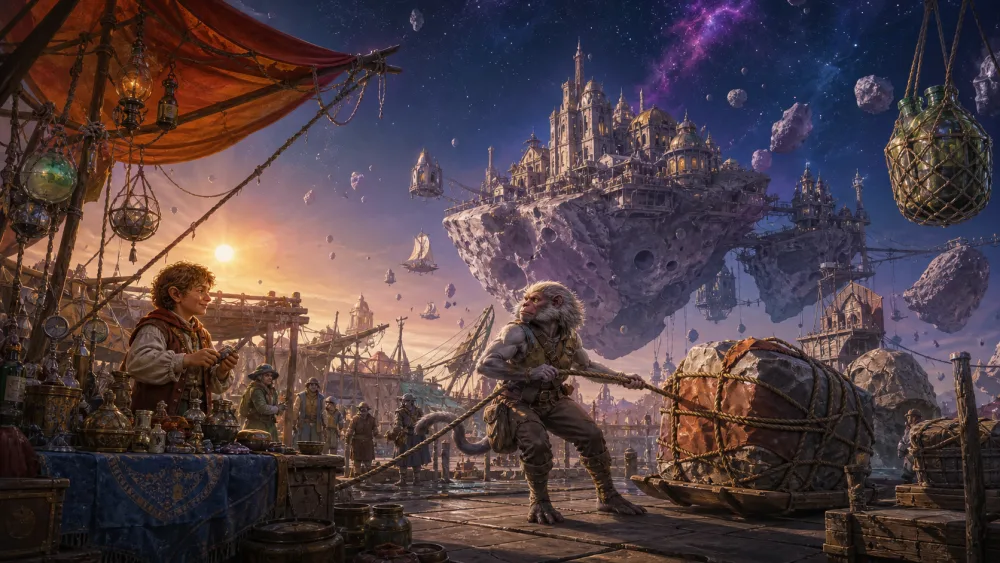
Bral is roughly 1 mile long, half a mile wide and deep, with a leading edge where most ships dock and a trailing edge. A gravity plane bisects its length, splitting it into a topside (the city proper) and an underside (military territory, closed to the public). Between the two runs a half-mile network of caverns carved out by the pirates and smugglers who founded the place.
History in brief. Captain Bral founded the asteroid as a pirate refuge roughly 170 years ago. Over decades of lawless rule, merchants slowly moved in until Prince Cozar, a former pirate captain who saw the winds shifting, consolidated power and declared himself the Rock's first overlord. His son Frun was a hedonist figurehead remembered mainly for renovating the palace and building the Arena that bears his name, and Frun's son Calar ruled only days before dying under mysterious circumstances, found floating just beyond the Rock's air envelope.
Prince Andru and the Court
Calar's younger brother Andru took the throne, publicly punishing a group of alleged culprits with arrest and execution within days. What the book reveals, as DM-facing information rather than something any NPC volunteers, is that Andru secretly orchestrated his brother's murder himself. He's 44, slender and graceful, self-serving, and utterly convinced the ends justify the means. His throne isn't unshakeable: rival factions would rather see a weaker leader or an easily-influenced council in charge, which keeps him playing a careful ongoing political game.
His inner circle includes Proconsul Gadaric Main, his chief advisor, the stereotypical elderly court wizard, hot-headed and not entirely reliable, and Captain Mahaxara Khal, the tall, athletic captain of the Royal Guard, marked by snake tattoos and unwavering loyalty to House Cozar, though she has no taste for courtly intrigue herself.
The Four Underbarons
Each underbaron runs a criminal fiefdom equivalent to a thieves' guild, and each one's businesses operate under that underbaron's protection in exchange for insurance fees, reciprocal in practice, since an underbaron who fails to reimburse a client for a rival's damage loses standing fast. Prince Andru tolerates all four specifically because they check each other's ambitions.
- Ozamata, lawful evil human, controls the docks and most of the Low City.
- Meredin Sandyfoot, neutral good halfling, headquartered in the Burrows, holds sway over the city's craftspeople.
- The Juggler, chaotic good elf, real name Kiria Evensong, oversees a network of swindlers and minstrels from the Juggler's Folk Guildhouse, a backstreet theater she also performs in under her stage identity.
- The Unknowable One, a mind flayer operating from the caverns between topside and underside, specializing in smuggling. This underbaron breeds intellect devourers and plants them as spies among ordinary Bralian citizens, the single most unsettling thread running under the city, and one most residents have no idea exists.
The Wards
High City rises on the trailing edge, green, spacious, and home to the nobility. Starhaven, Andru's palace, crowns the highest point, domed and vine-draped, its windows magically shatterproofed. Lake Bral fills a chasm that extends clean through the gravity plane, giving the lake two surfaces, one topside and one in a cavern deep inside the Rock; when the water runs low every few years, the navy tows in an ice asteroid and breaks it up. Other landmarks: the Festival Grounds and Arena of Frun, the Library of the Spheres (a vast non-magical archive whose contents never leave), the Man-o'-War restaurant and inn (weapons-free by dress code, managed by a hadozee named Shrii Ballek), the Royal Theater Company, and the Temple District, where priests cast helpful spells for a donation: Commune 1,000 gp, Legend Lore 1,500 gp, Lesser Restoration 150 gp, Remove Curse 2,000 gp, and Scrying 250 gp among them.
Middle City is the financial and mercantile heart, home to residents who can afford to live outside the Low City but lack High City standing. The Great Market is its chaotic commercial hub. The Donjon, a walled fortification by the lakeshore, holds prisoners judged too dangerous for the underside's labor fields, run by a plasmoid boss named Ux. Notable businesses include the Edge (a huge tavern tended by a chatty thri-kreen mystic named Vikka), Elmandar's Star Charts (300-800 gp per map, free lifetime updates), Gaspar's Reclamations (a recovery firm for lost magic items), the Juggler's Folk Guildhouse, the Red Masks Guildhouse (a violent youth gang frequently clashing with the Juggler's Folk), the Mages' Guildhall, the Sindiath Line (charter passage across Wildspace), the Smith's Coster (the Rock's largest merchant company, trading weapons technology into cultures that lack it), and Valkan's Legion (the largest non-crown military force on the Rock).
Low City is the city's beating heart, choked with peddlers, beggars, and thieves at all hours, home to most of Bral's taverns and workshops alongside a startling number of vacant buildings. New arrivals disembark here at the Docks on the leading edge. Landmarks: the Happy Beholder (a prosperous, trouble-free tavern owned by Large Luigi, a lawful neutral beholder with zero political ambition), the Lesser Market, the Mercane Agency (a discreet outpost where mercanes broker helms and magic items through human intermediaries), the Rockrat (the filthiest tavern on the Rock, run by a friendly wererat named Maya), and Xenotermination, Ltd. (combat specialists who hunt formidable Wildspace creatures and occasionally recruit outside talent, a built-in adventure hook). Three historic enclaves cluster near the docks: the Burrows, a warm halfling neighborhood that greets new arrivals with bread and directions; the Dwarven District, known for its craftwork; and Gifftown, where giff residents swap war stories and occasionally settle disputes with marksmanship contests.
The Underside is off-limits and run entirely by the military. Most of it is farmland worked by convicted prisoners under loose army supervision, growing the food that keeps the city fed without imports. The Citadel commands the Rock's army, with Port and Starboard Towers connected by covered walkways, all bristling with ballistae and mangonels. The Naval Base berths the royal fleet, with two or three ships always ready to deploy. The Vanes, four enormous sails on the trailing side, adjust the Rock's rotation when needed. Anyone caught here without authorization is assumed to be a spy or an escaping prisoner.
Running a Session on the Rock
There is no city watch patrolling the streets. Most citizens police themselves: tavernkeepers hire muscle, vendors watch for shoplifters, everyone guards their own purse. Serious crimes can be reported voluntarily to one of three magistrates, who dispatch the Magistrate's Watch only if they judge the situation worth it. This makes Bral's justice system a poor tool for a party that wants quick official recourse, and a much better tool for a DM who wants players to solve their own problems.
Start every new arrival at the Docks, not the palace. The city's own geography routes arrivals through the Low City first, which means a party's introduction is naturally the busiest, least glamorous part of town. High City's calm is a contrast worth earning by climbing the city's social geography.
Let the underbarons' rivalry do worldbuilding for you. The Juggler's Folk and the Red Masks are in open conflict; the Unknowable One's operation is secret from the other three as well as the crown. Dropping a party into an existing rivalry keeps the city feeling lived-in.
Treat the Unknowable One as a long-game threat. A mind flayer quietly breeding intellect devourers and turning citizens into unwitting spies rewards patience: background rumors, a friendly NPC who starts acting subtly wrong, a smuggling job moving something far worse than contraband. Save the reveal for when the party has enough investment in the city to feel the loss of a compromised NPC.
Give the crown a reason to notice the party. Andru would rather recruit a capable, unattached group than make enemies of one, so a party doing something visibly useful is more likely to draw a summons from Starhaven than a confrontation.
Denizens of Wildspace
Wildspace is populated, and this section covers who a party meets out there, grouped by what a DM needs them for. Everything here is lore and table-use framing; no stat blocks, Challenge Ratings, or combat numbers, which live in Boo's Astral Menagerie itself.
Slavers and Predators
Neogi look like an oversized spider fused with an eel's neck and head, and they're built entirely around domination, poisoning both body and mind to subjugate creatures physically stronger than themselves. Neogi once dominated umber hulks outright, using them to build the nightspider ships that still bear their signature. Their society has no concept of individuality beyond one's ability to control others and no functional grasp of loyalty; adults mark themselves and their captives to signal rank. Its grim endpoint: an aged neogi gets overpowered and poisoned by its own kind, transformed into a bloated mass that younger neogi lay eggs on, and the hatchlings devour the old neogi and each other until only the strongest survive. Treat a neogi encounter as adversarial by default.
Vampirates are the risen dead of pirates who refused the afterlife, gaunt and milky-eyed, still crewing ships and plundering the unwary. Unlike a classic vampire, a vampirate doesn't drink blood; instead they drain life energy directly by touch or from a short distance, looking healthier as they feed without ever looking fully alive. They eat, drink, and sleep by choice, and rest in coffins or grave dirt when available.
Scavvers are shark-like void scavengers that trail larger creatures and ships to feed on refuse, riding inside a host's air envelope to keep pace. Brown and gray scavvers are mostly nuisances. Night scavvers invade a ship's envelope outright to attack the crew on deck, and are apparently good eating themselves. Void scavvers are the most dangerous: solitary, pitch-black, willing to go after whoever's cooking rather than waiting for scraps, with an eye-borne fear ray that makes an encounter considerably worse than its size suggests.
Feyr are tentacled horrors that feed on strong emotion, preferring to devour nightmares from sleeping victims to minimize risk to themselves. A feyr that finds a ship tries to stow away inside its air envelope, staying invisible until it can strike an unguarded sleeper, retreating rather than risk dying in a real fight.
Neh-thalggu, known as brain collectors, hail from the Far Realm but have spread through the Astral Plane in search of the Humanoid brains they consume to fuel their own magic. Cosmic horrors round out the category as the far end of the threat scale, vast ancient Aberrations the book leaves largely to a DM's imagination.
Merchants and Neutrals
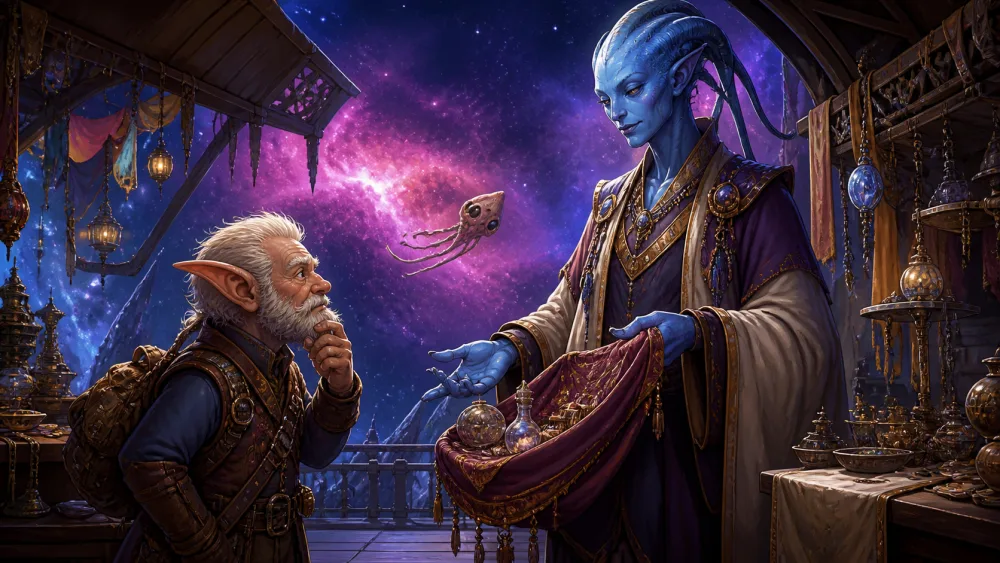
Mercanes are the setting's premier magic-item traders: 12-foot-tall, lanky, blue-skinned giants in elegant robes, dealing in artifacts and spelljamming helms alike. They deal fairly and reliably with anyone who hasn't harmed or swindled another mercane, the catch being their private multiverse-spanning telepathy, which spreads word of a bad actor to every mercane instantly. Getting back into a mercane's good graces afterward is described as next to impossible, which makes a first deal a lasting asset or liability.
Dohwar are short, pudgy, flightless avian merchants who look and move like penguins, conducting business in secrecy even when nothing illegal is involved; a group is called a cartel. They communicate through a telepathic merging that links two dohwar and a third willing party, worship an entirely commerce-focused pantheon, and were the ones who first sold spelljamming helms to the space clowns.
Chwinga are tiny, gentle elemental nature-spirits who consider themselves humble custodians of the natural world. They normally avoid other creatures but find civilization's trappings endlessly fascinating, and will shadow a creature that catches their interest before occasionally bestowing a small magical gift and moving on. In Wildspace, chwinga astronauts live on habitable moons, sometimes stowing away on ships or riding space guppies.
Kindori resemble enormous mouthless whales with light-emitting eyes along their leading edge, used both for long-distance communication and for drawing sustenance directly from starlight. Large enough to generate their own air envelope and gravity plane, a kindori functions as a small mobile ecosystem, with mosses and parasites growing on its surface attracting scavvers to clean them off. Its bones don't decay after death, and a skeleton fitted with a helm can become a ship in its own right.
Empires and Raiders
Githyanki dominate this category as tall, gaunt, psionically potent natives of the Astral Plane, most famously the followers of the Lich-Queen Vlaakith who raid into Wildspace for magic and riches. This book adds three archetypes: buccaneers, warriors who abandoned Vlaakith's service to live by their own code; star seers, who believe the stars are literally the eyes of the multiverse and spend centuries contacting ancient stellar entities; and xenomancers, explorer-scholars who catalog unfamiliar creatures, shifting between diplomacy and survival instinct depending on how first contact goes.
Mind flayers command the other major faction from behind the wheel of a nautiloid. They've also been known to ally with psurlons, splitting a shared meal (illithids take the brains, psurlons take the rest), an alliance githyanki despise enough to actively raid psurlon strongholds wherever they're found.
Giff mercenary companies are a very different kind of power, not an empire but a martial culture whose spacefaring branch organizes every aspect of society along military lines from birth to death, with promotions earned through valor rather than seniority. Regiments specialize in muskets and grenades, and shock troopers soften a target with firearms before closing to melee.
Hadozee crews are a common sight aboard non-hadozee ships, frequently hired as mercenary crew for their climbing and gliding ability. An experienced spacefaring hadozee can dive off one side of a ship, glide beneath the keel using the vessel's own gravity plane, and surface fighting on the opposite side entirely.
The Genuinely Strange
Reigar are humanoid-shaped descendants of an octopus-like species, marked by bioluminescent freckles, shifting skin color, and a magical halo of glittering motes that doubles as armor. They destroyed their own home world in a war they call the Master Stroke, the culmination of a shared belief that warfare waged beautifully enough is the highest form of art, and have distrusted each other ever since. They now wander seeking artistic inspiration aboard esthetics, symbiotic organic ships they grow themselves, each reigar bound to a unique magic item called a talarith that only its creator can use.
Psurlons are ancient wormlike Astral Plane natives who live for thousands of years, leaving their strongholds roughly once a century to invade a Wildspace system and hold a seven-year ritual called the Feast of Worlds. A psurlon that dies gets its corpse stored by its kin, who lay eggs inside it; the hatched worms devour the corpse and each other until a single survivor emerges as a new adult. A psurlon ringer can consume and psionically assume the exact appearance, memories, and languages of a specific person, permanently, reversible only by a wish spell.
Aartuks are intelligent, war-loving plant creatures shaped like a five-pointed star, covered in flexible bark, whose homeworld was destroyed by beholders. The survivors roam in small nomadic war-bands, sometimes aboard ships taken by force from murdered crews. Their entire language is built from rustling, snapping, and hissing sounds with no written form.
Space clowns are a cautionary tale as much as a monster. They descend from an entire human population on the ring-shaped worlds of a system called Clownspace, whose worship of a god of revelry spiraled into addiction to a demonic-ichor elixir called Thrill Joy, which slowly transformed the faithful into fiendish, clown-appearing creatures. They acquired their first helms from dohwar traders, and their spread has left both fear and a strange cultural fascination in its wake.
Zodars are bipedal, obsidian-armored entities of unknown origin who interact with other creatures through prolonged, expressionless silence. A zodar can be provoked into speaking only a handful of times across its entire existence, and when it finally does, the message is treated as profoundly significant precisely because it happens so rarely.
Lunar and Solar Dragons
Fizban's Treasury of Dragons owns dragon mechanics and campaign-role framing generally; see the dragon types guide and running dragons guide for that system. This book adds two families as Wildspace natives, outside Fizban's own twenty.
Lunar dragons (also called moon or phase dragons) are xenophobic and capricious, burrowing lairs directly into desolate moons. Before laying eggs, a female stocks her lair and won't leave again until the offspring can fend for themselves; hatchlings are alabaster white and darken with age until an ancient lunar dragon is the color of slate. What sets them apart temperamentally: a lunar dragon takes more pleasure in denying other creatures treasure than in acquiring it, and its hoard often includes spelljamming helms seized from ships that entered its territory.
Solar dragons (also called radiant or sun dragons) are born inside stars, serpentine and finned, with luminous nebulous wings and multicolored scales, able to see clearly in blinding light. In the airless void they prize food over treasure, hunting kindori and scavvers, and a solar dragon that mistakes a distant ship for prey will veer off once it realizes its error, provided nobody opens fire first. Territory scales with age: a young solar dragon might claim an asteroid belt, an ancient one an entire system.
Using These Denizens at the Table
Predators work best as a countdown, not a surprise. Feyr and vampirates both prefer to strike from concealment and retreat rather than fight openly. The tension comes from a party realizing something has been aboard their ship for a while. Drop small escalating signs before the reveal.
Merchants create better long-term stakes than combat encounters. A mercane's reputation network and a dohwar cartel's secrecy both mean a single early interaction can pay off, or cost, sessions later.
The genuinely strange work better under-explained. The book leaves zodar origins and cosmic horror motivations deliberately vague. A DM who explains too much turns an unknowable entity into just another monster with a backstory.
Dragons anchor a region, not a single encounter. A lunar dragon's moon-lair or a solar dragon's system-wide territory both work better as a standing feature of a system a party returns to.
Running a Wildspace Campaign
Spelljammer's real DM question isn't how the rules work. It's what to do about everything the box doesn't give you.

What the Boxed Set Actually Gives You
Three 64-page books: the Astral Adventurer's Guide (character options, wildspace and ship rules, one detailed city), Boo's Astral Menagerie (a creature roster plus astral-conversion tools and encounter tables), and Light of Xaryxis (one complete adventure). Concretely: six new races, two backgrounds, a full travel and ship-combat subsystem, forty-plus creatures, and one fully detailed location. That's a real, substantial amount of usable material, and it is also, deliberately, not a complete setting.
What it doesn't give you is a gazetteer of Wildspace systems. No star maps, no named worlds beyond the two built for the included adventure, no default cosmology of where your campaign sits relative to everything else. A DM opening this box expecting the same ready-to-run world atlas that Eberron or Theros provides will not find one.
Choosing a Campaign Tone
The rules stay the same no matter what tone you run, which means the DM, not the book, decides what kind of campaign this is.
Exploration-first. The party charts a system world by world, with the air-quality clock and gravity-plane oscillation doing quiet background work as real hazards rather than combat set pieces. This rewards a slower pace and treats the missing gazetteer as an asset: there's nothing already written to contradict, so anything the party discovers is first-discovery by definition.
Political and mercantile. Built around a home base like the Rock of Bral, leaning on its underbarons, magistrates, and merchant houses for a campaign about factions, trade routes, and reputation. Ship ownership matters less here than relationships do.
Pulp-action. The tone Light of Xaryxis itself demonstrates: fast, campy, cliffhanger-driven, closer to a serialized adventure than a sandbox. Works well as a shorter structured arc, and is the easiest to run straight out of the box.
Most real tables end up blending all three: a political home base, occasional pulp set pieces, and exploration whenever the party pushes into an unmapped part of a system.
Building the Gazetteer Yourself
The book names exactly two example systems, Doomspace and Xaryxispace, and both exist specifically as settings for the included adventure. Building your own is straightforward: a sun, a handful of planets and moons, and a rough sense of travel time between them. You don't need to detail every world before your first session. Detail the one or two your party will actually visit, and expand outward as the campaign demands.
- Reuse an existing campaign world as your first system's centerpiece. If your table already has a Forgotten Realms, Eberron, or homebrew world, that world becomes one planet in a system you build around it.
- Give your system exactly one home-base world or station first, whether that's the Rock of Bral or a world of your own design.
- Populate distances loosely at first. Relative distance matters more than exact mileage; "a few days at cruising speed" is often enough for an early session.
- Let the denizens above fill in who's already out there before inventing your own factions from scratch.
Building an Encounter Roster
Boo's Astral Menagerie gives two direct tools. The Unusual Nature trait converts practically any terrestrial creature into a space-dwelling one by granting it independence from air, with the DM deciding whether it needs an air envelope of its own. Your existing monster knowledge doesn't go to waste the moment a campaign leaves the ground.
The Wildspace, Astral Sea, and Ship Encounters tables generate a random encounter appropriate to where the party currently is, including rolling up a specific ship type and crew for a ship-to-ship encounter. Use these as a prep shortcut, not as your only encounter design method: a roster built entirely from random tables feels randomly assembled rather than intentional.
Placing Wildspace Over an Existing Campaign
This is the single most common way the setting actually gets used, and the book supports it explicitly. Your existing world doesn't disappear; it becomes one world inside its own Wildspace system, reachable and leaveable by ship or via the Astral Sea. A party that's spent a year adventuring in a homebrew kingdom can discover their world sits inside a crystal sphere, board a ship, and keep every NPC relationship and unresolved plot thread they already built while gaining an entirely new axis of travel.
- Decide the trigger. A found spelljamming helm, a crashed ship, an NPC offering passage, or a plot hook that requires leaving the world entirely.
- Treat your home world's geography as already-known territory. Entering Wildspace adds a layer above it rather than erasing what the party knows.
- Introduce one new system feature at a time. Air envelopes and gravity planes matter immediately; weightlessness and drifting can wait until they actually come up.
- Use the Rock of Bral as a soft landing, giving the party a stable base while the rest of the system stays under construction.
The Shape of Light of Xaryxis
Described structurally only. It's a four-part, twelve-chapter campaign for characters starting at 5th level and advancing to 9th, each chapter designed to run as a single 2-to-3-hour session, each ending on a cliffhanger. The book is explicit about its inspiration: 1980s pulp science fiction in the vein of Flash Gordon, campy and fast-moving rather than slow-burn intrigue. Running it well means leaning into that tone deliberately.
Treat it as an example of what a Spelljammer adventure can look like, not a template you're obligated to follow. A homebrew campaign built along the placement guidance above doesn't need pulp-serial pacing to work.
Final Verdict
Spelljammer's rules, wildspace travel, ship combat, six new races, two strong backgrounds, are solid on their own merits, and the Rock of Bral is one of the best-detailed single locations in any recent 2014-line sourcebook. What it isn't is a complete, ready-to-run setting. The gazetteer gap is real, it's the thing every review mentions first, and no amount of enthusiasm for the rules changes that.
Buy this if: you want strong, usable mechanics for space travel and ship combat, a real standout campaign home base, and you're willing to build or borrow the rest of the setting yourself.
Skip or wait if: you specifically want a complete, pre-built sandbox setting with a full star map handed to you. That expectation will not be met, and no amount of DM effort changes what's printed on the page.
Common Mistakes
- Assuming a Spelljammer race requires a Spelljammer campaign. None of the six has any mechanical dependency on Wildspace-specific rules. An Astral Elf, a Giff, or a Plasmoid plays identically in a ground-based campaign.
- Building Hadozee from an old source. This is the one race where outdated information produces a mechanically wrong character sheet, not just a stylistically dated one.
- Sourcing githyanki to this book. The lore connection is real and explicit; the playable race option is not here.
- Treating every fall as harmless because "it's Wildspace." Only a fall across a gravity plane skips damage. A fall toward a solid surface deals normal damage.
- Forgetting weightlessness applies the instant gravity is absent, including inside a ship whose gravity plane has been suppressed by a landing or a colliding vessel.
- Assuming a party needs a ship for every Astral Sea crossing. Thought-propelled travel at 5 feet per Intelligence point is a rules-legal option, not flavor text.
- Running the air-quality clock as an always-ticking hazard. The 120/120 windows are long enough that most campaigns refresh well before day 121 through normal port calls.
- Running shipboard weapons as a party's primary combat tool. The book is explicit that they're slow and usually worse than a party's own attacks and spells.
- Forgetting the spelljammer moves the ship for free. Movement and steering cost nothing, freeing the pilot to also act normally, concentration permitting.
- Assuming every ship can land anywhere. About half the sixteen types can't touch down on solid ground, and a couple can't float either.
- Ignoring crew complement when calculating air quality. This matters most when a party picks up passengers, prisoners, or refugees mid-voyage.
- Treating Bral like a lawless free-for-all. It's self-policing plus a slow, discretionary official system layered on top, not chaos.
- Revealing Prince Andru's secret through an NPC too early. The book presents it as information the DM knows, not something any in-world character casually possesses.
- Trying to detail an entire Wildspace system before session one. This is the most common way DMs burn out on this setting before it starts.
- Treating the gazetteer gap as a flaw to apologize for. An intentionally thin setting is creative space, not a placeholder waiting to be filled with "real" content.