Introduction
A dragon's lair is not just the room where the boss fight happens, and a dragon's hoard is not just a loot table. Fizban's Treasury of Dragons treats both as direct extensions of a dragon's own magical power - the size of a hoard tracks a dragon's age and strength, a lair generates atmospheric regional effects for free, and plundering the wrong pile of gold can measurably weaken a dragon before the party ever draws a weapon. This guide covers how to build both pieces without reaching for a single random treasure roll you don't understand.
Direct answer: Scale a dragon's hoard to its age first (a wyrmling has a few hundred gold pieces, an ancient dragon can hold millions), then decide whether the lair itself deserves atmospheric regional effects (free, no challenge rating cost) or added lair actions (a real power increase for a dragon that doesn't already have legendary actions). Everything else - hoard curses, linked caches, plundering consequences - builds on top of that age-and-size foundation.
Where Dragons Build Lairs
Young dragons establishing a first lair are drawn, consciously or not, toward sites of existing magical resonance rather than picking an arbitrary cave. The book frames this as dragons seeking out places where the world's own magic already pools: a spot where several ley lines intersect, the crash site of an ancient meteorite, a location where a lost magocratic empire once saturated the land with spellcraft, or a site with some other unusual, pre-existing feature. A handful of examples the book suggests: a climate anomaly (a cool oasis inside a hot desert, a warm spring inside a frozen tundra), a wild-magic zone where spellcasting occasionally triggers a Wild Magic Surge, natural rock formations that align with celestial events on solstices or equinoxes, or a site where a god or titan's remains lie buried.
None of this is required - a dragon can lair anywhere it wants - but tying a new lair to one existing point of magical interest gives a DM a built-in reason the location matters beyond "this is where the boss fight happens," and it sets up the regional effects below as something the dragon amplifies rather than something it invents from nothing.
Regional Effects: Free Atmosphere, No Challenge Rating Cost
A legendary dragon's lair doesn't just sit in the world - it alters the world around it, and the book is explicit that these effects carry zero impact on challenge rating. That means a DM can add as many or as few as fit the scene without doing any extra math, which makes regional effects one of the highest-value, lowest-cost tools in this whole chapter.
The book organizes regional effects into several categories worth knowing:
- Terrain changes - difficult terrain from overgrown plant life, sinkholes, hedge mazes, or ice walls, or the reverse: terrain that actively works against intruders trying to hide.
- Weather changes - persistent fog, storms, or unnaturally pleasant conditions centered on the lair.
- Water changes - fouled, frozen, or supernaturally purified water within miles of the lair, sometimes with a charm effect tied to drinking from it.
- Changes to creatures - beasts born nearby developing a chance of being half-dragons, local wildlife picking up the dragon's coloration, or nearby people slowly absorbing personality traits that echo the dragon's own.
- Planar connections - portals to an appropriate Elemental Plane, or windows that let the dragon communicate with its own echoes on other worlds.
- Dragon magic - abilities tied specifically to the lair, like a dragon becoming instantly aware of any death within a mile, or hearing everything said within earshot of its own spoken name. The book's own default examples lean on family identity: gold dragons can appear in the dreams of anyone sleeping nearby, green dragons become untrackable near their own lair, brass dragons stay aware of anyone who comes near water in their territory, and gem dragons can cast clairvoyance to observe specific features of the land around them.
- Cosmetic alterations - purely visual or auditory phenomena, like a dragon's face appearing in the clouds above its lair, with no mechanical effect at all. A copper dragon's likeness might appear naturally in nearby stone formations, or the water near a bronze dragon's lair might host unusually vivid, colorful plant life - flourishes that tell a player which dragon they're dealing with before combat even starts.
None of these require touching the dragon's stat block. Pick two or three from different categories that fit the dragon's family and personality - a red dragon with fire-plane portals and unnaturally hot, dry weather; a crystal dragon whose lair distorts every voice into a strange, high pitch - and the lair feels alive well before initiative is ever rolled.
Lair Actions: The One Piece That Does Cost Something
Lair actions are a different story. The book offers several that apply to any dragon in any lair - the dragon recharging its breath weapon on a die roll, healing hit points equal to its Hit Dice by drawing on the lair's magic, dealing lingering damage to a creature already hit by its breath weapon, or gaining temporary resistance to physical damage - and chapter 5 adds more tailored to specific families and lair maps.
The important distinction: an adult or ancient dragon already has legendary actions, so adding lair actions on top doesn't meaningfully change how dangerous it is. A younger dragon that doesn't yet have legendary actions is a different case entirely - giving it lair actions is a real power increase, and the book explicitly recommends adjusting that dragon's challenge rating upward by 1 or more if you do. Regional effects are free; lair actions on a legendary dragon are basically free; lair actions on a non-legendary dragon cost real math.
Age and a Dragon's Lair
Normally, a dragon only gains lair actions and starts generating regional effects once it reaches adulthood - the close bond between a dragon and the fabric of the Material Plane takes roughly a century in one place to fully develop. But the book explicitly allows breaking this rule: a DM who wants a young dragon or even a wyrmling to have lair actions or regional effects can simply grant them, scaled down (a smaller effect radius, lower save DCs) to keep the encounter fair. This is the same design lever used elsewhere in this book - age gates the default power curve, not a hard limit on what any individual dragon can have.
Hoard Size by Age Category
Hoard value tracks age closely enough to double as a quick sanity check for any dragon encounter you're building:
| Age Category | Approximate Hoard Value | Notes |
|---|---|---|
| Wyrmling | A few hundred gp, maybe a handful of magic items | Kept in a secret cache near where the wyrmling sleeps |
| Young | Several thousand gp | First permanent lair; regional effects may just be starting to emerge |
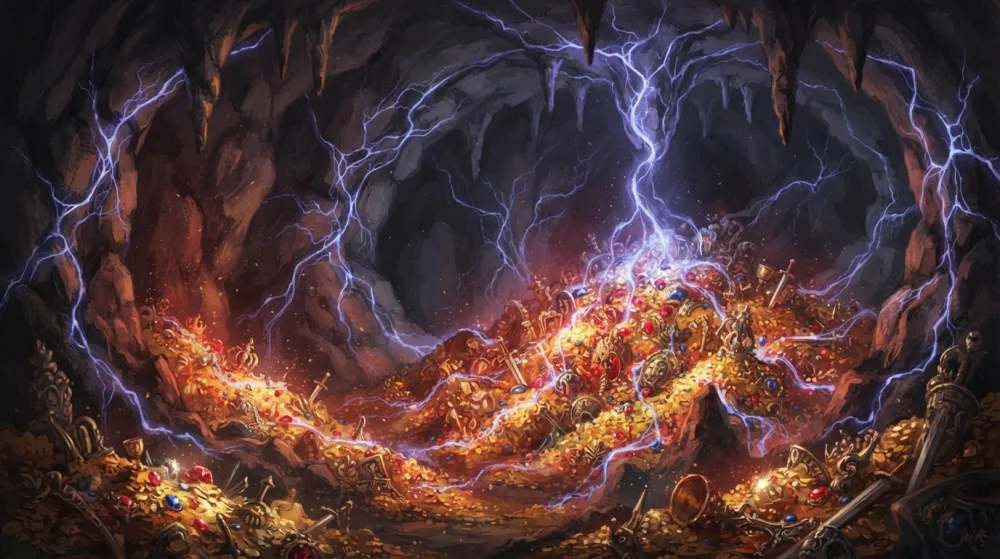
| Adult | 15,000+ gp, split across multiple caches | Crossing 15,000 gp alongside a century of age is what makes a dragon legendary |
| Ancient | 200,000+ gp across eight to ten caches, sometimes exceeding a million gp | Caches spread across the greater part of a continent |
The adult threshold is the one worth internalizing: a century of life and roughly 15,000 gp of hoard, together, is what binds a dragon, its lair, and its territory into the tangle of magical energy that produces legendary actions, lair actions, and regional effects all at once. A young dragon that somehow amasses an unusually large hoard early is a legitimate way to make an encounter punch above its nominal age, since hoard size and age both feed the same underlying power.
Linking a Hoard Across Multiple Caches
As a dragon ages past adulthood, it typically splits its hoard across several caches rather than keeping everything in one place - partly to reduce the risk of losing everything to a single burglary, and partly because each cache extends the dragon's magical influence (and its regional effects) to wherever that cache sits. Adult dragons generally add a new cache every time their hoard reaches another multiple of 15,000 gp, and by ancient age a dragon typically maintains eight to ten caches worth a combined 200,000 gp or more.
Dragons often deliberately split a themed set of items - the pieces of a broken artifact, a full suit of ceremonial armor, numbered volumes of an encyclopedia, statuettes depicting different kinds of dragons, portraits of a well-known historical family, or cards from a complete deck - across multiple caches specifically to strengthen the mystical link between them and reinforce the dragon's claim over treasure it isn't physically guarding. The book's own advice is to make the missing-piece count discoverable early: a chess set or a deck of cards makes the total obvious on its own, while a less intuitive set can be hinted at with an early find - a decorative box with empty compartments, say, that silently tells the party how many more pieces are still out there.
This doubles as a built-in campaign structure: a party that finds one or two pieces of an obviously incomplete set has a natural reason to track down the dragon's other caches, turning "loot the dragon" into a multi-session treasure hunt rather than a single loot screen.
Plundering a Hoard: The Mechanical Consequences
Because a dragon's power is bound up in its treasure, taking that treasure away has a real mechanical effect, not just a narrative one. If a lair's remaining treasure drops below roughly 10,000 gp, the site stops counting as a lair at all - the dragon loses access to lair actions there, and any regional effects around it fade over time exactly as if the dragon had died.
This creates a legitimate, book-sanctioned strategy: a party that identifies a dragon's smaller, less-guarded cache and strips it quickly - before the dragon can respond - measurably weakens that dragon's connection to the territory around that specific site. Disturbing a hoard almost always draws the dragon's attention (through minions or the dragon's own magical connection to the treasure), so this isn't a risk-free plan, but it's a real alternative to a straight fight. Taken to its extreme, stripping every cache from an adult or ancient dragon could theoretically strip its legendary status entirely - though the book is honest that pulling this off would require the dragon to be magically restrained first, which is arguably harder than just defeating it in a fight.
Hoard Curses, Hauntings, and Lingering Magic
A dragon's hoard can carry consequences well past the dragon's own death. Some regional effects tied to a hoard linger even if the treasure is physically relocated - an item that pollutes or purifies any water it touches, coins that encourage lush plant growth when buried, or a sentient item that quietly tries to steer its new owner back toward the dragon's original lair. Individual pieces can also be haunted, carrying a restless spirit whose unfinished business has to be resolved before the haunting ends - the book's own suggestions include entrusting the item to the ghost's living heir, entombing it alongside the ghost's own remains, destroying it outright, using it for one specific purpose the spirit cares about, reuniting it with the rest of a linked set, or hunting down and destroying the ghost's actual killer, who might be a dragon echo of the hoard's original owner active on another world entirely. A haunted item can manifest as a full ghost, specter, or wraith, or it can simply behave like a sentient magic item with an agenda of its own.
The sharpest consequence is a hoard curse. A dragon facing a violent death can lay a lingering curse on anyone who plunders its treasure, and that curse typically follows the treasure itself, not just the original thief - meaning anyone who later comes into contact with cursed pieces can be affected too. Curse effects the book suggests range widely in severity: an unremovable level of exhaustion, automatic failure on saves against dragons' breath weapons and Frightful Presence, vulnerability to the cursing dragon's own breath damage type, a flat speed reduction, an inability to recover hit points from Hit Dice during a short rest, or - the harshest version - a cursed victim's soul becoming imprisoned by the dead dragon's spirit at the moment of death, preventing any form of resurrection.
Breaking a hoard curse is deliberately difficult. Temporary relief is possible through remove curse (suppressing it for an hour) or greater restoration (suppressing it until the victim's next long rest), but actually ending it requires reassembling the entire hoard in one place and performing a specific rite - possibilities the book names include casting hallow over the reassembled treasure, offering blood from everyone who took part in killing the dragon, bathing the treasure in the dragon's own blood, or making a sacrifice to Bahamut, Tiamat, or both. Removing even a single coin after the hoard is reassembled reactivates the curse from scratch. As a shortcut, folding the cursed treasure into a different dragon's hoard entirely nullifies the original curse the moment ownership transfers - a clever party might negotiate exactly this kind of trade with a friendlier dragon, handing over cursed treasure in exchange for a smaller, uncursed sum.
Competition for a Hoard as an Adventure Frame
A dragon's treasure doesn't only attract the party. Cults, reclusive scholars, rival adventuring parties, and secretive organizations might all have their own reasons to want a specific hoard - not always simple greed, but often a need to draw on the hoard's concentrated magic for some larger ritual. The book's own suggested motivations give a sense of the scale these schemes can reach: raising a permanent protective ward over an entire city-state or small kingdom, tearing down a large magical ward protecting some other region, creating (or conversely repairing) a dead-magic zone where spells and magic items simply stop working, reasserting the Material Plane's dominance in an area where another plane's influence has been seeping in, or opening an outright portal to another plane or another world of the Material Plane.
Introducing a second party competing for the same hoard turns a straightforward dungeon crawl into a race, and gives a DM a reason to have the dragon's treasure matter to the wider world even after the dragon guarding it is gone. A cult racing the party to a dead dragon's hoard specifically to fuel a dead-magic ritual reframes the entire dungeon: speed and denial matter as much as looting everything on the way out.
A Worked Example: Building One Lair From Scratch
Putting the pieces together: say the table needs an adult blue dragon's desert lair. Age category sets the hoard baseline at 15,000+ gp split across a couple of caches - the main lair holds the bulk of it, with a smaller secondary cache elsewhere in its territory. Since it's already adult and legendary, lair actions cost nothing extra; picking Lair Rejuvenation and Toughened Scales from the general list fits a dragon that expects to fight rather than flee. Regional effects are free, so layer on two or three that reinforce the family: Exposing Terrain (matching a controlling, orderly personality that doesn't want intruders sneaking past its notice) and a planar connection tied to the Elemental Plane of Air, appropriate to a lightning-breathing chromatic dragon.
For the hoard itself, roll the adult-tier coin and item counts, then reskin a few pieces to match the dragon's own book-described standards - blue dragons "have standards" for what belongs in a hoard, so a handful of the gems and art objects can be described as unusually fine even by dragon standards, with anything the dragon judged unworthy long since discarded or given away. Finally, decide in advance whether this dragon's death should curse its hoard: given a controlling, prideful personality, a curse that strips a thief's ability to recover hit points during a short rest (a fittingly petty, controlling effect) fits better than a more violent option. None of these choices required rolling every table in the chapter - just picking the pieces that reinforce the one dragon already decided on.
What's in a Hoard, and How to Build One
The Dungeon Master's Guide's random treasure tables work fine for a quick hoard, but this book's own procedure produces more variety at roughly the same average value - useful for any hoard significant enough to matter to the story. In broad strokes, the procedure works like this: each age category (wyrmling, young, adult, ancient) has its own baseline roll for coins across four denominations, plus a separate count of mundane items, gems, art objects, and magic items appropriate to that age.
The scale-up across ages is dramatic. A wyrmling's hoard tops out in the low hundreds of gold pieces once every denomination is converted, alongside only a handful of mundane items, a couple of gems, an art object or two, and maybe one magic item. A young dragon's hoard jumps into the thousands of gold pieces and roughly doubles its gem and art-object count. An adult dragon's hoard crosses firmly into gold-and-platinum territory, typically totaling somewhere in the tens of thousands of gold pieces with around a dozen art objects and several magic items. An ancient dragon's hoard is the outlier: platinum alone can run into the tens of thousands of pieces, gold well past a hundred thousand, and the item counts - gems, art objects, and especially magic items - all scale up accordingly. The exact numbers matter less than the shape of the curve: each age tier isn't just "more of the same," it's roughly an order-of-magnitude jump in what the party is looking at.
The categories are worth knowing even without rolling the exact tables:
- Coins can carry real flavor through origin - some local and contemporary, others from an ancient culture, a distant region, or even another world entirely, which lets a DM hint at a dragon's true age just through the coins in its hoard.
- Mundane items (a forgotten painting, a funerary urn, an unidentifiable relic) work as characterization tools and adventure hooks in their own right, independent of monetary value.
- Gems and art objects get their value determined separately from their description, leaving room for a DM to reskin them to match a specific dragon's known preferences - a sapphire dragon's hoard skewing toward sapphires, a copper dragon sleeping on a literal bed of copper coins.
- Magic items can be rolled from the Dungeon Master's Guide's standard tables or hand-picked by rarity and category. The book leans on a minor-versus-major split introduced in Xanathar's Guide to Everything: minor items cover common gear, single-use potions and scrolls, and anything with a low-impact or purely utilitarian effect, while major items are permanent and carry real long-term impact on a campaign. Picking a hoard's magic items by category, rather than pure random roll, gives a DM full control over how much raw power a given hoard actually hands the party.
Building a hoard this way, rather than just naming a gold total, turns a dragon's treasure into a description of who that dragon is - which coins it kept, which mundane object it never explained, which gems it specifically sought out - instead of a number on a loot sheet. A dragon's hoard, read carefully by a party willing to look past the gold total, can tell them almost as much about its owner as an hour of roleplay would.
Lairs and Hoards as a Dragon's Legacy
Everything in this guide connects back to what happens when the dragon that built it eventually dies. A lair's regional effects fade over roughly ten days once the dragon is gone, the same way they fade if a party simply strips the treasure below the lair threshold - but a violent death can extend those effects instead of ending them, leaving fouled water, restless nightmares, or trembling earth behind for that same ten-day window. A hoard curse, once triggered by that death, can outlast the dragon by decades if nobody ever reassembles the pieces. None of this needs to be planned out in full before the fight - but deciding in advance whether a specific dragon's hoard is the kind that quietly fades away or the kind that keeps causing problems long after the body is gone is worth doing before the party lands the killing blow, not after.
Get the Free GM Session Kit
Running 2014 D&D at the table? Session Zero template, recap format, and a prep checklist, built for the classic rules.
No spam, unsubscribe anytime.
Where This Sits in the Wider Dragon Cluster
This guide covers the lair and the hoard specifically. For the dragon that owns them - personality, age-category goals, death and undeath - see the Running Dragons guide. For which of the twenty families fits a given lair and hoard, see the Dragon Types guide. For how a dragon's hoard fits into the wider treasure-and-rewards framework this library already covers, see the D&D 2014 Treasure and Rewards guide. For the specific magic items, hoard-item subsystem, and draconic gifts this book adds on top of a standard hoard, see the D&D 5e 2014 Expansion Magic Items Guide. Return to the Dungeon Master Guides hub for the rest of the DM-facing library.
Final Verdict
The core idea worth carrying forward is that a dragon's lair and hoard aren't set dressing - they're a direct measurement of the dragon's own power, age, and legendary status. Scale the hoard to the age first, add regional effects freely since they cost nothing, treat lair actions as a real power lever only for dragons that don't already have legendary actions, and remember that taking treasure away is a legitimate way to weaken a dragon before the fight even starts. A hoard built this way tells the party who the dragon is before they ever meet it.