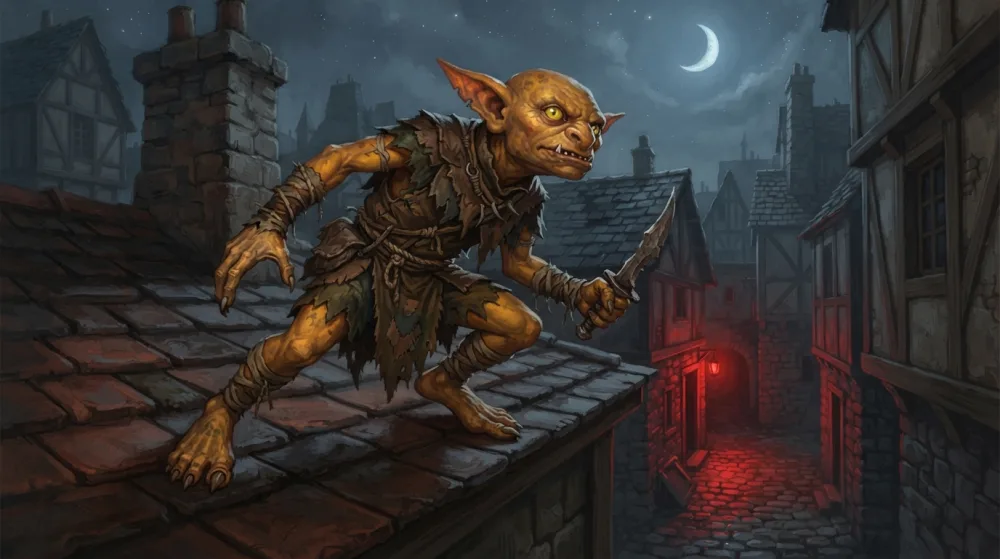
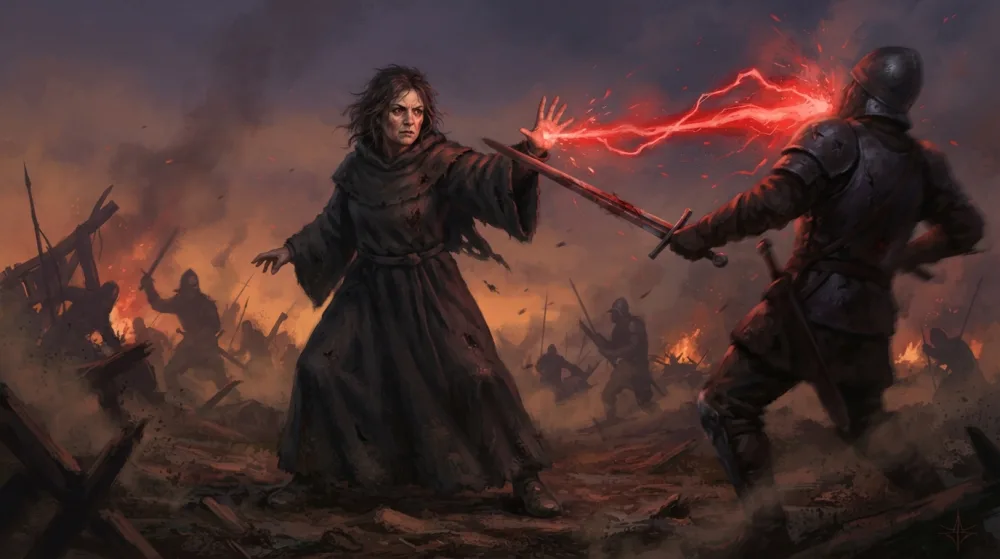
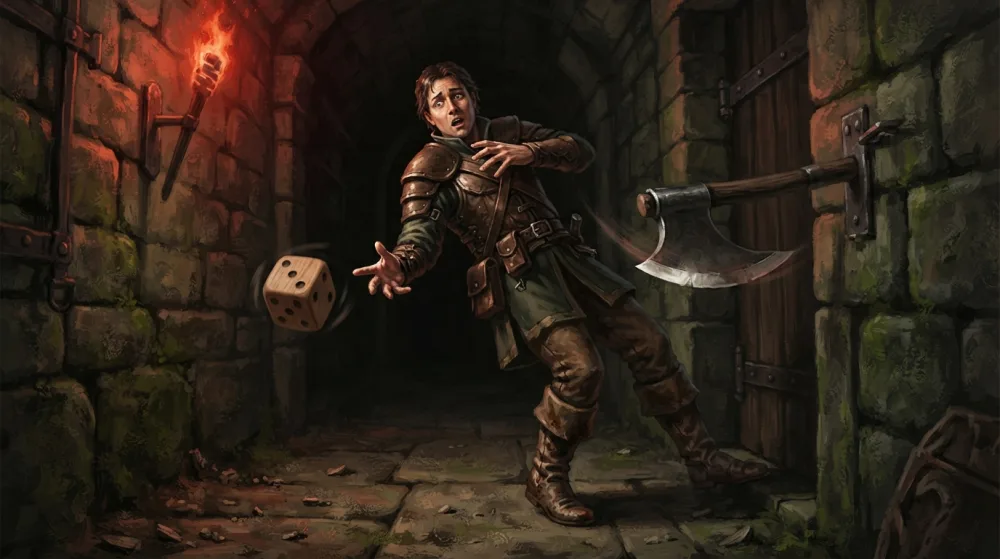
Introduction
The Guildmasters' Guide to Ravnica hands D&D 5e 2014 players and DMs a single-city setting built around conflict: ten guilds, each with its own government, army, church, or criminal enterprise, sharing one sprawling metropolis called the Tenth District. There is no continent to cross and no pantheon to memorize before your first session. There is a city, and there are the factions running it.
Ravnica started as a Magic: The Gathering setting, and the book leans on that history without requiring it. The guilds map onto Magic's two-color pairs (Azorius is white-blue law and order, Rakdos is black-red blood and spectacle, and so on), but you do not need to know a single card to use any of it. What you need to know is which guild fits the character you want to play.
This guide covers the whole book in one place, in the order a table actually uses it. Character options come first, because race, class, and background are what a player puts on the sheet. Guild membership comes next, because on Ravnica it is the decision that reframes every other one. The Tenth District follows, since a DM needs somewhere to put the story. Then the guild-flavored treasure, then the adventure-building toolkit behind the screen.

Two readers use this material in opposite directions. A player builds outward from a character concept: pick a race and class, then find the guild that wants them. A DM builds inward from a conflict: pick a precinct or a guild rivalry, then let the players' guild choices decide who the antagonists are. Both directions run through the same ten factions.
Character Options
Guildmasters' Guide to Ravnica adds five brand-new player races, guild-flavored culture notes for Human and Elf, two guild-born subclasses, and ten guild backgrounds. None of it requires you to know Ravnica's politics before you sit down to build a character.
The book treats guild membership as the central character-creation decision, and it is worth building in that order: pick a race and class first, then use those choices to figure out which of the ten guilds actually wants you. A Centaur Barbarian reads differently depending on whether you slot it into the Gruul Clans' territorial fury or the Boros Legion's disciplined march.
That build order matters for a practical reason, not just a thematic one. Guild membership is not a separate character option sitting next to race and class - it is a framing decision that changes how you read every other choice. A Vedalken picked for its saving-throw floor plays identically whether you slot it into the Azorius Senate or leave it guildless, but the guild you choose afterward changes which NPCs trust the character, which spells the guild-spell list adds on top of the class list, and what the character's rank and renown track looks like session to session. Sort race, class, subclass, and background first; let guild selection be the choice that ties them together.
New Races
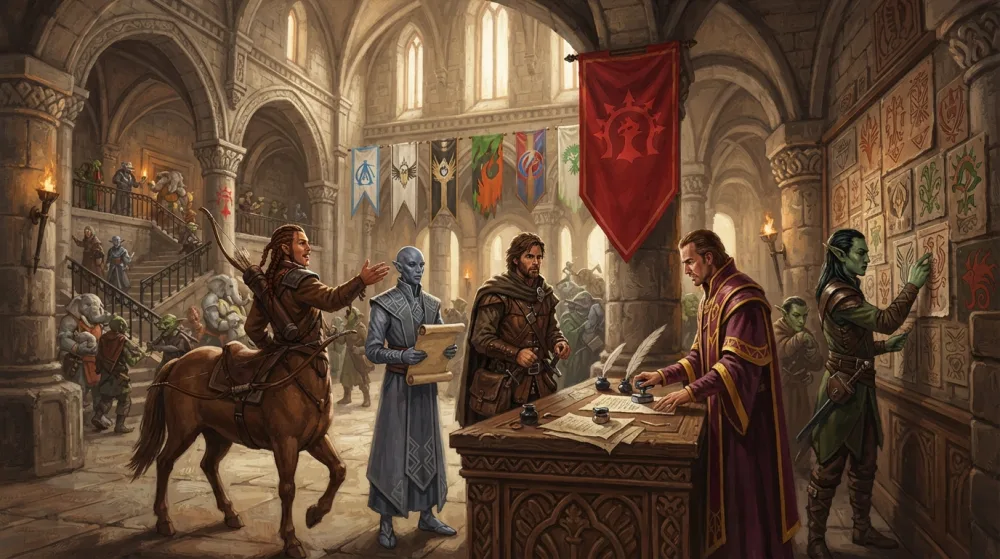
Five races debut in this book, and none of them has an equivalent anywhere else in the 2014 library. Each one gets its own full guide with ability scores, traits, and class-pairing analysis; the summaries below are just enough to point you at the right one.
| Race | What Makes It Distinct |
|---|---|
| Centaur | A Fey creature type rather than Humanoid, a 40-foot base speed, and a bonus-action gore attack after a charge - built for a mobile frontline build. |
| Loxodon | A flat Natural Armor floor (AC 12 + Constitution modifier) that competes directly with Unarmored Defense and other AC-calculation features. |
| Minotaur | Horns plus Goring Rush and Hammering Horns, a shove-on-hit combo that rewards a Barbarian or Fighter who moves before swinging. |
| Simic Hybrid | The richest single-race decision in this batch - pick one animal enhancement at 1st level and a second at 5th, from six total options. |
| Vedalken | Advantage on Intelligence, Wisdom, and Charisma saving throws with no magic-only restriction - a strong defensive floor for any mental-save-heavy build. |
The Fey creature type on Centaur matters for more than flavor: any spell or effect that targets Humanoids specifically (hold person, dominate person, and a handful of others) simply does not touch a Centaur. That is a defensive edge in a game that leans on those spells constantly. Loxodon's Natural Armor is a floor, not a bonus - it sets your base AC at 12 plus Constitution and explicitly does not stack with a class feature that calculates AC a different way, so check that interaction before assuming it stacks with Unarmored Defense. Simic Hybrid asks the most of a new player: six total animal-enhancement options split across two choice points (1st and 5th level) means the full comparison lives in its dedicated guide, not a two-line summary here.
Every one of these races is playable outside Ravnica with zero adjustment. A Loxodon Monk or a Centaur Ranger works in Faerun or Eberron exactly as written; the guild affiliations described throughout this guide are Ravnica-specific color, not a prerequisite.
None of the five races comes with a built-in guild lean the way Human and Elf do below - the book leaves race-to-guild pairing entirely up to the player. A Minotaur reads as comfortably at home smashing through the Gruul Clans' territorial skirmishes as it does enforcing Boros military discipline, and a Vedalken's cool rationalism fits the Azorius Senate's bureaucracy just as well as the Izzet League's experimental chaos. If you want a race that signals a guild at a glance, use the suggested-races column in the ten guilds table rather than reading one out of the race traits.
Regional Flavor for Human and Elf
Two existing PHB races get Ravnica-specific cultural notes instead of new mechanics. Neither one changes a single trait, ability score, or feature.
Human. Humans are Ravnica's largest population but not its ruling class: not one of the ten guild paruns who founded the modern guild structure was human, and no current guildmaster is human either. What humans dominate instead is the tier just below the top - lieutenants, advisors, and strategists whose ambition keeps pushing against the sheer power of the dragons and demons who hold the highest seats. The one distinguishing feature of Ravnica's humans is breadth: they are the only people found in meaningful numbers in every one of the ten guilds, with no natural guild alignment pulling them toward one faction over another. That makes Human the default pick for a player who already knows which guild they want and does not want a race with its own competing cultural lean - the guild does the flavor work, and the race gets out of the way.
Elf. Ravnica's elves lean toward guilds built around nature, growth, and stability, and the book ties each of the three PHB subraces to a specific guild culture:
| Elf subrace | Ravnica name | Guild tie |
|---|---|---|
| High Elf | (absorbed, no longer distinct) | Simic Combine |
| Wood Elf | Silhana | Selesnya Conclave |
| Dark Elf | Devkarin | Golgari Swarm |
High Elves have been absorbed into the Simic Combine so completely that they have lost their original tribal identity, trading the classic unearthly presence of other-world elves for slender builds, angular features, and pale skin that often shades toward green. Wood Elves go by Silhana here and gravitate toward the Selesnya Conclave, sharing that guild's conviction that civilization and nature are not opposites. Dark Elves are called Devkarin rather than drow, closely tied to the Golgari Swarm, and share the classic sunlight sensitivity of their underground-dwelling kin - though their coloration matches Wood Elves rather than the drow of other worlds, usually dark brown or black hair over otherwise similar features. None of this changes a single ability score or trait; a Silhana Wood Elf plays exactly like the Wood Elf in the Player's Handbook.
The Gruul Clans also revere nature, but their opposition to civilization itself keeps most elves at arm's length from that guild specifically. It is the one guild the book explicitly calls out as a poor cultural fit despite the shared nature theme, which is a useful data point if you are building an elf character who is meant to feel like an outsider within their own species' usual leanings.
For the actual ability scores, subrace traits, and build guidance behind either race, use the full guides: the Human Race Guide and the Elf Race Guide cover every PHB trait plus every prior sourcebook's additions, Ravnica included.
Guild-Linked Subclasses
Two subclasses originated in this book and are covered in full as sub-articles in the class guides, with their guild origin credited (both were later reprinted in Tasha's Cauldron of Everything, which is why you will sometimes see them cited to that book instead). Neither requires guild membership to take.
- Order Domain (Cleric) - the domain of law, command, and civic order, a natural fit for a Cleric serving the Azorius Senate or any guild that prizes structure over improvisation.
- Circle of Spores (Druid) - a decay-and-necrotic-flavored Circle that reads as a natural pick for a Druid tied to the Golgari Swarm's death-and-renewal cycle, though nothing in its mechanics requires that guild specifically.
Both subclasses read as guild-flavored because of where they debuted, not because either one is mechanically locked to Ravnica. An Order Domain Cleric works just as well backing a lawful kingdom's inquisition in any other setting, and a Circle of Spores Druid fits a swamp-dwelling necromancer-adjacent build with zero guild affiliation at all. Full mechanics, spell lists, and feature breakdowns live in their linked guides.
Guild Backgrounds
The book adds ten backgrounds, one per guild: Azorius Functionary, Boros Legionnaire, Dimir Operative, Golgari Agent, Gruul Anarch, Izzet Engineer, Orzhov Representative, Rakdos Cultist, Selesnya Initiate, and Simic Scientist. Every one of them is covered with the full skill, tool, language, equipment, and feature breakdown in the D&D 5e Backgrounds Guide, alongside every PHB and prior-sourcebook background, so you can compare a guild background against a Sword Coast or core option in one place. Each guild's entry below names its background and the feature that matters most in play.
A guild background is the fastest way to give a character a guild identity. Because each one is written for its specific guild's day-to-day work (an Azorius Functionary's paperwork-and-procedure skill set looks nothing like a Rakdos Cultist's showmanship-and-performance kit), the background you pick is usually a stronger signal of which guild fits your character than race or class alone. A player torn between two guild concepts can often settle it by asking which background's proficiencies they would rather have on the sheet.
None of the ten backgrounds carries a race restriction. Any of the five new races, or any existing PHB race, can take any of the ten guild backgrounds without a DM ruling.
Build Your Dungeons & Dragons (5e, 2014) Character
The Dungeons & Dragons (5e, 2014) character builder is live - build a Beastkin, a Kobold, or whatever your table is missing, free, right now.
Start BuildingHow Guild Membership Actually Works
Every citizen of Ravnica belongs to something. Not a nation, not a church in the usual sense - a guild. The city has no king, no unified government, and no single religion; instead it has ten enormous, centuries-old institutions that run everything from the courts to the sewers to the underground fighting circuits. A judge, a soldier, a spy, a gravedigger, a mad scientist, a loan shark, a riot clown, a druid, a biotech researcher: on Ravnica, all ten of those are guild jobs.
You establish guild membership by choosing that guild's background. Unlike a typical Player's Handbook background, a Ravnica guild background is not just backstory: the book assumes you keep your guild affiliation for your character's entire active career, so your guild shapes what you are doing right now, not just what you did before session one.
Guild spells. If your class has the Spellcasting or Pact Magic feature, your guild's spell list gets added to your class's spell list. A Boros Legionnaire Wizard, for instance, can learn guiding bolt even though it is normally a Cleric spell, because it is on the Boros Guild Spells table. This does not grant bonus spells known or prepared. It widens which spells you are allowed to pick from.
Renown. Your standing inside your guild is tracked separately from character level, using a renown score that starts at 1. Advancing your guild's interests in a way other members notice raises it by 1; completing an adventure-scale mission on the guild's behalf raises it by 2. At renown 3 you are a respected, established member with informal support from your guild mates. At renown 5 you gain an extra contact. Past that, most guilds layer on a series of formal ranks - Azorius has Official, Authority, Minister/Judge/Senator, and Arbiter; the Boros Legion runs Sergeant through Commander; House Dimir and the Gruul Clans skip formal titles in favor of looser trust thresholds. Higher renown generally means a better salary between adventures, access to guild resources like charms and recruits on a mission, and eventually a leadership role of your own.
Higher renown also buys practical resources beyond a title. Most guilds hand you a single-use guild charm at the start of a renown-gated mission, and several - Azorius, Boros, Orzhov, and Simic among them - let a sufficiently renowned character call on squads of guild soldiers, researchers, or lawmages to assist on that specific mission. A few guilds skip formal ranks entirely: the Golgari Swarm and the Cult of Rakdos measure standing by how well the guildmaster and your fellow members actually know your name and your work, rather than by a title you could point to on an org chart.
Contacts. Every guild background comes with a starting set of contacts - an ally and a rival within your own guild, plus one contact (ally or rival) in a different guild - determined by rolling on that guild's Contacts tables or picking an option that fits your backstory. House Dimir works differently: your visible contacts mostly come from your secondary, infiltrated guild, since a true Dimir agent rarely knows more than a code name or a drop-off location for their actual handler. Reaching renown 5 in any guild, even one you do not formally belong to, adds an additional contact on top of your starting set.
Styles of membership. The book sorts guild members into four relationship types, and picking one before you start playing sharpens your character fast. Loyalists believe in the guild's stated ideals and fit its usual race/class/personality profile - a paladin devoted to Boros justice as a personal creed, not just an oath of convenience. Opportunists join for what they can extract from membership and treat the guild's goals as secondary. Rebels love their guild but reject how it operates day to day, like a Boros legionnaire who thinks the chain of command is too soft on corruption. Anomalies are members whose race or class is unusual for the guild, but whose personality and ideals line up perfectly - a Vedalken paladin in the Boros Legion, for example.
Insignia and currency. Every guild background's starting equipment includes that guild's insignia, a physical badge of membership that opens doors and occasionally closes them, depending on who is looking at it. Ravnica's coinage reflects the same guild-run structure: the standard 1-zino coin is minted by whichever guild issued it, all functionally equivalent to a gold piece for game purposes, but a visible reminder that even the city's money runs through guild institutions rather than a central treasury.
Changing guilds and going guildless. A character can abandon one guild for another mid-campaign, though the book notes you can rarely go back once you leave; you lose your old background feature, guild spells not already known through your class, and (except in unusual circumstances) your renown, gaining the new guild's equivalents over time rather than instantly. Roughly half of Ravnica's population belongs to no guild at all - bakers, cartographers, independent mercenaries, university professors, and plenty of adventurers who just do not want the obligation. A guildless character skips this chapter's mechanical hooks in exchange for complete independence, which is a real, supported build.
Why Every Guild Feels On Edge Right Now
One piece of city-wide context explains why nearly every guild's stated goals below sound more urgent than a calm, stable government would produce: the Living Guildpact, the single figure whose job is to embody and enforce the treaty that keeps the ten guilds from openly warring, has effectively vanished, appearing rarely and unpredictably. Without that check in place, every guild is quietly testing how far it can push its own agenda before another guild, or the whole city, pushes back. The Azorius lean harder into emergency legal powers. The Boros brace for open military conflict. The Simic accelerate their most defensive research. None of the ten guilds wants a citywide guild war, but several of them have started acting as though one is coming regardless, which is exactly the kind of low-grade, faction-driven tension a Ravnica campaign is built to run on. You do not need to resolve this mystery to play a Ravnica character - it is DM-facing campaign material more than a player-facing rules hook - but it is worth knowing as the reason every guild's goals read a little more anxious than a settled, centuries-old institution normally would.
The Ten Guilds
Guild selection is the single most important character-creation decision in a Ravnica campaign, more consequential than race, more consequential than class. Your guild supplies your background, your starting equipment, your contacts, a list of guild spells your spellcasting class can draw on, and an entire social context for how your character moves through the city. Pick the Azorius Senate and you are part of a rules-obsessed legal bureaucracy chasing after a fugitive concept of justice. Pick the Cult of Rakdos and you are a performer in a demon-worshiping circus that treats riots as an art form. Same character sheet math, completely different character.
This is not a solo decision, either. A typical Ravnica party sits three or four different guild loyalties at the same table, and the book expects that friction to do real work: a Boros paladin and a Gruul barbarian can share a battlefield without sharing a worldview, and a Dimir rogue in the party might be quietly reporting on everyone else at the table without anyone at the table (in character) knowing it.
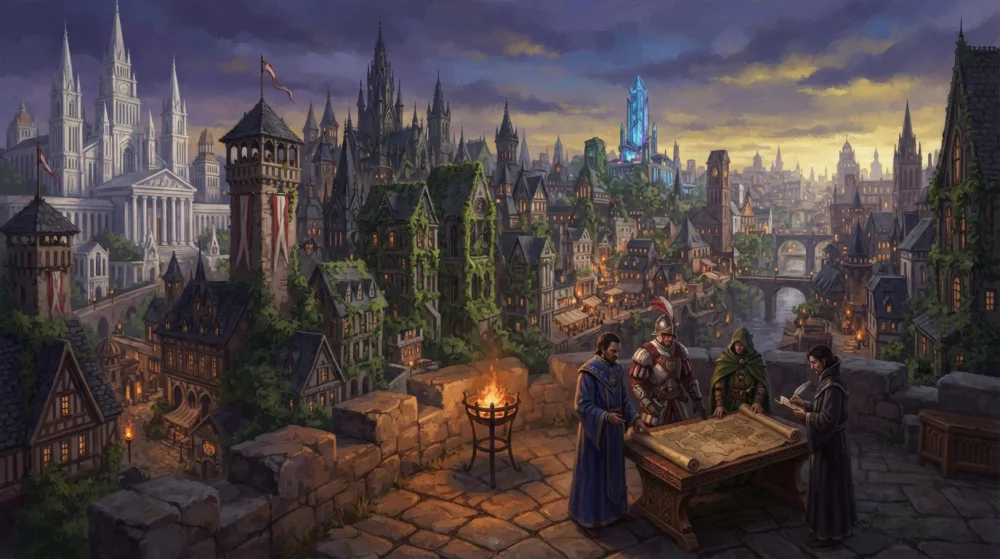
Long-standing tradition also steers certain races toward certain guilds, even though nobody is born into a guild the way they are born into a family or a species. A dark elf raised outside the Golgari Swarm would be unusual almost to the point of implausibility, and the Ordruun line of minotaurs has fed generations of officers into the Boros Legion. None of that is a hard rule - the suggested races and classes below are exactly that, suggestions - but it is useful context for why an NPC might raise an eyebrow at an unexpected guild-race pairing even when the rules have no objection to it.
The Ten Guilds at a Glance
The two-color pairing in the table below traces back to Ravnica's origin as a Magic: The Gathering setting, where each guild sits at the intersection of two of the game's five color-identity philosophies. You do not need any card-game knowledge to use this table - the pairing is just a fast way to describe each guild's personality in shorthand.
| Guild | Real-World Analog | Color Identity | Alignment Lean | Suggested Races/Classes | Best Character Fit |
|---|---|---|---|---|---|
| Azorius Senate | Law, bureaucracy, and police | White-Blue | Usually lawful, often neutral | Human, Vedalken / Bard, Cleric, Fighter, Paladin, Wizard | A rule-bound investigator or enforcer who believes order comes before comfort |
| Boros Legion | Standing army and paladins-in-armor | Red-White | Usually good, often lawful | Human, Goblin, Minotaur / Cleric, Fighter, Paladin, Ranger, Wizard | A righteous soldier who wants a chain of command and a clear enemy |
| House Dimir | Espionage network and secret police | Blue-Black | Usually neutral, sometimes evil | Half-Elf, Human / Monk, Rogue, Wizard | A spy who thrives on secrets, double identities, and quiet leverage |
| Golgari Swarm | Waste management, agriculture, and necromancy | Black-Green | Usually neutral, often evil | Human, Elf (dark) / Druid, Fighter, Ranger, Rogue, Wizard | A character drawn to the darker, patient side of nature and decay |
| Gruul Clans | Barbarian raiders on civilization's fringe | Red-Green | Usually chaotic, often neutral | Human, Centaur, Goblin, Minotaur / Barbarian, Cleric, Druid, Fighter, Ranger | Someone who wants to smash the city's structures and live by strength |
| Izzet League | Mad science and public works | Blue-Red | Usually chaotic, often neutral | Human, Goblin, Vedalken / Fighter, Sorcerer, Wizard | A reckless genius who cares more about the experiment's result than its safety |
| Orzhov Syndicate | Organized crime dressed as church and bank | White-Black | Usually lawful, often evil | Human / Cleric, Fighter, Rogue, Wizard | A schemer comfortable exploiting debt, faith, and hierarchy for profit |
| Cult of Rakdos | Demon-worshiping circus and riot troupe | Black-Red | Usually chaotic, often evil | Human, Goblin / Barbarian, Bard, Fighter, Warlock | A showy performer who lives for spectacle and chaos over subtlety |
| Selesnya Conclave | Nature commune and citizen militia | Green-White | Usually good, often neutral | Human, Centaur, Elf (wood), Half-Elf, Loxodon / Bard, Cleric, Druid, Fighter, Monk, Paladin, Ranger, Warlock | Someone who wants community, purpose, and strength in numbers |
| Simic Combine | Biotech research collective | Green-Blue | Usually neutral | Human, Elf (high), Simic Hybrid, Vedalken / Druid, Fighter, Monk, Wizard | A curious scientist experimenting with the boundaries of life itself |
Azorius Senate
The Azorius Senate is Ravnica's government: judges, legislators, and police rolled into one guild, led by the ancient sphinx Isperia. Its three branches, called columns, split the work - the Sova Column adjudicates, the Jelenn Column writes law, and the Lyev Column enforces it. Most Azorius adventurers end up attached to Lyev, since patrol work and investigation are where the action is. The Azorius believe civilization survives only through a strong, safety-focused legal code, and they treat every guild that operates outside that code as a slow-motion threat to be contained through ever more specific legislation.
Who fits. Alignment leans usually lawful, often neutral. Suggested races are Human and Vedalken, and suggested classes are Bard, Cleric, Fighter, Paladin, and Wizard. The guild's spellcasters skew toward control-oriented specializations - Wizards of the School of Enchantment or Abjuration, Clerics of the Order Domain - because law enforcement magic is about restraining and protecting, not destroying. Martial Azorius characters usually serve as arresters: Fighters of any archetype or Paladins who have sworn the Oath of Vengeance. A Bard of the College of Lore fits the guild's diplomatic side as an elocutor, negotiating between the senate and the other nine guilds.
Roleplay hook. Azorius characters tend toward cold dignity and pragmatic orderliness. They do not let emotion cloud judgment, and they say exactly what they mean, no matter how many words it takes. Their guiding ideals split between believing law is the path to peace and a colder conviction that coercion is simply how compliance gets enforced.
Background. The Azorius Functionary background grants Insight and Intimidation proficiency and the Legal Authority feature, which gets you an audience with almost anyone simply by showing your insignia - useful right up until you are dealing with someone the law cannot touch.
Guild spells.
| Level | Spells |
|---|---|
| Cantrip | friends, message |
| 1st | command, ensnaring strike |
| 2nd | arcane lock, calm emotions, hold person |
| 3rd | clairvoyance, counterspell |
| 4th | compulsion, divination |
| 5th | dominate person |
Azorius magic tends to visibly announce itself: expect blue-and-gold runes floating in circular patterns or shimmering azure barriers whenever a lawmage casts.
Party and rank. An all-Azorius adventuring party fields a soldier or lawmage (Fighter or Wizard) alongside a precognitive mage (a Cleric of the Knowledge Domain) directing missions, with an elocutor (Bard) handling negotiations outside the party's usual jurisdiction. On the advancement side, renown 3 promotes you to Official - justiciar, officer, or scribe depending on your track - and renown 50 can carry you all the way to Arbiter, one of only three column heads answering directly to Isperia herself.
Enemies and allies. The Azorius see nearly every other guild as a form of disorder in progress. They have cracked down hardest on the Gruul Clans and the Cult of Rakdos, and they view House Dimir's espionage and the Orzhov Syndicate's racketeering as slow-burning threats to the rule of law. Even the guild's fellow order-leaning factions, the Boros Legion and the Selesnya Conclave, draw Azorius suspicion for acting outside the courts. Any guild willing to operate strictly within the law, even temporarily, becomes a workable ally.
Boros Legion
The Boros Legion is Ravnica's standing army, led by the archangel Aurelia and staffed from the top down with literal angels commanding mortal soldiers. Its members fuse military discipline with righteous zeal: the Boros exist to protect the innocent and enforce justice through force, and that mission occasionally puts their own rank-and-file at odds with the letter of the law they are sworn to defend. Generations of the Ordruun minotaur line have served as Boros generals, and the guild draws heavily from every race willing to take up arms for the cause.
Who fits. Alignment leans usually good, often lawful. Suggested races are Human, Goblin, and Minotaur, and suggested classes are Cleric, Fighter, Paladin, Ranger, and Wizard. Martial troops - Fighters, Rangers, or Barbarians of the Path of the Zealot - form the legion's bulk, while spellcasters serve as embermages (Wizards of the School of Evocation) or medics (Clerics of the Life or Light Domain). A Paladin who swears the Oath of Devotion, a Fighter of the Eldritch Knight archetype, or a Cleric of the War Domain can combine martial training with magic as a firefist, one of the legion's most respected combat roles.
Roleplay hook. Boros characters approach every task with something close to military precision, bear injury with stoic pride, and treat their weapons and insignia as sacred gifts from the angels. Their ideals cluster around justice, protection of the innocent, and solidarity with fellow legionnaires.
Background. The Boros Legionnaire background grants Athletics and Intimidation proficiency plus one gaming set, and its Legion Station feature gets you a weekly salary, requisitioned gear, and safe rest at any Boros garrison in the city.
Guild spells.
| Level | Spells |
|---|---|
| Cantrip | fire bolt, sacred flame |
| 1st | guiding bolt, heroism |
| 2nd | aid, scorching ray |
| 3rd | beacon of hope, blinding smite |
| 4th | death ward, wall of fire |
| 5th | flame strike |
Boros magic favors dramatic bursts of flame or radiance, and beneficial spells cast on an ally often manifest as a momentary halo of bright fire.
Party and rank. A Boros-only strike team pairs one or two soldiers (Fighter or Paladin) with a medic (Cleric) and an embermage (Wizard), sometimes rounded out by a lightly armored swiftblade (Ranger) for stealth work the rest of the unit cannot handle. Renown 5 at 5th level unlocks the skyknight role, mounted on a Skyjek roc, or a place in the Wojek League, the legion's combined military police and intelligence branch.
Enemies and allies. The Boros find real common ground with the Azorius and the Selesnya, guilds that share their commitment to order, and a looser one with the Orzhov. They are actively bracing against Gruul raids on their fortifications and House Dimir infiltration of their own ranks, and they see the Golgari and the Cult of Rakdos as chronic sources of urban chaos worth policing. Even guilds the legion distrusts can become situational allies when their goals happen to align against a bigger threat.
House Dimir
House Dimir is the guild most citizens of Ravnica are not sure actually exists. Publicly it is a network of couriers, librarians, and information brokers; privately it is an espionage and assassination network led by the shapeshifting guildmaster Lazav, so secretive that most Dimir agents never learn the identity of their own handler. Every Dimir agent maintains a cover identity inside a second guild, infiltrating it for intelligence, sabotage, or recruitment, which makes House Dimir the only guild built entirely around a double life.
Who fits. Alignment leans usually neutral, sometimes evil. Suggested races are Half-Elf and Human, and suggested classes are Monk, Rogue, and Wizard. Rogues of the Thief, Assassin, or Arcane Trickster archetype and Monks of the Way of Shadow make natural field agents, and Wizards specialized in Divination, Enchantment, or Illusion become the guild's feared mind mages, pulling thoughts and memories directly out of a target's head. House Dimir also has almost no Fighters, a martial exception among Ravnica's guilds, since blunt force runs against the guild's every instinct toward subtlety.
Roleplay hook. Dimir characters are practiced at hiding their true thoughts and feelings, treat any doubt about whether something is a secret as a reason not to share it, and rarely show anger outright, preferring to plot their revenge quietly instead. Their ideals range from a cold love of control and secret-keeping to a hunger for knowledge about how the city actually works underneath its public face.
Background. The Dimir Operative background is the only Ravnica background built around a second choice at character creation: you pick or roll a secondary guild to infiltrate, and that guild's own starting equipment folds into yours on top of the standard Dimir gear (Deception and Stealth proficiency, a disguise kit). Its False Identity feature lets you maintain and drop that cover persona at will.
Guild spells.
| Level | Spells |
|---|---|
| Cantrip | encode thoughts, mage hand |
| 1st | disguise self, sleep |
| 2nd | detect thoughts, pass without trace |
| 3rd | gaseous form, meld into stone, nondetection |
| 4th | arcane eye, freedom of movement |
| 5th | modify memory |
Encode thoughts is Dimir's signature cantrip, a new spell this book introduces rather than a reprint, letting you compress a memory, idea, or message into a physical, shareable thought strand. See the enchantment spells guide for its full mechanics and how it compares to the rest of the school.
Party and rank. A Dimir cell built as an adventuring party leans on Rogues and Monks for fieldwork, backed by a mind mage (Wizard) for magical support, since a handful of healing potions do more work than a dedicated healer in a guild this averse to being noticed. At renown 3 you become an independent agent and receive a spies' murmur, a telepathic communication device shared with other Dimir agents - the closest thing this guild offers to a rank title.
Enemies and allies. House Dimir treats every other guild as a source of information to exploit and a threat level to track, with no exceptions. The Izzet and the Gruul worry Dimir strategists most, since their impulsive, unpredictable decision-making is hard to model and plan around. Cooperation with the Azorius or Boros happens when it is the easiest way to get a rival arrested or eliminated by someone else's hands.
Golgari Swarm
The Golgari Swarm treats death as part of nature's cycle rather than its opposite, and it runs Ravnica's undercity accordingly: waste management, agriculture, and necromancy under one roof, led by the elf lich Jarad. Three power blocs - Devkarin dark elves, medusas, and the insectile kraul - coexist and jostle within the swarm, and Golgari leadership has changed hands through assassination more than once. Members see the guild less as an organization and more as a single organism they are absorbed into, with roles assigned by whatever the swarm currently needs.
Who fits. Alignment leans usually neutral, often evil. Suggested races are Human and Elf (dark, also called Devkarin), and suggested classes are Druid, Fighter, Ranger, Rogue, and Wizard. Golgari shamans lean into decay-themed magic as Wizards of the School of Necromancy or Druids of the Circle of Spores or Circle of the Land. Golgari Rangers favor insects and reptiles as companions through the Beast Master archetype, and Rogues of the Thief or Assassin archetype fill out the guild's skirmisher and Ochran assassin roles.
Roleplay hook. Golgari characters are unmistakably products of the undercity: relentless and determined like roots working through stone, unsettlingly comfortable narrating an enemy's injuries in grisly anatomical detail, and largely at peace with their own eventual death. Their ideals lean into nature's cyclical view of decay and growth, interdependence within the swarm, and for some members, a belief that Golgari ascendance is close at hand.
Background. The Golgari Agent background grants Nature and Survival proficiency plus a poisoner's kit, and its Undercity Paths feature lets you and your allies travel the city at double speed outside combat - a quiet but useful pick for any campaign that treats city navigation as more than flavor text.
Guild spells.
| Level | Spells |
|---|---|
| Cantrip | dancing lights, spare the dying |
| 1st | entangle, ray of sickness |
| 2nd | protection from poison, ray of enfeeblement, spider climb |
| 3rd | animate dead, plant growth |
| 4th | giant insect, grasping vine |
| 5th | cloudkill, insect plague |
Golgari magic tends to arrive with a sickly green glow and the unmistakable smell of rot. Subtlety was never the point.
Party and rank. A Golgari party pairs shamans (Druid and Wizard) providing leadership with a warrior (Fighter or Ranger) and a stealthy Ochran operative (Rogue) for the guild's assassination and protection work. Renown 10 opens the door to the Ochran itself, the swarm's order of bodyguards and assassins, while renown 50 can carry a dark elf spellcaster all the way to matka, spiritual head of the Devkarin.
Enemies and allies. The Golgari share a general nature-oriented philosophy with the Simic, Gruul, and Selesnya, though their comfort with death as a natural process puts a real gap between them even there. They mostly avoid direct confrontation, preferring attrition over frontal assault, but they will strike back hard against the Azorius extending jurisdiction into the undercity or the Boros pressing raids into Golgari territory. Every other guild reads, to the Golgari, as short-sighted and destined to eventually rot and collapse, which the swarm considers less an insult than a simple fact of the natural order.
Gruul Clans
The Gruul Clans are less a single guild than a loose, often-warring confederation of bands who reject Ravnica's civilization outright, led (when they bother to follow anyone) by the cyclops Borborygmos of the Burning Tree clan. Distinct clans - Burning Tree, Ghor, Scab, Slizt, Gravel Hide, and Zhur-Taa among them - squat in the rubblebelts and abandoned zones at the city's edges, raiding inward and defending their territory from encroaching development. Joining means going through a symbolic rite of being buried alive: the person you were before is dead, and you rise from the earth untested, judged only by what you accomplish as Gruul from that point forward.
Who fits. Alignment leans usually chaotic, often neutral. Suggested races are Human, Centaur, Goblin, and Minotaur, and suggested classes are Barbarian, Cleric, Druid, Fighter, and Ranger. Most Gruul warriors are Barbarians of the Path of the Totem Warrior or Path of the Berserker, Fighters of the Champion archetype, or Rangers of the Hunter or Beast Master archetype. Spellcasters lean spiritual rather than academic - Druids of the Circle of the Moon or Clerics of the Tempest Domain practice what the clans call the Old Ways, channeling primal energy that predates the city itself. The Gruul are also one of the few guilds with essentially no Wizards; book learning has little place in a culture built around strength and instinct.
Roleplay hook. Gruul characters trust the beasts of the wild over people, scorn anyone who cannot survive away from the comforts of the city, and bristle at being told what they are not allowed to do. Their ideals run through anarchy, unfiltered self-expression, and a fierce belief that the strong are meant to dominate the weak, tempered for some by sincere devotion to the Old Ways as inherited tradition rather than raw aggression.
Background. The Gruul Anarch background grants Animal Handling and Athletics proficiency plus a herbalism kit, and its Rubblebelt Refuge feature lets you find shelter, food, and water for up to five allies in the city's abandoned and overgrown places.
Guild spells.
| Level | Spells |
|---|---|
| Cantrip | fire bolt, produce flame |
| 1st | compelled duel, speak with animals, thunderwave |
| 2nd | beast sense, shatter |
| 3rd | conjure animals, conjure barrage |
| 4th | dominate beast, stoneskin |
| 5th | destructive wave |
Gruul spellcasting is fueled by visible rage, and it typically shows as flames smoldering behind the caster's eyes or dancing across their hands.
Party and rank. A raiding party drawn entirely from the Gruul mixes anarchs and berserkers (Fighter, Ranger, or Barbarian) with a druid of the Old Ways (Druid or Cleric), trading subtlety for raw combat power almost across the board. Renown 10 grants a beast companion mount - a batterboar, ceratok, or raktusk drawn straight from the rubblebelts - and renown 50 lets a character challenge their own clan chieftain directly for leadership.
Enemies and allies. The Gruul share a general respect for nature with the Golgari, Selesnya, and Simic, though they would just as soon smash a guild's sewers or laboratories as cooperate with them toward a shared goal. Because they view every guild as a piece of the civilization machine they want to break, the Gruul do not reserve special hatred for any single rival, though the guilds that actively hunt them, primarily the Boros and Azorius, draw their fiercest counterattacks.
Izzet League
The Izzet League is Ravnica's mad-science guild, chasing public-works solutions and elemental experimentation with a fiddle-and-find-out methodology that treats every unpredictable outcome as useful data. Its founder and current guildmaster is Niv-Mizzet, a fifteen-thousand-year-old, vain, brilliant dragon who sets long-range research goals and leaves the details to his underlings on the Izmundi board of directors. Individual laboratories - Pyrology, Storms and Electricity, Metallurgy, Alchemy, Orientation, and more - each pursue their own specialty with minimal central oversight, and results range from useful infrastructure to citywide property damage.
Who fits. Alignment leans usually chaotic, often neutral. Suggested races are Human, Goblin, and Vedalken, and suggested classes are Fighter, Sorcerer, and Wizard. Most Izzet Sorcerers claim the Wild Magic origin (a handful claim Draconic Bloodline, fittingly given the guildmaster), and Izzet Wizards specialize in the School of Conjuration, Evocation, or Transmutation. Martial members usually serve as Eldritch Knight Fighters, guarding laboratories or advancing to the elite flame-throwing scorchbringer role.
Roleplay hook. Izzet characters get excited about their own ideas fast, talk in dense technical jargon without noticing they have lost the room, and judge every project by whether it produces a result rather than whether it followed a plan. Their ideals split between prizing creativity and discovery for their own sake and a more disciplined belief that rigorous experimentation, not intuition, is what actually moves the multiverse forward.
Background. The Izzet Engineer background grants Arcana and Investigation proficiency plus one set of artisan's tools, and its Urban Infrastructure feature gives you access to a building's blueprints and structural knowledge - handy for both construction and infiltration.
Guild spells.
| Level | Spells |
|---|---|
| Cantrip | produce flame, shocking grasp |
| 1st | chaos bolt, create or destroy water, unseen servant |
| 2nd | heat metal, rope trick |
| 3rd | call lightning, elemental weapon, glyph of warding |
| 4th | conjure minor elementals, divination, Otiluke's resilient sphere |
| 5th | animate objects, conjure elemental |
Chaos bolt is the guild's signature spell and, like encode thoughts, a new addition rather than a reprint: a 1st-level evocation spell whose damage type is randomized every cast and that can chain to a second target on matching dice. See the evocation spells guide and sorcerer spells guide for the full mechanical breakdown.
Party and rank. An Izzet-only team centers on a mage (Wizard or Sorcerer) flanked by guards (Fighter) and attendants of any class, without a dedicated healer - alchemist-crafted potions fill that gap instead. Renown 3 unlocks either the researcher rank, which lets a spellcaster build a mizzium apparatus, or the scorchbringer special role, which comes with a flame-throwing pyroconverger for laboratory defense.
Enemies and allies. The Izzet respect the Simic as fellow scientists, even if they find Simic research too cautious for their taste, and they appreciate the raw passion of the Boros, Gruul, and Rakdos without sharing any of those guilds' actual goals. Conflict tends to be circumstantial rather than ideological: the Izzet clash with the Dimir over stolen research, the Gruul over smashed equipment, and the Boros or Azorius whenever an experiment crosses into public danger or breaks a law nobody thought to write yet.
Orzhov Syndicate
The Orzhov Syndicate wears the twin masks of church and bank over what is, underneath, an organized crime family. Led by the Obzedat, a Ghost Council of the guild's oldest and most powerful undead oligarchs, the Orzhov equate sin with debt and profit from both simultaneously, extracting tithes as penance and interest as commerce from a citizenry many of whom start their relationship with the guild already owing it everything. Every new member begins as a borrower, regardless of family wealth, and climbs the hierarchy only by proving usefulness to those above.
Who fits. Alignment leans usually lawful, often evil. The suggested race is Human, and suggested classes are Cleric, Fighter, Rogue, and Wizard. Members typically choose one of three parallel tracks: advokist (a Wizard of the School of Abjuration, Divination, or Enchantment, or a Cleric of the Order Domain, working the guild's legal side), enforcer (usually a Fighter or a Rogue of the Thief or Assassin archetype, collecting debts and protecting Orzhov property), or priest (almost always a Cleric of the Order Domain, hearing confessions and collecting tithes).
Roleplay hook. Orzhov characters are comfortable acting on financial incentive above almost anything else, treat debts as things that are never meant to be forgiven, and range from the arrogance of inherited wealth to the grim discipline of someone climbing out of it. Their ideals cluster around wealth, personal power, and prestige, though a rarer strain values stability - the belief that the economy, and society with it, functions best when everyone stays firmly in their assigned place.
Background. The Orzhov Representative background grants Intimidation and Religion proficiency, and its Leverage feature lets you demand small favors from guild subordinates below you in the hierarchy.
Guild spells.
| Level | Spells |
|---|---|
| Cantrip | friends, guidance |
| 1st | command, illusory script |
| 2nd | enthrall, ray of enfeeblement, zone of truth |
| 3rd | bestow curse, speak with dead, spirit guardians |
| 4th | blight, death ward, Leomund's secret chest |
| 5th | geas |
Orzhov spellcasting favors swirling shadows, brilliant light, or the momentary appearance of shadowy spirit forms - a fitting mix for a guild that treats religion and finance as the same business.
Party and rank. An enforcement-focused Orzhov party runs enforcers (Fighter) backed by a euthanist (Rogue) and a knight (Paladin), while a scheme-focused one leans on a priest (Cleric) and an advokist (Wizard) with bodyguards in support. Knighthood arrives at renown 10, carrying titles like Knight of Penance or Knight of Despair, and the top civilian rank of pontiff at renown 50 requires Orzhov birth, the guild's one hard limit on how far an outsider can climb.
Enemies and allies. The Orzhov generally view order-leaning guilds more favorably than chaotic ones, right up until Azorius law enforcement gets in the way of an active racket, which happens often enough that the Azorius are the syndicate's single greatest ongoing threat. Alliances form easily but transactionally: the Orzhov team up with whoever shares an immediate common enemy, and treat a debtor from any guild as a useful pawn rather than a lasting friend.
Cult of Rakdos
The Cult of Rakdos is named for and led by the demon lord who founded it, and it channels its members' worst impulses into performance rather than pure destruction: fire jugglers, spikewheel acrobats, pain artists, and noise musicians putting on nightly shows across the city's plazas. The guild's founding purpose was entertainment, mining, and manual labor, and while the Guildpact legally protects the cult from extermination, most Ravnicans secretly enjoy its shows more than they publicly admit. Rakdos cultists believe unrestrained, moment-to-moment hedonism is the only sane response to a doomed, chaotic universe.
Who fits. Alignment leans usually chaotic, often evil. Suggested races are Human and Goblin, and suggested classes are Barbarian, Bard, Fighter, and Warlock. Most performers are Fighters of the Champion or Eldritch Knight archetype, Barbarians of the Path of the Berserker, or Rogues of the Thief or Assassin archetype, while spellcasting performers usually take the form of Bards of the College of Valor or College of Swords, or Warlocks who have made a pact with the Fiend - fittingly, given Rakdos himself is a literal demon lord.
Roleplay hook. Rakdos characters revel in mayhem, lose themselves in violence once it starts, and find cackling delight in even the bloodiest slapstick. Their ideals run from pure hedonism to a more pointed belief in creative destruction and total personal freedom from anyone else's rules.
Background. The Rakdos Cultist background has the richest equipment list of the ten guild backgrounds - a spiked chain, ten torches, a hooded iron lantern, and an actual musical instrument alongside Acrobatics and Performance proficiency - and its Fearsome Reputation feature lets you shrug off minor property crime as long as no legal authority actually witnesses it.
Guild spells.
| Level | Spells |
|---|---|
| Cantrip | fire bolt, vicious mockery |
| 1st | burning hands, dissonant whispers, hellish rebuke |
| 2nd | crown of madness, enthrall, flaming sphere |
| 3rd | fear, haste |
| 4th | confusion, wall of fire |
| 5th | dominate person |
Rakdos spellcasting is always a show: harmless flame and shadowy shapes wreathe the caster or their target, and a mind-affecting spell might briefly stamp a flaming Rakdos symbol over the victim's face.
Party and rank. A Rakdos troupe doubling as an adventuring party puts a master of ceremonies (Bard) at the public-facing center, with performers (Fighter, Barbarian, Rogue, or Warlock) each running an individual act and a blood witch (Warlock) sometimes standing in for the group's spellcasting role. Renown 10 unlocks the blood witch special role itself, tasking a character with personally tormenting one specific, named enemy of the cult on Rakdos's own behalf.
Enemies and allies. The Rakdos share the most ideological ground with the Gruul and Golgari, all three guilds wanting to tear down Ravnica's power structures even if they disagree about what should replace them. Their favorite targets are guilds with power they can mock or undermine, especially the Azorius, whose overreach the cult treats as a personal insult to artistic freedom.
Selesnya Conclave
The Selesnya Conclave is a nature commune that doubles as one of Ravnica's largest standing armies, organized into local enclaves called vernadi and led by Trostani, a fusion of three dryads with the guild's guiding Worldsoul, Mat'Selesnya. The conclave believes strength comes from numbers and harmony rather than conquest: it grows its community through active recruitment and childhood upbringing, trains members in both military and religious roles from a young age, and displays real ferocity only when that harmony is threatened from outside.
Who fits. Alignment leans usually good, often neutral. Suggested races are Human, Centaur, Elf (wood), Half-Elf, and Loxodon - the widest race list of any guild - and suggested classes are Bard, Cleric, Druid, Fighter, Monk, Paladin, Ranger, and Warlock. Military roles suit Fighters, Rangers, or Paladins (usually of the Oath of the Ancients), while religious leadership suits Druids of the Circle of the Land, Clerics of the Life or Nature Domain, Monks of the Way of the Open Hand, or Warlocks whose patron is the Archfey - fittingly, since Mat'Selesnya itself can fill that patron role.
Roleplay hook. Selesnya characters rarely raise their voice or lose their temper, feel the pains and joys of the people around them (friend or foe alike), and would generally rather make a friend than defeat an enemy. Their ideals emphasize harmony, humility, and the preservation of life, alongside an evangelical hope that the whole city could find peace inside the conclave's community.
Background. The Selesnya Initiate background grants Nature and Persuasion proficiency plus one artisan's tools or musical instrument, and its Conclave's Shelter feature gives you and your allies free shelter and healing at any Selesnya enclave in the city.
Guild spells.
| Level | Spells |
|---|---|
| Cantrip | druidcraft, friends |
| 1st | aid, animal friendship, charm person |
| 2nd | animal messenger, calm emotions, warding bond |
| 3rd | plant growth, speak with plants |
| 4th | aura of life, conjure minor elementals |
| 5th | awaken, commune with nature |
Selesnya members call their magic doruvati, a Sylvan word meaning gift, and it usually shows as graceful swirls of green and silver light with phantasmal leaves drifting through the air.
Party and rank. A Selesnya party functions like a self-contained community: a Fighter, Ranger, or Paladin for martial strength, a Druid or Cleric for support and healing, a Bard or Warlock for additional spellcasting, and a Monk, Bard, or Ranger covering stealth and scouting. Renown 3 opens several special roles at once - evangel, votary, or sagittar - and renown 25 at 10th level unlocks the Ledev guardians, mounted knights who ride dire wolves in the conclave's service.
Enemies and allies. The Selesnya vision treats every other guild as a potential convert rather than a permanent enemy, but the conclave clashes with the riotous Rakdos, the secretive Dimir, and the chaotic Izzet, all of whom threaten the ordered community the conclave is trying to build. Any guild pursuing peace, community strength, or environmental protection reads as a natural ally and a plausible source of new recruits.
Simic Combine
The Simic Combine is Ravnica's biotech research guild, chasing a utopian vision where nature and civilization adapt to fit each other, led by Prime Speaker Zegana from the isolated, ocean-connected sinkholes called zonots. Two competing philosophies drive the guild's internal politics: the traditional Utopians favor slow, careful, cyclical improvement and mostly stay out of the city's politics, while the newer Adaptationist faction believes open guild war is coming and pushes for rapid, defensive biological engineering, including the Guardian Project that produces the Simic hybrids serving as the guild's living soldiers.
Who fits. Alignment leans usually neutral. Suggested races are Human, Elf (high), Simic Hybrid, and Vedalken, and suggested classes are Druid, Fighter, Monk, and Wizard. Scientist-track members are usually Wizards of the School of Conjuration or Transmutation or Druids of the Circle of the Land, manipulating life and environment directly. Simic Hybrid characters often started as Guardian Project test subjects and lean into Fighter, Rogue, or Way of the Open Hand Monk roles, while contemplative deepsage members - Wizards or Monks of the Way of the Four Elements, with a focus on water and air - meditate on the guild's Holdfast and Upwelling philosophies rather than fighting directly.
Roleplay hook. Simic characters cannot wait to see what they become next, describe events as though they are already writing them into research notes, and stay insatiably curious about the near-infinite forms life can take. Their ideals split between a chaotic drive to hurry every living thing toward perfection whatever the cost and a more lawful faith in pure logic over emotion or inherited principle.
Background. The Simic Scientist background grants Arcana and Medicine proficiency, and its Researcher feature means you always know where (if not how) to find a fact you do not already have.
Guild spells.
| Level | Spells |
|---|---|
| Cantrip | acid splash, druidcraft |
| 1st | detect poison and disease, expeditious retreat, jump |
| 2nd | alter self, enhance ability, enlarge/reduce |
| 3rd | gaseous form, water breathing, wind wall |
| 4th | freedom of movement, polymorph |
| 5th | creation |
Simic magic often takes on the traits of fish or amphibians when it alters a creature's body, and blue-green spiral eddies of energy commonly accompany the casting.
Party and rank. A Simic research team forms around one or two mages (Wizard or Druid) working as biomancer and terraformer, supported by a Simic hybrid soldier (Fighter) and a contemplative deepsage (Monk). Renown 10 opens the luminary special role for non-scientist guardians and deepsages, and a character with enough standing can eventually stand for election as Speaker of a zonot, provided they can win the support of the other eight sitting Speakers.
Enemies and allies. The Simic have a natural affinity for nature-oriented guilds and a professional respect for the Izzet as fellow scientists, even though Simic researchers find Izzet methodology reckless by comparison. Otherwise the combine leans isolationist, preferring its underwater laboratories to city politics, though the Golgari's direct attacks on Simic zonots and Azorius scrutiny of Simic research keep the guild from staying fully out of the city's growing tensions.
Choosing Between Guilds
Hot Take: Don't pick your guild by alignment or class fit alone - pick it by what kind of scenes you want your character living through week to week. A Lawful Good Fighter reads as an obvious Boros Legion or Azorius Senate pick on paper, but a Boros Fighter spends the campaign taking orders and fighting street-level threats under a rigid chain of command, while an Azorius Fighter spends it investigating, arresting, and navigating a legal bureaucracy. Same alignment, same class, two completely different weekly experiences at the table. Read the "Who fits" line for your top two guild candidates, then ask which one's actual day-to-day job you'd rather roleplay.
Ten guilds means ten viable answers to "what does my character do all day," and this book is unusually explicit that the answer matters more than the stat block. A character built for combat can find a home in the disciplined ranks of the Boros Legion, the raiding chaos of the Gruul Clans, or the demon-fueled spectacle of the Cult of Rakdos, and each version plays out completely differently at the table even with identical class levels. Use the comparison table above to shortlist two or three candidates based on race, class, and alignment, then read each guild's full entry and pick whichever one's day-to-day job description you would actually want to roleplay session after session.
Mixed-guild parties are the default assumption in most Ravnica campaigns, and the book leans into it rather than treating it as an inconvenience. A table with an Azorius lawmage, a Gruul barbarian, and a Simic biomancer seats three characters who would not naturally trust each other, and the game treats that as a feature to design around. The enemies-and-allies notes above double as a quick-reference cheat sheet for how two guildmates from rival factions would size each other up on first sight, useful at session zero and useful again any time the party splits along guild lines mid-adventure.
None of this locks you in permanently. A character who starts as a true-believer Boros loyalist can spend a campaign drifting toward rebel status as the legion's chain of command disappoints them, or abandon the guild outright partway through and rebuild as a Dimir infiltrator once the story calls for it. The guild you pick at 1st level is a strong starting statement about who your character is, not a cage.
The Tenth District
The Tenth District is the only part of Ravnica mapped down to the neighborhood level, and that level of detail exists for a reason: it gives every character a specific street to be from. The book splits the district into six precincts, each roughly the size of a small city, plus the layered underground running beneath all of them. A DM does not need to memorize the whole map before session one. Pick the precinct your campaign opens in, learn its affiliated guilds and law-and-crime baseline, and treat the rest as places the party might travel later.
Every guild operates in every precinct, so this section answers a different question than the guild entries above: not who your character works for, but where the story actually happens. The Tenth District is only one of ten districts on Ravnica, but it is the one where every guild keeps its primary headquarters, which makes it the natural default setting for a first campaign here.
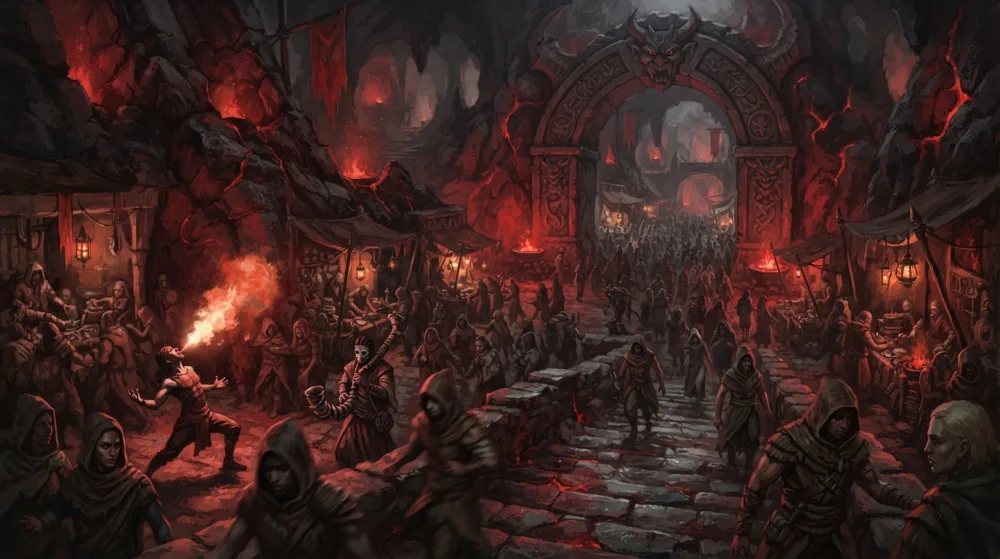
Precinct Comparison
| Precinct | Character | Affiliated guilds | Best campaign fit |
|---|---|---|---|
| Precinct One | Wealthy, courtly, tightly policed | Azorius, Orzhov, Selesnya | Political intrigue, espionage, a stable neutral home base |
| Precinct Two | Working professionals, quiet corruption | Azorius, Boros, Orzhov | A grounded, morally grey crime drama under a respectable surface |
| Precinct Three | Nature reclaimed by the city, communal | Selesnya, Gruul | Pastoral downtime, livestock and beast-handling hooks, occasional Gruul raids |
| Precinct Four | Constant low-grade war zone | Boros, Izzet, Gruul, Rakdos | Combat-forward campaigns, a party that wants conflict from session one |
| Precinct Five | Universities, libraries, information brokers | Simic, Izzet, Dimir, Azorius | Mystery, research, espionage, a spellcaster-heavy party |
| Precinct Six | Working-class docks and warehouses | Orzhov, Golgari, Boros, Rakdos | Street-level crime, smuggling, a fast route down into the undercity |
Precinct One
Precinct One is the seat of Ravnica's wealth and government, and it reads that way on every street. Immaculately maintained avenues and manicured gardens create an impression of order and high culture, filled during the day with tourists, diplomats, and financiers, and quiet at night except for lit carriages carrying the well-off between exclusive nightclubs and restaurants. Neighbors here are polite toward others of their own station, but gossip travels fast and is broadly accepted as a matter of course.
All ten guilds keep some interest in Precinct One, but three dominate it. Lawyers, bureaucrats, and soldiers of the Azorius Senate are visible throughout the precinct, since this is effectively the city's administrative center. The Orzhov Syndicate runs many of the clubs and restaurants and keeps both its guildhall, Orzhova (the Church of Deals), and its monumental Vizkopa Bank here. The Selesnya Conclave maintains the grounds around the central plaza and often supplies diplomatic envoys for negotiations that take place in the precinct.
Neighborhoods and landmarks. Tenth District Plaza sits at the precinct's heart: kept perpetually clean by magic and patrolled by Azorius arresters, it counts as neutral ground for every guild, gang, and faction in the city, and drawing a weapon there brings a fast response. Plaza Avenue connects the plaza's south end to the Chamber of the Guildpact, the grand meeting hall where the Living Guildpact keeps a rarely used office while functionaries carry out the actual work of adjudicating inter-guild disputes. Plaza East houses government officials and visiting diplomats. Plaza West holds the district's best nightclubs and restaurants, most Orzhov-run, with few permanent residents beyond the very rich. Plaza South, derisively called Downside by the elite, is the actual hub of commerce, home to specialty shops and the merchants and crafters who work them.
Goods and services. Few general shops operate in Precinct One. Luxury goods, grooming supplies, and fine clothing fill the boutiques, and even practical gear like backpacks and lanterns carries artisan flourishes and a price to match. Standard adventuring equipment, weapons, and armor are hard to find here. Meals and lodging run from comfortable to aristocratic depending on the neighborhood, and a party trying to maintain anything less than a modest lifestyle can expect disadvantage on Charisma checks with residents, at the DM's discretion.
Law and crime. Azorius law enforcement is constant, with at least one arrester per street and a typical crime response of 1d6 minutes, backed by precognitive mages who flag trouble before it fully starts. Very little street-level crime survives that scrutiny. What crime exists moves into private rooms in exclusive establishments, where the Orzhov and other wealthy criminals run high-end black market deals well away from arrester eyes.
Rumors and hooks. A couple of dignitaries reportedly went missing from the opera house mid-performance. A merchant named Nolson is said to be selling enchanted purses and handbags that move fast. A wailing spirit has been seen floating over the plaza, apparently agitated about something inside Vizkopa Bank. And an elderly Orzhov syndic was recently overheard near the plaza handing out coins and muttering that the end is near, a strange enough scene that it has become neighborhood gossip in its own right.
Precinct Two
Small houses, modest apartments, and commercial shops fill Precinct Two, home to law enforcement officers, lawyers, retired soldiers, and working families. Streets stay tidy and buildings serviceable, but beneath that urbane surface, tension simmers between officers of the law and the opportunistic crime families who also call this precinct home. Residents value civic duty, conformity to one's role, and strong family ties, and friendly rivalry over who is achieving more is a normal part of good neighborliness.
New Prahv, the Azorius Senate's guildhall, sits at the precinct's eastern edge, and many residents work there directly. Active officers and retired soldiers of the Boros Legion make their homes here as well. The Orzhov Syndicate maintains a quieter presence through its ties to many of the small businesses.
Neighborhoods and landmarks. New Prahv itself is the tallest structure in the Tenth District, three towering columns each housing one of the Senate's three branches. Whitestone, on the precinct's north side, is an orderly neighborhood of alabaster stone houses built to house New Prahv's workers; its construction displaced many residents into the far more crowded Griffin Heights to the south, where corruption runs deep and less scrupulous officials trade information and money with the Orzhov in the neighborhood's business fronts. Augustin Station, the district's main airship terminal, sits at Griffin Heights' western edge, with twenty platforms running flights to the Millennial Platform, other Tenth District precincts, other districts entirely, and destinations across the wider world. A ten-foot granite statue of Agrus Kos, a Boros soldier who became a hero foiling schemes against the Guildpact during the Decamillennial Celebration decades back, stands in a small Whitestone park and doubles as an informal gathering point for veterans, mob contacts, and spies playing strategy games in the open.
Goods and services. Most merchandise is available somewhere in Precinct Two. Former soldiers and ex-adventurers run many of the shops, and weapons and armor are commonly available in Griffin Heights specifically. Meals and lodging skew modest to comfortable, with corner taverns doubling as neighborhood social centers. Locals are unwelcoming to anyone who does not fit the precinct's modest-lifestyle norm, whether too poor or too rich; adventurers at either extreme can face disadvantage on Charisma checks here.
Law and crime. Response to a reported crime runs about 2d6 minutes, backed by two Azorius soldiers or a half-dozen Orzhov thugs depending on which side of the precinct's power struggle is closer. That struggle between law enforcement and organized crime rarely turns openly violent (antagonists tend to simply disappear or have an accident instead), though outright violent crime involving psychologically scarred ex-soldiers does surface from time to time.
Rumors and hooks. A shopkeeper named Janus is unloading merchandise unusually fast, raising suspicion he is in some kind of trouble. A weaponsmith named Minera is quietly moving high-quality, possibly enchanted blades. Two Boros minotaurs garrisoned at Sunhome spent a night at Newson's Tavern trading stories about a strange madness spreading through their ranks. An airship docked overnight at Augustin Station with no crew aboard and no explanation for how it arrived. And a lawmage reportedly went berserk, requiring two full arrester squads to subdue, repeating only that a homunculus made him do it.
Precinct Three
Ample parks, busy stables, and large gardens give Precinct Three, known informally as the Greenbelt, a different feel from the rest of the district. Nature and urban life intermingle here, and residents treat it as a respite from the noise elsewhere in the Tenth District. Families have lived in the same structures for generations, days center on tending gardens and animals, and evenings turn to communal storytelling and performances by trained beasts. Neighbors here are comfortable sharing space with pets and beastly companions and pitch in freely to help with plants, animals, and children.
The Selesnya Conclave's influence dominates the precinct, anchored by Vitu-Ghazi, its towering guildhall-tree, at the northern edge. Members of the Gruul Clans occasionally venture into the precinct's northern reaches, and rarely for peaceful reasons.
Neighborhoods and landmarks. Vitu-Ghazi itself doubles as a cathedral to Mat'Selesnya and draws Selesnya pilgrims from across Ravnica; anyone approaching without ill intent is welcome in its public areas. The Canopy, the northern neighborhood beneath Vitu-Ghazi's shadow, houses a growing population in buildings built around and among the trees, connected by ladders and rope walkways. The Great Concourse, an elevated network of white stone roadways, links the major Selesnya communities and doubles as a busy marketplace on ordinary days and a mass gathering point on high holy days. Concordance, the precinct's oldest neighborhood, sits atop former Orzhov structures long since reclaimed by moss and shrub growth. Beast Haven, the western neighborhood, is filled with pastures and stables where beasts of labor are trained and sold; escapes and minor rampages happen occasionally but get handled fast by the tough locals.
Goods and services. Precinct Three is the Tenth District's main food source, and the finest steeds and livestock come from here (though war beasts are usually trained separately in Precinct Four). Barter is welcome here, unusually for the district, and some vendors refuse coin outright. Manufactured goods are relatively scarce outside big markets like the Great Concourse. Lodging quality varies widely, skewing pricier in Concordance and cheaper in Beast Haven. Residents do not judge much by appearance or visible wealth, though the very wealthy tend to draw quiet dislike; adventurers keeping an aristocratic lifestyle can face disadvantage on Charisma checks here.
Law and crime. Precinct Three largely polices itself. Each block elects a watch captain trained by Selesnya soldiers, backed by citizen volunteers in a crisis. Typical response to a reported crime is 1d8 minutes, handled by a watch captain with two guards or two wolves (a knight or a Selesnya druid with a topiary guardian in Concordance specifically). Crime here splits into two forms: outright banditry, usually targeting visitors or carried out beyond the precinct's borders, and livestock theft, which occasionally flares into neighbor-on-neighbor violence, especially in Beast Haven.
Rumors and hooks. Something has been spooking the pack animals for no clear reason. An old rubblebelt granary is rumored to be stuffed with bandit plunder. Giant spiders above Velen's Rest have turned aggressive, and someone was already poisoned. Vitu-Ghazi is due to close to visitors, with no announced reason. Ground tremors last night were probably wurms tunneling nearby, unwelcome news to the Selesnya. And a loxodon priest is said to still be having visions worth asking about, if anyone can track her down.
Precinct Four
Few days or nights pass quietly in Precinct Four. The frequent din of battle as Boros soldiers guard against Gruul marauders, the strange sounds of volatile Izzet experiments, and occasional goblin gang flare-ups keep the precinct dynamic and dangerous. Buildings range from ramshackle tenements damaged by past conflict to impregnable fortresses and laboratories to busy, well-defended markets. Residents here are always ready for a fight, and good neighbors are the people who stand with you when the fighting starts.
The Boros Legion keeps its guildhall fortress, Sunhome, here, forming the heart of the precinct's defense against threats from the northern rubblebelt. The Izzet League likes testing its latest experiments in this precinct, with its towering guildhall, Nivix, rising over the south end. The Gruul Clans frequently raid in from the rubblebelt to the north. The Cult of Rakdos delights in stoking the precinct's constant conflict, both for mayhem's sake and for inspiration for future performances.
Neighborhoods and landmarks. Sunhome is an imposing fortress, barracks, and spiritual center all at once, widely believed impregnable and treated as a symbol of Boros resolve to any attacker from the north. Nivix, one of the tallest towers in Ravnica, crackles with wild Izzet power and houses labs, testing facilities, and inventor housing. The Red Wastes to the north are a rubblebelt wasteland of ruins and debris, home to the Gruul Clans and the beasts, elementals, and monsters they share the space with; almost nobody else lives there by choice. The Bulwark, between Sunhome and Nivix, is filled with reinforced low-rent apartments and shops for workers and professionals who see opportunity in supporting the Boros garrison. Skarrg, a gutted, cratered ruin in the Red Wastes, is the closest thing the Gruul have to a guildhall: clans converge there periodically to roast boars, boast, and form a loose camaraderie before scattering again. It is emphatically not neutral ground, and outsiders are not welcome.
Goods and services. Availability swings wildly by neighborhood. The Red Wastes have essentially no formal commerce beyond bartering with or scavenging from the Gruul. The Bulwark stocks basic goods and services, with weapons and armor especially plentiful thanks to the constant threat of conflict and nearby Precinct Six foundries. Tin Street, which runs through the precinct's western portion, has nearly anything available for the right price. Lodging ranges from squalid to wealthy, and affluent residents tend to keep their wealth quiet to avoid becoming raider targets. Adventurers keeping either a squalid or an aristocratic lifestyle can face disadvantage on Charisma checks here, at the DM's discretion.
Law and crime. Much of Precinct Four functions as a war zone, and mundane law enforcement does not always keep up. Boros patrols offer no guarantee of safety, and nearly everyone here knows how to fight to some degree. Typical response to a reported crime or dangerous threat is 1d8 minutes, backed by a Boros knight leading 4d4 soldiers. Petty crime draws little attention since soldiers stay focused on violence and mayhem. The Red Wastes sit mostly beyond the reach of both Boros patrols and Azorius law. Elsewhere, goblin gangs shake down locals and skirmish over turf, and the Shattergang Brothers, a notorious gang working Tin Street, deal openly in weapons and explosives.
Rumors and hooks. Sergeant Uwen reportedly got hold of something that even Gruul war wurms fear, powerful enough to send one running just by standing there. Anyone shopping for the best deals on explosives should talk to the Shattergang Brothers, no questions asked. Niv-Mizzet's severed head was allegedly seen floating above Nivix last night. A merchant named Beria on Tin Street has new curiosities from an undercity expedition, possibly magical. A whole street has smelled of sulfur for two days, and people are getting sick with the soldiers slow to react. And someone swears they saw an angel and a demon having a perfectly polite conversation.
Precinct Five
Prestigious universities, ancient libraries, and hidden laboratories make Precinct Five the Tenth District's hub of learning. People of every age come here to study, whether poring over texts or seeking out a mentor, and it is also the place to find information brokers dealing in knowledge available nowhere else. Multilevel buildings crowd together with little regard for planning, opening occasionally onto a square or campus where the socially minded gather during the day. Taverns and pubs here run more urbane than elsewhere in the district, often hosting poetry readings and musical performances into the night.
Residents value intellectual zeal and inquisitiveness; a heated debate or touting a recent success is a normal way to show your worth, and good neighbors keep unfinished projects hidden until the results are ready to show. Zonot Seven, home to the Simic Combine's guildhall, sits on the precinct's western edge. The Izzet League maintains a network of labs and workshops near Nivix in Precinct Four but keeps a real presence here too. House Dimir agents move seen and unseen throughout the precinct, secretly running the Ismeri Library. Some members of the Azorius Senate who prefer scholarship to law also make their homes here.
Neighborhoods and landmarks. Zonot Seven is a watery habitat of huge sinkholes filled with overflow from a subterranean ocean, home to Zameck, the Simic guildhall, and the only zonot within Ravnica City proper; a large chamber just below street level is a gathering place for Simic speakers, including Prime Speaker Zegana. The Blistercoils, a series of giant Izzet-built waterwheels at the precinct's north end, generate far more magical energy than public works, Simic labs, and Izzet workshops actually use, with the dangerous excess stored in underground batteries. Hightower, the western end of the precinct, is packed with schools of every scale and specialty, most topped with a signature spire. Prism University, a crystal-paned school of magical theory, maintains a formal state of neutrality even though it is an open secret that most guilds have planted agents there to recruit promising students. The Ismeri Library, one of the greatest libraries on Ravnica, holds hundreds of thousands of books and also functions as a secret hub of Dimir communication, with coded messages hidden across multiple volumes.
Goods and services. Small shops run by tinkers and academics stock specialty items for scribes, researchers, and inventors, and Precinct Five has the district's best apothecaries, alchemists, and magic-mongers. Mundane adventuring gear, weapons, and armor are comparatively hard to find. Information itself is a valuable commodity here, traded openly by booksellers, private investigators, rumormongers, and spies. Lodging runs modest to wealthy, with high-ranking Simic researchers and established scholars skewing toward the pricier end. Both the very poor and the very rich draw uneven treatment here; adventurers at any lifestyle extreme can face disadvantage on Charisma checks, at the DM's discretion.
Law and crime. Crime in Precinct Five tends toward the hard-to-detect: blackmail, espionage, and literal identity theft by shapechangers. Most residents, absorbed in their own studies, have no idea it is happening around them. Violence is rare, and Azorius arresters work hard to keep any incident quiet to preserve public calm. Typical response to a reported crime is 1d12 minutes, handled by two veteran Azorius arresters.
Rumors and hooks. A translocation device is reportedly operating at only fifty percent tolerance, and funding is expected to be pulled any day. Zameck has apparently built a better soldier, and some of the formulas involved have leaked outside Simic halls. A ghost haunting the Ismeri Library's history section can now speak, and it is said to be looking for someone specific. Elemental-composed creatures were seen emerging from the Blistercoils this morning and could be anywhere in the city by now. A researcher let her rival see unpublished findings, and she is rumored to be about to sell them to an information broker. And a merchant named Sila has new exotic spell components said to enhance magic in ways nothing else can.
Precinct Six
Large warehouses, major thoroughfares, and nondescript worker tenements make the utilitarian Precinct Six a hub for shipping, storage, and mercantile trade. Wide cobblestone streets carry beasts and constructs hauling raw goods in and manufactured materials back out, and the near-constant activity, plus the anonymity of so many warehouses, makes the precinct popular for both legal and illicit rendezvous. At night, undead and horrors climbing up from Deadbridge Chasm keep wary residents indoors, while a few people who deal in darker magic go looking for the monsters instead.
Residents are practical-minded and tolerant of a fair amount of illicit activity as long as everyone minds their own business, aside from the Smelting Quarter, where the atmosphere runs louder and rowdier. The Orzhov Syndicate owns many of the precinct's warehouses and controls much of the commerce around Tin Street. Members of the Golgari Swarm work the edges of Deadbridge Chasm, an opening into their sprawling underground network. The Boros Legion rents warehouse space for manufactured goods from the Smelting Quarter, and Kamen Fortress garrisons troops to protect that interest. The Cult of Rakdos runs a number of pain clubs across the precinct, especially near Tin Street, and Rakdos street performances are more common here than anywhere else in the district.
Neighborhoods and landmarks. The Smelting Quarter, at the precinct's north end, is the heart of the district's manufacturing industry, smoky and busy day and night; goblins settle near its factories on Foundry Street, and clashes between Boros soldiers, goblins, and Rakdos cultists are common. The Gore House, a Rakdos club run by a viashino named Nyoser, occupies a defunct factory in the Smelting Quarter's south end and also holds the main entrance to the Demon's Vestibule, the stairway down to Rix Maadi. Medori Park, in the precinct's west, is named for an Orzhov pontiff who converted a city park into a warehouse lot; it is especially rife with undead after dark, and the Orzhov and Boros both guard their most valuable stored goods there, often with angels. Deadbridge Chasm, a gaping opening lined with mossy stairs and fungal blooms, is the entrance to the Golgari's undercity domain and their guildhall, Korozda; kraul make homes in the walls lining its descent, and Devkarin elves climb up through it to trade on Tin Street. Wayport rises like a pillar from the middle of the chasm, connected to the surrounding city by bridges large and small, and only the wealthiest merchants can afford its storage space. Benzer's Bridge, a major cargo thoroughfare, hosts a small daytime market and, after dark, secret pain clubs hidden in rooms below it.
Goods and services. Trade goods and artisan's tools are readily available in Precinct Six, though weapons, armor, and mounts are rarely sold openly here. Fences deal in stolen and otherwise illicit goods, and along Tin Street, most anything can be had for the right price. Lodging runs poor to modest, matching the laborers, dockhands, and performers who live here; the wealthy are treated as outsiders, and the destitute are generally shunned. Adventurers keeping a lifestyle cheaper than poor or pricier than modest can face disadvantage on Charisma checks here, at the DM's discretion.
Law and crime. Precinct Six's residents are pragmatic and not overly concerned with minor crime. Azorius arresters patrol the warehouse districts, and Boros soldiers stay common near the warehouses and Smelting Quarter, with a typical response time of 2d10 minutes and a squad of two Boros soldiers. At night or in the Smelting Quarter specifically, expect 1d4 Boros soldiers led by a sergeant instead. Organized crime runs deep here, especially the goblin gang controlling Foundry Street under a goblin named Krenko, and turf wars flare regularly. Violent crime is common across the precinct, with most bodies ending up in Deadbridge Chasm, and night-lurking monsters remain a persistent problem, striking and vanishing before help can arrive.
Rumors and hooks. Something very large lurked in the chasm last night and knocked a carriage clean off a bridge; the passengers barely escaped. Krenko's gang is reportedly paying well for mizzium, no questions asked. A wight has struck again in Precinct Six, this time draining an arrester and a cutpurse in an alley in front of a witness. Unearthly shrieking near Benzer's Bridge kept residents awake and unnerved. A smith named Rhionna is closing her forge over constant tool theft, though her staff insists they are innocent. And a warehouse in Medori Park glowed an intense red through its windows last night, smelling of sulfur, with nobody willing to go check it out.
The Undercity
Below the sewers and transit tunnels of the city works lies the undercity, a separate society of people who have no desire, or no choice, to live under the open sky. Four guilds hold real power down here: House Dimir, the Golgari Swarm, the Cult of Rakdos, and the Simic Combine, each occupying its own network of caverns, causeways, and flooded chambers.
Nightveil. The sprawling residence of much of House Dimir's elite, Nightveil partly overlaps the Tenth District within the undercity. An extensive natural cavern network houses high-walled mansions and sunken crypts built with a grand, sinister motif, and patrolling specters and other incorporeal undead make unwelcome entry difficult.
Dusk Mantle. The House Dimir guildhall proper is protected by memory wards, glyphs of warding that store modify memory spells, specifically so that almost nobody who has actually been there remembers it afterward beyond what is strictly necessary. Most assume it lies somewhere within Nightveil, but it could just as easily be anywhere else in the undercity.
Korozda. Also called the Maze of Decay, Korozda is an arched subterranean cathedral surrounded by fungal hedgerows and moss-covered ruins, home to the Golgari Swarm. Its center holds a great amphitheater where the Golgari bring their most important issues for debate. Penvar, the Hanging Keep, is a castle fixed upside down on the ceiling above Korozda's entrance, garrisoned mostly by insectoid kraul soldiers who keep unauthorized visitors out.
Rix Maadi. Known as the Dungeon Palace, Rix Maadi is the Cult of Rakdos's guildhall and the demon Rakdos's own lava-filled lair. The Demon's Vestibule, an immense crumbling red stone staircase beginning at the Gore House in the Smelting District, carries travelers down through terrifying banner-hung images as they descend. Farther down, the temperature climbs until the passage opens into the Festival Grounds, where the Rakdos stage their bloodiest performances alongside their torturous equipment.
The Undersea. Rivers, lakes, and oceans run deep beneath Ravnica's surface, several connecting directly to the Simic Combine's zonot habitats. Aquatic races and monsters use these waterways as their own thoroughfares, making the Undersea as much a transit network as a habitat.
Don't treat the undercity as a generic Underdark reskin with different guild names stapled on. The Underdark's core appeal is that nothing down there wants you alive; Ravnica's undercity is the opposite pitch: four fully functioning societies with their own economies, politics, and guildhalls, where the danger comes from those societies' own rules, not from an absence of civilization. A party that walks into Rix Maadi expecting mindless monsters instead finds a working demon-run entertainment district with its own bouncers, ticket prices, and etiquette. That mismatch of expectations is worth more at the table than another dark-tunnel ambush.
Trade Ways, Sewers, and Transit
Two major avenues cross the entire Tenth District, cutting across precinct lines and giving a party a fast, memorable route between otherwise distant neighborhoods. Tin Street is the longest thoroughfare in the city and a hub of activity day and night, popular for both shopping and nightlife thanks to its restaurants and theaters. Much of it runs through western Precinct Four, with other stretches claimed outright by goblin gangs; a visible Boros presence helps residents feel safer, though rubblebelt raiders and goblin thieves remain a real threat along its length. The Transguild Promenade runs from the edge of the Precinct Four rubblebelt to the southern gates of Precinct One, heavily patrolled by Boros soldiers in its northern reaches, with caravans from the north traveling under armed escort. Markets and parks line the Promenade as it winds through Precinct One, and parades fill the street on festive holidays.
Immediately below street level sits the city works: sewers and the transit system, maintained primarily by the Izzet League. Many Golgari Swarm members live or work down here, farming fungus and scavenging valuables from the muck, and Orzhov crypts and vaults, Dimir hideouts, and Simic laboratories all turn up in the city works as well. Anchored by enormous chains at the point where Precincts One, Three, and Four meet, the Millennial Platform is a floating observation deck offering the best overhead view of the district and home to its most exclusive restaurant; every citizen gets one free airship token to the platform each year, but a table at the Millennial Restaurant itself often takes months to book.
Sewers run in a vast, winding network lit by continual flame spells. Storm sewers carry rainwater and street debris into great cisterns for purification before it enters the plumbing that serves Ravnica's nicer neighborhoods; separate sewers carry waste and refuse into different cisterns or dump it straight into the undercity's subterranean oceans. Pipe tunnels, wrapped around the sewer system, carry steam, distilled magical energy, and water throughout the city; they are large enough for a humanoid to walk through but often uncomfortably hot and thin on breathable air. Transit tunnels hold magically charged tracks that send vehicular constructs to major locations across the Tenth District and beyond, opening into small stations with stairs leading back up to the surface. Crypts scattered through this layer hold ancient resting places, many warded against unauthorized entry; some serve as homes for restless undead, others as gathering points for thieves and smugglers who prefer working out of sight.
For a party, this layer is the practical connective tissue between the surface precincts and the undercity proper: a transit tunnel gets characters across the district fast, a pipe tunnel gets them somewhere they are not supposed to be, and a sewer or crypt entrance is often the quiet, unwatched way down into Nightveil, Korozda, Rix Maadi, or the Undersea.
Guild-Flavored Magic Items
Ravnica does not have a generic treasure pile. Every one of the city's ten guilds mints its own coinage, crafts its own gear, and rewards its own loyalists with items that look and function like the guild that made them. An Azorius arrester carries a Guild Signet that casts ensnaring strike; a Rakdos cultist carries the same ring set to cast hellish rebuke. Find a Mizzium-line device and you already know the Izzet League built it. Find a shield sculpted with a grieving human face and you already know it came off a fallen Boros soldier.
That is the point of this chapter of the book: treasure as characterization. Below are the ten guild-affinity item tables that tell you what each faction values, followed by full mechanics for every item the book introduces, grouped by their actual printed rarity rather than an assumed one.
Guild Affinity at a Glance
The book ties two items to every single guild: a Guild Keyrune and a Guild Signet, each with a distinct rarity, effect, and spell per guild. Beyond those two, each guild's table names a short list of Dungeon Master's Guide (DMG) items that fit its culture, plus any items unique to that guild. The table below summarizes the flavor; full mechanics for the DMG items live in the D&D 5e 2014 Magic Items Guide, not here.
| Guild | What they value | Guild-original items | Representative DMG items |
|---|---|---|---|
| Azorius Senate | Items that subdue wrongdoers and heighten vigilance | Guild Keyrune (Rare), Guild Signet | Rod of Alertness, Wand of Binding, Defender, Rod of Lordly Might |
| Boros Legion | Weapons of war and angel-blessed relics | Guild Keyrune (Rare), Guild Signet, Pariah's Shield, Sunforger | Holy Avenger, Sun Blade, Horn of Valhalla, Spellguard Shield |
| House Dimir | Stealth, disguise, and mind-shielding | Guild Keyrune (Very Rare), Guild Signet, Spies' Murmur | Ring of Invisibility, Cloak of Invisibility, Crystal Ball, Hat of Disguise |
| Golgari Swarm | Scavenged goods, stealth, insects, and poison | Guild Keyrune (Very Rare), Guild Signet, Moodmark Paint | Ring of Regeneration, Staff of Swarming Insects, Cloak of Arachnida |
| Gruul Clans | Destructive weapons and strength-enhancing gear | Guild Keyrune (Rare), Guild Signet | Belt of Giant Strength, Berserker Axe, Ring of Spell Turning |
| Izzet League | Unpredictable, experimental invention | Guild Keyrune (Rare), Guild Signet, Mizzium Apparatus, Mizzium Armor, Mizzium Mortar, Pyroconverger | Staff of the Magi, Apparatus of Kwalish, Ring of Elemental Command |
| Orzhov Syndicate | Ornate status symbols and items of authority | Guild Keyrune (Rare), Guild Signet | Tome of Leadership and Influence, Rod of Rulership, Sphere of Annihilation |
| Cult of Rakdos | Fire, spectacle, fear, and controlled destruction | Guild Keyrune (Uncommon), Guild Signet, Rakdos Riteknife | Iron Flask, Nine Lives Stealer, Sword of Sharpness, Necklace of Fireballs |
| Selesnya Conclave | Healing, nature magic, and elven weaponcraft | Guild Keyrune (Rare), Guild Signet | Rod of Resurrection, Staff of Healing, Oathbow, Elixir of Health |
| Simic Combine | Transformation, adaptation, and aquatic gear | Guild Keyrune (Uncommon), Guild Signet | Wand of Polymorph, Manual of Bodily Health, Cloak of the Manta Ray |
Five more items do not belong to any single guild. The book lists them on a General Items table because every guild is happy to use them: the Skyblinder Staff (Uncommon), Illusionist's Bracers, Peregrine Mask, Sword of the Paruns, and Voyager Staff (all Very Rare). All five appear in the write-ups below.
One more guild reward exists outside this item list: a guild charm, a single-use magical effect placed on a mundane object and given to a member with a renown score of 10 or higher. Charms let their bearer cast one of a handful of guild-themed spells for free, once, before vanishing. It is a narrower, more disposable reward than the items covered here, and specific enough to each guild's spell list that it is best understood alongside that guild's own entry.
Guild Keyrune
Wondrous item, rarity by keyrune (requires attunement by a member of the relevant guild)
A guild keyrune is a foot-long ceremonial key carved from stone, one per guild, that functions as a badge of authority granting access to that guild's headquarters and outposts. A DM can hand one to a character whose renown with the guild reaches 25.
Speak the keyrune's command word as an action and set it on the ground in an unoccupied space within 5 feet of you, and it transforms into a specific creature (several of which are unique to this book's own bestiary rather than the core Monster Manual). The creature is friendly to you, your companions, and your fellow guild members, understands your languages, and obeys spoken commands, or takes the Dodge action and moves to avoid danger if you give none. It reverts to keyrune form at the end of its duration, early if it drops to 0 hit points, or early if you speak the command word again while touching it. Once it reverts, it cannot transform again for 36 hours.
| Guild | Rarity | Creature | Duration | Notable feature |
|---|---|---|---|---|
| Azorius | Rare | Giant eagle | 1 hour | Telepathy within 1 mile; you can see and hear through it as an action |
| Boros | Rare | Veteran (human) | 8 hours | Fights for you and offers usually-sound tactical advice |
| Dimir | Very Rare | Intellect-devourer-shaped horror | 24 hours | Pursues one mission you assign, then reports back |
| Golgari | Very Rare | Giant scorpion | 6 hours | INT 4; telepathic with you within 60 feet |
| Gruul | Rare | Ceratok (rhinoceros-like beast) | 1 hour | Cobbled-together, crude keyrune form |
| Izzet | Rare | Galvanic weird | 3 hours | Serves as bodyguard, laborer, or lab test subject |
| Orzhov | Rare | Winged thrull | 2 hours | Grudging, mocking service if you are not Orzhov-born |
| Rakdos | Uncommon | Cackler | 1 hour | The only Uncommon keyrune variant |
| Selesnya | Rare | Dire wolf | 8 hours | INT 6; telepathic with you within 1 mile; understands Elvish and Sylvan |
| Simic | Uncommon | Category 1 krasis (Grabber and Stabilizing Legs adaptations) | 5 hours | The other Uncommon keyrune variant |
Guild Signet
Ring, uncommon (requires attunement)
A guild signet is awarded to a member whose renown score reaches 5. It has 3 charges and regains 1d3 expended charges daily at dawn. While wearing it, expend 1 charge to cast the spell tied to your guild (save DC 13, no material components required beyond the ring itself).
| Guild | Associated spell |
|---|---|
| Azorius | Ensnaring strike |
| Boros | Heroism |
| Dimir | Disguise self |
| Golgari | Entangle |
| Gruul | Compelled duel |
| Izzet | Chaos bolt |
| Orzhov | Command |
| Rakdos | Hellish rebuke |
| Selesnya | Charm person |
| Simic | Expeditious retreat |
A Guild Signet is a low commitment, low rarity item that still delivers a free, no-component casting of a useful spell up to three times a day, refreshing on its own schedule rather than a long rest. That makes it one of the most efficient early-game guild rewards in the book, worth handing out well before a character earns anything rarer.
Common and Uncommon Items
Moodmark Paint (wondrous item, common). A small jar holds enough thick, black paint to mark one creature's face for a single use; applying it in dabs and spots that resemble insect or spider eyes takes 1 minute. For the next 8 hours, the marks shift to reflect your emotional state. A creature that can see you and succeeds on a DC 10 Wisdom (Insight) check can tell whether you are happy, sad, angry, disgusted, surprised, or afraid, plus the main source of that emotion. A dark elf reading the marks has advantage on that check, a small nod to the Golgari Swarm's heavy Devkarin membership, since this is a Golgari-table item.
Mizzium Apparatus (wondrous item, uncommon, requires attunement by a sorcerer, warlock, or wizard). An Izzet harness of leather straps, tubing, glass cylinders, and mizzium-alloy fittings, weighing 8 pounds. While wearing it, you can use it as an arcane focus, and you can attempt to cast a spell you do not know or do not have prepared, provided the spell is on your class's spell list, you have a slot of the right level, and you can supply its components. Expend the spell slot as normal, then make an Intelligence (Arcana) check (DC 10 + twice the spell's level) before it resolves. Succeed, and the spell you chose goes off normally. Fail, and you instead cast a different spell, determined randomly from a fixed table for that slot's level (1st-level options include burning hands, chaos bolt, and color spray; the tables continue up through 5th level, with a 6th-level-or-higher slot rolling on the 5th-level table). Attempting an unknown cantrip uses a flat DC 10 check instead, with no effect at all on a failure.
The Mizzium Apparatus is a gamble: it lets a Wizard or Sorcerer punch outside their known spell list, but a failed check burns the slot on a spell you did not pick. It rewards a build that already has a strong Arcana bonus and can stomach the variance.
Pyroconverger (wondrous item, uncommon, requires attunement). An Izzet-made handheld flamethrower. As an action, project fire in a 10-foot cone; each creature in the area makes a DC 13 Dexterity save, taking 4d6 fire damage on a failure or half on a success. Each time you use it, roll a d10 and add the number of times you have used it since your last long rest. On an 11 or higher, it malfunctions: you take 4d6 fire damage yourself, and you cannot use it again until you finish a long rest.
The malfunction math means the Pyroconverger gets more dangerous to its own wielder the more you lean on it in a single day. By the third or fourth use in a fight, it is a coin flip against your own face.
Skyblinder Staff (staff, uncommon, requires attunement). You gain a +1 bonus to attack and damage rolls with this quarterstaff, and a +1 bonus to spell attack rolls while holding it. When a flying creature you can see within 30 feet makes an attack roll against you, you can use your reaction to hold the staff aloft and flare it with light: the attacker has disadvantage on the roll and must succeed on a DC 15 Constitution save or be blinded until the start of its next turn. A General item, meaning any guild might field one, but an obvious pick for a character who regularly fights aerial threats.
Spies' Murmur (wondrous item, uncommon, requires attunement). A dark-metal headpiece worn curved around the ear. If you know a creature wearing another Spies' Murmur within 1 mile, you can communicate with them telepathically. As a bonus action, you can let that creature hear everything you hear for 1 hour; you can end this early as a bonus action, and it ends automatically if you are incapacitated. House Dimir's signature item, and one of the few in this book built entirely around a non-combat function.
Rare Items
Mizzium Armor (armor, medium or heavy but not hide, rare). Reinforced with the Izzet League's magic-infused metal alloy, this armor does not require attunement. While wearing it, any critical hit against you becomes a normal hit instead. When you are subjected to a magical effect that lets you make a Strength or Constitution save to take half damage, a successful save instead means you take no damage at all.
Both properties are strictly defensive and always on, which makes Mizzium Armor unusually strong for a Rare item with no attunement cost: a free slot's worth of survivability against two of the most common threat types a martial character faces.
Mizzium Mortar (wondrous item, rare). A 2-foot mizzium tube with a glowing ball of molten metal visible at the loaded end. It has 4 charges, regaining 1d4 daily at dawn. Molten Spray expends 1 charge as an action to loose a 30-foot cone of molten mizzium; each creature in the area makes a DC 15 Dexterity save, taking 5d4 fire damage on a failure or half on a success. Mizzium Bombard expends 3 charges as an action to launch a hail of molten projectiles in a 20-foot-radius, 40-foot-high cylinder centered on a point you can see within 60 feet; each creature in the area makes a DC 15 Dexterity save, taking 5d8 fire damage on a failure or half on a success.
With only 4 charges and Mizzium Bombard costing 3 of them, this item is built for one big alpha strike per day rather than repeated use. Use Molten Spray for the smaller recurring threats, and save the Bombard charge for when enemies bunch together.
Pariah's Shield (armor, shield, rare, requires attunement). A Boros Legion shield sculpted with a grieving human face on its front. You gain a +1 bonus to AC for every two allies within 5 feet of you, up to a maximum of +3, stacking with the shield's normal AC bonus. When a creature you can see within 5 feet takes damage, you can use your reaction to take that damage instead, with its type changing to force. Built for a frontline defender surrounded by a tight formation: both properties scale with how many allies are actually standing next to you, which rewards holding a line over fighting solo.
Sunforger (weapon, warhammer, rare, requires attunement). You gain a +2 bonus to attack and damage rolls with this weapon. As an action, you can hurl it up to 120 feet to a point you can see; on arrival, it vanishes in an explosion, and each creature in a 20-foot-radius sphere centered there makes a DC 15 Dexterity save, taking 6d6 fire damage on a failure or half on a success. You can then use an action to recall it to your empty hand, but it cannot explode again until you finish a short or long rest. Leave it uncalled, and it reappears at the explosion point once you are no longer attuned to it or 24 hours pass. A Boros signature weapon that trades repeat explosions for a solid +2 melee weapon the rest of the time: functionally two items in one slot.
Very Rare Items
Illusionist's Bracers (wondrous item, very rare, requires attunement by a spellcaster). Originally developed by a House Dimir illusionist for casting multiple minor illusions at once, these bracers reach further: while wearing them, whenever you cast a cantrip, you can use a bonus action on the same turn to cast that cantrip a second time. A General item that any spellcasting class can use, and one of the strongest cantrip-focused items in the book. Doubling a damage cantrip's output every turn is a repeatable action-economy gain, not a situational one.
Peregrine Mask (wondrous item, very rare, requires attunement). While wearing this winged helm, you have a flying speed of 60 feet and advantage on initiative rolls. No charges, no activation, no duration.
Sword of the Paruns (weapon, longsword, very rare, requires attunement). You gain a +1 bonus to attack and damage rolls. Once on each of your turns while holding it, you can trigger one of three effects: after you use the Attack action to attack with the sword, let one creature within 60 feet use its reaction to make a weapon attack; after you take the Dash action, let one creature within 60 feet use its reaction to move up to its speed; or after you take the Dodge action, let one creature within 60 feet use its reaction to gain the benefit of the Dodge action. Named for the ten guild founders collectively, and mechanically the sword lives up to that framing: every use of its power benefits an ally, not the wielder, which makes it a strong pick for a support-leaning frontliner in a tight party over a pure damage build.
Voyager Staff (staff, very rare, requires attunement by a spellcaster). You gain a +1 bonus to attack and damage rolls with this quarterstaff, and a +1 bonus to spell attack rolls while holding it. It has 10 charges, and you can use an action to expend charges to cast one of the following using your own spell save DC: banishment (4 charges), blink (3 charges), misty step (2 charges), passwall (5 charges), or teleport (7 charges). It regains 1d6+4 charges daily at dawn. If you expend its last charge, roll a d20; on a 1, the staff vanishes forever. A General item and, alongside Illusionist's Bracers, one of the two strongest picks on the whole General table.
Legendary: Rakdos Riteknife
Weapon (dagger), legendary (requires attunement)
You gain a +1 bonus to attack and damage rolls with this cruelly serrated dagger, whose hilt resembles a demonic head and wings. Whenever you slay a creature with an attack using it, that creature's soul is imprisoned inside the dagger (holding up to five souls at once), restorable to life only by a wish spell. For each soul currently stored, your attacks with the dagger deal an extra 1d4 necrotic damage on a hit. While the dagger is within 5 feet of you, your dreams are haunted by whispers from the trapped souls.
Siphon Vitality. As a bonus action, release any number of stored souls to regain 1d10 hit points per soul released.
Annihilation. Once the dagger holds all five souls, you can use this property: as a reaction immediately after you hit a creature with the dagger and deal damage, release all five souls. If the target now has fewer than 75 hit points, it must succeed on a DC 15 Constitution save or die. If it dies, you cannot use Annihilation again until you finish a long rest.
Rakdos Riteknife's legendary rarity is carrying more weight than its base combat math. Strip away the soul-collecting gimmick and it's a +1 dagger, weaker on its face than a Rare Sunforger's +2 warhammer. The payoff, Annihilation's save-or-die, only exists after you've already landed five separate killing blows with this exact weapon and the target happens to be under 75 hit points when you trigger it. Compare that to the DMG's own legendary daggers and swords, which deliver their power on every swing rather than gating it behind a five-kill setup condition. It's a great roleplay item for a Rakdos-flavored character, and the extra necrotic damage per stored soul is a solid bonus while you're building toward that fifth kill. Just don't expect it to out-damage a straightforward legendary weapon turn over turn.
Every guild table above also names Dungeon Master's Guide items: a Rod of Alertness for Azorius, a Holy Avenger for Boros, a Wand of Polymorph for Simic, and so on. Those items work exactly as printed in the DMG; nothing about a Ravnica campaign changes their mechanics. For their full rules, rarity, and attunement requirements, see the D&D 5e 2014 Magic Items Guide.
Running a Ravnica Campaign
This is the DM-only half: how to build original adventures out of the guilds' constant, low-grade war with each other.
Ravnica does not need a campaign-ending prophecy to generate adventures. Ten guilds share one city, none of them fully trust each other, and the Guildpact keeps outright war illegal without making the tension go away. That is the whole engine. Pick a guild, pick a location that guild controls, pick a villain who wants something from it, and you have a session.
The framework below expands on the general adventure-building material in chapter 3 of the Dungeon Master's Guide, applying it to a setting where "which faction is behind this" is nearly always a more interesting question than "what is the monster." If you want the pre-written starting adventure that ships in the same chapter of Guildmasters' Guide to Ravnica, that is a separate, protected piece of content this guide deliberately does not cover; use the tools here to build your own instead.
Building a Guild-Based Adventure
Every guild-based adventure in this book is built from the same four ingredients: a guild location, a guild villain, a character objective, and an adventure hook. You do not need all four for a single session - a location and a villain are often enough - but knowing the full set means you always have a next step when a session runs short or a subplot needs filling out.
Guild locations. Each guild controls a signature type of site: an Azorius arrester station, a Boros garrison, a Dimir safe house, a Golgari undercity mansion, a Gruul rubblebelt encampment, an Izzet workshop, an Orzhov basilica, a Rakdos nightclub, a Selesnya vernadi, a Simic growth chamber. Any of these can anchor an adventure on its own: characters might need to break into one, break out of one, defend one, or infiltrate one under cover. A generic goal list works across all ten - prevent a catastrophe inside the location, find the source of strange occurrences, escape when disaster strikes, quell a riot, drive out a monster that has moved in, defend against an outside attacker, seize control of the site, or infiltrate and report back.
You can also chain two locations together into a single adventure: characters transport something recovered at the first site to the second, plant evidence at the second site to incriminate someone connected to the first, follow a fleeing suspect from one to the other, or use information gained at the first location to crack a mystery at the second. This is the fastest way to turn a single-session location crawl into a two- or three-session arc without inventing new mechanics.
Each signature location also comes with a concrete map in the source material and a table of possible mishaps specific to that site. An Izzet workshop is prone to wild magic surges, cursed objects, or a random antimagic field kicking in mid-scene, while a Dimir safe house is warded so thoroughly that most people who have been there have no memory of the visit at all. Lean on a location's specific flavor of danger rather than defaulting to a generic trap or ambush.
Guild villains. Every guild produces its own flavor of antagonist, but a handful of generic villain motives recur across all ten: someone trying to disgrace a powerful rival, someone climbing their guild's internal ranks by illegitimate means, someone who has already seized power and needs to be supplanted, agents infiltrating a rival guild, agents poaching members from a rival guild, or agents sabotaging a rival guild's operations. Layer a guild's specific culture on top of one of these generic shapes and you have a villain who feels native to Ravnica rather than a stock antagonist wearing a guild badge. If you need more texture once you have picked a motive, the Dungeon Master's Guide chapter 4 villain-scheme and villain-methods tables still apply.
Character objectives. Not every mission needs to come from outside the party. Guild membership gives characters their own reasons to adventure: retrieving an item important to the guild, extracting information from a guild contact, protecting or rescuing a guild member during a disaster, freeing a captured member, tracking down someone who has gone missing, hunting an enemy of the guild, bailing out a member who has run afoul of the law, or recruiting a promising prospect. This is where each guild's own flavor does the most work with the least setup. A Golgari character's guild missions lean toward retrieval and salvage in the undercity; an Orzhov character gets sent to collect debts or bury evidence; a Rakdos character is handed a flashy prop and told to test a new act mid-combat.
Adventure hooks. Hooks are the loosest of the four tools: situations that suggest adventure without locking in a specific villain or location. A sudden riot, an unexplained magical effect spreading through a neighborhood, a rumor that will not stop circulating. Hooks are how you open a session without committing to the whole shape of the adventure in advance, letting the party's choices determine which location or villain the hook eventually points to. Each precinct's rumor list above is a ready-made supply of them.
Don't reach for a world-ending Ravnica plot as your default. The book's own villain tables are built almost entirely from local, personal-scale stakes - a corrupt precinct captain, a jealous rival researcher, a nightclub owner covering up a death - and that's the setting working as intended. Ravnica's tension comes from ten factions permanently elbowing each other for territory, not from an apocalypse waiting to happen. Save the city-wide stakes for a campaign's actual climax; spend most of your sessions on the kind of guild-versus-guild pettiness that would never make it into a Forgotten Realms adventure but is exactly what makes this setting distinct.
Guild Versus Guild
Interguild conflict is Ravnica's default state, which makes a villain's guild affiliation an instant source of tension. If the whole party belongs to one guild, almost any other guild supplies a workable antagonist - the natural relationship between any two guilds runs from mutual suspicion to open hostility, and it only takes one villain willing to escalate that baseline into an actual scheme. A party's own guild can even supply the villain: a corrupt official, an internal rival, or a guildmaster who has gone rogue all put characters in conflict with the institution they nominally serve. When characters come from different guilds, a shared enemy from a guild none of them belong to gives the whole party a reason to cooperate without forcing anyone to betray their own faction.
Use the Cross Purposes idea to connect a villain's scheme to the party directly: have the villain's activity target a character outright, threaten something or someone they care about, challenge a personal ideal, or compete with their guild's own goals. A villain whose plans open an opportunity for a character's guild to advance its own agenda, or who catches the party physically between two factions already at odds, works just as well. The point is to make sure at least one character has a reason to care that does not depend on being told to care by an NPC patron.
A one-guild adventure is the simplest shape, but adding a second guild's involvement usually makes the story sharper. A rival pursuing the same goal by worse methods, bystanders from another guild caught between the villain and the party, a second wholly unrelated plot unfolding at the same time, or a rival who actively meddles hoping the party fails, all raise the stakes without requiring a bigger villain. A second guild can also help rather than complicate: a known rival might provide essential aid against the main villain specifically because it also serves their own guild's interests, which is a useful pressure-release valve when a session is running long on obstacles and short on allies.
Guild intrigue specifically tends to run through pairs of guilds: two factions competing for influence over a person, contesting a piece of territory, locked in a feud that might be negotiable, or forming a dangerous alliance a third guild wants disrupted. Splinter factions breaking off from two existing guilds to form an entirely new one is the most ambitious version of this idea, and works well as a campaign-length subplot rather than a single session.
Allies, Rivals, and the Quick Build
A friendly guild contact can act as a patron, sending a character on a mission or calling in a favor, and can occasionally get into trouble that forces the party to choose between rescuing them and pursuing the actual villain. An antagonistic contact works the opposite way: showing up at inconvenient moments, catching the party mid-crime, leaking information to the villain, or eventually becoming a villain in their own right. The most interesting complications come from contacts who overlap between characters - two NPCs who are each a different character's friend but bitter enemies of each other, or a single NPC who is a trusted ally to one character and a personal rival to another.
When you need a location-based adventure fast, the process collapses to three steps: pick a guild (randomly if you like), determine the adventure's goal from that guild's location list, then populate the site with creatures associated with that guild. Optionally chain in a second location using the framework above. This is the fastest path from "we need a session" to a runnable one-shot, and it scales cleanly into a longer arc once you decide the goal was not fully resolved.
Adventure Types by Guild
Some guilds naturally support certain adventure shapes better than others. Use this as a starting filter, not a hard rule: a Boros mystery or an Azorius dungeon delve both work fine if the specific villain calls for it.
| Adventure type | Guilds that fit best | Why |
|---|---|---|
| Dungeon delve | Dimir (heaviest), Golgari (heaviest), Rakdos, Simic | The undercity beneath Ravnica's streets is Golgari and Dimir home turf, with Rakdos and Simic sites also plausible underground |
| Wilderness | Gruul (heaviest), Selesnya | The rubblebelt ruins and cultivated sylvan wilds are the closest thing Ravnica has to open country |
| Plots and intrigue | Azorius, Dimir (heaviest), Golgari, Orzhov (heaviest), Simic | Every guild has internal politics, but Dimir and Orzhov are built entirely around scheming and leverage |
| Mystery | Dimir (heaviest), Golgari, Izzet, Orzhov (heaviest), Simic | Ravnica's rampant crime gives lawful and criminal characters alike plenty to investigate |
| Disaster | Golgari, Gruul, Izzet (heaviest), Selesnya, Simic (heaviest) | Magical mishaps, rampaging wurms, and terraforming accidents all threaten the surrounding neighborhood |
| Protection | Boros, Gruul, Orzhov, Rakdos (heaviest) | Criminal shakedowns, military raids, and riots give heroes someone concrete to shield |
Choosing a guild for an adventure comes down to three practical questions. First, which guild has an aesthetic or a story hook that actually excites you to run; that enthusiasm reads at the table more than any mechanical fit does. Second, which guild fits what your players are already drawn to - a table full of Rakdos characters is signaling they want mayhem and combat, while a Dimir-heavy table wants intrigue and sabotage, and their guild choices are a better guide to their tastes than asking directly. Third, which guild supplies the easiest villain: Gruul, Rakdos, Dimir, and Golgari are the book's own picks for straightforward antagonists.
Guild Villains and Campaign Arcs
Each guild below gets its signature location, its villain archetype, its hook flavor, and the campaign shape it supports best. For each guild's culture, suggested classes, and player-facing identity, see the ten guild entries above.
Azorius villains. Signature location: the arrester station, a combined courthouse, prison, and precinct headquarters. Villain archetype: an authority figure who abuses the machinery of law itself - a venal judge swayed by bribes, an overzealous imperator willing to arrest a whole neighborhood to find one stolen item, a precognitive mage inventing visions to frame enemies. Hook flavor: the law turning against the innocent. Run as a full campaign villain, an Azorius antagonist works best as a slow climb: low-level characters suffer harassment from an overzealous arrester, then gradually identify the specific imperator driving the aggression, and watch that same figure advance through the ranks alongside them until a climactic confrontation with a corrupt arbiter.
Boros villains. Signature location: the legion garrison, a fortified military post that doubles as a siege target or a base to defend. Villain archetype: zealotry curdled into extremism - a vigilante avenging a partner's death, a commander who has decided their private vision of justice outranks orders, an angel who has turned on the very soldiers she commands. Hook flavor: military force applied where it should not be. Boros makes a strong ally-turned-complication villain: characters who start out fighting alongside the legion can watch that alliance curdle as punishments grow crueler and excessive force starts catching innocents, until a Boros friend gets caught up in the fervor and the party has to decide whether persuasion or force is the only way to pull them back.
Dimir villains. Signature location: the safe house, warded against memory and nearly impossible to find twice, doubling as both a hideout and an interrogation site. Villain archetype: infiltration and mind magic - a spy plundering another guild's secrets, a mind mage erasing witnesses' memories, a shapeshifter impersonating a guild leader to sow conflict. Hook flavor: the reveal that an apparently unrelated plot was Dimir-orchestrated all along. Dimir villains work best as the hidden hand behind other guilds' problems: seemingly unrelated early missions can all turn out to be threads back to the same conspiracy, which a campaign built around Dimir rewards players for noticing.
Golgari villains. Signature location: the undercity mansion, a buried aristocratic relic that doubles as both a treasure vault and a lair. Villain archetype: decay and reclamation taken to an extreme - a shaman spreading fungal infection to raise zombies, a lich capturing subjects for mind-controlling fungus, a death priest hoping to revive Ravnica's dead gods. Hook flavor: the natural cycle turned hostile. Golgari villains are comfortable playing a long game: a campaign can spend its early levels having the party resolve seemingly unconnected interguild disputes, unaware the swarm is quietly instigating all of them, before the scale of a spreading plague forces a confrontation.
Gruul villains. Signature location: the rubblebelt encampment, a temporary camp built into ruins that doubles as a raid staging ground. Villain archetype: direct, unsubtle destruction - a druid summoning vines to tear down buildings, a chieftain settling a personal vendetta with a raid, a clanless giant wrecking anything in its path. Hook flavor: chaos with no political layer to unravel. Gruul is the book's recommended default when an adventure just needs straightforward physical danger, and a Gruul-driven campaign escalates cleanly: early raids that look coincidental turn out to line up with astronomical omens the Old Ways druids track, building toward a climactic ritual meant to summon the ancient god Ilharg.
Izzet villains. Signature location: the experimental workshop, a laboratory prone to magical mishaps ranging from a minor mess to a district-wide catastrophe. Villain archetype: careless ambition escalating into real danger - a disgraced researcher orchestrating a disaster to embarrass the guild, an obsessive alchemist whose failures keep getting worse, an inventor building weapons under cover of legitimate research. Hook flavor: an experiment gone wrong with a personal cost. Izzet is the easiest guild fit for a disaster-response session; a longer campaign can start with a mishap that turns out to be deliberate and climax with the party racing to disable a secret weapon.
Orzhov villains. Signature location: the grand basilica, a cathedral-scale front for banking, organized crime, and ancestor worship, with vaults and crypts sharing the same lower level. Villain archetype: leverage and debt - a pontiff using a dead relative's spirit to intimidate rivals, a knight collecting a debt inherited from an ancestor, a blood-drinking vampire using prisoners as a food supply inside a bank vault. Hook flavor: money and obligation with a supernatural edge. Orzhov villains rarely announce themselves as enemies; they work best as a slow-building trap of favors and fine print, with the syndicate only starting to call in favors once the party has become influential enough to be worth controlling.
Rakdos villains. Signature location: the notorious nightclub, a permanent venue for performances that toe the line between legal and lethal. Villain archetype: mayhem in service of spectacle - a ringmaster whose magic fills an audience with bloodlust, a hypnotist conditioning a crowd to riot on cue, a blood witch trying to rouse the demon lord Rakdos himself. Hook flavor: a show that stops being a show. The book explicitly treats Rakdos as morally mixed - most members just want to put on a good show - so a Rakdos adventure works best when the party has to figure out which performer is dangerous rather than assuming the whole guild is the enemy.
Selesnya villains. Signature location: the vernadi, a tree-centered community that looks peaceful from outside but is quietly defended by trained soldiers and archers. Villain archetype: zealotry mistaken for virtue - a guardian launching preemptive raids against an imagined threat, an evangel using coercive recruitment tactics, a self-proclaimed prophet gathering an army in Mat'Selesnya's name. Hook flavor: nature's gentler image curdling into something controlling. Selesnya works best as a slow burn: the guild really does help the party early on, which makes it land harder when charms and coercion surface, escalate into wurms and armies threatening holdouts, and eventually force the party to rally the other nine guilds against the friendliest faction in the city.
Simic villains. Signature location: the growth chamber, a laboratory of overlapping domes built for incubating hybrid creatures and krasis. Villain archetype: research without ethical limits - a team creating hybrid soldiers engineered to exploit rival guilds' weaknesses, a researcher delving into alien lore that warps their mind, a biomancer building a krasis targeted at a specific guild out of revenge. Hook flavor: an experiment that has outgrown its containment. Simic villains work well as the quiet architects of a coming guild war: early sessions dealing with rogue hybrids as isolated accidents gradually reveal a deliberate military build-up, forcing the party to choose between preventing the war outright or finding another way to hold the balance of power.