
Tales of the Valiant launched with eight core lineages. Three Kobold Press books then added sixteen more. The Old Margreve brings four forest peoples, Labyrinth Worldbook brings five lineages shaped by the Great Maze and its dead worlds, and Player's Guide 2 brings seven more, from wall-crawling dhampir to waspfolk tosculi.
Most of them are specialists. An Erina with a burrowing speed is extraordinary in soft earth and ordinary in a stone megadungeon. A Sapopova owns every flooded ruin and does little in a desert. This guide rates all sixteen, gives each one's traits, best classes, and heritage pairings, and then covers how to pick between them for the campaign you are actually playing.
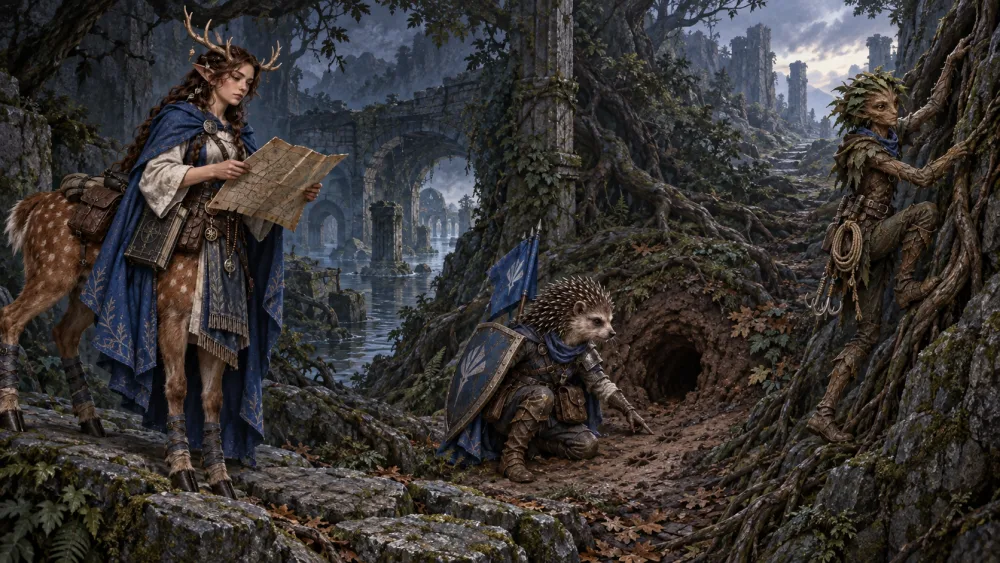
Expansion Lineages at a Glance
| Lineage | Book | Standout trait | Best classes |
|---|---|---|---|
| Alseid ● | The Old Margreve | 40-foot speed plus Light Hooves stealth | Ranger, Rogue, Monk, Druid |
| Bearfolk ● | The Old Margreve | Wild Heart fear defense for adjacent allies | Barbarian, Fighter, Paladin |
| Erina ● | The Old Margreve | Burrowing speed equal to walking speed | Rogue, Ranger, Druid |
| Piney ● | The Old Margreve | Living Wood reaction AC against melee | Druid, Fighter, Wizard |
| Derro ● | Labyrinth Worldbook | 120-foot Superior Darkvision, Psychic Barrier | Rogue, Warlock, Wizard |
| Dragonborn ● | Labyrinth Worldbook | Ancestry-based resistance and Breath Weapon | Fighter, Paladin, Sorcerer |
| Gearforged ● | Labyrinth Worldbook | Constructed Vitality and Upgrade choice | Fighter, Paladin, Cleric |
| Minotaur ● | Labyrinth Worldbook | Charge shove and Labyrinth Sense | Fighter, Barbarian, Paladin |
| Satyr ● | Labyrinth Worldbook | Bounding Leap reaction movement | Rogue, Monk, Bard |
| Dhampir ● | Player's Guide 2 | Wall-and-ceiling climb speed, Dark Thirst | Rogue, Warlock, Fighter |
| Elemental Scion ● | Player's Guide 2 | Earth, fire, water, or wind adaptation | Sorcerer, Fighter, Druid |
| Goblin ● | Player's Guide 2 | Nimble Escape and Strength in Numbers | Rogue, Ranger, Fighter |
| Rachisan ● | Player's Guide 2 | Alliumite, Cruciferan, or Tuberkith adaptation | Druid, Cleric, Ranger |
| Sapopova ● | Player's Guide 2 | Swim speed, Amphibian, Superior Vision | Ranger, Rogue, Druid |
| Shade ● | Player's Guide 2 | Phantasmal Form ghost transformation | Rogue, Warlock, Wizard |
| Tosculi ● | Player's Guide 2 | Hive Mind telepathy and Glide | Rogue, Ranger, Bard |
The dots use the same rating key as the lineage hub: ● an outstanding fit, ● a dependable choice, ● a campaign-dependent choice, and ● a weak fit. The dot beside each lineage name is its overall rating from the hub. Ability scores do not come from lineage in Tales of the Valiant, so every rating here is about traits, not stat bonuses.
The Old Margreve Lineages
The Old Margreve is Kobold Press's primeval-forest setting. Its four lineages share a theme: they are built for wilderness travel, and each pays some cost when the adventure moves into cities, towers, and cut-stone dungeons. The book also adds the Delver, Forest Bastion, Hiveheim, Moonlit, and Old Ways heritages, which show up in the pairings below.
Alseid
Alseid are deer-bodied woodland people built for speed, stealth, and awareness. They are grounded skirmishers with a 40-foot base speed, excellent senses, advantage on Stealth, trackless movement, and strong defenses against fear and exhaustion. The price is their body shape, which makes stairs, ladders, and trapdoors a recurring problem.
Traits
- 40-Foot Speed ●: A permanent 40-foot walking speed is a large level-one edge. It improves kiting, scouting, closing distance, retreating, and crossing difficult terrain, and unlike flight or teleportation it costs no resource or action.
- Heightened Senses ●: Advantage on Perception checks that rely on sight or hearing, plus better function in dim light and light obscurement. It does not replace darkvision, but it makes Alseid very reliable in the places they are meant to be.
- Hybrid Humanoid ●: Advantage on saves against exhaustion and the frightened condition. Exhaustion resistance pays off in forced marches and harsh travel; fear resistance pays off against bosses, undead, dragons, and fey.
- Light Hooves ●: Advantage on Dexterity (Stealth) checks and optional trackless movement. A Ranger or Rogue with Light Hooves is hard to detect and harder to pursue.
- Quadruped ●: Humanoid architecture is awkward for you. Ladders, stairs, trapdoors, manholes, and similar structures can become difficult terrain or force you to squeeze where a normal Medium creature would move freely.
Best classes
- Ranger ●: The cleanest fit. Ranger turns speed, tracking, stealth, and Perception into one package that feels native to the Margreve.
- Rogue ●: Light Hooves plus Rogue stealth is excellent, and 40 feet of movement gives you more room to reposition and escape after Cunning Action.
- Monk ●: Movement stacked on movement makes a skirmisher that is very hard to pin, though Quadruped raises table questions in some spaces.
- Druid ●: The lineage does not boost spellcasting, but exhaustion defense and scouting make the Druid better at moving through and reading wild places.
- Fighter ●: Archers and light skirmishers benefit most. Heavy-armor melee Fighters still like the speed and fear defense but waste the stealth.
Heritage pairings
- Forest Bastion (The Old Margreve) ●: The default pairing. It adds Animal Handling or Nature, trapper's tools, and a social reroll against urban-born creatures.
- Old Ways (The Old Margreve) ●: Nature and Survival proficiency, druidcraft, and the ability to read beasts, plants, and vegetation. Ideal for a forest-speaker concept.
- Martial Law (Book of Blades) ●: Athletics, Intimidation, light armor, weapons, and bonus-action Help suit a disciplined battlefield scout.
- Wildlands and Grove ●: Wildlands adds animal interaction and deters low-CR beasts; Grove adds a climb speed and stealth support that partly overlaps Light Hooves.
- Horse Lord (Book of Blades) ●: Good plains-and-herd flavor, but Expert Trainer improves a horse, not you.
- Feysworn (Player's Guide 2) is the strongest newer fit for alseid tied to fey woods and old bargains, while Joymonger (Player's Guide 2) and Kithren (Player's Guide 2) suit herd, festival, and close-community concepts.
Quadruped is what keeps Alseid balanced. Without it, the lineage would be close to automatic for Rangers and Rogues. If your campaign rarely goes indoors, Alseid is stronger than its rating suggests; if it is mostly towers and sewers, you are paying for traits you will use less.
Bearfolk
Bearfolk are broad, cold-hardened people with one of the more interesting social-combat packages in the game. Despite the look, they have no claws or bite. Their traits are about physical presence, fear resistance, and endurance in harsh places, which makes them a strong frontline lineage for players who still want to matter when the talking starts.
Traits
- Apex Predator ●: Add your Strength or Constitution modifier to a Charisma check a number of times equal to your proficiency bonus (PB) per long rest. It applies to Charisma checks generally, not only Intimidation, so a Barbarian can be a credible face when command presence or sheer confidence matters. Pick whichever of the two scores your build will actually raise.
- Wild Heart ●: You and allies within 5 feet have advantage on saves against being frightened while you are conscious and not incapacitated. The radius is small and the effect is strong, since fear is a common boss mechanic.
- Thick Coat ●: Cold resistance plus immunity to extreme cold. Solid in a normal campaign and close to an outstanding rating in a northern, mountain, winter, or Shadow Realm game, because it covers both combat damage and environmental attrition.
Best classes
- Barbarian ●: The obvious fit. Strength or Constitution is already your priority, fear protection matters in melee, and cold resistance stacks with the class's durability.
- Fighter ●: Fighters keep Wild Heart close to allies and use Apex Predator to cover the class's usual social weakness. Battle leaders benefit most.
- Paladin ●: Paladin already helps saves, so there is overlap, but fear-specific protection and physical social presence make a strong concept.
- Cleric ●: Frontline Clerics stand near allies anyway and gain a social option without Charisma investment.
- Rogue ●: Works for an enforcer, but most Rogues want stealth or mobility more than a tank-adjacent package.
Heritage pairings
- Martial Law (Book of Blades) ●: Athletics and Intimidation stack with Apex Predator, and bonus-action Help rewards staying near allies.
- Moonlit (The Old Margreve) ●: Builds a fear-resistant, shadow-fighting protector for dark-forest, undead, or Shadow Realm campaigns.
- Hiveheim (The Old Margreve) ●: The thematic default, with nature and survival tools; its strongest feature depends on the campaign.
- Cottage and Slayer ●: Cottage adds party temporary hit points after long rests for a caretaker-protector. Slayer makes Apex Predator intimidation and tracking more reliable.
- Privileged (Book of Blades) ●: Fits a courtly champion or house guard, but martial and wilderness heritages usually do more.
- Kithren (Player's Guide 2) suits protective clans and found families, Joymonger (Player's Guide 2) suits feast-hall bearfolk, and Conflicted (Player's Guide 2) fits bearfolk from threatened borderlands.
Wild Heart plays better on a Fighter than on a Barbarian. Barbarians love the fantasy, but a Fighter is often better at standing exactly where the party needs them without rage timing, and a 5-foot radius rewards disciplined positioning over raw aggression.
Erina
Erina are small hedgehog people with a broad exploration package. Darkvision, a burrowing speed, poison resilience, Heightened Senses, and anti-grapple Spines support scouting and make them awkward targets up close. Alseid is faster and Piney is tougher; Erina has the clearest set of tools for soft-earth exploration.
Traits
- Darkvision ●: Standard 60-foot darkvision, always useful and especially good alongside burrowing and infiltration.
- Digger ●: A burrowing speed equal to your walking speed, but you cannot burrow through ice or rock. Where the terrain allows it, this creates alternate routes, ambush angles, escape paths, and hiding places most lineages cannot reach without magic.
- Erina Resilience ●: Advantage on saves against being poisoned plus poison resistance, valuable for scouts who trigger traps and meet venomous creatures first.
- Heightened Senses ●: Advantage on Perception checks that rely on sight or hearing. Perception is too central to call this merely nice.
- Spines ●: When you grapple or are grappled, the other creature takes piercing damage equal to your PB at the start of your turn. Treat it as insurance against being grabbed, not a damage plan.
Erina are Small, which helps stealth and tight spaces but restricts Heavy weapons.
Best classes
- Rogue ●: A strong fit. Darkvision, Small size, burrowing, Perception advantage, and poison resistance all serve scouting and trap-forward play.
- Ranger ●: Uses every part of the lineage: tracking, scouting, burrowing, and poison defense.
- Druid ●: Burrowing and senses give strong non-spell utility before Wild Shape enters the picture.
- Monk ●: Small, mobile, and painful to grapple, with burrowing for positioning.
- Fighter ●: Fine as a light skirmisher or archer; heavy-weapon builds clash with Small size.
Heritage pairings
- Forest Bastion (The Old Margreve) ●: Social recovery, Nature or Animal Handling, and trapper's tools for a scout.
- Grove ●: A climb speed on top of burrowing makes an Erina very hard to contain.
- Privileged (Book of Blades) ●: A flexible skill and contested social advantage open a social-infiltration lane for a spy or court informant.
- Salvager ●: Thin in general, but better here than on most lineages when the campaign has traps and devices.
- Martial Law (Book of Blades) ●: Bonus-action Help is the draw; the armor and weapon proficiencies overlap martial classes.
- Delver (The Old Margreve) ●: Flavor-perfect and mechanically redundant, because both grant burrowing.
- Conflicted (Player's Guide 2), Hivebound (Player's Guide 2), and Kithren (Player's Guide 2) fit displaced communities, warren societies, and family-centered scouts.
Erina rewards players who think in terrain. Its burrow changes a map with soil, sand, or loose earth; polished stone corridors leave that headline trait unused.
Piney
Piney are plant-touched people shaped by the old forest with a defensive package: broad save advantages, a reaction that raises AC against melee attacks, and a sunlight-based recovery tool that returns Hit Dice on short rests. Its value is steady rather than positional.
Traits
- Flexible Size ●: Medium or Small depending on height and build. Medium is the better default for weapon users; Small supports stealth and tight spaces but blocks Heavy weapons.
- Hybrid Humanoid ●: Advantage on saves against exhaustion, paralysis, petrification, and effects that would make you fall unconscious. That covers several effects that otherwise remove a character from the fight.
- Living Wood ●: When an attacker you can see would hit you with a melee attack, use your reaction to raise your AC by your PB against that attack, PB times per long rest. It is narrower than shield, since it covers one attack rather than a round, but it scales all campaign and costs no spell slot.
- Photosynthetic ●: One hour in sunlight or natural bright light satisfies your daily food needs, and a short rest spent entirely in that light can recover expended Hit Dice up to your PB, once per long rest.
Best classes
- Druid ●: The strongest thematic fit and a good mechanical one; Druid likes the anti-disable saves and wilderness sustain.
- Fighter ●: Living Wood turns a meaningful melee hit into a miss without costing the Fighter anything on its turn.
- Wizard ●: A slot-free melee answer plus protection from effects that knock a caster out of the fight. Witches, Sorcerers, and Theurges get the same benefit.
- Cleric ●: Frontline Clerics appreciate the defensive reaction and broad saves.
- Ranger ●: Uses outdoor recovery well, and Living Wood helps when enemies close the distance.
Heritage pairings
- Old Ways (The Old Margreve) ●: The most coherent pairing: Nature, Survival, druidcraft, and reading plants and beasts.
- Grove ●: A climb speed and natural stealth make the forest-body fantasy mechanically active.
- Forest Bastion (The Old Margreve) ●: Flexible skills and a social reroll for a Piney who bridges forest and town.
- Cottage and Martial Law (Book of Blades) ●: Cottage adds long-rest temporary hit points for a steady support character; Martial Law suits a shield-line forest defender.
- Privileged (Book of Blades) ●: Mostly a campaign-tone pick for a court emissary.
- Feysworn (Player's Guide 2) is the strongest newer fit for piney tied to fey forests, with Kithren (Player's Guide 2) for grove families and Waterside (Player's Guide 2) for river and marsh woodlands.
Players read Photosynthetic's food clause and stop. The Hit Dice clause is the real feature: in outdoor campaigns, Piney can stretch an adventuring day in a way few lineages can.
Labyrinth Worldbook Lineages
Labyrinth Worldbook is set in the Great Maze, a web of worlds, dead planets, and impossible paths touched by the Void. Its five lineages range from generalists that work anywhere (Gearforged, Dragonborn) to specialists that are excellent only when the campaign leans into the book's premise (Derro, Minotaur). The book's recommended heritages come from its own set: Fallen, Maze-Born, Oldwood, Steam-and-Brass, Stygian, and Void-Touched.
Derro
Derro are Small underworld survivors shaped by darkness, isolation, and contact with things beyond the stars. They have exceptional vision and one of the best anti-horror packages in the game. In a bright wilderness campaign they lose some shine; in a Labyrinth game full of dead worlds, Void cults, and buried passages, they feel purpose-built. Derro lore uses mental strain and eldritch horror, so treat those as tone and flavor, not a license for disruptive play.
Traits
- Small Size ●: Small with a 30-foot walking speed. Good for stealth and tight spaces; skip Derro if your plan is a greatsword.
- Superior Darkvision ●: Darkvision to 120 feet. Doubling the usual range changes dungeon scouting, ambush detection, and ranged engagement distances. The cost is sunlight sensitivity on sight-based Perception checks.
- Dread Within ●: Advantage on saves against being charmed or frightened, useful for anyone who cannot afford to lose turns to control.
- Psychic Barrier ●: Psychic resistance plus advantage against dread and void taint effects. This is the reason to pick Derro, and it is campaign-dependent.
Best classes
- Rogue ●: Small size, long darkvision, and mental defenses make excellent scouts.
- Warlock ●: The eldritch theme fits, and the defenses let a caster stand closer to psychic and horror threats.
- Wizard ●: Psychic Barrier keeps the Wizard online against mind-affecting enemies.
- Ranger ●: Best underground or in ruins, where 120-foot darkvision creates real tactical value.
- Fighter ●: A Dexterity Fighter works; a Strength Heavy-weapon Fighter does not.
Heritage pairings
- Fallen (Labyrinth Worldbook) ●: A book recommendation and the cleanest grim-survivor pairing.
- Void-Touched (Labyrinth Worldbook) ●: The other recommendation and the most on-theme, for a character unmistakably shaped by the Void.
- Salvager and Cloud ●: Salvager suits ruined-world scavengers; Cloud adds arcane utility to a lineage tied to strange knowledge.
- Conflicted (Player's Guide 2), Covenant (Player's Guide 2), and Hivebound (Player's Guide 2) cover rival enclaves, cult obligations, and tight underground communities.
Derro is a campaign call. In a normal city-and-wilderness game it is merely fine. In a Void, horror, or underground campaign it is one of the best defensive picks on the board.
Dragonborn
Dragonborn are sturdy draconic humanoids with a scaling breath weapon, an ancestry-based resistance, darkvision, and short-range keensense. They do not warp a build the way Human or Avian Beastkin can, but they give every class a reliable extra button and a passive defensive identity. The decision that matters is Draconic Ancestry: pick it like a build choice, not a color palette.
Traits
- Draconic Ancestry ●: Your dragon type sets both your Breath Weapon damage and your resistance. Acid, cold, fire, lightning, and poison are familiar; Labyrinth Worldbook adds necrotic void dragonborn and radiant yellow dragonborn. Confirm the rarer ancestries fit your GM's setting.
- Breath Weapon ●: A bonus-action line or cone with a Constitution-based save DC, scaling from 1d10 to 4d10 by tier, with PB uses per long rest. Modest at low levels, but it does not cost your main action, so use it when it can tag several enemies or your action is already spoken for.
- Dragon Hide ●: Resistance to your ancestry's damage type, the most consistent Dragonborn feature. Necrotic is excellent in undead and Void campaigns; radiant is rare and valuable when it matters.
- Dragon Sight ●: Darkvision plus 10-foot keensense gives better close-range detection of hidden or invisible threats than most lineages have.
Best classes
- Fighter ●: A bonus-action area tool and durable resistance on a heavy-armor frontliner.
- Paladin ●: Breath Weapon fills the Paladin's missing area option, and resistance helps staying power.
- Barbarian ●: Resistance may overlap rage depending on type, but the breath is a useful non-weapon option.
- Sorcerer ●: The theme is obvious, and the breath adds an area attack that spends no slots.
- Cleric ●: Passive defense plus a bonus-action attack on turns the action goes to healing or concentration.
Heritage pairings
- Maze-Born (Labyrinth Worldbook) ●: A book recommendation and the most Labyrinth-forward choice.
- Fallen (Labyrinth Worldbook) ●: The other recommendation, for harsher, survivor-coded dragonborn.
- Anointed and Fireforge ●: Anointed fits radiant and temple concepts; Fireforge fits smithing clans and fire ancestry.
- Coterminous (Player's Guide 2) suits planar, void, or elemental-boundary dragonborn, Slayer suits monster hunters, and Covenant (Player's Guide 2) suits sworn draconic houses.
Dragonborn lives or dies by the resistance choice. Breath Weapon is the visible trait, but Dragon Hide is the one that quietly wins encounters over a campaign, so choose the ancestry for the damage your campaign actually throws at you.
Gearforged
Gearforged are living minds in mechanical bodies with defenses, survival traits, and an Upgrade choice that work without a particular campaign premise. They are primarily Humanoid, so do not assume full Construct rules unless a trait says so.
Traits
- Chassis Size ●: You choose another lineage option to set your chassis size and shape. This is flexible but does not stack two lineage packages; the Gearforged traits replace the other lineage's.
- Hybrid Humanoid ●: Disease immunity, poison resistance, and advantage against paralysis, petrification, and poison.
- Constructed Vitality ●: You do not need to eat, drink, breathe, or sleep, entering a dormant state instead of sleeping. The dormant-state Perception drawback is real, but this changes how you handle hazards, travel, and attrition.
- Machine Speech ●: Useful in a campaign full of gearforged and machines, mostly identity elsewhere.
- Upgrade (choose one): Always Armed ● keeps a weapon on you through disarms and searches. Bulk Up ● makes you Large, adds weapon damage, and grants advantage on Strength checks and saves, which can swing one important fight per long rest. Quick Fix ● grants bonus-action temporary hit points when you are below half HP and recharges on a short or long rest.
Best classes
- Fighter ●: Uses every Upgrade well; Bulk Up and Quick Fix are especially clean.
- Paladin ●: The defensive floor, disease immunity, and Quick Fix durability suit a frontline caster.
- Mechanist and inventor concepts ●: If the table supports a machine-focused crafter, Gearforged is the obvious chassis.
- Cleric ●: Constructed Vitality and Quick Fix support a durable healer, and the lineage fits sacred-machine themes.
- Rogue ●: Always Armed supports concealed weapons, and constructed defenses help survive traps.
Heritage pairings
- Steam-and-Brass (Labyrinth Worldbook) ●: A book recommendation that reinforces the mechanical body directly.
- Stygian (Labyrinth Worldbook) ●: The other recommendation, for gearforged tied to the River Styx, memory loss, or the underworld.
- Fireforge and Salvager ●: Forge-built artisans and rebuilt, scavenged bodies.
- Ironwrought (Player's Guide 2) is the signature newer fit for workshops and industrial communities, Covenant (Player's Guide 2) suits creator oaths and sacred directives, and Cosmopolitan suits gearforged built in a large city.
Quick Fix is the broadest Upgrade for a campaign with unknown conditions. Always Armed and Bulk Up are more specialized, while short-rest emergency durability has a use in most adventuring days.
Minotaur
Minotaur is a Strength-forward martial lineage with a natural horn attack, limited-use charging pressure, and one of the most setting-relevant exploration traits in the book. You move, hit, shove, and remember the way back. It is best when the campaign has maps that matter, in combat and out of it.
Traits
- Natural Attacks ●: Horns give you a built-in melee option, useful at low levels, while unarmed, and for Charge.
- Charge ●: Once per turn, after moving at least 10 feet toward a target and hitting it with your horns, you add damage and can shove it as a bonus action. PB uses per long rest keeps it from being spammed.
- Labyrinth Sense ●: You can retrace without error any path you have already taken, no check required. In a flat arena campaign that is flavor; in the Great Maze it is gold.
Best classes
- Fighter ●: The attacks, positioning, and durability to make Charge matter.
- Barbarian ●: Rage plus horn-forward melee is straightforward, and Charge adds pressure to a class that wants to close.
- Paladin ●: Likes forced movement and a durable frontline role; bonus-action conflicts are manageable.
- Ranger ●: A Strength Ranger in maze, dungeon, or travel-heavy games.
- Monk ●: Possible, but the lineage leans Strength and the bonus-action shove fights Monk's rhythm.
Heritage pairings
- Maze-Born (Labyrinth Worldbook) ●: The signature pairing, reinforcing the navigation identity. The book also recommends Fallen and Oldwood.
- Fallen (Labyrinth Worldbook) and Oldwood (Labyrinth Worldbook) ●: Exiled or dead-world minotaurs, and ancient horned forest guardians.
- Martial Law (Book of Blades) ●: Athletics, Intimidation, and tactical Help for disciplined soldiers.
- Conflicted (Player's Guide 2), Coterminous (Player's Guide 2), and Kithren (Player's Guide 2) cover maze wars, planar labyrinths, and close-knit horned clans.
Minotaur is better as a battlefield-control lineage than a damage lineage. The shove is what changes fights: it breaks enemy positioning, pushes targets into hazards, and opens space for allies.
Satyr
Satyr is a Fey skirmisher lineage. Its traits reward moving after melee contact and back that up with some of the best magical defenses in the game. You hit, slip away, and make enemies waste movement.
Traits
- Fey Type ●: Satyrs are Fey instead of Humanoid. That dodges effects aimed at Humanoids and exposes you to effects aimed at Fey, so read creature-type clauses.
- Bounding Leap ●: After you hit with a melee weapon attack or unarmed strike, use your reaction to move half your speed without provoking opportunity attacks, PB times per long rest.
- Fey Resilience ●: Protection against being charmed or knocked unconscious, plus advantage on saves against spells and magical effects. That is broad enough to survive encounters that disable sturdier-looking lineages.
- Natural Attack ●: A 1d8 horn attack using Strength or Dexterity, better than most natural weapons and useful when disarmed.
Best classes
- Rogue ●: Bounding Leap solves melee Rogue's biggest problem, getting away after the hit, without spending Cunning Action.
- Monk ●: Dexterity horn attacks and reactive movement fit well, though reactions get crowded at higher levels.
- Bard ●: The fey performer fantasy, and Fey Resilience protects a support caster.
- Ranger and Fighter ●: Melee Rangers and Dexterity duelists both use Bounding Leap well; heavy Strength builds leave finesse on the table.
Heritage pairings
- Oldwood (Labyrinth Worldbook) ●: A book recommendation for ancient-forest and fey-world themes.
- Wildlands ●: The other recommendation and a clean fit for wilderness satyrs.
- Grove and Cosmopolitan ●: Grove adds climb and stealth; Cosmopolitan fits the city reveler or court musician.
- Feysworn (Player's Guide 2) is the obvious fey-origin pairing, Joymonger (Player's Guide 2) reinforces revels and music, and Islander (Player's Guide 2) suits hidden-isle fey courts.
Satyr is the Rogue lineage people miss because it has no darkvision. Reaction movement after every connecting hit is worth more to a melee Rogue than seeing in the dark.
Once you know which book your table allows, the next choice is class. If you want to test a lineage against a class before committing, this is the point to try the pairing in the builder.
Build Your Tales of the Valiant Character
The Tales of the Valiant character builder is live - build a Beastkin, a Kobold, or whatever your table is missing, free, right now.
Start BuildingPlayer's Guide 2 Lineages
Player's Guide 2 adds seven new lineages plus variants of core lineages (Duergar, Drow, Sea Elf, and Aberrant Syderean, covered in their parent guides). Four of the seven ask for a second choice, an adaptation or duty, that defines the build. Every one has book-recommended heritages, listed first below.
Dhampir
Dhampir are living characters touched by undeath: mobile melee skirmishers with strong vertical movement, a bite that generates temporary hit points, and undead-adjacent defenses. They shine where ceilings, walls, ruins, ships, alleys, and caves let climbing change the encounter. On flat open fields the bite and defenses still work, but the lineage loses its best trick.
Traits
- Size Flexibility ●: Medium or Small depending on height. Small supports stealth and tight spaces; Medium avoids the Heavy weapon restriction.
- Climb Speed ●: A 30-foot climb speed that works on vertical and upside-down surfaces while your hands are free. It changes scouting, ambushes, escape routes, and ranged angles.
- Dark Thirst ●: Your fangs are a simple melee weapon that can use Strength or Dexterity. Feeding adds necrotic damage, grants temporary hit points, and gives advantage on your next attack before the end of your next turn.
- Darkvision ●: Broadly useful, but sunlight imposes disadvantage on sight-based Perception checks, so outdoor scouts need backup detection.
- Hybrid Humanoid ●: Advantage against being poisoned and against exhaustion. The Undead connection is flavorful, but read each spell and feature rather than assuming full Undead rules.
Best classes
- Rogue ●: Climb speed, stealth routes, and attack advantage from Dark Thirst.
- Warlock ●: Fits the undead theme and uses climbing to control line of sight.
- Fighter ●: Turns Dark Thirst into repeatable frontline sustain.
- Monk and Ranger ●: Monk stacks mobility with wall-and-ceiling positioning; Ranger uses the climb, darkvision, and stealth angles.
Heritage pairings
- Conflicted (Player's Guide 2) ●: A book recommendation for dhampir raised amid suspicion or faction pressure.
- Supplicant ●: The other recommendation, for cursed, devoted, or redemption-focused dhampir.
- Vexed and Stygian (Labyrinth Worldbook) ●: Hauntings and bad omens, or underworld and river-of-souls concepts.
Dhampir is a skirmisher, not a static tank. Build around the climb speed first, and use Dark Thirst on characters who can survive a round in melee rather than as a backup bite.
Elemental Scion
Elemental Scions are humanoids shaped by earth, fire, water, or wind. They have a sturdy resistance-based floor and a Natural Adaptation that decides movement, damage, and exploration identity. Waterborn in an island campaign or Earthborn in a cave crawl can feel far stronger than either would on a generic road trip.
Traits
- Darkvision ●: 60 feet, fitting the subterranean, volcanic, storm, and deep-water themes.
- Hybrid Humanoid ●: Poison resistance plus one elemental resistance tied to your adaptation, and advantage against being paralyzed, petrified, and poisoned.
- Earthborn ●: Tremorsense 10 feet and immunity to movement reduction from difficult terrain. Excellent when the campaign actually uses rough ground.
- Fireborn ●: A light aura, protection from extreme cold, and PB fire damage added to melee weapon hits, the most direct martial option.
- Waterborn ●: Swim speed, water breathing, and movement through enemy spaces or extremely narrow gaps. The most broadly useful adaptation when water or infiltration matters.
- Windborn ●: A 10-foot flying speed with hover. Small on paper, but hover solves problems ordinary flight does not, and if another feature grants flight, Windborn improves that speed and adds hover.
Best classes
- Sorcerer ●: The cleanest elemental-bloodline fit, especially Fireborn or Windborn.
- Fighter ●: Fireborn damage, Earthborn footing, and the resistance package.
- Druid ●: Primal flavor plus Waterborn or Earthborn exploration tools.
- Ranger and Monk ●: Both turn the movement adaptations, especially Windborn and Waterborn, into encounter control.
Heritage pairings
- Coterminous (Player's Guide 2) ●: A book recommendation and the best planar-origin pairing.
- Seafarer (Player's Guide 2) ●: The other recommendation, excellent for Waterborn or storm-flavored Windborn.
- Waterside (Player's Guide 2) and Fireforge ●: River and coastal scions, or Fireborn artisans from volcanic settlements.
Elemental Scion is a test of how well you know your campaign. The best adaptation is the one your GM's maps will actually reward, not the element you like best.
Goblin
Goblins are Small, quick, opportunistic survivors built around bonus-action escape and party-adjacent damage. They dart into risky spaces, hit a target an ally is already pressuring, and leave before retaliation lands. They reward tables that fight as a group and are weaker for lone duelists.
Traits
- Small Size ●: Helps with hiding, tight routes, and mounts; limits Heavy weapons.
- Darkvision ●: 60 feet, supporting the scout and ambusher role.
- Nimble Escape ●: Disengage or Hide as a bonus action. It lets any class play aggressively, but it competes with other bonus actions.
- Strength in Numbers ●: When you damage a creature with a weapon or spell attack while an ally is within 5 feet of it, you add PB damage of the same type. It scales cleanly and rewards focus fire.
Best classes
- Rogue ●: Stacks naturally with stealth and ally setup, though Cunning Action overlaps Nimble Escape.
- Ranger ●: Mobile ranged pressure and coordinated target selection.
- Fighter ●: Nimble Escape controls melee engagement, and Strength in Numbers adds steady damage.
- Monk ●: Loves the mobility; watch the crowded bonus action.
- Bard ●: Spell attacks trigger Strength in Numbers, and the clever-survivor identity fits.
Heritage pairings
- Conflicted (Player's Guide 2) ●: A book recommendation for goblins from contested streets and clan rivalries.
- Salvager ●: The other recommendation, a perfect flavor match for scavengers and tinkerers even though the heritage itself is thin.
- Cosmopolitan and Hivebound (Player's Guide 2) ●: Dense-city guild networks, or close communities built on coordinated action.
Nimble Escape is strongest on non-Rogues. A Rogue already has similar action economy, while a Fighter or Ranger gains a whole new tactical layer.
Rachisan
Rachisan are Small plant-featured people whose traits pay off in survivability, party support, and plant-heavy terrain rather than damage. The Natural Adaptation sets the role: Alliumite is a reactive controller, Cruciferan improves rests, and Tuberkith brings rare anti-blind and awareness tools.
Traits
- Small Size ●: Stealth and tight spaces, with the usual Heavy weapon limit.
- Hybrid Humanoid ●: Advantage against paralysis, petrification, and exhaustion effects.
- Green Thumb ●: Add a d8 to plant-related checks and ignore movement reduction from plant growth. Narrow but strong in wilderness, fey, and farming settings.
- Alliumite ●: When wounded by a piercing or slashing weapon attack, use your reaction to force nearby creatures to save or be blinded until the start of their next turn. Once per long rest, powerful when timed well.
- Cruciferan ●: Short-rest meals restore a little HP to several creatures, and long-rest preparation can remove one nonmagical disease. Low-level parties remember every source of slot-free healing.
- Tuberkith ●: Immunity to the blinded condition plus awareness while unconscious, which matters during ambushes and captivity.
Best classes
- Druid ●: The cleanest nature-magic pairing.
- Cleric ●: Pairs with Cruciferan support.
- Ranger ●: Plant terrain and survival scenes, with Alliumite control on top.
- Wizard and Rogue ●: Wizard likes Tuberkith and the save coverage; Rogue uses Small size and Alliumite disruption.
Heritage pairings
- Cottage ●: A book recommendation for rural, familial, kitchen-table rachisan.
- Feysworn (Player's Guide 2) ●: The other recommendation, for fey-created or fey-touched plantfolk.
- Grove and Kithren (Player's Guide 2) ●: Forest herbalists and guardians, or communal family adventurers.
Tuberkith is the strongest Rachisan choice for most campaigns, because blind immunity is rare and costs nothing to use.
Sapopova
Sapopova are Small amphibious frogfolk and toadfolk: water-capable scouts with sharp visual perception and a Natural Adaptation that leans toward athletic jumping or odd ranged tricks. In a swamp, island chain, sewer network, flooded ruin, or river city, they have more routes than anyone else in the party.
Traits
- Small Size ●: Stealth, cover, and tight routes; no Heavy weapons.
- Swim Speed ●: 30 feet, excellent in water-forward campaigns and useful in many dungeons.
- Amphibian ●: You breathe air and water, so a pond or flooded corridor becomes a route and an escape hatch.
- Superior Vision ●: Darkvision, color vision in dim light and darkness, and advantage on Perception checks to visually locate creatures and moving targets.
- Frogkin ●: Athletics proficiency, and standing long and high jumps count as if you had moved 10 feet.
- Toadfolk ●: Cheek storage and an improvised ranged weapon attack with Tiny items. Not optimal, but it produces the table moments people remember.
Best classes
- Ranger ●: The best use of amphibious scouting and visual tracking.
- Rogue ●: Small size, water routes, and superior detection.
- Druid ●: Swamp, pond, and river themes fit cleanly.
- Monk and Bard ●: Monk stacks Frogkin jumps with class mobility; Bard plays up the storytelling side of Toadfolk.
Heritage pairings
- Islander (Player's Guide 2) ●: A book recommendation for island, pond, and marsh sapopova.
- Waterside (Player's Guide 2) ●: The other recommendation, for river villages, canals, and wetlands.
- Seafarer (Player's Guide 2) and Wildlands ●: Ship life and open water, or remote marsh scouts.
A 30-foot swim speed plus Superior Vision means the Sapopova scouts the flooded half of the map alone while the rest of the party takes the long way around. In a water campaign that outweighs the Heavy weapon restriction.
Shade
Shade is for characters caught between life and death. It combines a previous living form with undead-adjacent defenses, a once-per-long-rest ghost transformation, and short bursts of Ethereal sight. It changes how you solve maps, not just fights, which makes it strongest in infiltration, haunted places, planar boundaries, prisons, and ruins.
Traits
- Living Form ●: Choose another lineage to set your size, height, weight, speed, and appearance. The Shade traits still define the lineage rules.
- Hybrid Humanoid ●: Poison resistance, advantage against being poisoned, and advantage against exhaustion.
- Phantasmal Form ●: Once per long rest you gain resistance to nonmagical bludgeoning, piercing, and slashing damage, move through creatures and solid objects as difficult terrain, gain a 30-foot hovering flight, and gain advantage against being grappled and restrained. It solves many different problems, so do not spend it on a minor obstacle.
- Spectral Sight ●: Darkvision plus PB uses of brief sight into or back from the Ethereal Plane. Niche, and powerful in haunted or planar campaigns.
Best classes
- Rogue ●: Gets the most from infiltration, escape, and ghostly positioning.
- Warlock ●: Fits the half-dead theme and uses Phantasmal Form to control lines of sight.
- Wizard ●: Emergency defenses and ghostly exploration.
- Ranger and Fighter ●: Haunted scouts, or a once-per-day survival and repositioning tool on a frontliner.
Heritage pairings
- Diaspora ●: A book recommendation for shades displaced from their old lives.
- Vexed ●: The other recommendation, for curse, omen, and supernatural-burden stories.
- Stygian (Labyrinth Worldbook) and Coterminous (Player's Guide 2) ●: Death and memory, or a planar boundary between worlds.
Choose the living form with as much care as the class. It sets your size and speed for every scene where Phantasmal Form is not active, which is most of them.
Tosculi
Tosculi are Small waspfolk with hive-born communication, controlled falling, and a duty choice between buzzing control and poisonous melee. They reward planning: the more the party communicates and the more vertical the terrain, the better they get. A tosculi on a cliff, tower, tree city, or ruined bridge has options most Small lineages lack.
Traits
- Small Size ●: Scouting, cover, and mounts; no Heavy weapons.
- Glide ●: No fall damage after a 10-foot fall, plus up to 30 feet of horizontal movement. Not flight, but enough to make vertical maps play differently.
- Hive Mind ●: Bonus-action telepathy with a visible creature within 30 feet for up to 1 minute, PB times per long rest. Strong for scouting, stealth, and silent tactics.
- Detached Drone ●: Golden Song forces a nearby creature to save or be charmed or deafened until the start of your next turn. Short range keeps it honest.
- Roving Trooper ●: A 1d6 stinger natural weapon plus PB uses of a poison rider, best on characters already in melee.
Best classes
- Rogue ●: Hive Mind, Small size, Glide, and close-range tricks.
- Ranger ●: Silent coordination, scouting, and Roving Trooper pressure.
- Bard ●: Detached Drone and social-hive storytelling.
- Fighter and Monk ●: Roving Trooper as a straightforward melee kit, or Small skirmishing with vertical repositioning.
Heritage pairings
- Hivebound (Player's Guide 2) ●: A book recommendation and the signature tosculi heritage.
- Wildlands ●: The other recommendation, for remote hives, hunters, and hiveless wanderers.
- Conflicted (Player's Guide 2) and Kithren (Player's Guide 2) ●: Torn between hive and outside world, or an adopted community built on mutual care.
Hive Mind gets worse at tables where everyone just kicks the door. Pick Tosculi when your group actually plans its fights.
Choosing Among the Expansion Lineages
Sixteen options is a lot, and most comparisons collapse once you ask two questions: where does the campaign happen, and what does your character do in the party?
Start with the map. These lineages are mostly terrain specialists, and a trait that never fires is worth nothing.
| Campaign terrain | Lineages that shine | Lineages that struggle |
|---|---|---|
| Forests, roads, open wilderness | Alseid, Piney, Satyr, Erina | Derro (sunlight), Dhampir |
| Soft earth, burrows, natural caves | Erina, Elemental Scion (Earthborn) | Alseid (tight spaces) |
| Water, coasts, sewers, swamps | Sapopova, Elemental Scion (Waterborn) | Lineages without a swim speed |
| Deep dark, the Void, horror | Derro, Shade, Gearforged | Piney (no sunlight) |
| Mazes, megadungeons, planar routes | Minotaur, Shade, Gearforged | Alseid (stairs, ladders) |
| Vertical ruins, towers, cities | Dhampir, Tosculi, Goblin | Alseid, Minotaur |
| Winter, mountains, northern wilds | Bearfolk, Elemental Scion (Fireborn) | No clear losers |
Then match the role.
- Scout: Erina is the most complete. Alseid is faster and stealthier on open ground, Sapopova owns the water, and Derro sees twice as far in the dark.
- Frontliner: Gearforged has the best defensive floor, Bearfolk protects allies from fear, Minotaur controls position with Charge, and Dragonborn brings resistance plus an area attack.
- Skirmisher: Satyr leaves melee for free after every hit, Goblin disengages as a bonus action, Dhampir climbs where enemies cannot follow, and Tosculi glides off anything tall.
- Caster: Piney's Living Wood protects without a spell slot, Shade escapes almost anything once per day, Satyr's magical defenses keep a support caster upright, and Elemental Scion suits a Sorcerer's bloodline.
- Support: Rachisan (Cruciferan) and Bearfolk help the party more than themselves, and Tosculi's Hive Mind lets a quiet party coordinate.
Last, decide the second choice up front. Gearforged Upgrades, Elemental Scion and Rachisan adaptations, Sapopova's Frogkin or Toadfolk, and Tosculi duties each change the build more than any single class feature at level one. Make that choice alongside your class, not after it.
Hot Take: When the campaign is unknown, a lineage with an always-available defensive or recovery trait is often easier to use well than a terrain specialist. Gearforged's Quick Fix, Piney's Living Wood, and Satyr's Fey Resilience can matter in a corridor or on the road. Erina's burrow and Sapopova's swim speed can be exceptional, but their value depends on the map.
Heritage Pairing Logic
Heritage is your upbringing, chosen separately from lineage, and the Heritage Guide rates each one in full. A few rules cover all sixteen lineages here.
Start from the book's recommendation. Labyrinth Worldbook and Player's Guide 2 name recommended heritages for each lineage, and they are usually thematic and mechanically sound:
| Lineage | Book-recommended heritages |
|---|---|
| Derro | Fallen, Void-Touched |
| Dragonborn | Fallen, Maze-Born |
| Gearforged | Steam-and-Brass, Stygian |
| Minotaur | Fallen, Maze-Born, Oldwood |
| Satyr | Oldwood, Wildlands |
| Dhampir | Conflicted, Supplicant |
| Elemental Scion | Coterminous, Seafarer |
| Goblin | Conflicted, Salvager |
| Rachisan | Cottage, Feysworn |
| Sapopova | Islander, Waterside |
| Shade | Diaspora, Vexed |
| Tosculi | Hivebound, Wildlands |
The Old Margreve lineages pair most naturally with that book's own heritages: Forest Bastion and Old Ways for Alseid, Erina, and Piney, and Hiveheim or Moonlit for Bearfolk.
Add a new axis, not a duplicate. A heritage that repeats a lineage trait is wasted. Delver on an Erina is the clearest case, since both grant burrowing. Grove on an Alseid partly overlaps Light Hooves. Prefer a heritage that covers something your lineage lacks: social tools for a Derro scout, a climb speed for an Erina, a skill proficiency for a Bearfolk.
Martial Law is the universal martial pick. For Bearfolk, Minotaur, Piney, and Alseid frontliners, Martial Law (Book of Blades) adds Athletics, Intimidation, and bonus-action Help, and it rarely conflicts with anything.
Flavor-first heritages are fine when you choose them knowingly. Salvager is thin mechanically, yet it is the right story for a goblin scavenger or a rebuilt gearforged. Take it for the character, and let the lineage carry the power.
For the core lineages and the full comparison table, return to the Tales of the Valiant Lineage Guide. Variant lineages from Player's Guide 2 and Labyrinth Worldbook, such as Drow, Sea Elf, and Midnight Dwarf, live in their parent guides: Elf, Dwarf, and Syderean.


