Introduction
Van Richten's Guide to Ravenloft hands D&D 5e 2014 players and DMs a horror toolkit built on a single premise: every villain deserves a prison shaped by their own sins. The Domains of Dread are demiplanes carved out of the Shadowfell by the mysterious Dark Powers, each sealed around a single irredeemable villain, a Darklord, and twisted into a mocking reflection of that villain's worst memories. Count Strahd von Zarovich's Barovia is the most famous of these prisons, but the book catalogs dozens more, from the ice-bound science of Lamordia to the endless masquerade of Dementlieu.
Ravenloft asks something most 2014 settings don't: a real conversation with your table before you sit down to play. This isn't flavor text. The book opens its DM chapter with tools for setting boundaries and surveying player comfort before a single die gets rolled, because horror only works when everyone has opted in. A player usually starts with a Dark Gift or one of the new lineages. A DM starts from the opposite direction: build a Darklord first, then let their psychology dictate the domain around them.

Character Options
Ravenloft treats race, class, and background as the same starting point every other 2014 setting does, then layers one thing on top that doesn't exist anywhere else in this system's collection: a Dark Gift, a supernatural boon offered by sinister forces that always, without exception, comes with a price.
None of it requires you to know a single Domain of Dread before you build a character, and every lineage, subclass, and background here works outside Ravenloft with zero adjustment. A Dhampir Rogue or a Reborn Cleric plays in the Forgotten Realms or Eberron exactly as written; the Ravenloft framing is setting color, not a prerequisite.
Dark Gifts
A Dark Gift is a bargain, not a blessing. The book frames every one as a mysterious force - a whispered dream, a bargain struck at a forgotten shrine, a voice in a mirror, or the Mists themselves - offering real power in exchange for something the character can never fully take back. A starting character can choose one during creation, working with the DM on the specific origin story behind it.
A character who skips a Dark Gift at creation isn't locked out forever. The book calls this a Dark Bargain: sinister forces can offer a gift mid-campaign in exchange for a service or a future favor, and a character who already has one loses it and gains the new one instead. This might surface when time freezes on the brink of death and a voice offers rescue at a price, when a magical experiment goes catastrophically wrong, or when a Darklord refuses to negotiate unless someone accepts their bargain first. The terms always have to be clear to the player before they decide, and per the book's own consent rules, the player gets to say no.
Each gift grants a solid mechanical benefit alongside a real drawback, usually a chance to misfire, typically triggered by rolling a natural 1 on an attack roll, ability check, or saving throw.
Echoing Soul. Your soul carries memories that aren't entirely your own, whether from a past life, a swapped body, or a link to someone elsewhere. You gain two bonus skill proficiencies and an extra language, but a critical failure on any d20 roll can trigger an intrusive echo: a flash of someone else's memory that might charm you, frighten you, blind you to your real surroundings, or simply overwhelm you until your next turn.
Gathered Whispers. Spirits haunt you, audible only to you, and their voices occasionally spill into the world. You learn message for free, cast through the whispers rather than your own voice, and you can channel the spirits reactively to add your proficiency bonus to your AC against one attack per long rest. The cost: a critical failure can let the voices grow too loud to ignore, imposing disadvantage, deafening you, or frightening you.
Living Shadow. Your shadow acts with a mind of its own, sometimes mundane, sometimes menacing. You learn mage hand for free, cast through your shadow, and you gain a limited ability to strike at melee range through it with 10 extra feet of reach. The cost: a critical failure can let your shadow's own will bleed into a nearby roll, randomly boosting or penalizing it by a small die.
Mist Walker. You've learned to slip through the Mists that grip every Domain of Dread. You can cast misty step without a spell slot once per long rest, and you can navigate toward a specific domain as though carrying a Mist talisman keyed to it, without having visited before. The cost: staying too long in one place poisons the land around you, eventually forcing a Constitution save each long rest to avoid exhaustion that won't clear until you move on.
Second Skin. Another side of you, exaggerated or opposite from your usual self, waits beneath the surface. You can cast alter self's Change Appearance option once per long rest without a spell slot to become that second form, and a lingering cosmetic mark carries over until your next long rest. The cost: specific triggers - a scent, a sound, a particular phase of the moon - can force the change involuntarily unless you succeed on a Charisma save.
Symbiotic Being. A second, semi-independent being shares your body and can't be permanently removed. It grants a bonus skill proficiency and can burn one of your Hit Dice to rescue a failed saving throw, including a death save. The cost: the symbiote has its own agenda, and ignoring it too long risks being charmed into acting on its goals for hours at a time.
Touch of Death. Your touch carries an uncontrollable lethal charge. As an action you can make an unarmed strike dealing bonus necrotic damage scaling with level, you ignore a target's necrotic resistance, and grappling a creature damages it every round. The cost is entirely narrative and social - death and ill omens follow you, and the book leaves exactly how visible that reputation becomes up to your table.
Watchers. Ethereal, faintly malicious spirits in the shape of small animals gather around you and can't be permanently driven off. Once per long rest you can borrow their senses for advantage on Investigation and Perception and immunity to blinding, but their presence gives you disadvantage on Deception, Performance, and Persuasion against anyone who can see them, plus disadvantage against scrying.
None of these gifts are locked to a specific class or lineage. A Fighter with Touch of Death and a Wizard with Watchers are drawing from the same shared pool, which is part of what makes a Dark Gift a strong tool for reinforcing a character's origin story rather than optimizing a build.
Skip the temptation to treat a Dark Gift as a free power spike. Every one is written with a real, table-visible cost attached - an intrusive echo, a symbiote with its own agenda, a shadow that occasionally acts against you - and a DM who lets a player take the upside while quietly ignoring the drawback has broken the subsystem's entire premise. If a Dark Gift never actually costs your character anything at the table, it isn't doing its job.
Build Your Dungeons & Dragons (5e, 2014) Character
The Dungeons & Dragons (5e, 2014) character builder is live - build a Beastkin, a Kobold, or whatever your table is missing, free, right now.
Start BuildingThree New Lineages
Each is steeped in Ravenloft's central themes: undeath, fey corruption, and the slow erosion of identity.
| Lineage | What Makes It Distinct |
|---|---|
| Dhampir | A half-vampire lineage with a bite attack that heals its user - built-in lifesteal that changes melee-frontline and gish build math. |
| Hexblood | A hag-touched fey lineage with a built-in disguise self/hex/mirror image spell progression - free spellcasting that rivals races like Tiefling and Aasimar. |
| Reborn | An undead-adjacent lineage built around resurrection immunity and fragmented memory - a roleplay-forward pick as much as a mechanical one. |
Dhampir leans into a self-sustaining melee build: its bite doesn't just deal damage, it heals on a hit, which changes the math on any build that expects to trade blows repeatedly rather than burst one target down. Hexblood trades physical resilience for a free, leveled spell progression baked directly into the lineage, which puts real pressure on martial classes with no other route to magic. Reborn asks the least of a build sheet and the most of a backstory: resurrection immunity and a fragmented-memory table the character slowly fills in through play reward a table that wants roleplay payoff as much as a combat trait.
Two Subclasses and Two Backgrounds
College of Spirits is built around channeling the dead through Tales from Beyond and a mystical seance ability. Reach for it if your Bard concept is "medium who channels the dead" rather than "court performer" - it's built for a Bard who narrates a spectral guide's advice as much as they cast spells.
The Undead patron is a corrupted immortal who has begun transforming into an undead being. This reads closer to a controlled-risk berserker than a typical Warlock patron: Form of Dread is a limited-use transformation rather than an always-on buff, and Necrotic Husk deliberately trades the Warlock's own hit points and stamina for a burst of necrotic damage against everything nearby.
Haunted One and Investigator are the two new backgrounds. Both trade a standard equipment package for thematic gear, and both draw a starting curio from the book's Horror Trinkets table instead of leaving that slot blank. Haunted One fits a character defined by a personal brush with the supernatural; Investigator fits one built around methodically uncovering the truth behind a mystery. Full breakdowns live in the D&D 5e Backgrounds Guide.
A Dark Gift and a curse aren't the same thing, even though both come from the same sinister forces. A Dark Gift is chosen (or bargained for) and grants real, ongoing power alongside its cost; a curse, covered in the Horror Toolkit below, is imposed as a consequence and is purely a burden until resolved. A character can carry both over a long campaign, and the two systems stack without conflicting.
The Domains of Dread
The Land of the Mists isn't a continent. It's a shared name for dozens of sealed demiplanes, each built as a prison around a single irredeemable villain and cut off from every other domain by an ocean of sentient fog. A domain's borders don't lead anywhere on a map - they lead into the Mists, which might strand a traveler for hours, drop them in a domain of the DM's choosing, or simply turn them back around. That isolation is the point: every domain is a closed loop, and its people have no real concept that anywhere else exists.
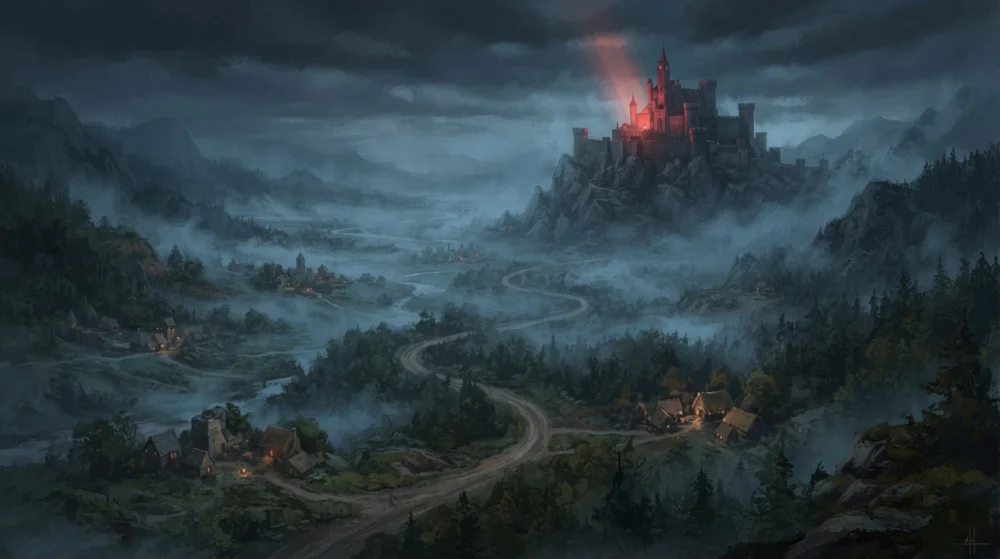
The book catalogs roughly 37 domains. Seventeen get a full Featured Domain treatment; the rest get shorter, roster-depth entries useful for a Mist talisman destination or a one-session detour.
How the Domains Work
The Mists. Every domain's border is the Mists, and every Darklord has some ability to open or close that border at will. A closed border punishes anyone who enters: a creature that starts its turn in the Mists risks gaining an unremovable level of exhaustion, and no matter which direction it travels, the Mists eventually turn it back toward the domain it tried to leave. An open border is safer but still disorienting. A Mist talisman, a nonmagical object resonant with one specific domain (a family heirloom, a bottle of local wine, a stamped coin), can guide a holder and anyone following them straight to that domain instead of leaving the outcome to chance.
Currency, language, and time. Domains mint their own coinage, but merchants everywhere accept any domain's gold, silver, and copper at face value. Every domain somehow shares Common as a trade language. Time is stranger: nearly every domain independently agrees the current year is 735, with Barovia alone keeping its own calendar dating from the founding of the von Zarovich line.
Souls and the Mists. Death in a Domain of Dread doesn't lead anywhere. A soul that dies here gets trapped in the Mists rather than passing on to any afterlife, and a character returned to life immediately realizes their soul was never going anywhere. Not everyone a party meets even has a soul to lose - many inhabitants are constructs of the Dark Powers themselves, indistinguishable from an actual person even under magical scrutiny, built to keep a domain's status quo running exactly as its Darklord remembers it.
Travel and correspondence. Real travel between domains is rare and largely limited to adventurers, Vistani bands, and the named wanderers covered below. Most long-distance communication runs through the Keepers of the Feather, a private network of Mist-navigating carrier ravens that will deliver a letter between domains for a small fee.
Domain Comparison
| Domain | Darklord | Genre / Tone | Best Campaign Fit |
|---|---|---|---|
| Barovia | Strahd von Zarovich | Gothic horror | The flagship Ravenloft experience - undead aristocracy, a cursed valley, tragic resurrection |
| Bluetspur | The God-Brain | Cosmic horror | Alien abduction, body horror, unreliable memory |
| Borca | Ivana Boritsi and Ivan Dilisnya | Gothic and psychological horror | Noble intrigue, poison, revenge among rival aristocratic houses |
| The Carnival | Nepenthe | Body horror and dark fantasy | Traveling entertainers, fey bargains, misfit found-family stories |
| Darkon | None (currently) | Dark fantasy and disaster horror | A once-great magocracy collapsing without its ruler, ongoing supernatural catastrophe |
| Dementlieu | Saidra d'Honaire | Dark fantasy and psychological horror | Masquerades, decadent aristocracy, impostor-syndrome themes |
| Falkovnia | Vladeska Drakov | Disaster horror | Zombie siege, totalitarian survival, dwindling resources |
| Har'Akir | Ankhtepot | Dark fantasy | Ancient tombs, desert perils, mummies and lost gods |
| Hazlan | Hazlik | Dark fantasy and disaster horror | Amoral spellcasters, magic-ravaged wasteland, wild magic |
| I'Cath | Tsien Chiang | Body horror and cosmic horror | An endless labyrinth-city, inescapable dreamworld |
| Kalakeri | Ramya Vasavadan | Gothic horror and dark fantasy | Monstrous royal heirs, family intrigue, a war-torn kingdom |
| Kartakass | Harkon Lukas | Dark fantasy and gothic horror | Hidden identities, exploitative fame, a bard-king's court of werewolves |
| Lamordia | Viktra Mordenheim | Body horror and gothic horror | Amoral science, frigid wilderness, bizarre constructs |
| Mordent | Wilfred Godefroy | Ghost stories | Haunted manors, ancestral curses, mist-shrouded moors |
| Richemulot | Jacqueline Renier | Disaster and gothic horror | Plague, crumbling infrastructure, wererats |
| Tepest | Mother Lorinda | Folk horror | Fey bargains, rural festivals, secret sacrifice |
| Valachan | Chakuna | Gothic horror and slasher horror | Hostile wilderness, diabolical traps, survival-game hunts |
| Other Domains of Dread | Various | All genres | Quick destinations, one-session detours, Mist-talisman hooks |
Barovia, the Flagship Domain
Barovia is Ravenloft's best-known domain, the setting of Curse of Strahd and the closest thing the line has to a mission statement. Count Strahd von Zarovich, an undead conqueror who sealed a pact with the land itself, rules from Castle Ravenloft over a valley of superstitious villagers who half-suspect the truth about their aloof lord and fear it too much to act. Wolves and raven swarms haunt the forests, burgomasters manage each isolated village's uneasy peace, and Vistani bands move through under Strahd's own protection thanks to an old debt to the fortune-teller Madame Eva.
The domain's defining trick is that its horror repeats. Strahd's real obsession is Tatyana, a woman he loved and lost centuries ago, whose soul the domain keeps delivering back to him in new incarnations, so his tragedy never actually ends. Castle Ravenloft, Krezk and its corrupted Abbey of Saint Markovia, the festival-obsessed town of Vallaki, the fear-soaked village of Barovia proper, and the corrupted Amber Temple where Strahd made his original pact all give a DM distinct locations without ever leaving the valley.
Bluetspur
Ravenloft's cosmic-horror domain, ruled by the God-Brain, an alien intelligence whose mind flayer thralls abduct victims for warped experimentation. Characters here confront untrustworthy memories as much as physical danger - suppressed recollections of surgical tables and impossible geometry can surface mid-campaign, and a DM can run entire adventures out of time as flashback sessions revealing what was done to a character before the game began. Hooks tend to start small and personal, a lost hour of memory or a strange scar with no clear origin, and expand into something a party can't fully rationalize away.
Borca
Unique among the Featured Domains for having two co-equal Darklords who barely interact: Ivana Boritsi, a genius poisoner from old wealth who loathes the life she fought to keep, and Ivan Dilisnya, a childish, ageless stalker who was given everything and still feels cheated. Powerful noble families run Borca's government, commerce, and entertainment from lavish estates while common folk scrape by on the margins. A campaign here runs on political intrigue, poison, and revenge, and a party can end up courted by both Darklords at once, with the eventual choice of pitting one against the other.
The Carnival
A traveling entertainment troupe ruled by Nepenthe, whose domain moves rather than sitting fixed on any map, blending body horror with dark fantasy in a way none of the other Featured Domains do. A Carnival stop can drop directly into any other domain's borders as a temporary, unsettling diversion, which makes it one of the more flexible domains for a self-contained horror detour. A party can walk into a Carnival stop mid-journey through a completely different domain and walk back out changed.
Darkon
The one Featured Domain with no active Darklord. Its former ruler, the lich Azalin Rex, vanished under circumstances the domain's own inhabitants can't agree on, leaving a magocracy in slow-motion collapse: a doomed capital, an escalating supernatural catastrophe with no one steering it, and factions like the vampiric secret police called the Kargat fighting to fill the vacuum. That absence is the whole hook - a party here can end up choosing whether the domain gets a new Darklord, a rescued old one, or no ruler at all.
Dementlieu
Ravenloft's masquerade domain, ruled by Saidra d'Honaire from behind a decadent aristocracy obsessed with appearances, illusion, and status. The Grand Masquerade, a recurring set-piece social event, gives a DM a built-in stage for intrigue, unmasking, and social collapse. The domain leans hard on impostor-syndrome themes: nearly everyone is performing a role, and the horror comes from wondering who's still wearing their real face underneath.
Falkovnia
Disaster horror without a supernatural twist to soften it. Vladeska Drakov rules a domain under active zombie siege, its people rationing dwindling resources under increasingly totalitarian control as fickle hero worship swings toward whoever seems capable of holding back the horde this week. The Siege of Lekar gives a DM a concrete, escalating set-piece to build a whole arc around. There's little room here for a subtle whodunit; Falkovnia rewards a party willing to make hard triage calls under a ticking clock.
Har'Akir
Ravenloft's mummy domain, ruled by Ankhtepot, an ancient pharaoh whose soul was fractured and scattered across his own tombs when he was imprisoned. That fragmented ka gives a DM a built-in reason for a dungeon-crawl campaign structure: each recovered piece is both a treasure and a step toward either his restoration or his final destruction. Har'Akir's gods are worshiped in earnest by its people, which lets a DM run devout faith and ancient dread side by side rather than treating religion as set dressing.
Hazlan
What happens when a domain's own magic turns against it. Hazlik, an amoral spellcaster Darklord, rules a wasteland ravaged by wild magic and reckless experimentation. Spellcasters here are rarely trustworthy, the environment can misbehave without warning, and a party built around magic-using characters gets an unusually personal stake in a domain where magic itself is consuming the land. Even a routine spell can go sideways, which makes Hazlan one of the few domains where a DM can justify unpredictable magical side effects without breaking the underlying rules.
I'Cath
Body horror layered over cosmic horror. Darklord Tsien Chiang uses the corrupted Nightingale Bell to project a dream-city of perfect order over the waking domain, trapping her population in an inescapable shared dreamworld even while awake. Endlessly changing labyrinth streets, deadly jiangshi guardians, and Tsien Chiang's own resurrected-but-warped daughters make this one of the more surreal domains. A party that falls asleep within I'Cath's borders risks waking up somewhere the map didn't have a moment ago.
Kalakeri
A once-prosperous kingdom torn apart by civil war and a dying queen's curse, now ruled by the fractured remnants of the Vasavadan royal line: three heirs transformed into monstrous forms by their own hatred, with Ramya Vasavadan as the central Darklord. Gothic horror and dark fantasy combine around family intrigue, and a party can end up backing one surviving claimant over the others. What was once a stable kingdom known for trade now offers nothing beyond permanent civil war, which gives Kalakeri a tragic backdrop rather than a domain that was always broken.
Kartakass
Ruled by Harkon Lukas, a werewolf bard-king obsessed with fame who fronts the domain's entertainment culture from behind a mask of celebrity. Hidden identities and exploitative ambition run through everything, and the Dark Powers make sure Harkon's endless quest for lasting acclaim keeps getting sabotaged in increasingly personal ways. A traveling entertainer party fits Kartakass better than almost any other domain - the line between a hired act and a hunted target is thinner here than Harkon's audiences realize.
Lamordia
Ravenloft's mad-science domain, a frigid wilderness ruled by Viktra Mordenheim, whose experiments produce bizarre constructs and mutagenic side effects she can't fully control. Body horror and gothic horror combine around the classic reanimation-gone-wrong premise, and a campaign can center on hunting down Mordenheim's escaped creations as easily as confronting the doctor herself. The cold is a constant pressure, a second antagonist that never lets a party fully relax between encounters.
Mordent
Ravenloft's ghost-story domain, its mist-shrouded moors and haunted manors ruled by Wilfred Godefroy under an ancestral curse. This is where Rudolph van Richten himself keeps a herbalist's shop in the town of Mordentshire, making it a natural home base for monster-hunter-flavored characters. Vengeful spirits, broken family legacies, and slow-building tragedy define its hooks more than any single monster type.
Richemulot
Disaster horror combined with gothic horror. Jacqueline Renier, a wererat Darklord, rules a domain gripped by a spreading plague, crumbling infrastructure, and martial law. The wererat population operates as much through infiltration as violence, and a party ends up navigating both a public-health crisis and a hidden predator problem at once. Trusting the wrong local official in Richemulot can mean trusting a wererat wearing a very convincing human face.
Tepest
Ravenloft's folk-horror domain, its rural festivals and nature worship concealing secret sacrifice under Mother Lorinda's rule. Fey bargains run through the culture, and its isolated, superstitious villages give a DM the "everyone here knows something they won't say" tension that defines the genre. The friendliest smile in a Tepest village is often the one hiding the most, and a party that assumes rural means harmless learns otherwise quickly.
Valachan
Gothic horror blended with slasher horror under Chakuna's rule: a hostile wilderness domain built around diabolical traps and survival-game hunts, where the Darklord treats trespassers as prey. This is the Featured Domain best suited to pure survival tension rather than intrigue - fewer conversations, more traps, and a Darklord actively, personally hunting the party.
Other Domains of Dread
The remaining domains get roster-depth coverage: enough to use as a destination, a Mist-talisman hook, or a one-session detour.
Cyre 1313, the Mourning Rail. Ruled by the Last Passenger, a lightning rail eternally fleeing the disaster that destroyed Eberron's nation of Cyre, carrying only the dead and unaware their escape already failed. A claustrophobic premise: a moving train with nowhere safe to disembark.
Forlorn. Ruled by Tristen ApBlanc, a dhampir whose druid family cast him out and whom he then killed in a rage. ApBlanc's condition inverts the usual vampire premise - he's alive by day and a tormented spirit by night, giving a DM two entirely different faces for the same villain.
Ghastria. Ruled by the hedonist Marquis Stezen D'Polarno, cursed by a magical portrait that drains his vitality except once a season, when showing it to an audience refreshes him at their expense. A party invited to view the painting is walking into a soul-draining trap dressed up as high society.
G'Henna. Ruled by the false prophet Yagno Petrovna, who leads a starving land in worship of the invented bestial god Zhakata. The horror is as much about manufactured faith as hunger - his followers believe without question, which complicates any straightforward rescue plot.
Invidia. Ruled by Gabrielle Aderre, an obsessive mother who uses a bone spirit board to summon supernatural guardians for her son Malocchio. Every servant who's ever worked her estate has vanished, which gives a party an obvious, ominous employment offer to walk into.
Keening. Ruled by the banshee Tristessa, whose wail haunts Mount Lament above a village of residents who have deliberately deafened themselves to survive her grief. A party that can hear the wail experiences the domain very differently than one that can't.
Klorr. Ruled by the obsessed clockmaker Klorr, a domain of shattered islands drawn one by one into a burning apocalypse on an unstoppable countdown. The rare domain where the horror is entirely structural: no villain to negotiate with, only a clock that never stops.
Markovia. Ruled by Dr. Frantisek Markov, whose formula grants intelligence at the cost of humanity, tested endlessly on the sapient animals of his tropical island. His subjects believe he's their god, which turns every encounter with Markovia's wildlife into a tragic misunderstanding as much as a threat.
The Nightmare Lands. Ruled by the Nightmare Court, a shifting phantasmagoric domain that traps sleepers from anywhere in dream-logic nightmares given form. Works especially well as a recurring dream-sequence destination rather than a place a party visits physically.
Niranjan. Ruled by the bronze dragon Sarthak disguised as a holy ascetic, who strips visitors of worldly goods and, eventually, their souls, under the guise of enlightenment. The horror builds slowly and consensually, a strong fit for a party lured in by curiosity rather than force.
Nova Vaasa. Ruled by Myar Hiregaard, a warlord whose personality split after her own worst massacre, alternating between a fair ruler and the bloodthirsty knight Malkan. A party that meets Myar during a calm stretch may not realize they're one trigger away from meeting Malkan.
Odaire. Ruled by the living marionette Maligno, who turned on the toymaker who made him and now rules a village populated only by children. The absence of any adult is the domain's own quiet reminder of exactly what happened here.
The Rider's Bridge. Ruled by the Headless Rider, an apparition appearing in different forms across multiple domains, always decapitating victims while searching for its own lost head. Escaping an encounter can drop a party in an entirely different domain on the far side of its bridge.
Risibilos. Ruled by Doerdon, a once-humorless king trapped inside his own small music hall, forced by misdirection and ventriloquism into an endless performance. The whole domain fits inside a single building, making it one of the easiest roster entries to drop into a session.
Sea of Sorrows. Ruled by the drowned pirate captain Pietra van Riese, whose zombified crew sail across a domain that can overlap any body of water in any other domain. A nautical-horror detour a DM can slot into almost any other domain's waterways without warning.
The Shadowlands. Ruled by Ebonbane, the accursed sword of a long-dead paladin, whose order of knights keeps returning home in defeat, filling the domain with vengeful souls despite their nominal heroism. This one subverts the usual monster-versus-hero framing: the knights themselves are part of the problem.
Souragne. Ruled by Anton Misroi, an undead former prison warden who still hunts inmates through the alligator-filled swamps around his old post. A party mistaken for escaped prisoners gets an immediate, personal stake.
Staunton Bluffs. Ruled by Teresa Bleysmith, who relives the day her jealousy of her own brother led mercenaries to slaughter her family. The faceless regiments sweeping the countryside every day are re-fighting the same battle she can never stop watching.
Tovag. Ruled by Kas the Bloody Handed, the vampire champion who betrayed the lich Vecna, trapped in a domain built around undead military dictatorship. Kas's connection to Vecna gives a DM a rare, direct thread from a roster-depth domain back to a wider D&D multiverse villain.
Vhage Agency. Ruled by the detective Flimira Vhage, whose entire domain, an occult detective agency, exists only inside her own mind, hiding her past as a criminal. Works as a recurring occult-detective hub, since every case originates from a different corner of the Land of the Mists.
Zherisia. Ruled by the doppelganger Sodo, an ancient shapeshifter who consumes organs to hold form, stalking the riot-torn city of Paridon. A party investigating Paridon's disappearances may spend an entire session suspecting the wrong person before the real horror clicks into place.
Choosing a Domain
With roughly 37 on the table, picking one comes down to matching genre to table taste before anything else. A table that wants classic gothic horror with a strong central villain belongs in Barovia, Borca, Kartakass, or Valachan. A table drawn to investigation and slow-burn mystery fits Dementlieu, I'Cath, or the Vhage Agency. A table that wants pure survival tension under a ticking clock belongs in Falkovnia or Valachan. And a table hungry for cosmic dread that resists easy explanation is better served by Bluetspur or the Nightmare Lands than by any domain with a recognizable, human-scale villain at its center.
Domain choice also sets the shape of a campaign's climax. A domain with a single, clearly defined Darklord supports a traditional build-toward-a-final-confrontation structure. A domain with a fractured or absent ruling power (Darkon, Kalakeri) supports a campaign about who fills the vacuum instead. A domain built around an ongoing, unwinnable condition (Klorr's countdown, I'Cath's inescapable dream) supports a campaign about managing or escaping a crisis rather than defeating a villain outright.
Don't reach for Barovia by default just because it's the domain everyone's heard of. Curse of Strahd earned its reputation, but a table that always defaults to Castle Ravenloft is leaving Lamordia's mad science, Falkovnia's zombie siege, and Kartakass's celebrity-obsessed werewolf court completely unused. Pick the domain whose genre matches what your table actually wants to play, not the one with the most name recognition.
Running Horror Campaigns
Van Richten's Guide to Ravenloft frames its entire DM chapter around one premise: a Domain of Dread isn't a location, it's a villain's psychology given geography. Before you touch a map or a monster stat block, you build the Darklord. Everything else - the terrain, the culture, the recurring nightmares - follows from who that person was and what they refuse to let go of.
Creating a Darklord
Sinister Reflections. The strongest technique for making a Darklord feel personal to your specific table is to build them out of your own players' characters. Ask each player for at least two favorite personality traits, ideals, bonds, or flaws. Then transform each one two ways: an exaggerated reflection pushes the trait to an unreasonable extreme (an idolized hero becomes an identity the Darklord is obsessed with replacing), and an opposite reflection flips it into direct conflict with the character who inspired it (that same idolized hero becomes someone the Darklord has convinced themself is secretly a hypocrite worth destroying). The resulting villain reads as a twisted mirror of the party even if no player ever finds out why.
Past life and wicked personality. Before a Darklord became irredeemable, they were a full person. Sketch who they were: where they lived, who their family was, whom they cared about, who hurt them, whose respect they craved. Then give them the same ideal/bond/flaw structure you'd give any NPC. The book is specific about bonds: avoid making a Darklord's bond simply "power." Power is a means, not an end - the actual bond should be a person, place, or object the Darklord desires and can never quite have. Their flaw is usually a destructive emotion driving an irrational, self-defeating habit. Strahd is the model case: his bond is Tatyana, not conquest, and his flaw, an obsessive refusal to accept loss, is what makes the prison work on him at all.
Corrupt beyond redemption. The Dark Powers don't claim the merely flawed. An act only counts as the kind of evil that creates a Darklord if it's intentional, unnecessary, successful, and causes significant harm - accidents, self-defense, and coerced actions don't qualify. Give the people the Darklord harmed real names and real agency. Once a person crosses that line, redemption stops being on the table, which is part of what makes them useful as a horror-story villain instead of a redemption-arc antagonist.
Monstrous transformation. Decide whether your Darklord has a monstrous form and how they got it. The book's own catalog leans into poetic irony over generic monstrousness: a Darklord who loses their voice and finds their words carving themselves into their skin as scars, one whose stolen treasure fuses into their body, one split into several bodies each representing a different moment of their life, or one who appears as someone they wronged, with their true form only surfacing under specific conditions.
Creating a Domain of Dread
A domain is a mocking reflection of the Darklord trapped inside it, never a neutral backdrop.
Darklord's shadows. Pick three of the Darklord's evil acts, and for each, imagine the scene: what it sounded and smelled like, what colors and shapes stood out, who was there and how they were breathing, what evidence remained. These sensory answers become the domain's actual geography - a manor's decor, a village's dominant colors, a landmark's shape. When placing prominent locations, pair opposites deliberately: something creepy beside something cute, something dead beside something alive. The unnatural combination unsettles more than either half alone. Then decide how the inhabitants rationalize what's happening around them.
Endless torment. A Darklord is functionally immortal, and their domain exists to make sure that immortality never brings peace. Concrete engines for this: deathless returns, where the dead reincarnate into a repeat of their old life; endless cycles, where the Darklord keeps grooming a protege who can never satisfy them; last gasp, an unstoppable ongoing catastrophe they can never look away from; obstinate ignorance, a curse against ever learning from their mistakes; shocking reminders, a domain saturated with specters of their past; and unpleasant hope, where their one desire sits constantly, tantalizingly unreachable. Barovia runs mostly on unpleasant hope layered with endless cycles.
Culture and monsters. A domain's culture should feel unsettling relative to the Darklord specifically - familiar strictures they once opposed, an alien society they can never belong to, or a parody of everything they once claimed to value. Domains don't function as logical societies; they're static, exaggerated glimpses of a Darklord's own perception, frozen in place. Then choose which monsters complement the Darklord's story and which oppose it: a wicked scientist might command flesh golems while dryads and ghosts, victims of their experiments, work against them.
Misty borders and downfall. Decide how the Mists behave at your domain's edge, and critically, how your Darklord uses their ability to open and close it. A Darklord who closes reactively, only when a specific threat approaches, tells a different story than one sealed by default. Then plan how the Darklord meets the players without the scene collapsing into violence - a dinner invitation, a chance meeting at a wedding where fighting is taboo, contact through dreams or letters. Finally, work out their actual weakness. A Darklord almost never falls to combat alone; their defeat should come from undermining the specific torment or bond that defines them.
Hot Take: Build the Darklord before you touch the map. A domain assembled first and populated with a villain afterward almost always reads as generic gothic wallpaper - fog, a castle, some wolves - because nothing in it actually answers to anyone's psychology. Every domain above that works, Barovia included, works because its terrain, culture, and recurring torments are inseparable from one specific person's worst memories. Skip the Sinister Reflections exercise and you're building a haunted house, not a Domain of Dread.
Genres of Horror
Each genre carries its own toolkit of monster, villain, setting, and plot ideas you can mix freely. Every domain above is tagged with one or two.
| Genre | Core Fear | Typical Prompt |
|---|---|---|
| Body horror | The body itself turning unpredictable or unrecognizable | A trusted ally is revealed as a husk puppeted by something living inside it |
| Cosmic horror | Insignificance against something incomprehensibly vast | Suppressed memories of alien experimentation resurface mid-adventure |
| Dark fantasy | Fantasy tropes curdled - ancient tombs, wastelands, corrupted magic | A once-mighty kingdom's rightful heirs return as monsters instead of saviors |
| Folk horror | A community's hidden, ritualized wrongness | Outsiders stumble into a rural festival that conceals a generations-old sacrifice |
| Ghost stories | Grief, guilt, and unfinished business | A vengeful spirit ties a family's tragedy to the land itself |
| Gothic horror | Poetic tragedy and the thin line between virtue and depravity | An undead aristocrat's centuries-old obsession repeats through every generation |
| Disaster horror | Society collapsing faster than heroism can fix it | A city under active siege, resources dwindling, no clean solution in sight |
| Occult detective | Investigation and cleverness against a supernatural criminal | A villain who treats the party's own detective work as a personal rivalry |
| Psychological horror | Characters' own minds and perceptions turning unreliable | A character's fears literally reshape the environment around them |
| Slasher / monster horror | One relentless, hard-to-stop killer stalking a defined group | A single powerful foe the party can't out-damage, only outmaneuver |
Mix genres freely - most Featured Domains carry two tags rather than one. Two of them come with real-world baggage worth reading up on before you build around them: body horror has a history of coding disability as monstrous, and psychological horror has a history of stigmatizing mental illness. Both work well when you build around the fear itself rather than leaning on either shortcut.
The Vistani and Ravenloft's Recurring Faces
Unlike a domain's trapped inhabitants, the Vistani belong to the Land of the Mists as a whole rather than to any single prison. Vistani bands are largely extended human families tracing their lineage to ancient clans, though other peoples - particularly halflings, wood elves, orcs, and tieflings - have been fully accepted into some bands over generations. They travel on foot, horseback, and in wagons, camping near welcoming settlements to trade craftwork, rear horses, and carry news between otherwise-isolated domains. Divination runs strong in Vistani tradition, often channeled through tarokka decks.
Vistani understand the Mists better than almost anyone: that they are more than weather and answer to forces both fickle and cruel, that they can carry travelers between domains but never be fully controlled, and that fortune can be glimpsed but never fixed. A caravan willing to take pity on a stranded outsider might let them travel as far as the next settlement, a low-cost way to move a party between domains without a talisman. That generosity has a limit: Vistani look after their own first, share news of wrongdoing quickly between bands, and a party that wrongs one caravan should expect that reputation to precede them.
A player building a Vistana character is building into an ongoing family relationship rather than a solo background choice. Worth asking at the table: did the character leave willingly, and if so, are they righting a wrong done to their family or protecting it from a danger they themselves represent?
Famed Vistani. Hyskosa is a poet-storyteller whose caravan has become unmoored from time, appearing across different eras and even outside the Domains of Dread, with his travel accounts often read as prophecy. Madame Eva, tied to Barovia, struck a bargain with Strahd that shields Vistani from most of the domain's dangers, a bargain that divides opinion sharply among other Vistani. Mother Luba, a halfling, specializes in laying wandering souls to rest and trapping the wicked spirits she can't resolve within her own tarokka deck.
Other groups. The Church of Ezra formalizes local superstition around an aloof goddess of the Mists with no central hierarchy. The Circle, a knightly order based in the Shadowlands, quests outward to vanquish evil and often drags tragedy home. The Kargat and the Kargatane, Darkon's secret police and its cultish mortal underclass, use dhampir transformation as a stepping-stone toward vampiric immortality. The Order of the Guardians hunts and contains dangerous supernatural objects. The Priests of Osybus work to free Strahd from his own prison. The Ulmist Inquisition uses psionic power to root out evil, often at the cost of being feared nearly as much as the villains they hunt.
Mist wanderers. Alanik Ray and Arthur Sedgwick, a detective and his physician husband, investigate paranormal mysteries wherever their travels take them. The Caller is a shapeshifting manipulator who isolates a single victim, coerces them toward deepening cruelty, then abandons them to the consequences - a useful engine for a domain-spanning conspiracy. Rudolph van Richten himself lost his wife and son to a vampire's revenge curse and now travels the Mists documenting horrors and mentoring characters devoted to fighting them. The Weathermay-Foxgrove twins, monster hunters trained by van Richten, round out the roster of allies a DM can drop into nearly any domain.
Running Horror at the Table
Preparing for horror. Horror only works when your table has actually opted in. Before your first session, pitch the tone and themes without spoiling the plot, then distribute an anonymous survey covering gore, phobias, romantic content, real-world-adjacent injustice, and specific genres your players do or don't want touched. Pair the content questions with gameplay ones: how scary players actually want the experience to feel, whether they want a high, average, or low risk of character death, how comfortable they are with effects that take away control of their character, and whether anyone has accessibility needs to plan around. Bring that list into session zero, where you also review consent norms: boundaries aren't negotiable, don't need to be defended or explained by the player who set them, and can be updated at any point without re-litigating past choices.
Atmosphere and pacing. Atmosphere comes from cumulative small choices: minimizing distractions, subtle instrumental music during lulls, controlled lighting, and props used sparingly. Your own delivery matters more than any prop - speak faster and sound anxious when danger arrives, whisper during tense moments, let yourself trail off as if you heard something. Pacing works like a roller coaster: sustained tension without release goes numb fast, so alternate scary beats with moments of real safety. End sessions on cliffhangers so players leave wanting to come back.
Describing horror. Reveal a horror indirectly and in stages rather than naming it outright. Before it arrives, let the environment foreshadow it - animals going quiet, weather turning, shadows behaving wrong. As it approaches, describe what characters hear and glimpse. Up close, lean on smell, temperature, and texture rather than appearance. You don't have to supply every detail yourself: asking a player what a smell reminds them of, or what they're certain they just glimpsed, turns their own imagination against them more effectively than any description you could write.
Subverting cliches. Build villains as real people with real motivations instead of stock archetypes, and put real thought into how different people from the same culture differ from each other rather than treating a whole population as interchangeable. Represent a wide range of genders, ethnicities, sexualities, and abilities in broad, non-stereotyped roles, and skip cliche accents entirely, especially for any character coded as marginalized.
Ask permission. Never impose a rules change on a character a player didn't sign up for. If an opportunity arises for a character to gain a Dark Gift or a new lineage trait mid-campaign, ask that player first, out of character. The same standing-permission rule applies to romance between characters, in-character violence, one player's character influencing another's, or raised voices at the table - a single unanswered or negative response means the scene doesn't happen. Keep a content tool on hand for what a survey can't anticipate. The book's own example is the X-card: anyone, including the DM, can raise it to signal a boundary has been crossed, with no explanation required and no debate entertained.
After the horror. Close every session, especially an intense one, by checking in: what unsolved mysteries interest players, what confused or bothered them, what they're looking forward to. If answers feel guarded, offer an anonymous channel instead. Horror content runs on trust, and trust needs regular maintenance.
The Horror Toolkit
Curses. A curse should be a dramatic consequence of a meaningful choice, not something every minor villain tosses off with their dying breath. A well-built curse has three parts. The pronouncement is the threat itself, spoken, carved, or implied by legend. The burden is the actual punishment, ideally with an ironic connection to the triggering act - a thief who steals from the dead might be marked with a hit-point-draining affliction. The resolution is the specific, achievable act that lifts it. A general curse yields to remove curse; the book's more dramatic, story-driven curses only get temporary relief from magic and require the resolution itself to end for good.
Fear and stress. An optional layer on top of the core rules. During character creation a player can pick up to two Seeds of Fear - specific, personal things their character is afraid of - and gains inspiration when they roleplay into that fear rather than ignoring it. Fear itself can force a DC 15 Wisdom save against becoming frightened, triggered by a Seed of Fear, an enemy immune to the party's usual tactics, a foe that shows it can one-shot a character, or anything that undermines a character's grip on reality. Stress tracks cumulative wear as a numeric Stress Score, rising from tense dramatic moments, going 24 hours without a long rest, or watching someone transform into something unnatural, and applies as a flat penalty to every attack roll, ability check, and saving throw until reduced.
Haunted traps. A haunted trap originates from overwhelming negative emotion or tragedy rather than deliberate engineering, and it announces itself with an emanation - a temperature drop, an object moving unprompted - before it triggers. Standard trap-disarming tools don't work; only Channel Divinity or remove curse can force a saving throw against being disarmed. Some also yield to specific, narratively appropriate actions tied to their origin, like wearing a dead owner's old clothes or singing the right lullaby.
Survivors. For short, self-contained horror beats, the book offers survivors: simple, disposable premade characters built around four archetypes - Apprentices, Disciples, Sneaks, and Squires. They start at 1st level with a stat block instead of a class and are explicitly designed to be expendable: if doom seems inevitable, let the players lean into it and give the character a memorable end rather than engineering a rescue. Use them to play out a crime's first witnesses before the party's real characters pick up the investigation, to give every player a role inside one character's shared nightmare, or to drop the table into a major historical event as direct participants. Let your players know clearly this is a temporary detour, not a permanent replacement.
The Tarokka Deck and Spirit Board
A tarokka deck is a 54-card fortune-telling deck: fourteen high cards marked with crowns representing fate, change, and despair, plus four ten-card suits (Coins for avarice, Glyphs for faith, Stars for personal power, Swords for aggression). A DM familiar with it can run fortune-telling scenes that tie a reading directly into a character's past, and even use a Darklord-creation pass where each decision draws on a card for inspiration.
The book explicitly states that the complete deck, with card-by-card meanings, appears in Curse of Strahd - a different, currently unprocessed sourcebook in this library. This guide covers the deck's structure and use but does not attempt to reconstruct individual card meanings.
A spirit board works alongside it as a seance tool: participants rest their fingertips on a planchette and the DM subtly guides it toward letters and symbols to reveal a cryptic message. Both props work best used sparingly, for a handful of memorable set-piece scenes rather than as a routine mechanic.
Common Mistakes
- Treating a Dark Gift as a free power spike. Every one carries a table-visible cost. A DM who quietly ignores the drawback has broken the subsystem.
- Assuming the lineages need the setting. Dhampir, Hexblood, and Reborn are standard 2014 lineages that work anywhere without adjustment.
- Defaulting to Barovia. It earned its reputation, but a table that always lands at Castle Ravenloft leaves 36 other domains unused.
- Treating the domains as a shared map. Each is a sealed demiplane. There's no overland route from Barovia to Lamordia.
- Forgetting that death traps souls in the Mists. A resurrected character learns their soul was never going anywhere, which is a horror beat, not a footnote.
- Building the domain before the Darklord. Do it in that order and you get generic gothic wallpaper instead of a prison shaped by one person's psychology.
- Giving a Darklord "power" as their bond. Power is a means. The bond should be a person, place, or object they desire and can never quite have.
- Expecting a Darklord to fall in combat. Their defeat should come from undermining the specific torment or bond that defines them.
- Running horror without an opt-in. The survey and session-zero conversation aren't optional flavor; the whole chapter rests on them.
- Imposing a mid-campaign Dark Gift or lineage change. Ask the player out of character first, every time.
- Handing out curses casually. Reserve them for real transgressions, and give every curse a specific, achievable resolution rather than a life sentence.
- Trying to reconstruct the Tarokka deck. The card meanings live in a different book this library hasn't processed.