Introduction
The Sword Coast Adventurer's Guide gives D&D 5e 2014 players and DMs a Forgotten Realms toolkit: a handful of new subclasses and backgrounds tied to the region, the gods of Faerun, the setting's major factions, and the cities and territories of the Sword Coast and the North. This guide covers all four in the order a table actually needs them - character first, then the faith, factions, and geography that give a character somewhere to belong.
Faerun itself is ancient. The world of Toril has passed through ages of elven and dwarven empires, a magical cataclysm called the Spellplague, and the more recent Second Sundering, before settling into the state the Sword Coast Adventurer's Guide describes. You don't need that full timeline to run a session; read the section you need and skip the rest.

Character Options
The Sword Coast Adventurer's Guide adds nine new subclasses, twelve new backgrounds, and light regional flavor for several existing races. None of it requires deep Realms lore to use. This section routes you to the guide that already covers each option's full mechanics rather than duplicating rules that live elsewhere in the library.
New Subclasses
| Class | Subclass | Guide |
|---|---|---|
| Barbarian | Path of the Battlerager (dwarves-only by default) | Path of the Battlerager |
| Cleric | Arcana Domain | Arcana Domain |
| Fighter | Purple Dragon Knight (Banneret) | Purple Dragon Knight |
| Monk | Way of the Long Death | Way of the Long Death |
| Monk | Way of the Sun Soul | Way of the Sun Soul |
| Paladin | Oath of the Crown | Oath of the Crown |
| Rogue | Mastermind | Mastermind |
| Rogue | Swashbuckler | Swashbuckler |
| Sorcerer | Storm Sorcery | Storm Sorcery |
| Warlock | The Undying | The Undying |
| Wizard | Bladesinging | Bladesinging |
Each subclass also has a summary entry in its class's own guide, alongside every PHB, Xanathar's, and Tasha's option for that class - start there if you want a quick comparison before committing to the full sub-article.
Backgrounds
Twelve new backgrounds - City Watch, Clan Crafter, Cloistered Scholar, Courtier, Faction Agent, Far Traveler, Inheritor, Knight of the Order, Mercenary Veteran, Urban Bounty Hunter, Uthgardt Tribe Member, and Waterdhavian Noble - are covered in the D&D 5e Backgrounds Guide, alongside every PHB background, with the same skill/tool/equipment/feature breakdown and standout picks.
Faction Agent is the background most directly tied to this setting - pair it with the Factions section below to choose which of the Harpers, the Order of the Gauntlet, the Emerald Enclave, the Lords' Alliance, or the Zhentarim your character actually serves.
Regional Race Flavor
The Sword Coast Adventurer's Guide adds regional culture and naming flavor for several existing PHB races (Dwarves, Elves, Halflings, Humans, Dragonborn, Gnomes, Half-Elves, Half-Orcs, and Tieflings) as they appear specifically in the North and along the Sword Coast. This is pure flavor - subrace naming conventions, regional culture notes, and setting-specific detail - with no new mechanics beyond what each race already has. Use it to root an existing race choice in the Realms specifically:
- Dwarf Race Guide
- Elf Race Guide
- Halfling Race Guide
- Human Race Guide
- Dragonborn Race Guide
- Gnome Race Guide
- Half-Elf Race Guide
- Half-Orc Race Guide
- Tiefling Race Guide
Build Your Dungeons & Dragons (5e, 2014) Character
The Dungeons & Dragons (5e, 2014) character builder is live - build a Beastkin, a Kobold, or whatever your table is missing, free, right now.
Start BuildingGods of the Forgotten Realms
Faerun's gods are real, active, and answerable: divine magic works because deities grant it, and a Cleric or Paladin's power is tied to an actual relationship with a specific god or philosophy, not an abstract force. The Sword Coast Adventurer's Guide organizes this pantheon by people - a broad Faerunian (human-associated) pantheon, plus distinct elven, dwarven, drow, and halfling pantheons.
None of this is required reading before your first session. Pick a domain or oath first, then use this section to find a deity whose portfolio matches it, or skip the deity question entirely and note "an unnamed nature god" until a name matters to your story.
The Faerunian Pantheon by Portfolio
The core Faerunian pantheon numbers roughly four dozen deities, worshiped across every race and region of Faerun, not tied to one people the way the elven or dwarven pantheons are. Grouped by the kind of character they support:
War and courage: Tempus (war, neutral), Torm (courage and self-sacrifice, lawful good), Tyr (justice, lawful good), The Red Knight (strategy, lawful neutral), Helm (watchfulness, lawful neutral), Hoar (revenge and retribution, lawful neutral). All of these grant the War domain or fit a martially-themed Paladin oath directly.
Magic and knowledge: Mystra (magic, neutral good), Azuth (wizardry, lawful neutral), Oghma (knowledge, true neutral), Deneir (writing, neutral good), Savras (divination and fate, lawful neutral), Gond (craft, true neutral). The natural pantheon for a Wizard-adjacent Cleric build (see the Arcana Domain, sourced from this same book) or an Arcana/Knowledge Domain Cleric.
Life, healing, and renewal: Lathander (dawn and renewal, neutral good), Ilmater (endurance, lawful good), Chauntea (agriculture, neutral good), Sune (love and beauty, chaotic good), Lliira (joy, chaotic good). Strong fits for a Life Domain Cleric or a support-focused Paladin.
Nature and the wild: Silvanus (wild nature, true neutral), Mielikki (forests, neutral good), Malar (the hunt, chaotic evil), Auril (winter, neutral evil), Talos (storms, chaotic evil). Nature Domain Clerics and Druid-adjacent characters draw from this group; note that several nature deities lean evil or destructive rather than protective.
Death and the afterlife: Kelemvor (the dead, lawful neutral), Myrkul (death, neutral evil), Jergal (scribe of the dead, lawful neutral), Bhaal (murder, neutral evil), Loviatar (pain, lawful evil). Death Domain Clerics draw from here; Kelemvor specifically represents a orderly, non-malicious view of death as opposed to Myrkul or Bhaal's darker portfolios.
Trickery, luck, and trade: Tymora (good fortune, chaotic good), Beshaba (misfortune, chaotic evil), Waukeen (trade, true neutral), Mask (thieves, chaotic neutral), Cyric (lies, chaotic evil). Trickery Domain Clerics and Rogue-adjacent character concepts fit here; Tymora versus Beshaba is a classic paired-opposites rivalry useful for a luck-themed character's backstory.
For the complete, exact deity-by-deity alignment and symbol reference, consult the Sword Coast Adventurer's Guide directly - this section groups the pantheon by reader decision rather than reproducing its full table.
Domain and Oath Quick Matches
| Class decision | Deity options | Why |
|---|---|---|
| War Domain Cleric | Tempus, Torm, Tyr, The Red Knight | Each directly grants the War domain in the source text |
| Life Domain Cleric | Lathander, Ilmater, Chauntea | Life-domain-granting deities with a renewal or endurance theme |
| Arcana Domain Cleric | Mystra, Azuth, Savras | Magic-focused portfolios that support a Wizard-adjacent Cleric build |
| Trickery Domain Cleric | Mask, Waukeen, Cyric (evil-leaning) | Trickery-domain-granting deities spanning neutral to evil alignments |
| Death Domain Cleric | Kelemvor, Jergal | Death-domain deities with an orderly, non-malicious portfolio |
| Oath of Devotion Paladin | Torm, Tyr, Ilmater | Lawful good deities whose portfolios emphasize courage, justice, and self-sacrifice |
| Oath of the Crown Paladin | Torm, Tyr, Helm | Law-and-duty deities that fit a paladin sworn to civilization and order |
| Oath of Vengeance Paladin | Hoar, Tyr | Retribution and justice-focused portfolios that support a vengeance-driven oath |
The Demihuman Pantheons
The elven pantheon is led by Corellon Larethian, god of art and magic, alongside deities like Sehanine Moonbow (divination, dreams, and death) and Solonor Thelandira (archery). It's the natural pantheon for an Elf character of any class, and pairs especially well with an Arcana- or Nature-leaning Cleric.
The drow pantheon centers on Lolth, goddess of spiders, whose worship defines much of drow society's cruelty and internal hierarchy. Eilistraee, goddess of song and moonlight, stands in direct opposition to Lolth and is the patron of choice for a drow character seeking redemption or a life above ground.
The dwarven pantheon is led by Moradin, god of creation, alongside Clangeddin Silverbeard (war), Berronar Truesilver (hearth and home), and Vergadain (luck and wealth). A natural fit for any Dwarf character, and the strongest single-deity match for a Dwarf Cleric or Paladin who wants their race and faith to reinforce each other.
The halfling pantheon includes Arvoreen (vigilance and war), Brandobaris (thievery and adventure), Cyrrollalee (hearth and home), and Sheela Peryroyl (agriculture and weather). Smaller and less detailed in this source than the elven or dwarven pantheons, but still a clean thematic fit for a Halfling character.
Faith in Daily Life
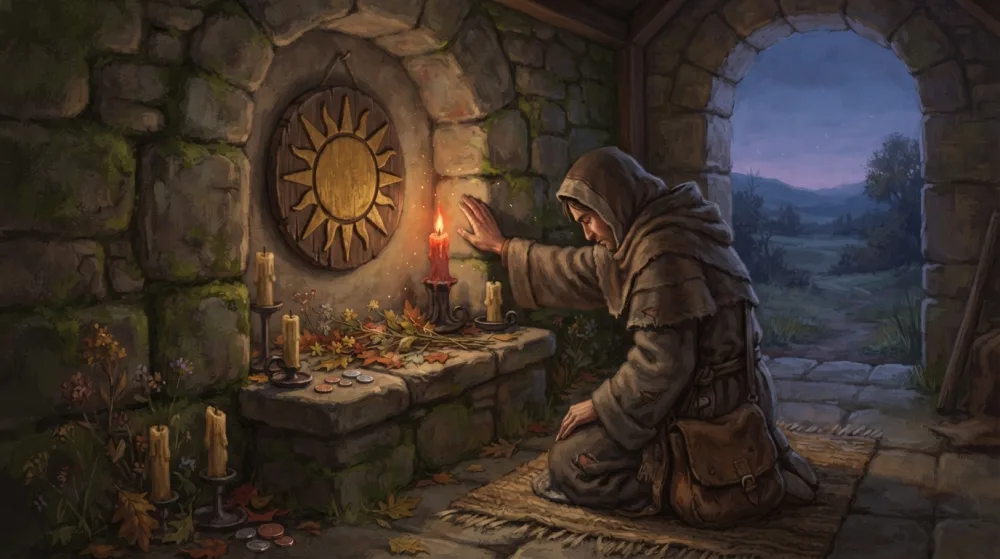
Faith in the Realms isn't limited to grand temples. A family or business might keep a small shrine to a favored deity - wind chimes consecrated to Akadi hung in a garden, a miniature symbol of Azuth displayed on a wall with room to burn incense nearby. Most shrines are unstaffed, maintained by whoever visits to pray, and a traveling priest passing through town is often enough to draw the local faithful out to meet them.
Communion with the gods rarely takes the dramatic form of a deity physically appearing. Prayer, song, and quiet meditation are the most common ways worshipers connect with their faith, and these moments are treated as intensely personal - "advice" that arrives during morning prayer is understood to be meant for the one praying, not a message to broadcast. Divine magic itself is also a channel for guidance, though the pronouncements it carries tend to be brief and open to interpretation rather than clear commands.
Hot Take: Don't skip the shrine detail when building a Cleric or Paladin's backstory. A single sentence - "my family kept a shrine to Waukeen by the market stall" - does more to make a deity feel real at the table than memorizing that god's full portfolio, and it gives your DM an easy, specific hook to use later.
Religious Persecution and Tolerance
Faerun's governments run the same moral spectrum as its gods, and most places that restrict worship do so narrowly: banning formal temples, organized priesthoods, and public festivals for a specific deity rather than punishing private belief. Waterdeep, for example, forbids temples to Talona (goddess of poison and disease) within the city, but an individual citizen who quietly reveres her isn't arrested for it, only viewed with suspicion, as long as they otherwise obey the law.
Some places go further for practical reasons - a tyrant might ban worship of Torm specifically because a courage-and-justice deity could inspire rebellion against unjust rule. This distinction between private faith and public institution is a useful, low-effort adventure hook: a party might be asked to protect a quietly-tolerated shrine, or navigate a city where their own Cleric's god is technically outlawed.
Factions
The North and the Sword Coast have no single centralized government, and the Sword Coast Adventurer's Guide treats that as the direct cause of the region's dense web of secret societies, mercenary companies, knightly orders, and wizardly circles. This section turns that material into character-ready faction ties: a job, a contact, a rivalry, or a reason your character left home in the first place.
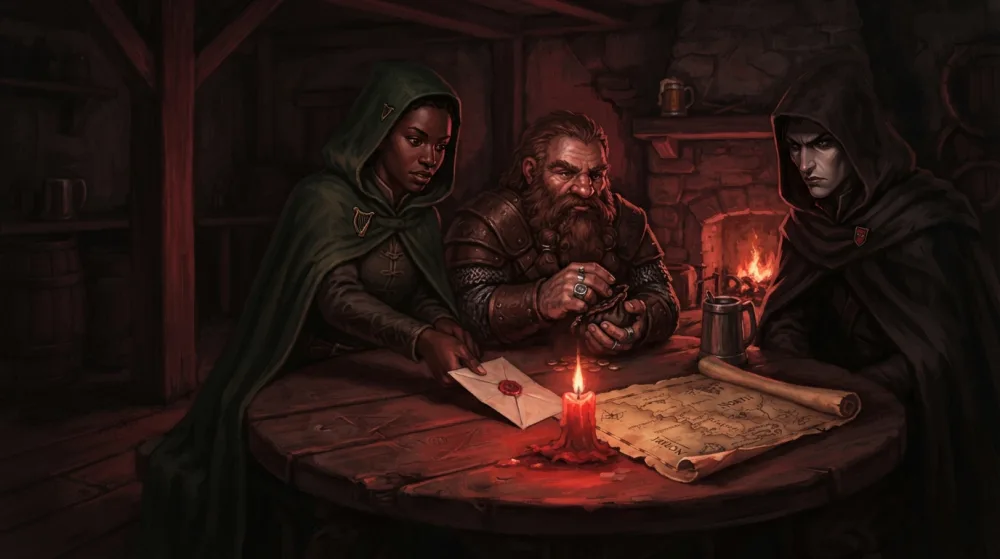
The five factions covered first are the region's major players, each tied to a specific skill in the Faction Agent background. Everything after that - knightly orders, wizardly circles, bardic colleges, druid circles, and mercenary companies - gives a narrower, more specific backstory hook.
The Five Major Factions
| Faction | Method | Associated skill | Best character fit |
|---|---|---|---|
| The Harpers | Knowledge, quiet influence, behind-the-scenes work | Investigation | A Bard, Rogue, or any character built around information and subtlety |
| The Order of the Gauntlet | Open, righteous combat against evil | Religion | A Paladin, Cleric, or any character who wants to fight evil openly rather than in the shadows |
| The Emerald Enclave | Wilderness survival and balance | Nature | A Druid, Ranger, or Barbarian tied to the North's wild places |
| The Lords' Alliance | City governance and shared regional defense | History | A character representing (or working for) one of the North's city-states |
| The Zhentarim | Commerce and organized, morally flexible operations | Deception | A character comfortable with grey-area work in exchange for real resources |
The Harpers have existed for over a millennium, disbanded and reformed several times, and work through knowledge and fairness rather than force. Harper agents are typically skilled at Investigation, and lean on other Harpers, sympathetic bards and innkeepers, rangers, and aligned clergy for support.
The Order of the Gauntlet is one of the newest major powers in Faerun, pursuing a similar goal to the Harpers through opposite methods: its holy warriors never hide, openly crushing evil and promoting justice. Order agents tend toward Religion proficiency and can call on law enforcement and the clergy of aligned gods.
The Emerald Enclave maintains the balance of the natural order against threats to it, drawing members from druids, rangers, barbarian tribes, and allied circles across the North. Enclave agents lean on Nature and can call on woodsmen, hunters, rangers, barbarian tribes, druid circles, and nature-aligned priests.
The Lords' Alliance (also covered as a regional political structure in the Regions section below) maintains its own cadre of agents whose concerns transcend any single member city's local politics. Alliance agents are required to know History and can rely on the governments and leaders that make up the Alliance.
The Zhentarim, sometimes called the Black Network, have worked in recent years to soften their reputation among common folk, drawing employees from many walks of life for tasks that serve the faction's goals without necessarily being criminal. Agents frequently lean on Deception and seek aid from wizards, mercenaries, merchants, and priesthoods allied with the network.
Knightly Orders of Faerun
Faerun's knightly orders aren't restricted to mounted, armored nobility - most are open to anyone willing to fight and die for the order's cause. A few named in this source: the Order of the Gilded Eye, based at Helm's Hold, dedicated to rooting out and severing connections to evil planar influence before it can take root (a strong fit for the Oath of the Crown's law-and-duty theme); the Order of Samular, warriors of Tyr based at Summit Hall who stayed loyal to their god even through his long silence; the Knights of the Unicorn, a romantic, adventure-for-its-own-sake order that follows Lurue's ideals; the Knights of Myth Drannor, reformed to build alliances between the civilized races against evil; and the Knights of the Silver Chalice, founded to restore a proper heir to Tethyr's throne.
Wizardly Circles
The Red Wizards of Thay are the Realms' most infamous organized wizards - red-robed, shave-headed, tattooed by school of magic, and organized under eight zulkirs who constantly compete for power. Their diplomatic standing in Thay grants them legitimacy elsewhere, but they're viewed with near-universal suspicion in the Sword Coast and the North, making them a strong choice for a morally complicated Wizard backstory.
The War Wizards of Cormyr are battle-ready evokers and other spellcasters sworn to protect the Cormyrean crown, often recruited from the Purple Dragons military before their arcane training. They serve as bodyguards, advisors, and spies for the royal family and Purple Dragon Knights, and can be summoned rapidly via enchanted rings worn by those they protect - a useful faction to introduce alongside a Purple Dragon Knight character or NPC.
Bardic Colleges
The Sword Coast supports a handful of bardic colleges beyond the old apprentice-to-master tradition, three of which have real presence in this source: the College of Fochlucan, revived at its original site near Silverymoon and allied with the Harpers though officially separate from them; the College of New Olamn, a prestigious Waterdeep-area institution founded by wealthy patrons, most of whose bards follow the College of Lore; and the College of the Herald, based at Herald's Holdfast, dedicated to preserving history and lore above musical performance, allied with but neutral from the Harpers' cause.
Druid Circles
Beyond the wider Emerald Enclave faction, a few specific druid circles are named in this source: the Circle of Swords, protectors of the Neverwinter Wood who drive out destructive humanoids and guard the wood's ruins; and the region's Moonshea Circles, who gather at sacred moonwells and venerate the land as the Earthmother. Both work as a specific, local druid affiliation for a character who wants more detail than "member of the Emerald Enclave" alone provides.
Mercenary Companies
The North supports numerous mercenary companies beyond the major factions above. Named examples include the Chill, an unusual goblinoid tribe that maintains relatively good relations with nearby settlements by hiring out as warriors instead of raiding; Silent Rain, an elf-only company from Evereska that takes only jobs promoting elven causes or destroying threats like orcs and gnolls; and the Bloodaxes, founded by dwarves exiled from their clans, now open to any race and built around giving exiles, criminals, and misfits a fresh start. Any of these works as a quick, ready-made backstory for a Fighter, Barbarian, or Ranger who fought for coin before adventuring - see the Mercenary Veteran background for the matching character option.
Sword Coast and the North Regions
The Sword Coast Adventurer's Guide covers the North in five broad clusters: the cities bound together by the Lords' Alliance, the dwarfholds carved into the region's mountains, the island kingdoms scattered across the Sea of Swords, a set of fully independent realms answering to no outside power, and the Underdark stretching beneath it all. Use the comparison table to pick a starting region fast, then read the entry that matches.
The book is explicit that none of this is meant to be treated as fixed canon at your table: names, threats, and politics are touchstones for a DM to build on, not constraints. Change what doesn't serve your campaign.
Region Comparison
| Region cluster | Government | Best for | Notable locations |
|---|---|---|---|
| Lords' Alliance cities | Cooperative city-state confederation | Conventional adventure hooks, a stable home base | Waterdeep, Baldur's Gate, Amphail, Neverwinter, Silverymoon, Mirabar, Yartar, Longsaddle |
| Dwarfholds of the North | Dwarven clan rule, fortress-cities | Underground exploration, dwarven-culture campaigns | Citadel Adbar, Citadel Felbarr, Gauntlgrym, Ironmaster, Mithral Hall, Sundabar, Thornhold |
| Island Kingdoms | Varies - local lords, pirate captains, isolated clans | Naval and coastal campaigns, isolated cultures | Mintarn, the Moonshaes, the Northlander Isles, Orlumbor, the Southern Isles |
| Independent Realms | No outside authority; self-governing or ungoverned | Lawless, morally grey, or frontier campaigns | Luskan, Icewind Dale, Candlekeep, Evereska, the Uthgardt lands, Helm's Hold |
| The Underdark | Hostile non-surface settlements, no unified rule | Survival horror, subterranean exploration | Menzoberranzan, Gracklstugh, Blingdenstone, Mantol-Derith |
The Lords' Alliance Cities
The Lords' Alliance isn't a nation - it's a mutual-aid pact between the rulers of the North's great city-states, who've pledged to share information and defense against common threats like orc hordes and Northlander pirates while keeping their own independence intact. Waterdeep, Baldur's Gate, Mirabar, Neverwinter, and Silverymoon anchor the alliance; smaller settlements like Amphail, Longsaddle, and Yartar round it out.
Amphail is a small horse-ranching town of roughly seven hundred people that punches above its political weight - three noble Waterdhavian families (Amcathra, Ilzimmer, and Roaringhorn) effectively run it as a place for their more troublesome children to cause mischief away from the capital's watchful eyes. It's a strong pick for low-stakes noble intrigue and a lighter change of pace between bigger adventures.
Baldur's Gate is a busy harbor city of tens of thousands built on trade, still carrying the scars of a recent, violent return of Bhaal, god of murder. It's ruled by a Council of Four dukes (currently led by Grand Duke Ulder Ravengard), policed by the Flaming Fist mercenary company, and quietly dominated in its underworld by a shadowy criminal organization known only as the Guild. A strong pick for urban intrigue, faction politics, and a city dense enough to explore block by block.
Neverwinter is a rebuilding boomtown - devastated decades ago by a volcanic eruption that split the city with a great chasm, now recovering under Lord Protector Dagult Neverember's leadership after the chasm's magical sealing. Empty land, low barriers to entry, and a "make your own opportunity" atmosphere make it an excellent home base for a party that wants to build something (a guild, a business, a reputation) rather than simply pass through.
Silverymoon is presented as close to a model city: a peaceful, cooperative community where humans, dwarves, gnomes, elves, halflings, and half-elves live and govern together, historically the anchor of the now-dissolved Silver Marches confederation. A strong pick for a diplomatic or knowledge-focused campaign, or simply a safe harbor between darker adventures elsewhere.
Mirabar, Yartar, and Longsaddle round out the Alliance's named member settlements, each with its own local character worth reading directly from the source if your campaign settles there specifically.
Dwarfholds of the North
Seven major dwarfholds anchor dwarven presence across the North: Citadel Adbar, Citadel Felbarr, Gauntlgrym, Ironmaster, Mithral Hall, Sundabar, and Thornhold. Each is a fortress-city built by and for a dwarven clan, and together they give a campaign built around dwarven culture, mountain strongholds, or underground exploration a full regional backdrop without leaving the North. Gauntlgrym in particular ties directly into Neverwinter's own recovery arc as a nearby ally the rebuilding city hopes will supply arms and armor.
Island Kingdoms
The Sea of Swords holds several distinct island cultures: Mintarn (a mercenary-friendly island nation, source of the soldiers who patrol Neverwinter during its rebuilding), the Moonshaes, the Northlander Isles, Orlumbor, and the Southern Isles. These work well for a naval campaign, a party that wants to island-hop between adventures, or a culture-clash story where an isolated island tradition meets outside influence.
Independent Realms
Not every settlement in the North answers to a larger authority. Luskan is the North's classic lawless port city, historically a rival and periodic threat to the Lords' Alliance cities. Icewind Dale is a harsh frontier region far to the north, defined by brutal weather and self-reliant communities. Candlekeep is Faerun's great fortress-library, a font of knowledge guarded as fiercely as any vault. Evereska is a hidden elven stronghold. The Uthgardt lands cover the territories of the North's barbarian tribes (see the Uthgardt Tribe Member background for a character option tied directly to this region), and Helm's Hold anchors the Order of the Gilded Eye's ongoing fight against otherworldly incursions. Each of these regions works well for a campaign that wants real unpredictability - no Alliance safety net, no guaranteed allies, and consequences that fall entirely on the party's own choices.
The Underdark
Beneath all of the North lies the Underdark, described in this chapter as the greatest and most dangerous "dungeon" in the region. Named settlements include Menzoberranzan (the drow city, one of the Underdark's most powerful and dangerous settlements), Gracklstugh (a duergar stronghold), Blingdenstone (a deep gnome settlement), and Mantol-Derith (a neutral trading post where surface and Underdark cultures meet under an uneasy truce). A campaign that goes underground should treat every settlement as actively hostile to outsiders by default - Mantol-Derith is the rare exception, and even that neutrality is fragile.
Related Guides
For the rules behind the character options above, see the D&D 5e Class Guides, the D&D 5e Backgrounds Guide, and the D&D 5e Race Guides. For the mechanics a deity choice feeds into, see the Cleric class guide and the Paladin class guide, including this book's own Arcana Domain and Oath of the Crown subclasses. New to the 2014 rules? Start with the D&D 5e 2014 beginner's guide.