Introduction
Eberron: Rising from the Last War hands D&D 5e 2014 players and DMs a setting built on a single premise: magic is a technology, not a mystery. Lightning rails carry passengers across continents, elemental-bound airships cross the sky, and the war that just ended was fought with magic the way other worlds fight wars with steel. There is a class built entirely around that idea, four new player races shaped by it, a dozen dragonmarked houses that control it commercially, and a tower-city, Sharn, built to show it off.
Eberron has a specific tone: pulp adventure and post-war noir, not high fantasy. The Last War ended a few years before most campaigns start, and its scars - an entire nation reduced to a still-smoking dead zone called the Mournland, refugees who never went home, spies and mercenaries with nothing left to fight for - are baked into the setting rather than left as background flavor.

This guide covers the whole book in the order a table actually uses it. Character options come first, because race and class are what a player puts on the sheet. Dragonmarks follow, since they layer on top of that build rather than replacing part of it. Then Khorvaire nation by nation, then Sharn, then the factions competing for a broken continent, then the treasure, then the tools for running the campaign behind the screen.
Two readers use this material in opposite directions. A player builds outward from a concept: pick a race and class, then decide which nation, house, and mark fit. A DM builds inward from a conflict: pick a nation, a faction, or a patron, then let the players' choices decide how the adventure connects to it.
Character Options
Eberron: Rising from the Last War adds four brand-new player races, a full new spellcasting class with three specialist paths, one new background, and a fresh layer of cultural framing for every race the Player's Handbook already covers. None of it requires you to know Khorvaire's politics before you sit down to build a character.
Eberron treats race and class as the same starting point every other 2014 setting does, then layers two things on top that do not exist anywhere else in this system's collection: a magic-as-technology class built around a repeatable infusion system, and a dragonmark-and-house framework that gives a character's family history real mechanical weight. Sort race, class, and background first; the dragonmark layer builds on top of those choices rather than replacing any of them.
New Races
Four races debut in this book, and none of them has an equivalent anywhere else in the 2014 library. Each one gets its own full guide with ability scores, traits, and class-pairing analysis; the summaries below are just enough to point you at the right one.
| Race | What Makes It Distinct |
|---|---|
| Changeling | A shapechanger with zero combat trait and two extra skill proficiencies from a social-skill list - built around infiltration and social builds like Rogue and Bard. |
| Kalashtar | Advantage on every Wisdom saving throw plus resistance to psychic damage, with no Darkvision trade-off - a psionic human/quori hybrid with a strong mental-save floor. |
| Shifter | Four distinct subraces (Beasthide, Longtooth, Swiftstride, Wildhunt), each with its own ability score bump and Shifting Feature - the richest single-race decision in this batch. |
| Warforged | A living construct that does not need to eat, drink, breathe, or sleep in the usual sense, resists poison, and gets a built-in +1 AC once its armor is integrated. |
Changeling's Shapechanger trait changes appearance completely with no stat change, which is a different tool than a disguise kit or an illusion spell - it holds up against a true seeing effect the way neither of those does. Kalashtar's Dual Mind trait is a blanket advantage on Wisdom saves, not a situational one, which puts it in the same conversation as Vedalken's mental-save package from Guildmasters' Guide to Ravnica even though the two races get there through very different racial fluff. Shifter asks the most of a new player: four subraces each solving a different problem (Beasthide for durability, Longtooth for damage, Swiftstride for mobility, Wildhunt for perception and anti-advantage defense) means the full comparison lives in its dedicated guide. Warforged trades the usual racial resilience trick for a build that reads as unusually low-maintenance at the table: no food budget, no watch rotation, no sleeping in armor to avoid a surprise round.
Every one of these races is playable outside Eberron with zero adjustment. A Kalashtar Cleric or a Warforged Fighter works in Faerun or Ravnica exactly as written; the cultural notes below are setting color, not a prerequisite.
Regional Flavor for Existing Races
Ten races the Player's Handbook and prior sourcebooks already cover get Eberron-specific cultural notes instead of new mechanics. Not one trait, ability score, or feature changes.
Dwarf. Eberron's dwarves trace their roots to a lost underground nation destroyed by the daelkyr, and most Khorvaire dwarves today descend from exiles driven out of that ruined nation. The Mror Holds hold the largest concentration, where clans dig through the wreckage of the old empire for both treasure and daelkyr-corrupted weapons - some clans ban that recovered magic outright, others openly wield it. Dwarves who settle in the Five Nations transfer their clan loyalty to their adopted cities instead, which makes a Brelish dwarf's attachment to the towers of Sharn feel every bit as personal as a Mror dwarf's attachment to their ancestral hold. The Mark of Warding runs through House Kundarak, a Mror Holds clan that now dominates Khorvaire's banking industry. See the Dwarf Race Guide for the full trait breakdown.
Elf. Eberron splits its elves into two ancient, mutually distant cultures rather than the Feywild-adjacent framing other settings use. The Aereni of Aerenal revere the Undying Court, a council of undead ancestors, and hold the outside world at arm's length; the Tairnadal, including the Valenar elves most commonly encountered on Khorvaire, bond with a dead patron ancestor at adulthood and spend their lives emulating that ancestor's path, whether that is a blademaster, a war chanter, or an archmage. Drow are a Xen'drik phenomenon almost unknown on Khorvaire, split into three distinct cultures of their own (Vulkoori hunters, Sulatar elemental-shapers, and Umbragen who fled underground). The Mark of Shadow runs through the elven Phiarlan and Thuranni lines, controlling much of Khorvaire's espionage business. See the Elf Race Guide.
Gnome. Zilargo's gnomes built an entire national identity around intrigue - every Zil child grows up learning to scheme, and even gnomes with good intentions tend to reach for cunning before honesty. Most Zil belong to the forest gnome subrace, and their natural illusion talent doubles as a tool for exactly the kind of trickery their culture prizes. The mysterious Trust, a conspiracy that quietly steers Zilargo's government from behind the throne, gives a gnome character a built-in hook for a spy or informant background. The Mark of Scribing runs through House Sivis, which built its reputation on impartiality and now operates Khorvaire's continent-spanning message-station network. See the Gnome Race Guide.
Halfling. Eberron's halflings originate on the Talenta Plains, where nomadic tribes still ride domesticated dinosaurs across the open grassland. A Talenta halfling who leaves the plains stands out visibly wherever they go, and reads very differently from the halfling communities that migrated west alongside early human settlers and picked up Five Nations dress and customs along the way. A Talenta character built around a dinosaur companion, a mount, or even just dinosaur-flavored combat maneuvers leans directly into that regional identity. See the Halfling Race Guide.
Human. Humans arrived in Khorvaire roughly three thousand years ago and now make up the majority population of the Five Nations, disrupting elven Aerenal and displacing the last remnants of the goblinoid Dhakaani Empire along the way. Eberron's humans are defined by variety more than any single trait - a Demon Wastes barbarian and a Brelish rogue share a species and little else - and five separate dragonmarks appear among them: Making in House Cannith, Passage in House Orien, Sentinel in House Deneith, Handling in House Vadalis, and a shared claim to Finding alongside half-orcs in House Tharashk. See the Human Race Guide.
Orc and Half-Orc. Orcs and half-orcs trace their deepest roots to the Shadow Marches, where the orc Gatekeepers learned druidic magic from the dragon Vvaraak and used it to bind the alien daelkyr beneath Khyber - a lineage that lets an orc or half-orc character claim one of Eberron's oldest defensive traditions instead of playing an outsider race. Three orc populations survive today: the Ghaash'kala who guard the Demon Wastes in service to the Silver Flame, the isolated Jhorash'tar of the Ironroot Mountains, and the Shadow Marches orcs split between the Gatekeeper tradition and the corrupting Cults of the Dragon Below. The Mark of Finding runs through House Tharashk's half-orcs specifically - a mark that neither full orcs nor humans in the house can manifest. See the Orc section of the Monstrous Races Guide and Half-Orc Race Guide.
Goblinoid (Goblin, Hobgoblin, Bugbear). Goblins, hobgoblins, and bugbears once ruled the entire continent as the Dhakaani Empire, until a war against the daelkyr cracked the empire from within. Today's goblinoids split into four cultures: city goblins integrated into Five Nations society since Galifar abolished slavery, the hobgoblin-led Ghaal'dar tribes that carved out the nation of Darguun, the raiding Marguul bugbears of the Seawall Mountains, and the isolated Heirs of Dhakaan, whose martial discipline and metalworking still outclass House Cannith's artificers by the book's own account. A Dhakaani character in particular gets an unusual hook: an agnostic, bard-led society with no clerics, paladins, or druids, where hobgoblins command, bugbears rage, and goblins fill both artisan and khesh'dar spy roles. See the Goblin section of the Monstrous Races Guide, Hobgoblin section of the Monstrous Races Guide, and Bugbear section of the Monstrous Races Guide.
Half-Elf. Khorvaire's native half-elves have built their own standing culture rather than living permanently between two others, and most reject the term "half-elf" for Khoravar - Elvish for "children of Khorvaire." Khoravar communities hold weekly unity dinners and often frame their identity around "the bridge between," the idea that half-elves are suited to translate and mediate between cultures a full-blooded elf or human might never bridge alone. Two dragonmarks run through Khoravar families: the Mark of Detection in House Medani and the Mark of Storm in House Lyrandar, the latter operating Khorvaire's airships and elemental-powered galleons. See the Half-Elf Race Guide.
Tiefling. Eberron's tieflings are rare and mostly live at civilization's fringes rather than in its cities. Most trace their bloodline to the Carrion Tribes of the Demon Wastes, where the tribes consider a fiend-touched birth a blessing rather than a curse; others are shaped by manifest zones where a fiendish plane's influence bleeds into the world, making them oddities rather than presumed villains. A third, much rarer origin ties a tiefling to the Venomous Demesne, a hidden city-state of warlocks and wizards on the far side of Droaam that the Five Nations barely knows exists. See the Tiefling Race Guide.
Dragonborn. Dragonborn in Eberron descend from a garrison the dragons of Argonnessen stationed in what is now Q'barra, tens of thousands of years ago, to hold back the fiendish Lords of Dust. That nation eventually collapsed when a corrupted Overlord shattered it from within, and the survivors retreated into Q'barra's jungles, where they still guard against corruption today. Dragonborn remain rare and poorly understood elsewhere in Khorvaire - most humans who encounter one assume they have met an unusually large lizardfolk - which gives a dragonborn character a built-in reason to explain themselves wherever the party travels. See the Dragonborn Race Guide.
The Artificer
Eberron: Rising from the Last War introduces the Artificer, a full Intelligence-based spellcasting class built around magic as technology instead of magic as raw arcane or divine power. Where most casters lean on a growing spell list, the Artificer spends most of its build decisions on Infusions, a repeatable system for turning mundane items into temporary magic items, which makes it play differently from any other class in this library.
Build Your Dungeons & Dragons (5e, 2014) Character
The Dungeons & Dragons (5e, 2014) character builder is live - build a Beastkin, a Kobold, or whatever your table is missing, free, right now.
Start BuildingThe full class guide covers Magical Tinkering, Infuse Item and the complete Infusions Known progression, the Steel Defender companion available to one specialist, and race-pairing analysis for the class's Intelligence-primary build math. Three specialist paths branch off at 3rd level, each with its own spell list and feature progression:
- Artificer Class Guide - the full class breakdown: features, Infusions, race pairings, and a level-by-level build example.
- Alchemist - built around Experimental Elixir, a flexible healing-and-utility toolkit with six selectable effects.
- Artillerist - built around Eldritch Cannon, a summonable turret with three configurable modes.
- Battle Smith - the only specialist that gets the Steel Defender, a construct companion built for melee support.
An Artificer's Infusions are class-specific, not general magic items, so the deepest strategy discussion for picking and swapping them lives inside the class guide rather than in the magic-items material below. If you are weighing a race for this class, Gnome, Vedalken, Kalashtar, and Warforged all flag the Artificer as a strong pairing.
The House Agent Background
The book adds one new background: House Agent, built for a character formally sworn to one of the twelve dragonmarked houses. Its tool proficiencies flex by house instead of being fixed, which makes it the only 2014 background whose equipment list changes based on a separate choice you make at character creation. Pick your house before you pick your class, since some houses pair better with certain builds than others.
It grants proficiency in Investigation and Persuasion, two tool proficiencies drawn from a table keyed to your specific house (Cannith heirs learn alchemist's supplies and tinker's tools, Kundarak heirs learn thieves' tools and tinker's tools, and so on), and starting equipment of fine clothes, a house signet ring, identification papers, and 20 gp. The full skill, tool, language, and feature breakdown, along with how House Agent compares against every other background, lives in the D&D 5e Backgrounds Guide. That section also covers House Connections, the background's narrative-forward feature that guarantees lodging, mission support, and contacts inside your house's business rather than granting a fixed combat benefit.
House Agent is not the only background that fits a marked character. Noble works for an heir with a real blood tie to house leadership, and Guild Artisan covers an Independent Scion who trained with the house but kept their distance. It is the clearest match for a character who wants their house relationship driving the plot from session one.
Dragonmarks
Most character-creation decisions in D&D 5e answer the question "what can my character do." A dragonmark answers a different one: "who owns my character's bloodline, and what do they expect from me in return." Eberron ties twelve of its most iconic magical traits to twelve specific families, each family bound into one of the dragonmarked houses that quietly run Khorvaire's economy. Pick the Mark of Making and you are not just a human with a bonus to Arcana checks and a free casting of magic weapon - you are a possible heir of House Cannith, the industrial dynasty whose forgeholds build everything from carriages to warforged, currently splintering into three rival factions after its Cyre headquarters vanished in the Mourning.
That is the real appeal of a dragonmark as a character option: a mechanical package wrapped around an instant, specific place in Eberron's social order. You do not have to invent a merchant family or a spy network from scratch. The book hands you one, complete with a leader, a headquarters, an emblem, and a stated business, then leaves it up to you to decide how close or how far you want to stand from it.
How Dragonmarks Actually Work
A dragonmark is not a feat, a background, or a free pick during character creation - it is a variant race option, and it only exists on bloodlines within a handful of existing races. You cannot train for one, buy one, or choose to develop one through study; a dragonmark appears on its own, usually around adolescence, and roughly half the members of an eligible bloodline never manifest it at all. Each dragonmarked house puts its heirs through a rite called the Test of Siberys specifically to find out who has the mark and who does not.
Which races carry which marks. The rules build this in as an actual racial-mechanics swap, not a re-skin:
- For humans and half-orcs, a dragonmark replaces the Ability Score Increase trait.
- For half-elves, a dragonmark replaces the Ability Score Increase and Skill Versatility traits, while keeping the rest of the half-elf package intact.
- For dwarves, elves, gnomes, and halflings, a dragonmark replaces your entire subrace choice - pick the Mark of Shadow instead of choosing high elf or wood elf, for instance, not in addition to it.
Dragonmark spells work two separate ways. Each mark grants one or two innate spells you can cast a limited number of times per rest directly through the racial trait, using a fixed spellcasting ability tied to the mark rather than your class's normal casting stat, and usually with no material components. Separately, if your class has the Spellcasting or Pact Magic feature, the mark's full leveled spell list gets added to your class's available spells - a Cleric with the Mark of Healing can prepare from the Mark of Healing Spells table right alongside the normal Cleric list. This second benefit only helps a character who already has a spellcasting class feature; it does not turn a non-caster into a caster.
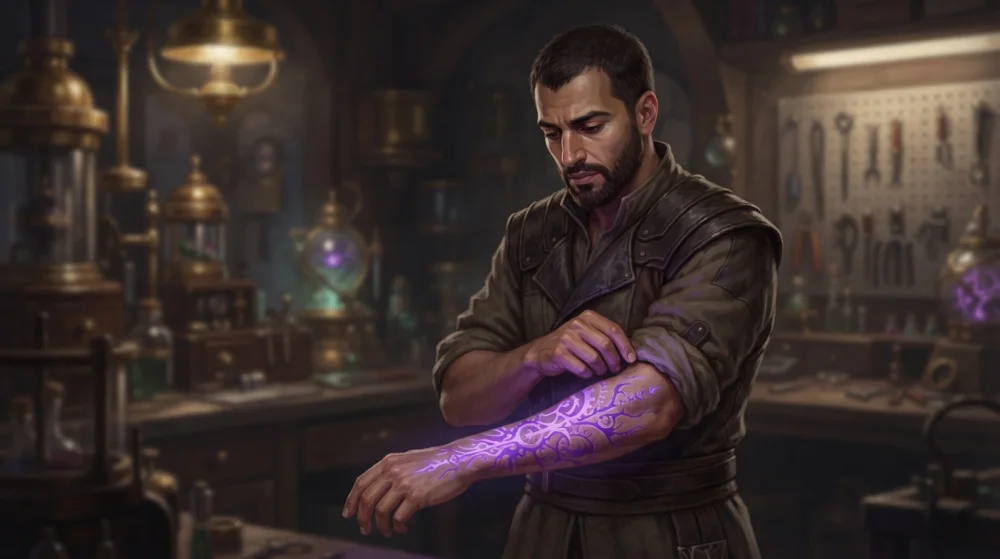
Appearance and quirks. A dragonmark appears somewhere on the skin in vivid blue-and-purple hues that shimmer or move slightly, grows warm and sometimes glows faintly when used, and cannot be permanently removed - even severing a marked limb just causes the mark to resurface elsewhere on the body eventually. It also tends to grow larger and more complex as the bearer levels up and channels stronger magic through it. If you want a distinguishing physical quirk beyond the standard look, the book offers a short table of options, from an unusually small or oversized mark to one that briefly relocates on its bearer after every long rest.
Your relationship to the house. Carrying a mark and belonging to a house are two different questions, and the book gives you four starting postures to pick from:
- Agent. A close, active relationship with the house - the House Agent background fits this directly, or Noble if your tie is through the house's leadership.
- Independent Scion. Raised or trained by the house but no longer bound to it, with no special privileges and no ongoing obligations. Guild Artisan is the default background fit, though Entertainer (Shadow), Sailor (Storm), Soldier (Sentinel), or Sage (Scribing) can all work depending on the mark.
- Excoriate. A dragonmarked heir formally cut off from their family, usually for defying house authority. The old practice of physically removing the mark is gone, but the label and the disgrace remain - worth deciding what you did to earn it.
- Foundling. No ties to any house at all, sometimes without even knowing about the bloodline until the mark manifested. Outlander and Urchin fit a Foundling who knows nothing of the houses; Acolyte or Hermit fits one who deliberately chose to ignore that heritage.
Dragonmarks at a Glance
| Mark | House | Race | Business Focus |
|---|---|---|---|
| Detection | Medani | Half-Elf | Bodyguards, investigation, risk management |
| Finding | Tharashk | Human, Half-Orc | Bounty hunting, investigation, dragonshard prospecting |
| Handling | Vadalis | Human | Animal training and breeding |
| Healing | Jorasco | Halfling | Healing |
| Hospitality | Ghallanda | Halfling | Food, lodging, urban information |
| Making | Cannith | Human | Manufacturing |
| Passage | Orien | Human | Land transportation |
| Scribing | Sivis | Gnome | Communication, translation, verification |
| Sentinel | Deneith | Human | Bodyguards, mercenaries |
| Shadow | Phiarlan, Thuranni | Elf | Entertainment, espionage and assassination |
| Storm | Lyrandar | Half-Elf | Air and sea transportation |
| Warding | Kundarak | Dwarf | Banking, storage, prisons |
| Aberrant | none (unbound) | Any race | No house affiliation - dangerous, unpredictable power |
Hot Take: Everyone wants to build the flashy Aberrant sorcerer, but a bound mark is the stronger roleplay engine for most tables - it hands you a built-in patron, a built-in rival, and a built-in reason to say yes to the next job, all without spending a feat slot on it.
Mark of Detection
The Mark of Detection sharpens observation and intuition, letting its bearer notice the connections other people miss, sense poison, and read the residue of magic. It belongs to House Medani, a half-elf house headquartered at the Tower of Inquisition in Wroat, Breland, under Baron Trelib d'Medani and marked by the sigil of a basilisk's eye. Medani runs the Warning Guild, brokering bodyguards and inquisitives who specialize in subtle threats and layered mysteries - a narrower, more cerebral niche than House Tharashk's bounty hunters or House Deneith's bodyguards, both of which overlap with Medani's territory. Medani heirs skew toward community-minded work over raw profit, often partnering with local law enforcement.
A half-elf with the Mark of Detection trades the standard half-elf Ability Score Increase and Skill Versatility traits for a Wisdom-focused increase, a bonus on Investigation and Insight checks, and the ability to cast detect magic and detect poison and disease innately, adding see invisibility at 3rd level.
| Character Level | Spells |
|---|---|
| 1st | detect evil and good, detect poison and disease |
| 2nd | detect thoughts, find traps |
| 3rd | clairvoyance, nondetection |
| 4th | arcane eye, divination |
| 5th | legend lore |
Roleplay hook. A Medani heir makes a natural party investigator or fixer - someone whose instincts flag the detail everyone else walked past. Play up the house's neutrality on inter-house politics and its track record of protecting ordinary people, and you get a character who takes jobs other adventurers would consider beneath them.
Mark of Finding
The Mark of Finding is the only dragonmark shared by two races, humans and half-orcs, and it traces back to the Shadow Marches, where clan hunters first used it to track prey through the swamps. It now belongs to House Tharashk, based in Zarash'ak and led jointly by three clan representatives known as the Triumvirate. Tharashk is the youngest dragonmarked house and has not fully embraced the older houses' customs - most heirs keep their family names rather than adopt "d'Tharashk." The house's Finder's Guild built its reputation on inquisitives and bounty hunters and has recently expanded hard into dragonshard prospecting, since dragonshards fuel Khorvaire's entire magical economy.
A half-orc or human with the Mark of Finding replaces most racial traits (age, alignment, size, and speed stay the same) with a Wisdom-focused increase, darkvision, a bonus on Perception and Survival checks, an innate casting of hunter's mark (adding locate object at 3rd level), and fluency in Goblin alongside Common.
| Character Level | Spells |
|---|---|
| 1st | faerie fire, longstrider |
| 2nd | locate animals or plants, locate object |
| 3rd | clairvoyance, speak with plants |
| 4th | divination, locate creature |
| 5th | commune with nature |
Roleplay hook. Tharashk's youth as a house is the hook - there is no centuries-deep tradition weighing an heir down, just clan loyalty, prospecting ambition, and a rivalry brewing with House Deneith over the mercenary trade. A Tharashk character fits a party that needs someone who can find what is missing, whether that is a fugitive, a lost heir, or a vein of Khyber shards.
Mark of Handling
The Mark of Handling grants an intuitive bond with beasts and the natural world - not just calming and training ordinary animals, but guiding exotic and even magical creatures with the same ease. It belongs to House Vadalis, headquartered at Foalswood near Varna in the Eldeen Reaches under Dalin d'Vadalis, a leader who has no interest in noble titles or house politics. Vadalis breeds and trains everything from cattle and hounds to griffons, hippogriffs, and bulettes (a dangerous specialty with predictably high turnover), and its magebreeding program, using dragonshard focus items to produce stronger, faster, smarter creatures, has spawned persistent unconfirmed rumors that the house has experimented on more than animals.
A human with the Mark of Handling trades the standard human Ability Score Increase for a Wisdom-focused increase, a bonus on Animal Handling and Nature checks, and an innate casting of animal friendship and speak with animals, extending to beasts and monstrosities of Intelligence 3 or lower starting at 3rd level.
| Character Level | Spells |
|---|---|
| 1st | animal friendship, speak with animals |
| 2nd | beast sense, calm emotions |
| 3rd | beacon of hope, conjure animals |
| 4th | aura of life, dominate beast |
| 5th | awaken |
Roleplay hook. A Vadalis heir is the party's answer to "who talks to the monster instead of fighting it," and the house's magebreeding rumors give a Vadalis character a built-in moral question to wrestle with: how far is too far when the goal is a better creature?
Mark of Healing
The Mark of Healing lets a halfling bearer close wounds with a touch and, with the right dragonshard focus items, even draw the recently dead back from the edge of Dolurrh. It belongs to House Jorasco, the Healer's Guild, headquartered at the Vedykar Enclave in Karrnath under Baron Ulara d'Jorasco - beloved across northwestern Khorvaire for her role fighting an epidemic a decade earlier, and instrumental in keeping every nation's army standing during the Last War through embedded Jorasco medics. Jorasco runs medical schools and houses of healing, charges for its services (instant disease removal via lesser restoration if you can pay, mundane care if you cannot), and is the primary source of commercial potions of healing. Persistent rumors tie the house to disturbing wartime experiments alongside House Vadalis.
A halfling with the Mark of Healing gains this as a subrace: a Wisdom increase, a bonus on Medicine checks and herbalism kit use, and an innate casting of cure wounds, adding lesser restoration at 3rd level.
| Character Level | Spells |
|---|---|
| 1st | cure wounds, healing word |
| 2nd | lesser restoration, prayer of healing |
| 3rd | aura of vitality, mass healing word |
| 4th | aura of purity, aura of life |
| 5th | greater restoration |
Roleplay hook. The tension between Jorasco's war-tested healing competence and its unapologetic billing practices makes for an easy character seed: does your Jorasco heir believe the house's line about reinvesting in future generations, or have they started to see the fee schedule as a betrayal of the calling?
Mark of Hospitality
The Mark of Hospitality is the quiet-power mark - its bearer can keep a space clean, season and preserve food, and, more importantly, connect with nearly anyone. It belongs to House Ghallanda, whose Hosteler's Guild owns or licenses most inns, taverns, and restaurants across the Five Nations, headquartered at Gatherhold in the Talenta Plains under Yoren d'Ghallanda. Ghallanda looks harmless next to House Deneith's soldiers or House Cannith's factories, but its real strength is information and favors - a Ghallanda innkeeper hears everything, and the house trades in built-up goodwill rather than sold secrets. Its enclaves, more numerous than any other house's, also function as neutral sanctuaries beyond any government's or house's legal reach.
A halfling with the Mark of Hospitality gains this as a subrace: a Charisma increase, a bonus on Persuasion checks and brewer's supplies or cook's utensils use, the prestidigitation cantrip, and an innate casting of purify food and drink and unseen servant.
| Character Level | Spells |
|---|---|
| 1st | goodberry, sleep |
| 2nd | aid, calm emotions |
| 3rd | create food and water, Leomund's tiny hut |
| 4th | aura of purity, Mordenkainen's private sanctum |
| 5th | hallow |
Roleplay hook. A Ghallanda character makes a natural party face and fixer - someone who can get a room, a meal, or a favor almost anywhere, and who has probably already heard the rumor the rest of the party is chasing. The house's expanding presence near dangerous frontiers like the Demon Wastes also gives a Ghallanda heir a reason to have already seen more of Khorvaire's edges than most.
Mark of Making
The Mark of Making channels raw creative power - its bearer can mend broken objects with a touch and always seems to have some minor invention in progress. It belongs to House Cannith, the House of Making, historically the unspoken leader of the Twelve and the dominant force in both mundane and magical manufacturing across Khorvaire. The Last War made Cannith's fortune and then nearly destroyed it: the house was based in Cyre, and the Mourning wiped out its central leadership and key facilities. Three barons now compete to fill the vacuum - Jorlanna in Fairhaven (alchemy), Zorlan in Korth (weaponsmithing), and Merrix in Sharn (warforged innovation) - and an heir of House Cannith has to decide, at least implicitly, which of the three they answer to.
A human with the Mark of Making trades the standard human Ability Score Increase for an Intelligence-focused increase, a bonus on Arcana checks and artisan's tools use, proficiency with one type of artisan's tools, the mending cantrip, and an innate casting of magic weapon that lasts a full hour without requiring concentration.
| Character Level | Spells |
|---|---|
| 1st | identify, Tenser's floating disk |
| 2nd | continual flame, magic weapon |
| 3rd | conjure barrage, elemental weapon |
| 4th | fabricate, stone shape |
| 5th | creation |
Roleplay hook. Making is the mark most likely to overlap with an Artificer build, but it fits a Wizard just as naturally. The three-way Cannith succession fight gives an heir an immediate, personal stake in Eberron's post-war politics without needing to invent one - just decide which baron's vision of the house's future your character wants to see win.
Mark of Passage
The Mark of Passage grants uncanny speed and, at its strongest, the ability to slip briefly through space. It belongs to House Orien, the House of Passage, headquartered at Journey's Home in Passage, Aundair, under Kwanti d'Orien. Orien built its power on land transportation - the dramatic lightning rail is its signature achievement, but the house also runs caravans, coaches, and the Courier's Guild's mail network, including a covert branch for riskier deliveries. The house is under real pressure now: the Mournland blocks ground routes and has starved Kwanti's rebuilding funds, while House Lyrandar's airships threaten to eclipse the lightning rail entirely, pushing Orien into an uneasy research partnership with House Cannith to unlock true teleportation.
A human with the Mark of Passage trades the standard human Ability Score Increase for a Dexterity-focused increase, a 35-foot base walking speed, a bonus on Acrobatics checks and land-vehicle operation, and a single daily casting of misty step.
| Character Level | Spells |
|---|---|
| 1st | expeditious retreat, jump |
| 2nd | misty step, pass without trace |
| 3rd | blink, phantom steed |
| 4th | dimension door, freedom of movement |
| 5th | teleportation circle |
Roleplay hook. An Orien heir is built for a party that needs to move fast and often - couriers, scouts, and characters whose backstory already put them on the road. The house's rivalry with Lyrandar and its struggle against the Mournland both give a natural adventure hook: an Orien character has a professional reason to want the lightning rail rebuilt, whatever it takes.
Mark of Scribing
The Mark of Scribing is built around language and communication - its bearer can feel words almost as living things, translates fluently, and can reach others across long distances. It belongs to House Sivis, headquartered at the Labyrinth in Korranberg, Zilargo, under Lysse Lyrriman d'Sivis, and marked by the cockatrice emblem. Sivis built its Message Stations network on speaking stones, magic items that let a Sivis heir send short messages between linked stones, and the house also trains and licenses the scribes, notaries, interpreters, cartographers, and heralds who keep Khorvaire's paperwork honest. Sivis maintains strict neutrality in every house or national dispute - a reputation for absolute trust that lets it notarize contracts, including House Kundarak's letters of credit, that both sides can rely on.
A gnome with the Mark of Scribing gains this as a subrace: a Charisma increase, a bonus on History checks and calligrapher's supplies use, the message cantrip, and innate castings of comprehend languages, adding magic mouth at 3rd level.
| Character Level | Spells |
|---|---|
| 1st | comprehend languages, illusory script |
| 2nd | animal messenger, silence |
| 3rd | sending, tongues |
| 4th | arcane eye, confusion |
| 5th | dream |
Roleplay hook. Sivis's public neutrality hides a house full of internal scheming and family feuds - gnomes love intrigue, and Doyenne Lyrriman spends real effort keeping those rivalries from spilling into the house's reputation. A Sivis heir plays well as the party's diplomat or information broker with a private agenda they are not fully sharing.
Mark of Sentinel
The Mark of Sentinel heightens senses and reflexes, letting its bearer respond to danger before it fully arrives, and can shield an ally directly from harm. It belongs to House Deneith, born in war-steeped Karrnath and headquartered at Sentinel Tower in Karrlakton under Breven d'Deneith. Deneith's Blademarks Guild has governed Khorvaire's mercenary trade for centuries, brokering everything from Valenar war bands to Droaam's goblin fighters, while its Defender's Guild provides elite bodyguards and its Sentinel Marshals hold cross-national authority to pursue criminals. Despite its military strength, Deneith maintains strict neutrality, hiring out to every side of a conflict - though Baron Breven is surrounded by advisors who would rather see the house rule outright, and an escalating rivalry with House Tharashk over mercenary contracts is only getting sharper.
A human with the Mark of Sentinel trades the standard human Ability Score Increase for a Constitution-and-Wisdom increase, a bonus on Insight and Perception checks, a single daily casting of shield, and a reaction that lets you swap places with an ally about to be hit, taking the attack yourself.
| Character Level | Spells |
|---|---|
| 1st | compelled duel, shield of faith |
| 2nd | warding bond, zone of truth |
| 3rd | counterspell, protection from energy |
| 4th | death ward, guardian of faith |
| 5th | Bigby's hand |
Roleplay hook. Sentinel is the mark for a character who defines themselves by protecting others, professionally or personally. A Deneith heir fits a party's frontline defender role mechanically and thematically at once, and the house's absolute neutrality gives a built-in reason to work for clients other characters might refuse.
Mark of Shadow
The Mark of Shadow bends illusion and stealth to its bearer's will - weaving distracting or delightful phantasms, or simply making its bearer hard to find. Uniquely among the marks, it is split between two rival houses. House Phiarlan, led by Elvinor Elorrenthi d'Phiarlan from the Demesnes (a network of artistic enclaves, each devoted to a different art form) and marked by the hydra, has offered entertainment and, more quietly, espionage in western Khorvaire for centuries. Near the end of the Last War, a bitter internal feud called the Shadow Schism split off House Thuranni, led by Elar d'Thuranni from Regalport in the Lhazaar Principalities and marked by the displacer beast; Thuranni now operates in the east, and while both houses keep up appearances of peace, the rivalry runs deep. As a rule, Phiarlan produces the better spies and Thuranni the better assassins.
An elf with the Mark of Shadow gains this as a subrace: a Charisma increase, a bonus on Performance and Stealth checks, the minor illusion cantrip, and a single daily casting of invisibility starting at 3rd level.
| Character Level | Spells |
|---|---|
| 1st | disguise self, silent image |
| 2nd | darkness, pass without trace |
| 3rd | clairvoyance, major image |
| 4th | greater invisibility, hallucinatory terrain |
| 5th | mislead |
Roleplay hook. Choosing Phiarlan or Thuranni is itself a character decision - a genteel performer-spy loyal to the old house, or a colder operative from the breakaway house built around precision violence. Either way, the Mark of Shadow fits a Rogue or Bard built around misdirection more than brute stealth.
Mark of Storm
The Mark of Storm calls to wind and water, and at its strongest lets its bearer command the storm itself. It belongs to House Lyrandar, headquartered at the island enclave of Stormhome in Aundair under Esravash d'Lyrandar and marked by the kraken. Lyrandar's elemental-bound galleons dominated sea and river trade for generations, and the house's decade-old airship program has since undercut House Orien's lightning rail for overland dominance - Lyrandar effectively controls both sea and sky. The Raincallers' Guild can even use the mark to shape weather for paying clients. Baron Esravash treats the house as more than a business, positioning Lyrandar as a champion of half-elf interests broadly, including support for the young Valenar kingdom as a potential homeland for the Khoravar.
A half-elf with the Mark of Storm trades the standard half-elf Ability Score Increase and Skill Versatility traits for a Charisma-and-Dexterity increase, a bonus on Acrobatics checks and navigator's tools use, resistance to lightning damage, the gust cantrip, and a single daily casting of gust of wind starting at 3rd level.
| Character Level | Spells |
|---|---|
| 1st | feather fall, fog cloud |
| 2nd | gust of wind, levitate |
| 3rd | sleet storm, wind wall |
| 4th | conjure minor elementals, control water |
| 5th | conjure elemental |
Roleplay hook. Storm is the mark for a character built around movement and command of the elements - airship crew, sea captains, or anyone whose family made its fortune controlling how Khorvaire gets from one place to another. Lyrandar's rivalry with Orien and its outsized role in half-elf identity politics both give a Storm heir plenty to care about beyond their own next job.
Mark of Warding
The Mark of Warding channels a dwarf's instinct for what is worth protecting, weaving mystic barriers and granting an intuitive read on locks and seals. It belongs to House Kundarak, headquartered at Korunda Gate in the Mror Holds under Morrikan d'Kundarak and marked by the manticore. Kundarak's Defenders Guild trains locksmiths and security specialists and runs Dreadhold, the house's flagship prison, but its real institutional power comes from the Banking Guild - Kundarak lands sit on deep veins of precious metal, and the house effectively invented Khorvaire's banking industry, including a system of extradimensional vaults for clients who need goods stored securely and retrieved anywhere. Kundarak's close alliance with House Sivis reflects a shared obsession with earned trust, and the house has little patience for renegade dwarves who use the mark to run cons.
A dwarf with the Mark of Warding gains this as a subrace: an Intelligence increase, a bonus on Investigation checks and thieves' tools use, and innate castings of alarm and mage armor (adding arcane lock at 3rd level), all without requiring material components.
| Character Level | Spells |
|---|---|
| 1st | alarm, armor of Agathys |
| 2nd | arcane lock, knock |
| 3rd | glyph of warding, magic circle |
| 4th | Leomund's secret chest, Mordenkainen's faithful hound |
| 5th | antilife shell |
Roleplay hook. A Kundarak heir fits naturally as the party's paranoid planner - someone who thinks about contingencies, security, and where the party's valuables are actually safe. The house's alliance with the Gatekeeper druids, both of whom share a stake in wards that hold back the daelkyr, also gives a Kundarak dwarf a plausible tie into Eberron's deeper cosmic threats without leaving the mark's home turf.
Aberrant Dragonmarks
Not every dragonmark obeys the rules the twelve houses follow. An aberrant dragonmark can appear on a member of any race, at any age, with no tie to bloodline or house - most often when people from two different dragonmarked families have a child together, a union the Twelve actively forbids for exactly this reason. Unlike the twelve bound marks, no two aberrant marks look or work quite alike, even when they grant similar power, and it typically takes real time and real mistakes for a bearer to learn to control one. That unpredictability is why aberrant marks carry a lingering stigma: centuries ago, legendary aberrant bearers like Halas Tarkanan (who could level cities with earthquakes) and the Lady of the Plague (who commanded disease and vermin) were powerful enough that the dragonmarked houses united in a purge called the War of the Mark. Whether that was justified persecution or a witch hunt depends on who is telling the story, but it worked - aberrant marks became rare and comparatively weak in its aftermath. Since the Mourning, they have been appearing again in greater numbers, and nobody in Khorvaire is quite sure why.
Mechanically, this is the Aberrant Dragonmark feat, available only to a character with no other dragonmark, of any race. Taking it increases your Constitution score by 1 (to a maximum of 20), lets you learn a cantrip and one 1st-level spell from the sorcerer spell list that you cast through the mark using Constitution as your spellcasting ability (regaining the use of the leveled spell after a short or long rest), and adds a volatile edge: each time you cast that 1st-level spell through the mark, you roll one of your Hit Dice - an even result grants temporary hit points equal to the roll, an odd result deals that much force damage to a random creature within 30 feet, yourself included if nothing else is in range. Taking the feat also saddles you with a permanent flaw rolled from a short table of unsettling side effects. At the DM's option, a character with an aberrant mark who reaches 10th level gains a small, repeating chance of manifesting an epic boon, at a steep permanent cost of one Hit Die and a chunk of hit point maximum if it triggers.
| Result | Flaw |
|---|---|
| 1 | Constant physical pain from the mark |
| 2 | The mark whispers, unclearly |
| 3 | The mark hisses audibly under stress |
| 4 | Burned, scaly, or withered skin around the mark |
| 5 | Animals grow uneasy near you |
| 6 | A mood swing accompanies every use |
| 7 | Your appearance shifts slightly with each use |
| 8 | Horrific nightmares follow each use |
Roleplay hook. An aberrant mark is the build for a character who wants dragonmark-flavored power without a house's obligations, support network, or scrutiny, and it comes with a built-in cost the twelve bound marks do not carry. It also fits naturally with House Tarkanan, the loose network of aberrant-marked outcasts operating in Sharn's underworld, for a group willing to take on a full political dimension around this choice.
Khorvaire, Nation by Nation
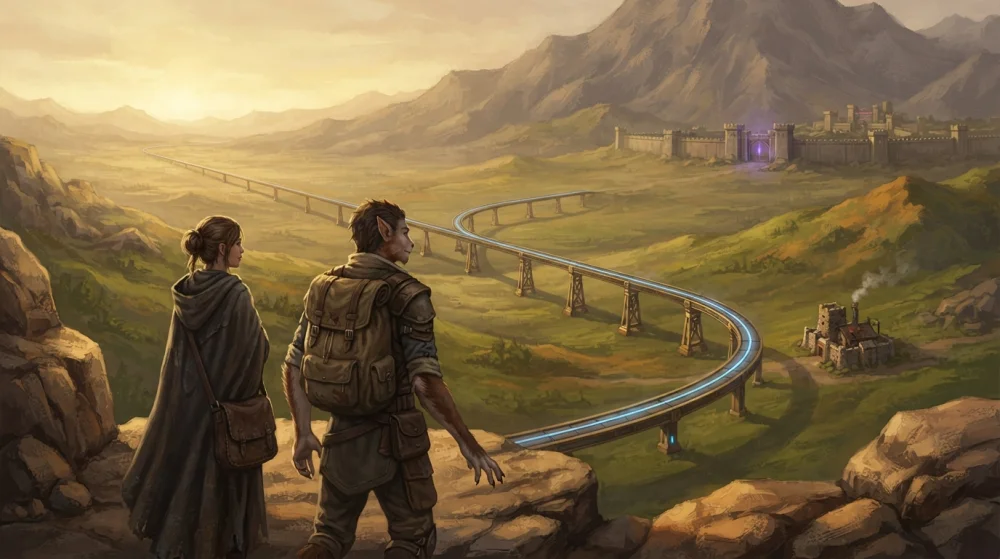
A century ago, the Kingdom of Galifar covered most of Khorvaire under one crown. The Last War tore it into pieces, and the Treaty of Thronehold that ended the fighting recognized the pieces as they stood rather than putting the old kingdom back together. What is left is a continent of nations built on very different foundations: five war-forged successor states, a scattering of older peoples who never bowed to Galifar in the first place, and a few new arrivals - goblin, elf, and monstrous - who carved out sovereignty during the fighting and made it stick at the negotiating table.
This section covers all seventeen nations and regions at comparable depth, then the Distant Lands beyond the continent and the faiths Khorvairians actually practice. Use the comparison table to find a nation that matches the campaign tone you want, then read that entry. None of it requires reading the other sixteen first.
| Nation | Capital | Character | Best campaign fit |
|---|---|---|---|
| Aundair | Fairhaven | Arcane academy culture, wit over brute force | Political intrigue, wizardry, espionage |
| Breland | Wroat | Industrial, pragmatic, cosmopolitan | Urban crime, noir, cosmopolitan parties |
| Cyre (the Mournland) | Metrol (destroyed) | A dead nation and a living wasteland | Horror, exploration, salvage runs |
| Darguun | Rhukaan Draal | Frontier goblinoid warrior nation | Mercenary campaigns, goblinoid PCs |
| Demon Wastes | None | Fiend-haunted volcanic badlands | High-danger fiendish frontier |
| Droaam | The Great Crag | A nation ruled by monsters, for monsters | Monstrous PCs, unconventional societies |
| Eldeen Reaches | Greenheart | Farmland and untamed forest, druid-led | Nature campaigns, shifter and druid PCs |
| Karrnath | Korth | Grim military discipline, undead auxiliaries | Martial campaigns, necromancy-adjacent tone |
| Lhazaar Principalities | Regalport | Loose confederation of pirate lords | Naval and pirate campaigns |
| Mror Holds | Krona Peak | Dwarven clan confederation over ancient ruins | Dungeon delving, dwarven-culture campaigns |
| Q'barra | Newthrone | Jungle frontier, dragonshard rush | Western-flavored frontier exploration |
| Shadow Marches | Zarash'ak (unofficial) | Swamp homeland of the orcs, daelkyr scars | Mystery, aberration horror |
| Talenta Plains | Gatherhold | Nomadic halfling dinosaur-riders | Tribal, dinosaur-mount campaigns |
| Thrane | Flamekeep | Theocracy of the Church of the Silver Flame | Faith-driven paladin and cleric campaigns |
| Thronehold | Throneport | Neutral island, spies from every nation | Small-scale espionage and intrigue |
| Valenar | Taer Valaestas | Elf warband kingdom devoted to ancestor-worship | Martial campaigns, warband play |
| Zilargo | Trolanport | Gnome homeland run by a secret police force | Intrigue, mystery, information-brokering |
Aundair
Capital: Fairhaven. Aundair is Khorvaire's arcane superpower, a nation of fertile farmland surrounding cities where magic touches daily life more than anywhere else in Khorvaire - cleansing stones in every village, animated farm equipment, and Arcanix, the floating-tower academy that trains the continent's finest wizards and sages. Queen Aurala ir'Wynarn drives that reputation harder with her Arcane Initiative, a push to expand Aundair's magical infrastructure and battle magic. Aundairians favor wit and cunning wordplay over brute force, and the Sovereign Host (with particular devotion to Aureon) dominates local worship, though the Silver Flame keeps a real foothold too.
The war ended without conquest, but not without scars. Thrane still holds the ancient Aundairian city of Thaliost, a running grievance most Aundairians have not forgiven. Worse, the Eldeen Reaches broke away from Aundair entirely halfway through the war, and many Aundairians still consider it a renegade province rather than a legitimate neighbor. House Orien keeps a major hub in the city of Passage, and House Lyrandar governs the resort island of Stormhome largely on its own recognizance. Some Aundairian noble lines carry inherited arcane pacts, and a rare heir who develops warlock powers usually finds an Archfey patron waiting at the end of that bloodline. A campaign here plays best as political intrigue among nobles, academy politics at Arcanix, or espionage work for the divination specialists of the Royal Eyes of Aundair.
Breland
Capital: Wroat. The most populous and industrially powerful of the Five Nations, Breland is where pragmatism wins over ideology. Brelish characters are known for cynicism, subterfuge, and a talent for finding the practical solution to any problem - traits that let crime and corruption flourish right alongside the nation's industry. King Boranel ir'Wynarn rules with an elected parliament, popular for his wartime record even as questions grow about succession. The King's Dark Lanterns run one of Khorvaire's best intelligence services, matched only by House Phiarlan and Zilargo's Trust.
Breland's defining feature is Sharn, the City of Towers and largest city on the continent, covered in its own section below since it is large enough to be a campaign setting on its own. Beyond Sharn, Breland's cosmopolitan cities host large populations of monstrous residents thanks to the nation's proximity to Droaam, and organized crime runs deep: the halfling-led Boromar Clan, the monster gang Daask, and the aberrant-marked House Tarkanan all operate here. Breland also took in the largest number of Cyran refugees of any nation, which shapes both its cities' poverty and its reputation for humanoid rights, and the floating war-fortress Argonth still patrols the Mournland's border in case Droaam or Darguun grow bold. A strong default pick for a first campaign - urban, morally grey, and built for a party that wants intrigue without needing deep setting knowledge on day one.
Cyre (the Mournland)
Capital: Metrol, destroyed. Cyre was once the seat of Galifar's royal line and a nation of art, artifice, and culture. On the Day of Mourning, some catastrophe no one has ever explained obliterated it in an instant, killing nearly the entire population and leaving behind the Mournland: a dead-magic wasteland of warped terrain, impossible weather, and creatures that should not exist. Prince Oargev ir'Wynarn, son of the presumed-dead Queen Dannel, holds court as king-in-exile from New Cyre, a refugee town raised inside Breland.
Cyran survivors are scattered across every treaty nation, and building a Cyran character means deciding what you lost and what you still carry - an heirloom, a lingering hope of restoration, or simple exhaustion with the past. House Cannith's old workshops in the ruined city of Eston are rumored to still hold treasures, and stories persist of warforged communities surviving inside the Mournland, including the warforged insurgent known as the Lord of Blades. This nation exists to be explored, not settled - a horror and salvage-run destination rather than a home base, best paired with characters who have a personal reason to go in and no illusions about how dangerous the trip will be. The Mournland faction entry below covers its hazards, sites, and recurring threats in full.
Darguun
Capital: Rhukaan Draal. Once part of Cyre, Darguun became a goblinoid nation when the hobgoblin warlord Lhesh Haruuc Sharaat'kor united the mercenary clans of the Ghaal'dar and seized the territory late in the Last War. Breland recognized the new nation to secure its border, and Thronehold's negotiators ultimately ratified it to keep the peace. Darguun does not run by the treaty nations' common laws; it is a frontier where enforcement depends entirely on which clan lord controls a given town, and some bugbear-dominated Marguul clans in the south reject Haruuc's authority outright.
House Deneith maintains a strong presence here, staffing the fortified enclave of the Gathering Stone to recruit goblinoid mercenaries. The ancient goblin empire that once ruled much of Khorvaire left ruins and dungeons scattered across the region, and the enigmatic Heirs of Dhakaan still hide in the Seawall Mountains, a possible future threat to Haruuc's fragile unity. Dhakaani ruins riddle the Seawall Mountains and the Torlaac Moor, remnants of the goblin empire that once ruled far more of Khorvaire than any human nation ever has. Darguun suits a mercenary-flavored campaign, a goblinoid-led party, or a frontier game where law is a local, negotiable thing rather than a given.
Demon Wastes
Capital: None. Rivers of lava cut through black sand and volcanic glass in a land that was once the seat of ancient archfiend power. Most of those fiends perished or fled millennia ago, but a few still linger, and new ones climb up from Khyber below. The Stone Cage, Shadowcrags, and Icehorn Mountains wall the Wastes off from the Eldeen Reaches, and the canyon system called the Labyrinth is the only way in or out thanks to ancient warding magic - a passage guarded by the Ghaash'kala, tribes of orcs sworn to contain the Wastes' evil.
Beyond the Labyrinth live the Carrion Tribes, humanoids twisted by generations of exposure to the Wastes and each devoted to a specific archfiend, locked in endless conflict with both the Ghaash'kala and each other. The fiends of the Wastes were spawned by Khyber rather than the Outer Planes, and the region is riddled with portals to twisted abyssal demiplanes - vast forests, living oceans, and rusted-iron expanses among them. A character from this region is almost always tied to one side or the other of that struggle: a Ghaash'kala paladin or cleric of the Binding Flame (a harsher cousin of the Silver Flame), or a former Carrion Tribes member working out a complicated relationship with the overlord they once served. This is the highest-danger entry in the gazetteer, built for a campaign that wants a hostile frontier rather than a home base.
Droaam
Capital: The Great Crag. Droaam is a nation of monsters, ruled by three legendary hags known as the Daughters of Sora Kell. Eleven years before the book's present day, the Daughters seized the wild lands west of the Graywall Mountains - territory Breland claimed but never actually controlled - and built a functioning nation out of the orcs, ogres, trolls, harpies, minotaurs, medusas, tieflings, changelings, and other peoples who had long sought haven there. The rest of Khorvaire refuses to formally recognize Droaam, and it sits outside the Treaty of Thronehold, but its cities keep growing anyway.
Droaam works closely with House Tharashk, trading monstrous mercenary labor and byeshk ore for coin and legitimacy, and the cities of Graywall and the Great Crag grow more organized every year. Not every monster in Droaam answers to the Daughters happily - the Dark Pack, an alliance of lycanthropes and worgs who fled the Silver Flame's purges, still hunts the nation's southern reaches on its own terms. Most Droaamites still follow the Dark Six. A Droaamite character means building outward from what makes your race different, not treating a monstrous species as a reskinned human - a kobold city rogue, an orc outlander barbarian, or a tiefling warlock sage are all natural fits here. This is the entry to reach for when a table wants to play something other than the standard fantasy heroic mold.
Eldeen Reaches
Capital: Greenheart. Fertile farmland gives way to the vast, untamed Towering Wood in a nation that seceded from Aundair fifty years before the book's present day, when eastern farmers rebelled over high taxes and wartime neglect and found an ally in the druidic Wardens of the Wood. The Treaty of Thronehold recognized the split, though plenty of Aundairians still consider it illegitimate and the Reaches maintain standing militias against a possible reclamation attempt.
Druidic magic runs through daily life here - animal messengers, awakened community members, and the guidance of the Great Druid Oalian, an awakened greatpine who leads from the grove at Greenheart. The Towering Wood is also home to nomadic shifter tribes and carries a strong fey presence, with manifest zones tied to the plane of Thelanis and the fey stronghold of the Twilight Demesne hidden within it. One especially dangerous stretch of the Towering Wood, called the Gloaming, carries a strong connection to the plane of Mabar instead, and undead and other malevolent creatures linger in its permanent shadow. House Vadalis keeps its largest enclave in the city of Varna. This is the region to reach for when a table wants a druid- or ranger-forward campaign, or a shifter character with an actual homeland to draw on.
Karrnath
Capital: Korth. A nation of storms and long winters, Karrnath prizes military discipline above all else - Rekkenmark Academy trained most of Galifar's officers before the war, and Karrnathi soldiers are widely considered the finest in Khorvaire even without the arcane support Aundair and Thrane brought to the fight. That gap was filled differently: severe famines early in the war pushed the crown to adopt the Blood of Vol as its national religion, and Karrnathi necromancers built undead soldiers into the war machine. King Kaius ir'Wynarn III has since broken with the Blood of Vol and stopped creating new undead, but skeletons and zombies still serve in Karrnathi ranks, and the nation remains divided over whether that legacy is a source of pride or shame. Rekkenmark Academy still stands as the finest military institute in Khorvaire, and the fortress city of Atur, the City of Night, remains the stronghold of the Blood of Vol's faithful, its catacombs holding legions of undead soldiers kept in reserve.
Karrnath's laws run harsher than anywhere else in the treaty nations, closer to martial law than civil governance. A Karrnathi character has to decide where they stand on the undead question - grateful to the Blood of Vol's Seekers, disgusted by necromancy, or simply a soldier who follows orders regardless. This nation fits a martial-tone campaign well, and it is the natural home base for any table that wants necromancy or undead auxiliaries treated as normal rather than exotic.
Lhazaar Principalities
Capital: Regalport. A loose confederacy of pirate lords, merchant princes, and sea barons holding the mist-shrouded islands of Khorvaire's northeastern coast, recognized by the Treaty of Thronehold as one nation even though each island domain runs its own affairs. Leadership here is earned rather than inherited - anyone with a ship and enough nerve can rise to captain or even seize a principality outright. High Prince Ryger ir'Wynarn of Regalport has the finest fleet in the principalities and wants to forge them into a real unified nation; so far, the other princes have said no. Legends say the lost isle of Trebaz Sinara, once home to the legendary pirate queen Lhazaar herself, holds generations of accumulated plunder, though it has not been sighted in five hundred years.
The Lhazaar are Khorvaire's finest sailors, serving every nation as privateers during the war and returning to honest trade, mostly, once it ended. The principalities hold the largest changeling population in Khorvaire, many gathered in the changeling-founded domain of the Gray Tide, and House Kundarak maintains the supposedly inescapable island prison of Dreadhold here. This is the region for a naval or pirate-flavored campaign, or a game built around a party earning its own principality through sheer audacity.
Mror Holds
Capital: Krona Peak. The Mror dwarves spent centuries as vassals of Karrnath before early-war miners uncovered the ruins of an ancient dwarven empire deep in the Ironroot Mountains. Twelve noble clans reorganized around that discovery, formed the Iron Council, and declared independence - a claim the Treaty of Thronehold later affirmed. But the deeper the Mror dug into what they call the Realm Below, the closer they came to Dyrrn the Corruptor, a daelkyr lord of madness whose aberrations and derro forces have kept the clans fighting an ongoing war in the depths ever since.
That fight has split Mror society: some clans, Soldorak chief among them, have taken up symbionts and daelkyr-derived power, while others, led by Mroranon, want nothing to do with it. Mror artificers are still working to master techniques recovered from the ancient dwarven ruins, and a Mror lord's household is often defined by whatever strange artifact it possesses - a bottomless cauldron of wine, or a crown of eyes that its owner swears reveals hidden evil intent. The Sovereign Host dominates Mror worship, with particular devotion to Kol Korran. A Mror character needs to decide where their clan falls on the daelkyr question, and whether the Realm Below represents opportunity or horror. This nation is built for dungeon-delving campaigns and dwarven-culture stories with an ongoing threat underneath the prosperity.
Q'barra
Capital: Newthrone. A young frontier nation on Khorvaire's eastern edge, settled by refugees fleeing the Last War who then discovered massive deposits of Eberron dragonshards - and a wave of prospectors, wandslingers, and opportunists followed. The settlers also discovered, to their surprise, that Q'barra was already inhabited: the lizardfolk of the Cold Sun Federation, the dragonborn of Ka'rhashan, and the Poison Dusk lizardfolk confederacy. King Sebastes ir'Kesslan of Newthrone has a treaty with the Cold Sun Federation, but prospectors regularly ignore its terms, and tension between settlers and natives has escalated for years. Explorers also tell of Haka'Torvhak, a hidden citadel of obsidian and brass said to be guarded by a dragon fused with an ancient demon - almost certainly a rumor, but one prospectors keep chasing anyway.
Q'barra splits into three zones: New Galifar, the original feudal colony; Hope, a lawless mining frontier to the north; and the unexplored lands of the scales beyond both. House Tharashk runs the dragonshard trade here. This nation plays like a classic Western - a sheriff-paladin protecting a mining town, a wandslinger sorcerer chasing gold, or a lizardfolk envoy trying to bridge two cultures that do not understand each other yet.
Shadow Marches
Capital: Zarash'ak, unofficially. The ancestral homeland of the orcs, a desolate swampland scarred by the ancient war against the daelkyr - a conflict that left twisted aberrations and lingering madness behind, along with the moonlit rituals some Marchers still perform to keep the old wards intact. Human refugees from Sarlona settled here long ago and merged with the orc clans over centuries, and a House Sivis expedition later discovered the region held both valuable dragonshards and a number of clans bearing the Mark of Finding - a discovery that founded House Tharashk.
The Shadow Marches are not a unified nation; no single voice speaks for its clans and tribes, and most tribes want nothing to do with outsiders at all. House Tharashk's city of Zarash'ak is the only real point of contact with the wider world. The region is also the birthplace of the Gatekeepers, the druidic sect that once drove back the daelkyr and still maintains the seals keeping them contained - seals House Tharashk's expanding mining operations risk disturbing. The green dragon Vvaraak, said to have taught the first Gatekeepers their druidic secrets thousands of years ago, reportedly left a hidden lair somewhere in the swamps that still holds fragments of the Draconic Prophecy. This nation is built for mystery and aberration-flavored horror, especially for a party investigating what is actually lurking beneath a swamp everyone else has written off as backward.
Talenta Plains
Capital: Gatherhold. The nomadic halflings of the Talenta Plains have no cities and no industrialized magic, but they domesticated the dinosaurs of the grasslands and ride them as mounts, livestock, and war beasts. Each tribe follows a lath (chieftain) and shamans who commune with ancestral and natural spirits, and during the Last War, Lathon Halpum united enough tribes to win recognition as a Thronehold nation - though what that recognition actually changes day to day remains an open question for most Talentans.
House Ghallanda and House Jorasco both trace their origins to the Plains, and dragonmarked bloodlines run through several tribes without requiring house membership. The Plains also hold ancient ruins the Talenta shun as haunted, along with rumors of a vast graveyard holding the bones of dragons from an age no living halfling remembers. The region holds an unusual concentration of manifest zones tied to Dolurrh and Thelanis, meaning ghosts and minor fey both turn up more often here than elsewhere. This nation is the natural pick for a barbarian- or ranger-forward tribal campaign built around a dinosaur companion, or a party drawn from Talenta's wandering warriors and spirit-talkers rather than a settled city.
Thrane
Capital: Flamekeep. The modern Church of the Silver Flame was founded in Thrane, and for the last seventy years the nation has been a functioning theocracy - the crown set aside in favor of church leadership during the Last War. Eleven-year-old Jaela Daran, the divinely chosen Keeper of the Flame, sits as head of state, though the practical work of governing falls to the Council of Cardinals. The Silver Flame's core mission is defending the innocent from supernatural evil, backed by militant templar battalions and village archery militias, but the faith's compassionate side runs just as deep - during the war, Thrane templars would defend a threatened Brelish village from a fiendish incursion regardless of which side that village was fighting for.
Thrane produces more clerics and paladins than any other nation, and Flamic architecture (soaring arches, open sanctuaries centered on a flame) marks its towns. Not every Thrane is a true believer - some cardinals chase wealth and power rather than Tira Miron's ideals, and the occupied Aundairian city of Thaliost remains a running sore with its neighbor. Along Thrane's eastern border, the ruined city of Shadukar, destroyed in a siege against Karrnathi forces, has never been reclaimed, and locals say it is haunted by ghosts from both sides of that fight. This nation is the obvious home base for a faith-driven paladin or cleric campaign, or a game that wants to take a theocracy's politics seriously rather than as set dressing.
Thronehold
Capital: Throneport. Once the seat of the unified Kingdom of Galifar, the island of Thronehold was largely abandoned after the war that splintered the kingdom, its castle guarded only by House Deneith's Throne Wardens. The town of Throneport in the castle's shadow filled the vacuum, becoming a haven for dissidents, spies, and mercenaries loyal to no single nation. The Treaty of Thronehold, negotiated and signed here, formalized that neutrality, and today the island hosts small peacekeeping garrisons from Aundair, Breland, Karrnath, and Thrane alongside representatives - and spies - from every nation on the continent.
Cyre no longer has a peacekeeping presence, but plenty of Cyran refugees find work here as agents and go-betweens. This is the smallest entry in the gazetteer by design, a single city where alliances shift daily and nobody's flag means much, and it plays best as an espionage or political-intrigue pocket campaign, or as a neutral meeting ground between characters who would otherwise represent hostile nations.
Valenar
Capital: Taer Valaestas. Partway through the Last War, an army of Tairnadal warrior elves crossed from Aerenal and seized this stretch of territory from Cyre, invoking a claim to the land that predates humanity's arrival on Khorvaire entirely. Cyre had employed the Valenar as mercenaries until the elves turned on their employer and carved out a kingdom instead; after the Mourning destroyed the rest of Cyre, no one had the will to contest the claim, and the Treaty of Thronehold recognized Valenar as a sovereign nation. High King Shaeras Vadallia now rules from Taer Valaestas, a city built for war behind a living wall of thorns.
Valenar society runs on a strict hierarchy: elf warbands patrol and raid, half-elf immigrants handle civic administration, and the Cyran humans who once lived here rank below both, subjects of a crown they never chose. Warbands regularly raid into Darguun and Karrnath looking for a worthy fight, testing the treaty's limits. Feytouched beasts bond with Valenar riders far beyond the famous warhorses, druidic magic reinforces the kingdom's fortress walls with living thorns, and House Lyrandar has invested heavily in Valenar's infrastructure in hopes of making it a home for its own landless half-elf agents. This nation is built for a martial, warband-structured campaign, especially one where the party's elf characters follow the ancestor-revenant Spirits of the Past faith.
Zilargo
Capital: Trolanport. At first glance the gnome homeland looks like a paradise: clean streets, the finest universities and libraries in Khorvaire, and crime nobody ever seems to see. That is because Zilargo's real government runs on layers of intrigue invisible to outsiders, policed by the Trust, a secret agency that eliminates threats to the state before they become problems. The Zil elect a ruling council that answers to a Triumvirate the Trust itself reports to, and the gnomes are satisfied with the arrangement - as long as you break no laws and do not threaten the status quo, the Trust leaves you alone.
Schemes, blackmail, and cunning negotiation are all acceptable ways to get ahead in Zilargo; violence draws the Trust's attention fast and rarely ends well for whoever drew it. The Library of Korranberg is considered the finest repository of knowledge on the continent, and the Korranberg Chronicle newspaper, whose reporters turn up quoted throughout this book, is based here, its chroniclers famous for traveling across Khorvaire chasing stories other papers will not touch. A meaningful fraction of the population works for the Trust in some capacity, making this the natural home for an intrigue- or information-broker-driven campaign, or a spy-flavored gnome character with a handler and a cover story.
Distant Lands
Khorvaire is not the whole world. These six entries cover the continents and regions beyond it - places most Khorvairians will never see firsthand, useful for the occasional trinket, rumor, or expedition rather than a full campaign home base.
Aerenal. The ancient island kingdom of the elves, where the honored dead do not fully leave. The deathless lords of the Undying Court study the Draconic Prophecy from the citadel of Shae Mordai, and positive-energy necromancy, distinct from and despised alongside the negative-energy kind, keeps generations of ancestors present among the living. Aereni civilization is over twenty thousand years old and more interested in perfecting old traditions than inventing new ones. The Tairnadal warrior elves who seized Valenar originally hail from Aerenal's northern steppes.
Argonnessen. Home to the oldest civilization on Eberron - dragons, and nobody else who has returned to describe it. The dragons have warded their homeland against divination and teleportation, and tribes of dragon-worshiping barbarians occupy its coastlines and the Seren Islands. No one from Khorvaire has ever ventured into the interior and come back. Some say individual dragons walk unseen among Khorvairians in humanoid form, pulling strings for reasons no one fully understands.
Khyber. Not a place so much as a category - every underground domain on Eberron. Natural caverns follow ordinary rules, but descend far enough and you reach demiplanes with no fixed connection to the surface world: a labyrinth of demons here, the guts of a colossal creature there, discovered through one tunnel and potentially unreachable again from that same spot. The daelkyr who plague the Mror Holds and the Shadow Marches originate here, and cults of the Dragon Below often trace back to a Khyber connection. Portals are rare and normally stable, but new excavation anywhere in Khorvaire risks opening one that was never meant to be found.
The Frostfell and Everice. Eberron's two polar regions, both nearly unknown to Khorvairians. Everice, at the south pole, is ruled by an archfey Queen of Winter and contested by frost giants and a clan of white dragons who keep the giants in check. The Frostfell, to the north, may be the original homeland of the dwarves - some say an ancient dwarven nation still survives beneath its ice, others that the ice itself is the result of an imprisoned archfiend's fall.
Sarlona. The ancient cradle of human civilization, now dominated by the Empire of Riedra under the psionic Inspired - rulers who unified the continent's shattered nations after generations of war. Riedra is closed to outsiders and unsettling by reputation: monoliths said to control the dreams of entire cities, secret police who root out dissent with psionics. A single holdout nation, the mountain refuge of Adar, resists Riedra's expansion and is the ancestral homeland of the kalashtar.
Xen'drik. A continent shattered by its own history - built by giants, cursed and broken by dragons after a rebellion led by the elves the giants once enslaved. What is left is unmappable terrain, warped by old magic, holding both Siberys dragonshards and giant-forged artifacts for anyone willing to risk the drow, the wandering giants, and a land that reportedly never lets you walk the same path twice. Stormreach, a port city built over ruins, is the main gateway for Khorvairian expeditions.
Faith and Belief
Eberron's gods never manifest directly, which leaves plenty of room for a character to hold any belief - including none at all - without contradicting the setting. Most of Khorvaire follows the Sovereign Host, but several regions and cultures follow something else entirely.
Sovereign Host. The dominant faith across most of the Five Nations: nine gods (Arawai, Aureon, Balinor, Boldrei, Dol Arrah, Dol Dorn, Kol Korran, Olladra, and Onatar) worshiped loosely, with no central authority enforcing a single creed. A follower typically feels a stronger pull toward one Sovereign but shows respect to all nine.
The Dark Six. The Sovereign Host's shadow pantheon - the Devourer, the Fury, the Keeper, the Mockery, the Shadow, and the Traveler - worshiped openly in Droaam and in hidden cults elsewhere. Belief in the Host implies acknowledging the Six exist too; the only real choice is whether to fear them or actually revere them.
Church of the Silver Flame. Thrane's state religion and the faith with the most organized hierarchy in Khorvaire, built around the sacrifice of the paladin Tira Miron, who bound a fiend into a pillar of silver fire and now guides the church as its Voice. Militant but built around a compassionate stated mission, with an internal tension between that ideal and the zealotry of splinter sects like the Pure Flame.
Blood of Vol. A grim faith built on the belief that death is the true enemy and that every person carries the potential for divinity within their own blood - not through becoming undead, which the faith actually treats as a tragic failure state, but through unlocking that inner spark. Strongest in Karrnath and the Lhazaar Principalities, and unfairly associated in the public mind with the terrorist Order of the Emerald Claw, which most Blood of Vol followers reject.
Cults of the Dragon Below. Not one religion but a catch-all outsiders use for wildly different fringe beliefs - warlocks bound to fiendish overlords, daelkyr-worshiping madness cults, scholars trading secrets for power. Some cults are driven by sincere belief that aberrations represent the next stage of existence; others do not fully understand what they have actually pledged themselves to. See the Cults of the Dragon Below faction entry for the DM-facing antagonist version of these groups.
Path of Light. Practiced mainly by kalashtar, a faith centered on personal discipline and spreading compassion to push back an age of spiritual darkness called il-Lashtavar. A splinter sect, the shadow watchers, believes that darkness must be actively hunted and destroyed rather than only outshone - a doctrinal split any kalashtar character has to weigh in on.
Spirits of the Past. The ancestor-revenant faith of the Tairnadal elves of Valenar, where each elf is chosen at adulthood to carry the memory and instincts of a legendary ancestor and spends their life living that ancestor's legend forward. Currently closed to half-elves, who cannot enter the trance state the bond requires - a limitation some in Valenar hope to eventually break.
Druids of Khorvaire. Not one order but five overlapping traditions: the Ashbound (who see civilization itself as a threat to nature and sometimes strike at settlements or dragonmarked houses that encroach on the wild), the Children of Winter (who treat death and decay as necessary balance and, in their extreme fringes, have spread plagues to force that balance back), the Gatekeepers (who ward against extraplanar incursions, centered in the Shadow Marches), the Greensingers (fey-focused mediators who count both bards and Archfey-patron warlocks among their ranks), and the Wardens of the Wood (the largest and most recognized sect, based in the Eldeen Reaches, who see civilization and nature as compatible if properly balanced and often serve their communities as militia and mediators).
Sharn, City of Towers
Sharn earns its name the moment you look up. Towers rise until they vanish into cloud, skycoaches thread bridges strung a mile above the street, and somewhere below your feet a district exists that has never seen the sun. It is the largest city in Khorvaire, home to half a million permanent residents and tens of thousands more passing through on any given day, and it is built so tall and so dense that a single quarter can contain more distinct neighborhoods, economic strata, and factions than most entire nations get in the gazetteer above.
That density is the whole appeal for a Dungeon Master. A campaign does not need to leave the city to find political intrigue, gang warfare, planar mystery, and back-alley detective work, because Sharn stacks all of it into five quarters, each split into three vertical tiers, plus a floating noble district above and an industrial undercity below.
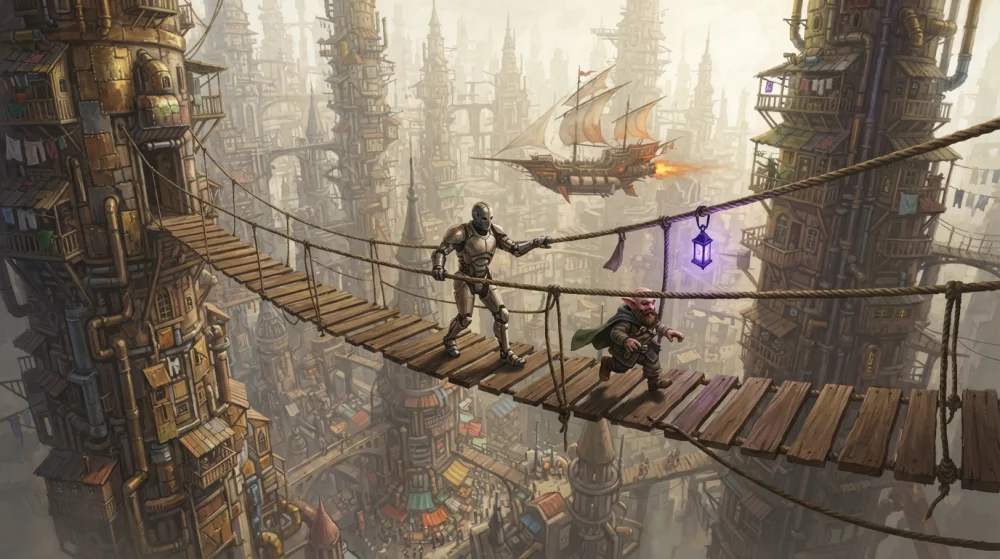
The Shape of Sharn
Sharn sits above the Dagger River at a point where the surrounding mountains left no room to spread outward, so the city grew up instead. Humans make up roughly a third of the population and dwarves about a sixth, with sizable communities of halflings, elves, gnomes, kalashtar, and changelings filling out the rest. The city is organized into five quarters: Central Plateau, Dura, Menthis Plateau, Northedge, and Tavick's Landing. Each quarter clusters around a set of core towers wide enough to hold entire neighborhoods inside their walls, connected by bridges and platforms, with smaller turrets grown from the towers' outer surfaces. The district of Skyway floats above the tallest spires, and the tunnels of the Cogs run beneath the lower city entirely.
Every quarter divides further into an upper, middle, and lower ward, and every ward splits again into individual districts, so a Sharn address is really a ward name plus a district name. Elevation tracks status almost everywhere in the city: upper wards house the wealthy and see steady Watch patrols, middle wards hold merchants and working professionals with a lighter police presence, and lower wards belong to laborers, the desperate, and the criminals who prey on both. Two quarters invert that rule. Dura is poor enough throughout that its upper ward functions economically like anywhere else's middle ward, and Central Plateau is wealthy enough that even its lower ward reads as comfortably middle-class.
The Last War never reached Sharn directly, but its aftermath shaped the city anyway. Aundairian saboteurs brought down a floating tower during the conflict, and the wreckage became the district now called Fallen. Residents carry grudges tied to specific nations rather than blanket hatred, since the war touched different neighborhoods through different atrocities. Trade disruption from the barely-signed Treaty of Thronehold means imported goods run short and smuggling fills the gap, and refugees, particularly Cyrans displaced by the Mourning, have overwhelmed districts like High Walls in Lower Tavick's Landing.
City services. A newcomer can get almost anything done without leaving a single ward, provided they can pay for it. The Orien post delivers letters for 1 cp through drop boxes scattered across the city, and hired couriers run 5 cp to 5 gp depending on distance and cargo. Sivis message stations handle faster correspondence in most upper and middle wards, and the Sivis enclave in the Dragon Towers district can cast sending for 200 gp if a message cannot wait. House Tharashk has cornered a stranger niche: trained gargoyle couriers that will carry a letter or small parcel for 5 gp to anyone who flags one down.
Magewrights and adepts sell spellcasting services in every district, at standard rates of 25 gp for a 1st-level spell, 50 gp for 2nd, and 100 gp for 3rd, though prices shift with the caster and the specific spell. Anyone offering higher-level magic is rare outside the dragonmarked houses or the city's wizard circles. Healing runs through House Jorasco, which operates houses of healing concentrated in the middle and upper wards; the Panaceum in Dragon Towers is the largest enclave and even keeps an altar capable of raise dead, though a Jorasco adept casts augury first and will refuse the job if the omens turn bad. A handful of devout clerics, including the high priest of the Undying Court in Shae Lias, can also raise the dead, but rarely for anyone outside their own faith.
Morgrave University anchors education and research, with an extensive library strong in arcana, dungeoneering, geography, and history, plus sages willing to hire out their expertise. The City Archive in Upper Central holds the city's legal and historical records, though access runs more restricted than the university library. Shopping splits by quality and specialty across the quarters: Tradefair in Middle Central caters to wealthy and aristocratic buyers, North Market in Lower Northedge covers common goods, the Bazaar of Middle Dura will sell you almost anything without asking where it came from, and Tavick's Market handles produce and goods hauled in from the surrounding farms.
Sharn measures cost of living with the same lifestyle categories the Player's Handbook uses. A restaurant or inn described as comfortable quality is one where a patron living a comfortable lifestyle or better can afford anything on the menu, and that scale carries through every district description below. It also has teeth at the table: several wards apply disadvantage on Charisma checks with locals when a character's displayed lifestyle sits noticeably outside what that ward expects, whether too poor for Upper Central or too rich for Callestan.
Holidays, sports, and games. Sharn's calendar runs thick with festivals. The Tain Gala, thrown monthly by Lady Celyria ir'Tain, sets the city's social order by who receives an invitation. Crystalfall on 9 Olarune and the Day of Mourning on 20 Olarune both commemorate war losses, the first a citywide vigil for a district destroyed by sabotage, the second a heavier day of remembrance specific to Cyran survivors. Sun's Blessing offers one of the safest days of the year for visitors, while Long Shadows, three nights sacred to the Dark Six's Shadow, is one of the most dangerous. The Race of Eight Winds, an annual aerial competition run through the spires of Dura, doubles as the city's biggest sporting event and its biggest excuse for a citywide party.
Beyond the Race, three distinctive sports are worth knowing before a campaign touches Dura or Northedge. Hrazhak pits two teams of seven shifters against each other on an obstacle-filled field, each side trying to steal the opposing team's idol; it runs as both a formal spectator sport in the Stone Trees arena and an informal street game played by shifter youths across the city. Skyblades takes jousting airborne, with hippogriff-mounted riders knocking each other from the saddle using blunted lances. Six stones is the darkest of the three: seven competitors are sealed in a chamber with a cockatrice, and the match ends when six of them have been turned to stone. Daask stages six stones matches, and most participants are debtors working off a loan rather than willing thrill-seekers.
City government. Ultimate authority rests with the City Council, seventeen members strong, one seat per ward plus separate representatives for Skyway and the Cogs. Selection processes vary by ward and carry no formal eligibility restrictions, meaning a sufficiently popular adventuring party could theoretically hold a seat. The council's actual composition runs from idealistic reformers to openly corrupt power brokers to at least one giant owl who can assume human form, and any of them could plausibly hire a party for a personal errand.
Temples, guilds, and adventurer's guilds. Every major faith keeps a presence in Sharn. The Sovereign Host dominates through the Pavilion of the Host in Middle Central, with three notable pilgrimage sites elsewhere: the Korranath's temple to Kol Korran, the Great Hall of Aureon, and the Pool of Onatar's Tears deep in the Cogs. The Church of the Silver Flame's largest temple, the Cathedral of the Cleansing Flame, sits in Upper Central, though its archierophant faces persistent corruption accusations. Smaller faiths have footholds too: the Blood of Vol operates openly in the Graystone district, the Undying Court keeps a temple at the Gates of Passage in Upper Northedge, and the Path of Light maintains a shrine in Overlook, home to Sharn's kalashtar community.
Guild life splits between the dragonmarked houses, concentrated in the Dragon Towers district, and a set of smaller associations open to anyone with the right skills. Two rival adventurer's guilds compete for the loyalty of Sharn's freelance heroes: the Clifftop Adventurer's Guild in Upper Dura, which holds members to a code of honesty and lawfulness, and the Deathsgate Guild in Middle Tavick's Landing, which cares only whether a job gets done. Both charge 12 gp in annual dues and offer free item storage, cheap lodging, and research advantage drawn from the guild's collective expertise, and members of one tend to clash with members of the other on sight. The Circle of Song offers bards a dues-free network of safe houses and mutual favors, anchored at the Golden Horn in Upper Menthis. Two rival arcane orders, the lawful Esoteric Order of Aureon and the more independent Guild of Starlight and Shadows, both charge steep membership fees for access to research advantages and reduced item-crafting costs, and both still bear the scar of a third order, the Closed Circle, wiped out two centuries ago for dabbling in forbidden daelkyr lore.
Ward Comparison
| Quarter | Tier feel | Notable sites | Best campaign fit |
|---|---|---|---|
| Central Plateau | Wealth, government, and dragonmarked business at every tier | Highest Towers, the Korranath, Dragon Towers, the King's Citadel | Political intrigue, espionage, dealing directly with the dragonmarked houses |
| Dura | The city's oldest and poorest quarter, dangerous even at its upper tier | Clifftop, the Bazaar of Dura, Callestan, Fallen | A crime-adjacent home base, smuggling, gang conflict, budget adventuring gear |
| Menthis Plateau | Sharn's entertainment and academic hub | Morgrave University, the theater district, the Burning Ring | Research hooks, performance and social intrigue, illegal fighting rings |
| Northedge | The quietest quarter, residential and largely peaceful | Shae Lias, Holdfast, North Market | Slow-burn mystery, noble patrons, a deceptively calm starting point |
| Tavick's Landing | The city's front door, martial and transient | Terminus Station, Deathsgate, High Walls | Arrival stories, refugee-driven plots, Blood of Vol intrigue |
Central Plateau
Central Plateau is where Sharn's money and power concentrate. Every dragonmarked house keeps a presence here, city government operates out of it, and foreign ambassadors work its embassies. Upper Central holds the seat of government in the Highest Towers district, the financial heart of the city around the temple-and-bank complex called the Korranath, and Platinum Heights, the most expensive shopping district in Sharn. Anyone maintaining less than a poor lifestyle draws suspicious looks here, at the DM's discretion worth disadvantage on Charisma checks with residents who assume they are staff or a vagrant.
Middle Central houses Ambassador Towers, where the Thronehold nations, Aerenal, and Riedra all keep embassies alongside the King's Citadel, Breland's elite intelligence service. Dragon Towers, also in Middle Central, is the single best place in the city to do direct business with a dragonmarked house, since Sivis, Tharashk, Jorasco, and Cannith all maintain their primary Sharn enclaves there. Sovereign Towers rounds out Middle Central with the city's grandest temple complexes. Lower Central, unusually for a lower ward, is peaceful and largely residential, priced for a comfortable lifestyle rather than a poor one.
Notable sites. The Aurora Gallery in Platinum Heights is Sharn's premier auction house for magic items and Xen'drik relics. The Vaults beneath the Kundarak Bank hold some of the most secure private storage in the city, an obvious heist target. The King's Citadel doubles as both Breland's intelligence headquarters and Sharn's high-security prison.
Things to do. A party can bid at the Aurora Gallery without knowing who else is bidding against them, plan a break-in against the vaults beneath the Korranath, or get entangled in the intelligence games running out of Ambassador Towers. The City Council itself is a source of patrons and enemies in equal measure: Central Plateau's own councilor, an elder statesman rumored to be tangled in bribery and graft, is exactly the kind of contact who can open doors and create problems in the same conversation.
Dura
Dura is where Sharn began, and the quarter has fallen furthest from that origin. Cracked stonework, dead lift shafts, and unrepaired magical lighting mark it as the poorest and most dangerous quarter in the city, but it is also the quarter with the most room to operate outside the law. Upper Dura functions like a middle ward economically, home to Clifftop, the base of the Clifftop Adventurer's Guild, and Daggerwatch, a garrison district for both the Sharn Watch and the Brelish army. Highhold carries strong Mror Holds influence courtesy of its dwarven population, and Overlook is the heart of the city's kalashtar community.
Middle Dura caters openly to the working class, anchored by the Bazaar of Dura, the largest commercial district in the city and the place to find nearly anything if you do not ask too many questions about its origin. Hareth's Folly hosts the Hollow Tower, an arena built for aerial jousting, and Rattlestone and Tumbledown are poor tenement districts scraping by on pride and camaraderie. Lower Dura is where the quarter's reputation is earned. Precarious keeps a real Watch presence thanks to the Skydocks that move goods up from the river, but the rest of the ward, especially Callestan, has been left to gangs and crime lords. Callestan specifically is a nexus where every major criminal power in Sharn keeps a stake.
Notable sites. Fallen, the ruined temple district struck by a falling tower during the Last War, sits in Lower Dura. Malleon's Gate houses the city's goblin population alongside monstrous immigrants from Droaam and Darguun. The Stores is a warehouse district with a large halfling population and Boromar Clan ties.
Things to do. Dura is the place to gamble on something shadier than the legal, heavily taxed games available elsewhere, to find a fence or hire someone with fewer scruples, or simply to talk about the Race of Eight Winds, which nearly everyone in the quarter follows closely. It is also, per the book's own framing, an easy place to have a terrible accident: stories about dragonmarked houses and unsupervised wizards running dangerous experiments in Lower Dura circulate constantly, and most of them are at least partly true.
Menthis Plateau
Menthis Plateau is Sharn's cultural and academic center, home to Breland's finest university and enough theaters to fill a season's worth of playbills without repeating a venue. Upper Menthis houses four of the city's best theaters, plus Morgrave University itself in the University district and Den'iyas, a gnome neighborhood tied to Zilargo that mixes fine tailoring with a reputation for intrigue and schemes.
Middle Menthis holds the most ethnically diverse population of any Sharn ward: Talenta halflings in Little Plains, Shadow Marches orcs and half-orcs in Cassan Bridge, Lhazaar immigrants around the Warden Towers garrison, and a community of Cyrans wealthy enough to have escaped the refugee camps settled in Smoky Towers. The Everbright district specializes in magic items of common and uncommon rarity, a reliable stop for an adventuring party restocking gear. Lower Menthis runs cheaper and rowdier, with the Firelight district covering gambling, paid companionship, and general vice, and the illegal, constantly relocating Burning Ring hosting unsanctioned gladiatorial fights.
Notable sites. The Art Temple, Grand Stage, and Sharn Opera House in Upper Menthis represent the highest end of the city's performance scene. The Diamond Theater in Lower Menthis has built an unlikely reputation for serious war drama through the reclusive playwright Luca Syara, whose true identity nobody in the city has confirmed.
Things to do. A party can consult Morgrave's sages, join one of the university's expeditions into Xen'drik or the ruins below Sharn, or take a shot at the stage themselves, whether performing legitimately or fighting in the Burning Ring. Den'iyas offers a shortcut into Zil-flavored intrigue for a party that wants schemes without leaving the quarter.
Northedge
Northedge is Sharn's quietest quarter, residential in character and easy to overlook until a plot needs somewhere unassuming to hide. Upper Northedge suits nobles who want distance from Central Plateau's bustle; Crystal Bridge and Oak Towers are packed with manors, and Shae Lias is a bastion of Aereni elven culture, complete with an embassy-and-temple complex at the Gates of Passage.
Middle Northedge is dwarf-dominated, centered on Holdfast, whose residents trace deep roots to the founding of Sharn itself and feel little connection to the Mror Holds. High Hope is the ward's temple district, informally considered the place to find a devoted priest rather than a ceremonial one. Lower Northedge, while poor, is a noticeable step up from the slums of Lower Dura; North Market handles everyday goods, and the ward has a significant shifter population supported by shifter-specific services and an informal hrazhak scene.
Notable sites. The Shrine of Fathen the Martyr in North Market memorializes a Silver Flame priest killed exposing a wererat conspiracy, and it still draws pilgrims uneasy with the shrine's uncomfortable history among Lower Northedge's shifters. Daca's Watch, a pillar-dwelling gnome oracle who has sat in place for over a century, has become both a tourist attraction and a reliable source of advice.
Things to do. Northedge is a reasonable place to settle down for a party wanting a home base with more security than Lower Dura offers. It is also where a patron search tends to pay off, since eccentric Upper Northedge nobles regularly look for adventurers to run errands, retrieve artifacts, or simply provide interesting company.
Tavick's Landing
Every traveler entering Sharn passes through Tavick's Landing, whether by lightning rail, overland road, or airship, and the quarter still carries a martial edge left over from wartime security measures. Upper Tavick's Landing functions almost as its own gated city, patrolled by House Deneith's Blademark mercenaries under full Sharn Watch authority. Visitors need a 5 gp license to carry a weapon and a 10 gp license naming any spells they intend to cast, both issued from the courthouse in the Twelve Pillars district, and the ward's dress code and public-conduct rules are enforced strictly enough to result in expulsion for violators.
Middle Tavick's Landing is friendlier to outsiders, home to the Cornerstone arena, the rival Deathsgate Guild, and a major House Jorasco house of healing. Lower Tavick's Landing absorbs most of the quarter's transient population: Terminus holds the lightning rail station, Wroann's Gate greets overland travelers, and Dragoneyes hosts most of the city's changeling community alongside its taverns, inns, and gambling halls. High Walls, converted from a residential district into an overcrowded refugee camp, mostly holds Cyrans displaced by the Mourning, though the district can seal into a fortress prison if the Watch judges it necessary.
Notable sites. Terminus Station connects Sharn to the wider lightning rail network and hosts small outposts from several other dragonmarked houses. The Graystone district in Middle Tavick's Landing is one of the few places in Breland where the Blood of Vol operates openly.
Things to do. A party can gamble in Dragoneyes, seek refuge or contacts in High Walls, or pursue Blood of Vol leads and rumors about the Order of the Emerald Claw through Graystone. Tavick's Landing is the natural place to start a campaign that opens with the party's first arrival in the city.
Above and Below
Two more districts round out Sharn's geography, one floating above the five quarters and one buried beneath them, plus a rougher waterfront district connecting the city to the river below.
Skyway. Built atop an island of solidified cloud above Central Plateau and Menthis Plateau, Skyway holds the mansions of Khorvaire's wealthiest families, including Tain Manor, home of the ir'Tain family and their monthly gala. No bridges reach Skyway; getting there means a skycoach or a hired flying mount. It is the district for a heist targeting the wealthiest people in the city, or for a party looking to mingle with nobility on its own turf.
Cliffside. Cliffside runs along the Dagger River's edge, handling the docks and waterfront trade that keep the rest of Sharn supplied. It is rough and poor despite a token Watch presence, home to sailors, dockworkers, and enough taverns and gambling dens to keep them entertained, plus sahuagin who work as paid guides for ships heading to Xen'drik. Massive lifts carry cargo up from the docks to Precarious in Lower Dura, and the shantytown of Mud Caves, carved directly into the cliff face by generations of the destitute, doubles as one of the better hideouts in the city for anyone with a reason to disappear.
The Cogs. Deep beneath the city, past the sewers and Old Sharn, the Cogs house Sharn's industrial foundries, fed by Fernian lava that House Cannith has tapped for centuries. Ashblack and Blackbones are the two main industrial districts, worked largely by warforged laborers, and Blackbones specifically is the best place in the city to find a particular warforged if a plot calls for one. Baron Merrix d'Cannith is rumored to run private experiments out of a forgehold in Ashblack, and industrial espionage between rival foundries is a reliable adventure hook on its own.
Dungeons of Sharn
Sharn sits on layers of older history, and two of them are dangerous enough to count as proper dungeons rather than districts.
The City of the Dead. A collection of crypts carved into the cliffs north of Sharn, the City of the Dead is the resting place of the city's wealthiest families; common Sharn residents are cremated, but the Sixty Families and others of sufficient means are interred here instead. Aureon's Holt tends the tombs, and Warden Tower keeps a lone Silver Flame hermit watching for supernatural trouble. Local legend warns of the Lich-Priest Gath, said to steal disobedient children for his skeletal court, which makes the necropolis a fine hook for a lower-stakes horror encounter without committing a campaign to full-on undead war.
Old Sharn. Beneath the current city lies an older Sharn, itself built atop even older goblin ruins, destroyed centuries ago by the aberrant-marked warlord Halas Tarkanan and his consort, the Lady of the Plague, when the dragonmarked houses moved to crush their uprising. King Galifar I sealed every known passage into the ruins with metal and magical gates, and tampering with those seals remains illegal. Nobody knows for certain what survives down there, though rumors range from vengeful aberrant ghosts to swarms of sentient vermin left behind by the Lady of the Plague's original curse. Old Sharn is the obvious answer for a campaign that wants a real underground dungeon crawl without leaving the city.
Criminal Activities
Theft, assault, murder, and fraud are illegal everywhere in Sharn, alongside "malicious theft of identity," the book's term for using shapeshifting or illusion to impersonate someone with harmful intent. Gambling and prostitution are legal but heavily taxed and regulated, and smuggling covers both outright contraband and goods that are simply expensive to import legitimately, like the drug dreamlily. Crime concentrates hardest in Lower Dura and the Cogs, where the Watch barely bothers to show up.
Three specific locations carry a criminal reputation worth knowing before running a Sharn-based crime plot. Fallen, the ruined temple district in Lower Dura, has been abandoned since Aundairian saboteurs brought down a floating tower onto it during the Last War; feral survivors called Ravers haunt its rubble, and its emptiness makes it prime real estate for any cult that needs a hideout. Khyber's Gate, beyond the Cogs, sits within the ruins of an ancient goblin city and is the closest thing Daask has to a home base; the Watch has no presence there at all. The sewers beneath the upper wards support their own subculture of sewer clans, mostly goblins alongside a few shifters, dwarves, and feral halflings, who fight over territory around the sewers' midden chambers and can serve a party as guides who know the tunnels better than anyone else alive.
Most organized crime in Sharn runs through one of four groups: the Boromar Clan (gambling, theft, and smuggling), Daask (violent crime run by monstrous immigrants from Droaam), House Tarkanan (aberrant-marked mercenaries and assassins), and the Tyrants (forgery and identity theft, mostly changelings). Each gets its full campaign-ready treatment in Powers of Sharn below; treat these four names here as the map of who controls what.
Don't let a Sharn campaign treat elevation as flavor text and nothing else. The upper-middle-lower ward split isn't just a wealth gradient painted onto a map, it's a mechanical promise: Charisma checks swing on displayed lifestyle, Watch response times stretch from minutes in Upper Central to effectively never in Lower Dura, and even a fall through the city plays out differently depending on which ward you land in. A party that spends an entire campaign in one tier of one quarter is playing a different game than a party that has to move between them, and the second version is the one Sharn was actually built for.
Forces of the Law
Three organizations enforce order in Sharn, each with a different mandate and reach.
The Sharn Watch. The Watch handles day-to-day law enforcement across the city, and its reputation is mixed at best: dedicated officers exist alongside rampant corruption, and the Watch has a habit of being conveniently absent whenever Daask or the Boromar Clan needs it to be. Watch presence tracks the same upper-middle-lower pattern as everything else in Sharn, heaviest in the upper wards and effectively nonexistent in places like Callestan or Khyber's Gate. Its internal divisions and named commanders are covered in the Sharn Watch faction entry below.
The King's Citadel. Direct agents of the Brelish Crown, the King's Citadel outranks the Watch entirely and can take over any investigation or command any officer it chooses. It leaves routine law enforcement, including the ongoing conflicts between Sharn's criminal organizations, to the Watch, reserving its own attention for threats to the whole city or kingdom: foreign spies, dangerous necromancers, and worse. The Citadel splits into four divisions: the King's Dark Lanterns (intelligence and covert operations), the King's Shields (royal protection), the King's Swords (elite military response), and the King's Wands (arcane specialists). Its headquarters in Andith Tower, in the Ambassador Towers district, also functions as the city jail, and unlike the Watch, the Citadel does not request help from capable individuals, it demands it, treating refusal from a Brelish citizen as an act of treason.
The Redcloak Battalion. Once one of the deadliest units to fight in the Last War, the Redcloak Battalion was broken up after the Treaty of Thronehold, with one detachment reassigned to Sharn and headquartered in Daggerwatch. Both the Watch and the King's Citadel call on the Redcloaks when a situation needs overwhelming military force. Many Redcloaks resent the reassignment to police work, and a real rivalry runs between them and the Citadel's King's Swords, who hold more prestige despite less combat experience. Redcloak veterans also tend toward open hostility to travelers from nations Breland fought during the war, treating the Treaty of Thronehold as a pause rather than a real peace.
Crimes and punishments. Minor crimes get settled with an on-the-spot fine from a Watch officer. Serious offenses send a suspect to a garrison to await trial, with especially high flight risks held at King's Citadel headquarters. A magistrate typically reviews a case within 1d4 days, questioning the victim under zone of truth before proposing a punishment; refusing the offer sends the case to a full trial. Fines are the most common outcome, scaled to the severity of the crime and, at the magistrate's discretion, to the offender's own wealth, since a fine that barely touches an adventurer or a member of the Aurum might be raised specifically to sting. Courts can seize property in place of gold, long-term imprisonment stays rare (execution is more common for anyone judged too dangerous to release), and lesser punishments range from visible branding to exile to lingering magical effects like an induced blindness or a curse. Repeat offenders can be formally declared outlaws, stripped of the law's protection entirely.
Factions
This is the DM-facing half of Eberron's power structure: the twelve major power blocs and five Sharn criminal syndicates the book hands a Dungeon Master to drive a campaign. Almost everything in this section assumes you are behind the screen, deciding who the party works for, works against, or gets caught between.
Eberron does not need a single campaign-ending villain, because it already has a dozen organizations pulling in different directions at once. The Aurum wants gold and secrets. The Chamber and the Lords of Dust are locked in a millennia-long chess match over the Draconic Prophecy. The Lord of Blades wants the warforged to inherit Khorvaire by force. The Dreaming Dark wants to conquer the continent's dreams before it conquers the continent itself. None of these goals require the Last War to restart - they just require a DM willing to let more than one faction want something at the same time.
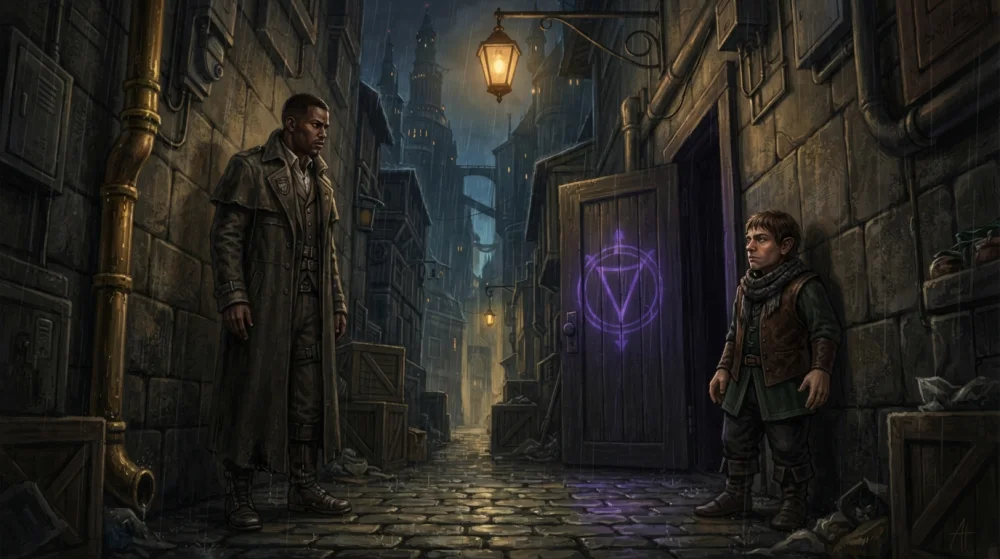
Unlike a Ravnica guild, none of these organizations are formal character-creation choices; the book pitches almost all of them as DM-facing antagonists, patrons, or campaign-defining forces rather than something a player picks at 1st level. A handful can sponsor a party as a group patron, but that is a DM decision made through play.
| Faction | Home base | Alignment lean | Best fit as ally or antagonist |
|---|---|---|---|
| The Aurum | Meeting halls in every major city; inner circle unknown | Any alignment, unified by greed and ambition | Behind-the-scenes patron or villain for intrigue-heavy campaigns |
| Cults of the Dragon Below | Scattered, anywhere; no central structure | Almost always evil, often mad rather than malicious | Versatile, escalating villains from mundane cultists to aberration-tier threats |
| Dragonmarked Houses | Every Five Nation, plus holdings across Khorvaire | Mixed, house by house | Patron, employer, rival, or corporate villain |
| The Chamber | Argonnessen, with hidden agents across Khorvaire | True neutral in practice, individual dragons vary | Ambiguous ally-patron for Prophecy-driven campaigns |
| The Dreaming Dark | Sarlona (Riedra), with Inspired agents across Khorvaire | Lawful evil, methodical and patient | Long-game infiltration villain; strongest tie-in to Kalashtar characters |
| The Daughters of Sora Kell | The nation of Droaam, west of Breland | Mixed, ruled by three powerful hags | Nation-scale patron or antagonist for monstrous races |
| The Gatekeepers | Shadow Marches and Eldeen Reaches | Good, ancient and dutiful | Ally or quest-giver for daelkyr and aberration-themed adventures |
| Heirs of Dhakaan | Underground vaults beneath Darguun | Lawful, honor-bound but not evil | Escalating military threat or a faction to earn the respect of over time |
| Lord of Blades | The Mournland | Chaotic, legitimate grievance and violent methods | Sympathetic-villain antagonist; strongest tie-in to Warforged characters |
| The Lords of Dust | Ashtakala in the Demon Wastes, agents everywhere | Evil, patient across millennia | Long-game manipulator villain; mirrors the Chamber from the opposite side |
| The Mournland | Former Cyre, sealed behind the mist | Not applicable (environment, not an organization) | Hazard-driven exploration setting; home to the Lord of Blades |
| Order of the Emerald Claw | Karrnath, with cells and vaults across Khorvaire | Evil, unambiguous | Straightforward pulp villain; strongest tie-in to necromancy themes |
The Aurum
The Aurum presents itself as a society for Khorvaire's wealthiest and most influential people - merchants, priests, military officers, and other luminaries who gather at galas and salons, openly display their rank through eight rings (one per finger, in copper, silver, gold, or platinum Concord), and frequently fund philanthropy the city notices. Beneath that public face, a secret inner circle called the Shadow Cabinet - nobles without crowns, industrialists without dragonmarks - works toward outright control of Khorvaire, whether by binding the Five Nations' rulers to its will or tearing down the current order entirely.
Most Aurum members are collectors first and conspirators never; a given Concordian typically fixates on one civilization or era of history, funding expeditions to Xen'drik ruins or Argonnessen relics to expand a private hoard. This is the most common way adventurers cross paths with the organization - as hired help for an expedition, or as pawns in one collector's scheme against a rival. The Last War fractured the Aurum's fortunes as much as it built them: some Concordians profited enormously by bankrolling war efforts or filling infrastructure gaps government attention abandoned, while others watched investments collapse when they unknowingly worked against a fellow member's interests.
Key NPCs. Antus ir'Soldorak, a dwarf who chairs the Platinum Concord and founded the Shadow Cabinet, made his fortune in Mror Holds gold and silver mines and mints his own currency, traveling in a gilded airship. Loyal Daison, a Karrnathi slumlord, built wealth on low-quality refugee housing and replaced a hand lost in an industrial accident with a golden prosthetic. The book also flags an aging dwarf retired general who collects unusual constructs while searching for a way to transfer his mind into a superior body, and an imprisoned Concordian who mobilizes contacts and well-placed allies from behind bars to secure release.
Campaign themes. The Aurum introduces easily and non-violently at first - a Concordian hiring the party to solve a mystery or fetch a harmless curio, or serving as the face of a group patron. It can escalate into a behind-the-scenes villain arc, with low-level clashes against hired goons rising through recurring mercenaries to, eventually, the reveal of the Shadow Cabinet itself and one of its grand schemes. Adventure hooks include recovering a lost journal from a Xen'drik-bound ship, locating a dragonmarked scion's grave for a buried signet, and sabotaging negotiations between a dragonmarked house and a local government to protect Aurum interests.
Cults of the Dragon Below
Where most Eberron factions have leadership and structure, Cults of the Dragon Below have neither. The term describes any sect devoted to the daelkyr or the fiendish overlords, and each cult pursues its own mad agenda tied to its dark patron - even cults serving the same master rarely recognize each other as allies. Most cultists are not evil by choice; they are drawn in by strange visions and corrupting madness, and even the most cultured, urbane cult leaders remain utterly convinced their beliefs are good, true, and just.
The postwar chaos and refugee displacement created ideal breeding conditions for new cults, and the Mror Holds specifically has seen a rise tied to the daelkyr Dyrrn the Corruptor's growing influence. A cult can be as small as a handful of deluded worshippers or as dangerous as a mind flayer secretly running a magic academy.
Key NPCs and cult flavors. Cults devoted to Belashyrra, the beholder-worshipping Lord of Eyes, who murder for eyes to preserve visual memories, or who venerate a beholder messiah outright; cults of Dyrrn the Corrupter seeking to transcend humanity through aberration-bonding, including one led by a mind flayer that kidnaps dragonmarked heirs to decipher and transfer their marks; a cult of Kyrzin that feeds elders to a captive gibbering mouther, believing their voices still whisper through the beast; cults of Rak Tulkhesh built around blood and strife, including one that has infiltrated a local militia and convinced its members that war refugees are secretly inhuman monsters; and an arcane think tank turned cult of Sul Khatesh, convinced its eldritch machine will heal the Mourning rather than worsen it.
Campaign themes. Cults scale cleanly with party level - low-level cultists and disorganized cells give way to stronger aberrations, fiends, and cult leaders serving the daelkyr or Lords of Dust as the campaign progresses. They suit either a slow investigative unraveling (mundane surface, otherworldly depths) or an explosive introduction with no ambiguity about the villains' nature. Adventure hooks include children reciting an increasingly disturbing nursery rhyme of unknown origin, a noble who dies of terror-induced heart failure after sitting for a portrait (as did every other subject the same artist painted), and strange bounty hunters who seem to know the party's secrets, with something writhing beneath their cloaks.
Dragonmarked Houses
No single organization matches the combined influence of the twelve dragonmarked houses across the Five Nations. Each house operates as part noble family, part business cartel, with interests ranging from hospitality to mercenary work to espionage-for-hire - interests broad enough that houses regularly step on each other's toes even when their core businesses do not overlap. House Orien's transportation dominance faces pressure from House Lyrandar's airships; House Tharashk's arrangement with Droaam threatens House Deneith's mercenary monopoly; House Cannith lost its unified leadership in the Mourning and fractured into competing branches. An organization called the Twelve exists to mediate these disputes, giving adventurers a way to get pulled into house rivalries directly or to work with the Twelve toward resolving them. The mark-by-mark mechanical breakdown lives in the Dragonmarks section above; this entry is the faction-and-adventure-hook side.
The houses generally thrived during the Last War, adapting their talents to war profiteering while remaining ostensibly neutral and selling to every side. House Cannith took the hardest hit near the war's end - many of its foundries were destroyed, the Treaty of Thronehold forced it to dismantle the creation forges that built the warforged, and the loss of Cyre left it leaderless and fragmented into three semi-independent branches. House Thuranni split from House Phiarlan during the war as well, driven apart by the conflicts of interest inherent in one espionage organization serving multiple warring sides.
Key NPC pattern. The book frames dragonmarked villains around covetousness - magical knowledge, wealth, or influence - pursued through methods that fit the bearer's specific mark, from a low-level House Shadow spy hidden in a circus troupe to a House Deneith warlord carving out a personal fiefdom. An arcane workshop, the kind of fortified facility House Cannith fabricators use, though Zil elemental-binders and Mror weapon-forgers maintain their own versions too, makes a strong recurring location: stealing a magic item pattern before it is finished, defending the site from a doomsday-weapon raid, or investigating rumors of illegal warforged construction.
Campaign themes. The houses work well for exploring both the upside of magic-as-industry (moving Khorvaire past feudalism) and its downside (corporate greed and unchecked expansion), and either theme can define a house wholesale or split it into idealistic-versus-greedy internal factions. Because the houses guard their public image carefully, any agent caught committing evil deeds gets swiftly and convincingly disavowed - which sets up a natural campaign arc where the party has to prove a rogue agent was acting on orders from the top. Adventure hooks include a House Cannith artificer hiring the party to steal secrets from a rival branch's forge, a haunted House Ghallanda hostel with worsening disturbances, and protecting a shipment aboard a House Orien lightning rail.
The Chamber
Conspiracy theorists claim a hidden network of dragons uses magic and humanoid agents to steer events across Khorvaire and beyond. They are right. The Chamber is a cabal of dragons that has monitored the continent for millennia, treating humanoids largely as pawns in a much longer game tied to the Draconic Prophecy - a map of possible futures rather than a fixed prediction, revealed through planetary and lunar motion, dragonmarked-house actions, and countless subtler signs. Most active dragons in Khorvaire belong to the Chamber; the rest are exiles, independent scholars, or dragons corrupted by daelkyr or fiends.
Chamber dragons are primarily observers, gathering Prophecy fragments and reporting to Argonnessen elders, but they are also tasked with stopping anyone who tries to exploit the Prophecy for personal gain - which puts them in direct, ancient opposition to the Lords of Dust. Individual Chamber dragons often run their own side agendas beyond pure observation: steering the Prophecy personally, experimenting on dragonmarked humanoids to understand the connection between marks and Prophecy, or locked in generations-long games against Lords of Dust rivals. The Chamber's overall aim is to maintain the status quo and oppose demons, which makes its agents plausible allies or patrons - but individual humanoids remain expendable pawns whenever the Prophecy demands it.
Key infrastructure. Planar observatories - remote structures built where Siberys and Khyber influences balance, lined with orreries tracking the planes - serve as the Chamber's primary research sites and a strong location for adventures involving disguised dragons or their servants.
Campaign themes. Early Chamber-linked adventures can feel mundane, running simple errands for a disguised dragon or secret agent without obvious moral weight. As the campaign deepens, the Chamber may reveal that the party has its own role in the Prophecy, especially any dragonmarked character, and both the Chamber and the Lords of Dust may begin interfering directly, forcing uncomfortable alliances of convenience. The Chamber can also serve openly as a group patron for a party gathering Prophecy intelligence.
The Dreaming Dark
The quori spirits that rule the plane of Dal Quor spent a thousand years seizing the continent of Sarlona; now they have turned toward Khorvaire. Dal Quor cycles between ages of light and darkness, and the current dark age is ending - the nightmare spirits behind the Dreaming Dark believe that forcing all of Eberron to dream the dreams they devise can hold that darkness in place indefinitely. Quori cannot manifest physically in Eberron, so they possess willing hosts (the Inspired) or manipulate dreams directly, tricking a priest with false divine visions or nudging a soldier toward rebellion.
The Dreaming Dark's greatest weapon is infiltration: any NPC could secretly be an Inspired vessel, and its scattered agents have no obvious connection to one another until they choose to reveal themselves. The Last War's chaos let Dreaming Dark agents operate almost unchecked, fanning nation-versus-nation animosity that persists in the lingering distrust after the Treaty of Thronehold.
Key NPCs. The Devourer of Dreams leads from within Dal Quor itself. Tirashana, a kalaraq quori, is the Dark's chief agent in Eberron and has planted mental copies of herself (mind seeds) across Khorvaire in unwitting hosts - including, unknown to her Watch colleagues, inside the leader of Sharn's own Blackened Book. Because dreams themselves take place on the plane of Dal Quor, a DM running the Dreaming Dark can build entire adventures around a dream sequence: a real threat that attacks a sleeper's mind or body, a comatose or possessed character who can only be reached through their own dreamscape, a psychic lock a villain has implanted to block off specific knowledge, or a direct excursion into Dal Quor itself. Establishing dreams as a recurring, mundane part of play early - checking in on one character's dreams after each long rest, say - makes it much harder for players to spot the moment the Dreaming Dark actually starts interfering.
Campaign themes. The Dreaming Dark pursues three objectives in Khorvaire: sowing chaos and distrust, promoting subverted champions (a nation, mercenary company, house, or religion turned to its ends), and relentlessly hunting the kalashtar, who descend from quori that rebelled against the Dark and want to push Dal Quor toward light instead. This gives the organization equal reach from small-scale bandit manipulation to continent-threatening conspiracies. Adventure hooks include a high priest trapped in an unwakeable sleep, a recognized speech quirk connecting several defeated enemies to someone the party trusts, and a war criminal claiming evidence of their own innocence while warning of a hidden influence steering the government.
The Daughters of Sora Kell
Once a wild frontier at the edge of civilized Khorvaire, Droaam is now home to one of the continent's strangest nations - ogres and minotaurs share streets with gnolls and goblins in the Great Crag, gargoyles and wyverns circle overhead, and harpies call work crews to the quarries with their songs. Under the rule of the Daughters of Sora Kell, three ancient and immensely powerful hags, the nation's diverse population is slowly learning to work together and turn its supernatural gifts toward building a functioning society rather than raiding one.
Droaam offers a rare framing device: a way to bring monstrous races into a campaign as more than combat encounters, since House Tharashk actively brokers Droaamish labor and mercenary work across the continent - ogre laborers, gargoyle couriers, and monstrous mercenaries appear in traditionally aggressive roles and in mundane ones alike. King Boranel of Breland brokered an uneasy truce with Droaam, but most other nations still refuse to recognize its sovereignty.
Key NPCs. Sora Katra, the Daughters' voice, is a charismatic shapeshifting illusionist who weaves curses and loves matching wits with heroes. Sora Maenya commands Droaam's armies with brute strength and underrated tactical skill. Sora Teraza, blind but gifted with vast divination, is the age's most powerful oracle - and the hardest to read, since her answers are cryptic even to her own sisters. Notable regional warlords include Cairngorm (a gargoyle lord), the Dark Pack (werewolf-led lycanthropes hostile to the Silver Flame), Kethelrax the Cunning (a kobold lord favored by Sora Katra), and Sheshka, Queen of Stone (leader of the medusas of Cazhaak Draal).
Campaign themes. The central question for running the Daughters is their true motive: sympathetic nation-building that gives Droaam's people a voice, straightforward villainy driven by a desire to end the Five Nations' dominance, or pure fulfillment of Sora Teraza's visions with no personal stake at all. Whatever answer you choose should also shape Daask, since that organization answers directly to Sora Katra. Droaam can also serve as a group patron, with Sora Kell herself as the sponsoring figure. Adventure hooks include a petrified prisoner's severed stone finger delivered as a ransom demand, a downed House Lyrandar airship near the Graywall Mountains requiring an urgent rescue, and Sora Teraza appearing in a character's dreams to point them toward a specific ruin.
The Gatekeepers
The Gatekeepers hold the oldest druidic tradition on Khorvaire, founded over fifteen thousand years ago when the green dragon Vvaraak gathered a following among the orcs of the Shadow Marches, taught them to read the natural world and work with stone and soil, and warned of a threat only the younger races could stop. That threat arrived: the daelkyr opened gates from Xoriat, unleashed mind flayers and beholders across Khorvaire, and shattered the goblin empire of Dhakaan before Vvaraak's students finally sealed the gates and bound the daelkyr in Khyber. The Gatekeepers have guarded those seals, and watched for worse to come, ever since, even as their teachings splintered into newer druidic sects that eclipsed the original order in size.
The Last War barely touched the Gatekeepers beyond the occasional need to drive off scouts or patrols threatening a seal's secrecy; when they failed, Xoriat's corruption occasionally spread through the surrounding land while the war raged nearby. Gatekeeper seals take many forms - amulets, druidic bloodlines, and most commonly great stone slabs carved with wards against Xoriat's influence, tended by resident guardians.
Key NPCs. The book's NPC prompts favor humble, dutiful figures over dramatic leaders: a Gatekeeper's spirit surviving inside an ancient toad, a half-orc Gatekeeper working within House Tharashk as an investigator of planar disturbances, or, as a rare exception, an old orc ranger murdering people in Sharn under the conviction they have been corrupted by the daelkyr.
Campaign themes. Gatekeepers fit most naturally as patrons, advisors, or timely rescuers against mind flayers and dolgaunts, since their mission is explicitly protective rather than expansionist. They can still read as antagonists when a seal or land dispute puts characters in their path - a noble's death changing ownership of a tract of land containing a seal is enough to spark sudden conflict, and even a well-meaning Gatekeeper can fall to madness or corruption and become exactly the threat the order exists to stop. Adventure hooks include repairing a widening crack in a seal with a treated Khyber dragonshard, escorting a replacement guardian to a seal after its previous keepers were corrupted, and working with a Chamber agent who is convinced the party's actions are inadvertently freeing a daelkyr.
Heirs of Dhakaan (Goblinoids)
War drums are sounding beneath Darguun. During the daelkyr invasion, some Dhakaani leaders foresaw the madness spreading through their civilization and led their forces into deep, sealed subterranean chambers to wait it out - these clans, the Kech Dhakaan, have only recently begun returning to the surface. The Dhakaani are devoted to war in a way matched only by the Valenar elves, and their weaponsmiths and armorers reportedly outclass even House Cannith's artificers. Their one weakness is political: with no emperor, the clans compete constantly for the right to rule, with the militant Kech Sharaat (Bladebearers) favoring force and the scholarly Kech Volaar (Wordbearers) favoring recovered knowledge and lost artifacts, while the neutral Khesh'dar (Silent Folk) spy on the modern world for every clan at once.
For now, the Heirs keep a low profile, fighting mostly underground and dispatching small surface squads that most humans mistake for ordinary Darguun mercenaries. The Last War's weakening of humanity, the rise of Darguun's own Ghaal'dar mercenaries providing cover, and the Mourning's proof that the Five Nations cannot be trusted to rule all convinced the Heirs the time had come to stir. The Dhakaani also reject reliance on magic in battle - no clerics or paladins exist among them, and only the Kech Volaar have absorbed some elven wizardry, alongside bardic duur'kala (dirge singers) shared across all clans.
Campaign themes. Dhakaani squads fight with precision that surprises characters expecting a ragtag band of goblinoids, coordinating to eliminate spellcasters first and sparing fellow Dhakaani even in internal conflicts while showing no such mercy to outsiders. The book suggests starting the Heirs as a mysterious, skilled threat easily mistaken for Darguun mercenaries, then gradually revealing the true scale of the returning empire - possibly even earning grudging respect from the party by surrendering a contested Dhakaani artifact rather than looting it, which opens a path toward the more diplomatically-minded Kech Volaar. From the Dhakaani point of view, humans stole their lands, pillaged their tombs, and enslaved their descendants; a party wielding a magic sword looted from a Dhakaani ruin should expect a strike force to treat that theft as a real grievance, not a plot contrivance. Adventure hooks include a missing border scout patrol, a collapsed mining tunnel opening into Dhakaani-held caverns, a single hobgoblin warrior dueling a mercenary captain at a town's gates in a blood debt already ten soldiers deep, and Dhakaani warriors kidnapping warforged so their own artificers can learn to build construct soldiers.
Lord of Blades
Stalking the Mournland like a spectral juggernaut, the Lord of Blades has become a rallying symbol for warforged who see their creation as pure exploitation. His message is blunt: we were made as weapons, so let us be weapons, and let the nations of the land reap what they have sown. His followers patrol the Mournland's ruins, salvage resources from Cyre's ashes, and despise creatures of flesh enough that most encounters with outsiders end in violence; other disciples strike targets across Khorvaire directly, destroying Cannith workshops, killing nobles known for warforged abuse, and seizing weapons or arcane research.
His identity before the Day of Mourning is unknown even to his followers. Theories range from Bulwark, King Boranel's former warforged bodyguard, to the last warforged completed at the Eston creation forges moments before the Mourning struck, to the more outlandish claim that he is the artificer Aaren d'Cannith - inventor of the warforged - who transferred his own consciousness into a warforged body after House Cannith turned his creation into a weapon of war. Whatever the truth, his cause draws sympathy from more than his own followers: the postwar debate over warforged rights left the warforged themselves no voice in the outcome, treated as property to be granted freedom rather than people claiming it, and the Lord of Blades' grievance is legitimate even where his proposed remedy is not.
Key infrastructure. Warforged ossuaries - former temples, crypts, or warehouses repurposed as combination crypt, monument, vault, and workshop - hold the honored remains of fallen followers and are defended fiercely.
Campaign themes. The book suggests layering nuance onto a straightforward antagonist by pairing a warforged attack, say on a Sharn foundry, with the discovery that the attacked party actually mistreats its warforged workers, or by introducing a nonviolent warforged sympathizer - a bard who speaks publicly about abuses without personally raising a weapon - to complicate a simple us-versus-them read. As a long-term threat, the Lord of Blades is explicitly building toward eldritch machines and other weapons; the book poses the open question of what happens if he discovers the actual cause of the Mourning. Adventure hooks include a newly awakened docent warning its owner of a coming catastrophe only the Lord of Blades can avert, and a warforged accused of murdering fellow mercenary-company members who claims total amnesia about the night in question.
The Lords of Dust
Ancient evils spawned at the dawn of time still haunt Eberron, biding their time in a game measured in millennia. The Lords of Dust serve the overlords - unfathomably powerful fiends bound at the end of the Age of Demons by the Silver Flame, releasable only if doing so fulfills the Draconic Prophecy - and every fiend spawned from Khyber owes fealty to one. In many ways the Lords of Dust mirror the Chamber, each side steering the Prophecy toward opposite ends: the Lords of Dust want their overlords loose and a new age of primordial darkness begun. Despite a unified ultimate goal, the organization functions as an alliance of independent cabals rather than one command structure, since the conditions to free one overlord can directly contradict those needed to free another.
Master shapeshifters, the Lords of Dust maintain agents across Khorvaire, but they have no interest in conquering the world in any conventional sense - they want to restore its prior, unnatural glory, and view directing humanoid affairs toward that end as a tedious necessity rather than a goal in itself. Most are rakshasas, though any Khyber-spawned fiend can belong; their chief servants meet at the ruins of Ashtakala in the Demon Wastes, including Mordakhesh the Shadowsword (speaker for Rak Tulkhesh), Hektula the First Scribe (speaker for Sul Khatesh), and Durastoran the Wyrmbreaker (speaker for Bel Shalor).
Campaign themes. The Lords of Dust pursue their goal in two layers: sustaining an overlord's influence through activities that echo its nature (Rak Tulkhesh's servants stir conflict, Sul Khatesh's servants tempt the selfish into warlock pacts), and manipulating specific mortals into specific deeds required to actually release one, since the fiends could often achieve an outcome directly but the Prophecy demands a particular hand do it. The book's own example has an overlord's release hinging on a specific king dying at a specific adventurer's hand, which the Lords of Dust must engineer rather than perform themselves. Because they work almost entirely through duped pawns, a campaign built around them rewards patience: early unconnected encounters can retroactively reveal themselves as pieces of a single scheme once the pattern becomes visible. Adventure hooks include a recently deceased retainer returning with no memory of dying, Chamber agents suddenly hunting the party because their recent actions unknowingly served a Lord of Dust's ends, and a trusted mentor abruptly sending the party on a string of uncharacteristic errands.
The Mournland
Cyre was once Galifar's brightest jewel - the seat of its wealth, its arcane and artistic achievement, and House Cannith's foundries. On 20 Olarune 994 YK, that ended in an instant: a wall of dead-gray mist swept across the nation, killing over a million people and transforming the land and everything caught within it. No one knows what caused the Mourning. What is left is a sealed, hostile expanse bordered by a mist wall up to five miles thick, where navigation checks suffer disadvantage, food and water must be brought from outside, and the terrain itself has been reshaped into glass plateaus, crystalline forests, and shapes that should not hold together.
Two major sites anchor most Mournland adventures: the Glowing Chasm, an unexplained purple-lit crack whose proximity mutates nearby creatures further, and Eston, House Cannith's former warforged-creation city, now overrun by living spells and twisted constructs. Healing magic is impeded, not disabled, contrary to popular belief, within the mist and in scattered pockets beyond it, and the region's warforged population, largely followers of the Lord of Blades, forms the closest thing to a functioning humanoid society anywhere inside the wastes.
Key threats. Treasure hunters and salvagers like Ikar's Salvage make natural recurring villains, alongside the Lord of Blades himself, a Belashyrra cult leader who tears eyes from victims to attach to cult members, a House Cannith branch-member hunting for an edge to secure her faction's ascendancy, and a Karrnathi bone knight seeking to raise an undead army from the battlefield dead. The ruined capital of Metrol, quiet by day and prowled by misshapen monsters hunting each other by night, and the obsidian Glass Plateau over the buried city of Making both make strong set-piece locations beyond Eston and the Glowing Chasm.
Campaign themes. Most expeditions fall into two camps: salvagers chasing Cyre's abandoned riches, and displaced Cyrans or their agents chasing lost loved ones, family heirlooms, or, in the case of Prince Oargev's servants, the regalia of the fallen Cyran crown. House Orien wants the region's lightning rail line restored; House Cannith wants its lost trade secrets and experimental artifacts back. The warforged colossus - a 200-to-300-foot war machine that fell during the Mourning - anchors some of the region's most dangerous dungeon-style exploration, its docent network, elemental weaponry, and sealed traps all potentially still active inside a fallen giant.
Order of the Emerald Claw
What began as an order of militant Karrnathi knights fell into disgrace and now survives as scattered cells of fanatical warriors, necromancers, and spies. On the surface, the Emerald Claw claims Karrnathi patriotism and Blood of Vol devotion; the truth is that it serves the lich Lady Illmarrow, carrying out murder, destruction, and necromantic terror in her name. Sincere worshippers of the Blood of Vol are quick to reject the order's claimed membership, unwilling to be associated with its fanaticism.
The order's roots lie in Karrnath's wartime adoption of necromancy: chivalric orders of Blood of Vol devotees, including bone knights trained to raise and command undead troops, fought alongside the living army. The Emerald Claw earned particular infamy for brutality against enemy soldiers and accusations of slaughtering civilians specifically to raise as undead, conduct forbidden even by Karrnathi command. When King Kaius III turned against the Blood of Vol near the war's end, most such orders disbanded; the Emerald Claw refused, fragmented into independent cells, and actually grew after the Treaty of Thronehold as Karrns who saw peace as betrayal flocked to it. Six years before the book's present day, Lady Illmarrow herself emerged as its leader - many members call her the Queen of the Dead and believe she is poised to ascend to godhood, granting them immortality or eternal undeath in turn.
Key infrastructure. Library vaults - crypts, dungeons, or buildings hidden in plain sight - store the order's forbidden magic and dark materials while doubling as chapter houses for local cells. Sample NPCs the book suggests include a mortal fanatic who drinks the blood of those he kills, a cleric who promises eternal life through undeath to convert enemies rather than simply defeat them, and a suave vampire who prefers charm to combat.
Campaign themes. The book explicitly frames the Emerald Claw as ideal pulp-adventure material - blatant, escalating villainy with hordes of evil minions and no ambiguity about whether stopping them is the right call, running from low-level skeleton-and-zombie skirmishes up through races against the order to recover necromantic relics. Its deeper hook is Lady Illmarrow's own goal: unlocking the secrets of her inactive Mark of Death, the lost thirteenth dragonmark, which could grant her power enough to anchor an entire campaign's central threat. Adventure hooks include a renegade band of Aundairian soldiers who turn out to be undead under the order's control, and the order's demand that a village hand over a specific volume from its library.
Don't build your first Eberron campaign around a single mastermind faction. The book's own throughline is that a dozen factions are already working at cross purposes before the party ever gets involved - the Aurum wants gold, the Chamber and the Lords of Dust are locked in an ancient stalemate over the Prophecy, the Lord of Blades wants vengeance, and the Dreaming Dark wants everyone's dreams. That density is what makes Eberron read as noir instead of high fantasy: pick two factions with incompatible goals, put the party in the middle, and you get a session's worth of intrigue without inventing a single new NPC. Save the "everything connects to one grand conspiracy" reveal for a campaign's actual endgame, not its opening arc.
Powers of Sharn
The five organizations below operate at the scale of a single city rather than a continent, and all five are based in Sharn. Four are explicitly criminal; the fifth, the Sharn Watch, is the law they operate around, bribe, or occasionally answer to. Unlike the twelve continental factions above, three of these five (the Boromar Clan, Daask, and House Tarkanan) are locked in an active, ongoing turf war the book expects a DM to run as a live backdrop rather than a static faction writeup - whichever side the party favors or opposes shifts the balance of Sharn's underworld in a way the other organizations notice and react to.
| Organization | Turf | Core business | Best fit as ally or antagonist |
|---|---|---|---|
| The Boromar Clan | Little Plains, Middle Menthis (citywide reach) | Gambling, smuggling, thievery | Noir-tradition villain or corrupt-but-useful patron |
| Daask | Khyber's Gate, Malleon's Gate, the Cogs | Extortion, violence-for-hire, drug trade | Escalating monstrous threat or secret-agenda patron tied to Droaam |
| House Tarkanan | Sharn-wide, no fixed territory | Contract theft and assassination; protection for aberrant-marked people | Ally for aberrant-marked characters, villain for house loyalists |
| The Tyrants | Dragoneyes district, Lower Tavick's Landing | Information brokering, forgery, identity theft | Mystery-driven patron or antagonist; strongest tie-in to Changelings |
| Sharn Watch | Citywide, response quality varies by ward | Law enforcement (with significant graft) | Flawed institutional ally; officers range from corrupt to honorable |
The Boromar Clan
Sharn's most powerful criminal organization began as a family of halfling immigrants from the Talenta Plains and now controls gambling, smuggling, and theft from its Little Plains headquarters in Middle Menthis. Most of the city's burglars, pickpockets, and fences either work for the clan or pay it tithes, and its web of bribery reaches from local Watch officers up to a seat on the city council held by Ilyra Boromar. The clan operates under one unspoken rule that keeps public opinion favorable: target tourists and travelers, not locals, which lets bribed Watch officers feel their blind eye is victimless. That dominance faces its first serious challenge in nearly a decade from Daask, the Droaamish mob steadily seizing Boromar territory in the lower wards.
Key NPCs. Saidan Boromar, the current patriarch and a former Lower Dura thief and assassin; Mala Boromar d'Jorasco, an heir of House Jorasco whose position secures free healing services for important clan members; Councilor Ilyra Boromar, whose influence has eroded as Daask's attacks embolden her council rivals; Halak Boromar, chief enforcer and leader of the Clawfoots; and Castar, a gnome and the lone non-halfling in the inner circle, serving as intelligence chief and struggling to find a plan against Daask.
Campaign themes. The Boromars work best as institutional, noir-flavored villains - the real threat is not a single boss but the watch officers, judges, and officials already in the clan's pocket, meaning characters who oppose the family discover their allies compromised one at a time. The clan runs much of its business out of gambling dens and nightclubs that also serve as secure meeting spaces, so a party that pushes too hard in one of these venues without bringing enough force to back it up is courting disaster rather than a fair fight. Adventure hooks include a changeling theft of a valuable smuggled artifact pushing the clan toward open war with the Tyrants, a kidnapped family visiting from the Talenta Plains sparking gang violence over the reward, and a festival for Saidan's birthday that draws every clan ally into one location, ripe for espionage or assassination.
Daask
Formed by monstrous immigrants from Droaam, Daask has spent the last decade building power in the Khyber's Gate and Malleon's Gate districts, drawing members from Sharn's most desperate residents alongside Droaamish soldiers - changelings, gnolls, harpies, ogres, minotaurs, medusas, and trolls. Its methods are violent by design: mugging, armed robbery, extortion backed by threatened force, and a drug trade built on dreamlily and a mysterious, unpredictable substance called dragon's blood.
The organization's savage public image is deliberate misdirection. Its Droaamish core is not simple criminals - they are elite soldiers serving Sora Katra as part of a larger operation establishing Droaam's foothold in Khorvaire's major cities. Rather than bribing the Watch the way the Boromars do, Daask relies on force and brutal reprisal against interfering officers, which, combined with its focus on Boromar-linked targets, leads many lower-ward Watch officers to simply let a Daask raid run its course.
Key NPCs. Sora Katra directs Daask remotely from Droaam, staying in contact by magic and tracking every operation in a detailed ledger. Cavallah, a disciplined oni, leads the Sharn cell and masterminds the campaign against the Boromars while secretly studying Sharn's manifest zone; she wears a hag eye that lets Sora Katra see and hear through her. Barash, a medusa, is her diplomacy-and-intimidation right hand. Ash, a human priest of the Shadow, runs the restored Temple of the Six and is rumored to covet Cavallah's position.
Campaign themes. Daask can stay a straightforward, escalating source of violence - low-level characters curbing muggings and raiding dreamlily dens, with the organization deploying steadily more dangerous monsters and eventually targeting the party's allies directly - or it can deepen into an investigation of Sora Katra's true agenda, tied directly to how you have decided to run the Daughters of Sora Kell. Dragon's blood itself is left deliberately open-ended by the source: the book poses whether it can trigger dragonmarks, mutate addicts, or serve some larger unrevealed plan.
House Tarkanan
During the Last War, Breland's King's Dark Lanterns trained a covert operative team drawn entirely from aberrant dragonmark bearers, treated as expendable and sent on one suicide mission after another. After losing half its members, the survivors turned on their masters, fled to Sharn, and founded House Tarkanan six years before the book's present day - named, in mockery, for Lord Halas Tarkanan, who once used his own aberrant mark to destroy Old Sharn.
The smallest of Sharn's major criminal organizations, House Tarkanan stays deliberately neutral in the Boromar-Daask war and will not assassinate either side's leadership. Its top priority is using its earnings to protect, train, and support people who carry aberrant marks - some members hate the dragonmarked houses for their historical persecution of aberrants, others fear a second purge is coming and see the growing power of the twelve houses as a threat to every nation in Khorvaire. Unlike House Phiarlan or Thuranni, which sell assassination only to a wealthy, vetted clientele across Khorvaire, Tarkanan's services are open to anyone with gold, but limited to jobs within Sharn itself.
Key NPCs. Thora Tarkanan (publicly known as Thora Tavin among Sharn's elite), founder and leader, can sense mystical energies well enough to identify other aberrant-marked people. Rotting Bal, an elf and former aberrant commando, is her most trusted lieutenant and an exceptional martial artist. Zae, a halfling who can speak to and control vermin, gathers the house's information.
Campaign themes. House Tarkanan works either as a recurring hostile force, emphasizing its ruthlessness and anti-house hatred especially against any party member with dragonmarked-house ties, or as a group patron for a party that includes an aberrant-marked character. A longer arc can build around Thora's search for the amplification secrets once held by Halas Tarkanan and the Lady of the Plague, whose marks were powerful enough to level a city. Adventure hooks include stealing research on the historical War of the Mark from a Morgrave University scholar, and rescuing an aberrant-marked dreamlily dealer captured by the Sharn Watch.
The Tyrants
No Sharn criminal guild is more shrouded in mystery than the Tyrants, an organization of changelings that has operated from the Dragoneyes district in Lower Tavick's Landing for over three hundred years. They deal in secrets and identities as commodities - forging documents, running long cons, and treating a person's face as just another disguise. Any beggar, bartender, or courtier in the city could secretly be a Tyrant-crafted persona, and the organization maintains a long-standing truce with the Boromar Clan while staying uninvolved in the Boromar-Daask conflict.
Like the Boromars, the Tyrants get away with their work largely through selective targeting (foreigners and tourists) and generous donations to the local Watch. Beyond running their own schemes, Tyrant charlatans sell services directly - framing innocents, manufacturing ironclad alibis, and forging anything from identification papers to fine art through the organization's magewrights and master forgers. First and foremost, though, they trade in information itself, hoarding secrets until the price or the moment is right.
Key NPCs. Ek, known as Tyrant One, leads the inner circle of changelings that runs the organization. Kilk, the city councilor for Lower Tavick's Landing, is entirely fictional - a persona played by rotating Tyrant members, in the same way a single identity within the organization can shift from one changeling to another between shifts without anyone outside noticing. The Spider, an information broker who fronts a Dragoneyes cosmetics shop called Honest Faces, sometimes trades secrets for services rather than gold.
Campaign themes. The Tyrants' defining theme is ambiguity - anyone the party meets could be a con, and the organization's own priorities (profit, secrets, or protecting Sharn's changelings) shift depending on which angle you emphasize. They are an easy, flexible source of information for a party in need of a lead, but they can also anchor a long-running conspiracy in which they have been working toward replacing city leadership for generations, impersonating the party's own patrons and allies along the way. Adventure hooks include a citywide scramble when rumor spreads of a master list naming every Tyrant agent's true identity, and a Sharn Watch captain publicly exposing his own blackmailed secrets rather than continuing to pay for silence.
Sharn Watch
The common wisdom in Sharn holds that the Watch works for the wealthy in the upper wards, for the Boromar Clan in the middle wards, and for no one in the lower wards - and the book confirms that is close enough to true. Most officers who take bribes still care about their communities; they simply see their benefactors as part of what keeps the city functioning, which lets a Boromar-paid officer feel justified ignoring crimes against outsiders while still stepping in for a local in danger. Response quality varies sharply by district, from immediate in Skyway and the upper and middle wards down to consistently slow in Lower Dura and the Cogs.
Three specialized divisions sit above the rank-and-file: the Blackened Book, elite abjurers and diviners who investigate magical threats and generally refuse bribes (though their assignments are filtered by higher-ups who protect certain nobles from scrutiny); the Guardians of the Gate, formed during the war to monitor foreign nationals and now supervising the refugee-heavy High Walls district, sometimes prioritizing city safety over strict legality; and the Redcloak Battalion, war-hero soldiers called in only for extreme force, fiercely loyal to Breland and effectively unbribable.
Key NPCs. Lord Commander Iyan ir'Talan leads the Watch and largely maintains the status quo for Sharn's elite. Commander Iyanna ir'Talan, his idealistic daughter, commands the Black Arch garrison and represents the Watch's best honest ally, at real personal risk from the city's crime lords for it. Lady Warden Maira ir'Talan leads the Blackened Book well - and, unknown to her colleagues, carries a Dreaming Dark mind seed planted five years earlier by Tirashana. Commander Lian Halamar answers to Boromar bribes in Upper Dura; Commander Silaena Cazal runs a web of graft across Menthis Plateau and resents the dragonmarked houses over her mother's exile from House Phiarlan for an aberrant mark.
Campaign themes. The Watch works best as a flawed institution rather than a monolithic ally or villain - individual commanders can anchor entirely different story arcs, from exposing Lian Halamar's Boromar ties to helping Iyanna purge corruption from within, to slowly uncovering that Maira ir'Talan's own Blackened Book has been compromised by the Dreaming Dark. A party allied with a specific Watch officer gains a source of cases that officer's superiors will not handle fairly, giving a DM a clean hook generator independent of the four criminal organizations above. Adventure hooks include a Watch crackdown on Daask spilling into open violence in the lower wards, and Blackened Book mages discovering scrying sensors planted throughout the city's Watch stations.
Magic Items and the Magic Economy
Every other D&D 5e (2014) setting treats a magic item as something worth a story. Eberron treats most of them as inventory. The book builds its entire treasure chapter around that one premise: magic in Khorvaire is an industry, powered by dragonshards and run by artificers, magewrights, and the dragonmarked houses, not a rare gift from the gods or a hard-won arcane secret.
Magic as Technology in Eberron
In a standard campaign, a common magic item is still a find - something a DM decides to place, not something a party expects to walk into a shop and buy. Eberron inverts that assumption on purpose. The setting's premise is that dragonshards, the magic-conducting crystals found across Khorvaire, made low-tier enchantment cheap and repeatable enough to industrialize, and every part of the treasure chapter is built to make that premise playable rather than just stated in the lore.
Buying a common item is a shopping trip, not a quest. In most communities, a character can simply look for a common magic item for sale. If the DM does not just decide what is in stock, the party makes a group Intelligence (Investigation) check (DC 10 in a city, 15 in a town, 20 in a village) to find a shop or peddler carrying it; a failed check means waiting at least 24 hours before trying again in that same community. Price runs 2d4 x 10 gp, or half that for a consumable like a potion or scroll - a number small enough that a mid-level party can realistically outfit itself with several common items between sessions instead of hoarding every one it finds.
Crafting a common item takes a workday, not a research project. A character with proficiency in the right tool, or in Arcana, can turn a dragonshard into a finished common item using a dedicated table instead of the full crafting rules: a cantrip spell scroll costs 8 hours and 15 gp, a potion of healing costs 8 hours and 25 gp, and any other common item costs 32 hours and 50 gp (halved for a consumable), with the dragonshard itself consumed in the process. Those hours do not need to be consecutive, so a character can knock a common item out across a handful of downtime days.
Crafting anything above common still uses the normal rules, with an Eberron-flavored complication table. For non-common items built under the Xanathar's Guide to Everything crafting rules, there is roughly a 10 percent chance of a complication every 25 days of work. A DM running Eberron can roll on a setting-specific table instead of, or alongside, the generic one: House Cannith or another dragonmarked house takes an interest in your work; a mishap creates a temporary manifest zone; you need an additional rare component; a shift in planar alignment delays the work by 2d6 days; the effort draws the attention of a major faction like the Aurum, the Chamber, the Emerald Claw, or the Lords of Dust; or, on the unluckiest roll, the finished item turns out to be sentient.
The upshot. Do not treat every magic item find in Eberron as a narrative event. A common item is closer to a nicer-than-usual piece of adventuring gear than a plot beat, which is exactly why so many of the items below read as mundane conveniences rather than combat tools. Save the narrative weight for the rare-and-above items, the dragonmark-locked pieces tied to a specific house's identity, and the Eldritch Machines that close out this section. For the general rules this economy sits on top of - rarity tiers, attunement limits, activation methods - see the D&D 5e 2014 Magic Items Guide.
Common Items
Thirteen of the book's 25 items are common rarity, and most of them lean into the magic-as-everyday-convenience premise directly - no combat application, no attunement drama, just a small quality-of-life trick a Khorvaire character can expect to own.
Armblade (weapon, any one-handed melee weapon, common, requires attunement by a warforged). A melee weapon built into a warforged's own arm. Attune by pressing it against your forearm for the full attunement period, after which you can extend or retract it as a bonus action - extended, it functions as if you were holding it, and that hand cannot do anything else while it is out.
Cleansing Stone (wondrous item, common). A fist-sized carved sphere that removes dirt and grime from your clothes and body with a single action while you are touching it. Aundair's public squares and Ghallanda's better inns commonly mount these on pedestals for anyone to use.
Everbright Lantern (wondrous item, common). A bullseye lantern built around an Eberron dragonshard, throwing light in a 120-foot cone - bright out to 60 feet, dim for the next 60. Functionally a permanent continual flame in a lantern housing, and cheap enough that most Khorvaire households that can afford light at all can afford this over an oil lamp.
Feather Token (wondrous item, common). A small metal disk stamped with a feather. Falling at least 20 feet while it is on your person slows your descent to 60 feet per round and negates fall damage entirely; the token burns out and goes inert the moment you land. One use, but a real safety net for a party that spends time on Sharn's towers or an airship deck.
Glamerweave (wondrous item, common or uncommon). Clothing woven with harmless illusory pattern magic. The common version lets you trigger a moving illusory pattern in the cloth as a bonus action - flames licking across a sleeve, ink swirling on a hem. The uncommon version lets the pattern rise off the fabric entirely and, once per day, adds a d4 to a Charisma (Performance) or Charisma (Persuasion) check made while wearing it.
Imbued Wood Focus (wondrous item, common, requires attunement). A spellcasting focus - rod, staff, or wand - cut from a tree grown in a manifest zone and infused with that plane's energy. Used as your focus, it adds +1 to one damage roll of a damage-dealing spell, provided the spell deals the damage type tied to the wood's plane of origin (fire from Fernian ash, radiant from Irian rosewood, acid or poison from Kythrian manchineel, lightning or thunder from Lamannian oak, necrotic from Mabaran ebony, cold from Risian pine, force from Shavarran birch, psychic from Xorian wenge). A cheap, always-on damage bump for a caster whose spell list leans hard into one damage type.
Keycharm (wondrous item, common, requires attunement by a creature with the Mark of Warding). House Kundarak's signature security tool. Tie an alarm, arcane lock, or glyph of warding spell you cast to the keycharm, and whoever holds it, attuned or not, gets the alarm notification, bypasses the arcane lock, or avoids triggering the glyph of warding - and can end any tied spell early with an action, if they know the command word. One keycharm can hold up to three tied spells at once.
Orb of Shielding (wondrous item, common, requires attunement). A polished sphere of crystal or stone attuned to one of Eberron's planes, usable as a spellcasting focus. Holding it when you take damage of the type tied to its material lets you use your reaction to shave off 1d4 damage, using the same twelve-plane damage-type pairing the Imbued Wood Focus uses, for defense instead of offense. A minor but free reaction, since it does not compete with your spellcasting.
Prosthetic Limb (wondrous item, common, requires attunement by a creature missing some or all of a limb). A mundane-function replacement for a lost hand, arm, foot, or leg - once attuned, it works exactly like the limb it replaces, and only you can detach or reattach it. Multiple prosthetic limbs on the same character count as one item for attunement purposes. Notable mostly for what it does not do: no combat bonus, no hidden power, just full function restored to a warforged or a Last War veteran who lost a piece of themselves in the fighting.
Scribe's Pen (wondrous item, common, requires attunement by a creature with the Mark of Scribing). Writes on any surface, visible or invisible at your choice - but always visible to anyone else carrying the Mark of Scribing, who can also reveal hidden text with a touch and an action. Writing left on a living, non-construct creature fades after 7 days. A House Sivis staple for secure correspondence between marked family members.
Shiftweave (wondrous item, common). A suit of clothing that can embed up to five distinct outfits in its cloth; speak the command word as a bonus action to swap between them. It only ever produces clothing, no armor and no gear, and it can visually copy other magical clothing's appearance without picking up any of that clothing's actual magic.
Spellshard (wondrous item, common). A polished dragonshard that stores the equivalent of a 320-page book, optionally locked behind a passphrase set at creation. Open your mind to it with an action to read its contents; writing new material or reading further takes concentration and normal reading and writing time. A wizard can use one as a spellbook, scribing spells into it at the usual gold and time cost - a lighter, harder-to-destroy alternative to a paper spellbook that fits the setting's magic-as-infrastructure feel.
Wand Sheath (wondrous item, common, requires attunement by a warforged). Clamps onto a warforged's arm and holds one wand, which you can extend (bonus action, usable as if held, hand stays free) or retract at will. The sheath and its housed wand count as a single item for attunement, though you still need your own attunement to the wand itself if it requires one.
Uncommon Items
Earworm (wondrous item, uncommon, requires attunement). A daelkyr-made symbiont that burrows behind your ear and bonds to your skull, granting fluency in Deep Speech. It has 4 charges (regaining 1d4 daily at dawn) that cast detect thoughts (2 charges) or dissonant whispers (1 charge) at DC 15. Every detect thoughts cast this way relays what you learned to the nearest daelkyr, or the next-nearest earworm on the way to one - a built-in surveillance backdoor, which makes this an uncomfortable item to attune to regardless of the mechanics.
Finder's Goggles (wondrous item, uncommon, requires attunement by a creature with the Mark of Finding). Lenses ground from Siberys dragonshards. While worn, add a d4 to Wisdom (Insight) checks, and once per day use an action to read the aura of whoever last touched an object: a Wisdom (Insight) check against DC 13 plus the number of days since contact, and success reveals the creature's type and lets you immediately cast locate creature on it through the goggles. House Tharashk's signature tracking tool.
Living Gloves (wondrous item, uncommon, requires attunement). Symbiotic chitin-and-sinew gloves that bond to your skin during attunement. Choose one proficiency when you attune - Sleight of Hand, thieves' tools, one kind of artisan's tools, or one kind of musical instrument - and checks with that proficiency add double your proficiency bonus instead of the normal amount, effectively granting expertise in a single skill or tool. Removing them requires the same curse-ending magic every symbiont on this list needs.
Wheel of Wind and Water (wondrous item, uncommon). Mounted at the helm of an elemental galleon or airship, it lets a creature with the Mark of Storm telepathically pilot the bound elemental inside the vessel. Mounted on an ordinary sailing ship instead, a Mark of Storm bearer at the wheel can conjure ideal local conditions and add 5 miles per hour to the ship's speed - House Lyrandar's signature nautical edge.
Rare Items
Only two of the book's items land at rare, and that thinness is itself a data point about how the book distributes its own treasure: it spends most of its original design budget on the common tier, where the magic-as-technology premise actually shows up at the table, and on the symbiotic very-rare items, where the daelkyr's presence in the setting shows up instead. Rare barely gets touched, which means a DM leaning on this book alone for rare-tier rewards will want to pull from the general Dungeon Master's Guide list more than from these pages.
Docent (wondrous item, rare, requires attunement by a warforged). A dragonshard-studded metal sphere, roughly 2 inches across, embedded somewhere on a warforged's body. Once attuned, it is a fully sentient item (any alignment, Intelligence 16, Wisdom 14, Charisma 14) that perceives through your senses and communicates telepathically. It knows Common, Giant, plus 1d4 more languages the DM picks, and can learn new ones by hearing or reading them through you if it knows fewer than six; it carries a +7 bonus in one of Arcana, History, Investigation, or Nature (rolled randomly); and it knows one at-will, no-component spell, either detect evil and good or detect magic, casting at its own discretion. Its most practical feature is Life Support: whenever you hit 0 hit points and end your turn there, the docent attempts a Wisdom (Medicine) check at +6 to stabilize you automatically, no action spent by anyone else. Because the docent's own personality decides when to use its properties, a warforged with a hostile relationship to their docent may find it uncooperative exactly when it matters most.
Ventilating Lungs (wondrous item, rare, requires attunement). Metallic lung replacements developed during the Last War's chemical-warfare era. They replace your original lungs, which vanish while you are attuned and reappear if attunement ends, and let you breathe normally in any environment, including a vacuum and inside an antimagic field - the breathing function itself cannot be suppressed by magic. You also gain advantage on saves against harmful gas effects like cloudkill, stinking cloud, inhaled poisons, and gaseous breath weapons. Once per day, use an action to exhale a no-component gust of wind at DC 15. A strong pick for any campaign that leans into Eberron's chemical-warfare history or its aberration-touched poison gas encounters.
Very Rare Items
Arcane Propulsion Arm (wondrous item, very rare, requires attunement by a creature missing a hand or an arm). A House Cannith prosthetic that attaches at the wrist, elbow, or shoulder and magically fills in the shape of the limb it replaces. Beyond full normal function, it doubles as a magic melee weapon (1d8 force damage, proficient) with the thrown property (20/60 feet) - throw it and it detaches, flies to the target, then flies back and reattaches on its own. You can also remove it voluntarily as an action; nothing else can remove it against your will.
Dyrrn's Tentacle Whip (weapon, whip, very rare, requires attunement). A daelkyr symbiont: a muscular, stinger-tipped whip that embeds its tendrils into your arm during attunement, retracting into or extending from your arm as a bonus action. It grants +2 to attack and damage rolls, deals an extra 1d6 psychic damage on a hit, and stuns the target until the end of its next turn on a natural 20 attack roll - but rolls made against aberrations with it suffer disadvantage, an odd built-in weakness against the very creature type most associated with its daelkyr maker.
Kyrzin's Ooze (wondrous item, very rare, requires attunement). A jarred, shifting symbiotic goo you must drink to attune. After that, you are resistant to poison and acid and immune to the poisoned condition for as long as the attunement holds. Once per day each, you can turn your body and gear ooze-amorphous for a minute, letting you squeeze through gaps as narrow as 1 inch without squeezing rules applying, or exhale a 30-foot line of acid (DC 15 Dexterity save, 8d8 acid damage, half on a success). Die while it is inside you, and it bursts out to engulf your corpse, turning it into a black pudding loyal to the daelkyr - a serious downside for a party that loses the ooze's host in the field.
Living Armor (armor, any, very rare, requires attunement). Black chitin armor with visible pulsing veins and glistening sinew, another daelkyr symbiont that burrows tendrils into you during attunement. It grants a flat +1 AC on top of its base armor bonus and resistance to necrotic, poison, and psychic damage - a strong defensive package, offset by an ongoing cost: after every long rest, you must feed it half your remaining Hit Dice (round up) or take a level of exhaustion. That upkeep makes it a poor fit for a character who cannot afford to burn Hit Dice regularly.
Speaking Stone (wondrous item, very rare). The physical backbone of House Sivis's continent-spanning message network. Carved from a Siberys dragonshard and inscribed with a unique symbol sequence, a speaking stone lets a gnome bearing the Mark of Scribing touch it and cast sending to any other speaking stone whose location or symbol sequence they know, with anyone within 5 feet of the receiving stone hearing the message as if they were the target. Every Sivis message station keeps a gnome on duty at its stone at all times to relay incoming traffic - functionally Khorvaire's postal and telegraph system in one item.
Legendary: Belashyrra's Beholder Crown
Wondrous item, legendary (requires attunement)
A daelkyr-made symbiotic crown shaped like a beholder's eyestalk cluster, its tendrils burrowing into the wearer's scalp during attunement. It grants 120 feet of darkvision, working against magical darkness too, and holds 10 charges (regaining 1d6+3 daily at dawn) that cast, at DC 16: charm person (1), sleep (1), hold person (2), ray of enfeeblement (2), fear (3), slow (3), telekinesis (5), flesh to stone (6), disintegrate (6), or finger of death (7). You cannot remove it or voluntarily end attunement while it is on you; only a curse-ending effect breaks the bond. While the daelkyr Belashyrra shares a plane with the crown, it can see through the crown's eyestalks - a permanent, unremovable surveillance line back to one of Eberron's most dangerous entities.
Belashyrra's Beholder Crown earns its legendary rarity through raw spell-charge value, not through any single overwhelming ability. Ten charges spread across a strong spell list (two separate save-or-die-adjacent options in disintegrate and finger of death, plus crowd control up and down the chain) is a lot of flexible power in one slot, and a fast recharge rate - 1d6+3 nightly, more than half the crown's total most nights - means a character can lean on it hard without running dry for long. The real cost isn't mechanical, it's narrative: you can never remove it, and something is always watching you through it. A DM handing this out is handing out a dangerous long-term liability alongside a strong toolkit, and a player accepting it should understand that trade going in rather than discovering it after the fact.
Eldritch Machines
Not every powerful device is a magic item a character can carry. Six Eldritch Machines round out the treasure chapter as immovable, campaign-scale set pieces - each one a location or a threat built to anchor a whole adventure arc, not an entry on a loot table. None carries a price, a rarity, or an attunement requirement; the book frames all six explicitly as plot devices, meant to represent a villain's master plan or a last line of defense against something worse.
Creation Forge. A spherical chamber housing a floating obelisk capable of generating warforged souls and installing them into newly built warforged bodies. Only dragonmarked members of House Cannith can create or maintain one, and the Treaty of Thronehold formally mandated every creation forge in Khorvaire destroyed after the Last War - which makes a rumored surviving forge, said to sit hidden beneath Sharn, a natural campaign hook about who still wants warforged built and why.
Dimensional Seal. A massive rune-covered slab that projects a 2-mile field blocking all conjuration magic and any teleportation or planar travel within it. Most surviving seals sit in the Eldeen Reaches and the Shadow Marches, remnants of the ancient war between the Gatekeepers and the daelkyr, and the techniques to build new ones are lost entirely. The setting's own lore ties the seals directly to keeping the daelkyr bound in Khyber and Xoriat from becoming coterminous with Eberron, so a plot built around destroying or defending enough of them carries world-ending stakes almost by default.
Mabaran Resonator. Draws on Mabar, the Endless Night, to reanimate the recently dead. While active, any humanoid that dies within 2 miles rises as a zombie under the resonator controller's command roughly a minute later - a device built to turn any nearby battlefield, plague, or disaster into a standing undead army.
Master's Call. A device built from the wreckage of destroyed constructs that can sense every warforged within 10 miles and, once every 24 hours, send them a telepathically enforced command. A warforged who fails a DC 12 Wisdom save is compelled to obey the embedded order for 24 hours before breaking free - a rare mechanic that turns an entire race into a potential single-command sleeper network, and a natural threat for a warforged-heavy party specifically.
Spell Sink. Projects a 1-to-3-mile antimagic field, toggled on or off by touch. Its physical form tracks its builder's nature - Ashbound druids might grow a living, magic-consuming tree; a mad artificer might assemble a dragonshard-and-metal vessel instead. A variant, the spell siphon, goes further: rather than simply neutralizing magic in its radius, it absorbs and stores that magical energy for later release in a single catastrophic burst.
Storm Spire. Controllable only by a bearer of the Mark of Storm, a storm spire lets House Lyrandar influence local weather across a wide area - a real boon for the population under normal circumstances, and a coercive weapon in the hands of a Lyrandar baron willing to hold good weather hostage for payment.
Running an Eberron Campaign
This is the DM-facing half: how to set a tone for your table, how to give your party a sponsoring organization with resources and obligations, and how Eberron's own planes of existence work when your campaign needs one.
A hundred years of war just ended, magic runs the economy instead of gathering dust in wizard towers, and nearly every major faction in Khorvaire wants an edge over its rivals - which means nearly every major faction has a reason to hire capable, discreet problem-solvers.
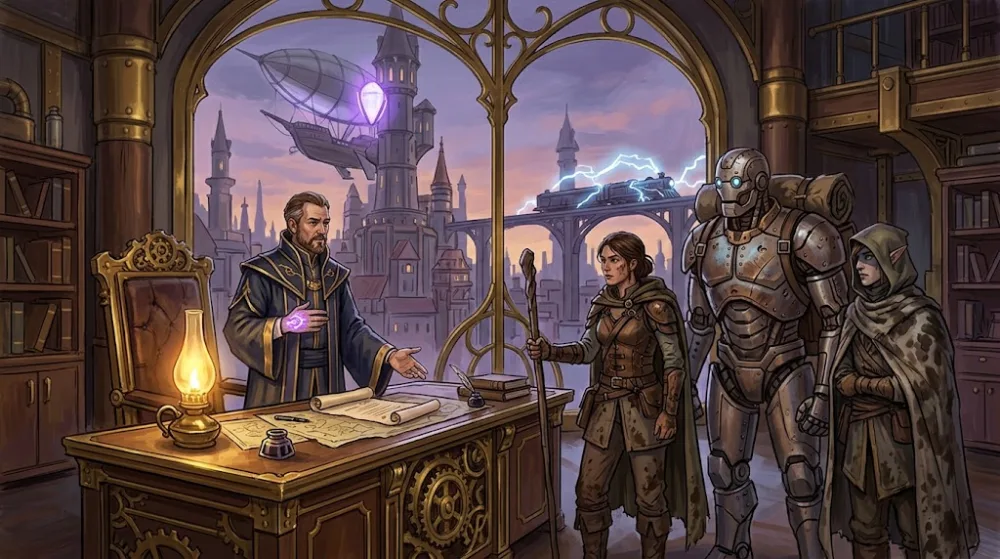
Pulp Adventure vs. Noir Intrigue
Eberron's own introduction names two storytelling traditions that shape nearly everything else in the setting, and the book expects you to weave them together rather than commit permanently to one. Pulp adventure moves fast: airship chases, wyvern-riding bandits, a crash landing in the gray mists of the Mournland, and a breakneck pace that rarely lets the characters stop and think. Noir intrigue moves slow and gets tangled: a mystery that deepens with every clue, moral ambiguity baked into nearly every villain, and a climax that arrives only after the characters have pieced together who is really responsible. Neither tradition excludes the other - the most memorable Eberron sessions tend to open with a noir hook and detonate into a pulp set-piece the moment the mystery's answer turns violent.
Building villains that last. A recurring villain is worth more to an Eberron campaign than a parade of one-shot threats, but only if that villain survives their first encounter with the party. The book offers several concrete tactics:
- Lackeys absorb the first blow. A smart villain never shows up to the opening confrontation in person - agents soften the party up first, and make sure the party knows exactly whose name to fear by the time the real confrontation happens.
- Resources buy time. A villain with access to magic can lean on mechanical and magical traps, divination wards, and protective items to slow the party down, and any surviving lackeys feed the villain enough intelligence to prepare specific countermeasures against a party's known tactics.
- An escape plan is not optional. Secret passages, teleportation, a flying mount, or a crowd of expendable minions all give a cornered villain a way out. Assume every worthwhile villain has at least one fallback.
- Hostages change the calculus. A villain holding captives the party cares about buys time even against characters who could otherwise win the fight outright.
- Death does not have to be the end. A villain who appears to die - falling from an airship, trapped in a collapsing building, swallowed by something worse - can return raised, undead, or simply alive and furious.
As the party grows more powerful, a villain who stays static stops being a threat. Three approaches keep a recurring antagonist relevant: mechanically improving the same individual using the class-level and Hit Dice guidelines in Dungeon Master's Guide chapter 9, swapping in a more advanced stat block for the same named character at a later stage of their career, or shifting the frame from an individual to the organization that individual represents - low-level characters loathing the sight of a minor Emerald Claw agent's insignia today can be facing far more dangerous members of the same order several levels later.
Moral ambiguity and the villain you know. Noir's defining trick is refusing easy answers, and Eberron leans into that hard: a red dragon is not guaranteed evil, a bronze one is not guaranteed good, and most villains are driven by recognizably human motives rather than cosmic evil for its own sake. Consider giving your villains understandable, even sympathetic reasons for what they do - someone targeting people with aberrant dragonmarks to prevent a second War of the Mark, someone committing worse and worse crimes while fighting off a terrible curse, someone climbing to power through entirely legal means and real popular support. Handle this carefully: moral ambiguity works well for tables that enjoy wrestling with no-good-answer dilemmas, and poorly for tables that do not, so read the room before leaning on it.
When a villain's true nature is too vast for the party to grasp right away, the book suggests tying that mystery to one of Eberron's own driving forces rather than inventing a wholly new cosmic threat: the Chamber, the Cults of the Dragon Below, the Daughters of Sora Kell, the Dreaming Dark, the Lords of Dust, or the Order of the Emerald Claw. Each gives a mysterious villain an off-the-shelf motive and network of allies without requiring the DM to build one from nothing.
Not every antagonist needs to be a shadowy mastermind, either. Sometimes the most effective villain is someone the party sees constantly - a con artist who leaves no evidence, a corrupt official who has technically broken no law, a zealot who judges the party's methods while doing far worse in secret. When the players come to loathe a villain they cannot pin anything on, the slow burn is working as intended. At the other extreme sits the mysterious villain, someone the party cannot identify or even fully understand until they have dug deep into the setting's own secrets - discovering a nemesis is one of the Inspired, for example, is only the beginning of the mystery, not the end of it.
Kicking off action, building intrigue. A pulp-leaning session benefits from starting with a bang: soldiers bursting into a tavern calling a party member by name, an explosion tearing through a market, two factions erupting into violence in front of the party with bystanders caught in the middle. Keep the pace from sagging mid-session by introducing a new complication whenever momentum lags - a minion of the main villain showing up to interfere, a rival with the same goal arriving to get in the way, an old enemy resurfacing for revenge.
A noir-leaning session benefits from the opposite rhythm: a slow, deliberate hook that plants a mystery rather than an explosion. A street fortune-teller's uncannily accurate reading, a wealthy patron's cryptic mission delivered aboard an elemental airship, a masked stranger's request at a costume ball, or an anonymous letter delivered by homunculus courier all work as openings that draw characters in without tipping the whole plot at once. Build toward a plot twist partway through - the apparent victim turning out to be the real villain, a supposedly worthless object turning out to be the actual prize, a trusted ally revealed as working for the other side - and let the party's own investigation carry them the rest of the way.
Don't force your table to pick a lane between pulp and noir before session one. The strongest Eberron sessions run the noir engine underneath and let the pulp engine handle the payoff - spend the first half of a session on a slow-building mystery nobody can quite explain, then let the answer detonate into an airship chase or a rooftop chase through Lower Tavick's Landing once the party corners whoever's actually responsible. Committing hard to one tradition for an entire campaign tends to flatten Eberron into either a generic action serial or an over-plotted spy thriller, and the setting is neither on its own - it's the tension between the two that gives Eberron its identity.
The Group Patron Framework
The book treats a sponsoring organization as the default way to give an Eberron party a reason to exist together, a source of resources, and a built-in set of allies and enemies from the first session. A group patron is not required, but the framework gives your table a fast, concrete way to answer "why does this party work together, and who backs them" without inventing an organization from scratch. Running a non-Eberron campaign instead? Tasha's Cauldron of Everything has its own setting-agnostic version of this same idea with eight different archetypes - see Group Patrons in the DM's Toolbox.
How patrons work. Every patron in the book is described along the same five axes, and it is worth using this same structure if you build a homebrew patron of your own: an example organization (its structure, headquarters, allies, and enemies), the character roles a party built around that patron tends to need, the shape of missions the party is likely to run, the concrete benefits the patron grants in exchange for service, and a short list of potential contacts who serve as the party's day-to-day point of connection.
A patron is not purely a resource - it is also a responsibility. Some patrons hand out specific assignments and expect obedience; others simply reward a party for pursuing goals that happen to align with the patron's own interests. The book groups the eleven patron types into three broad bands of autonomy, and knowing which band a patron falls into tells you immediately how much the DM should be steering versus letting the players set their own course:
- Highly directive patrons assign work and expect it done: Crime Syndicates, Dragonmarked Houses, Espionage Agencies, Military Forces, and Newspapers.
- Highly autonomous patrons offer opportunities and rewards without dictating activity: Adventurers' Guilds, Heads of State, Immortal Beings, Inquisitive Agencies, Religious Orders, and Universities.
- Player-directed means there is no patron at all - the party runs its own Crime Syndicate, Inquisitive Agency, Military Force, or Newspaper and answers to nobody but itself, at the cost of the support a patron would otherwise provide.
Beyond the specific benefits listed under each patron type, a party in good standing can request additional favors - small loans, specialized equipment, or access to people and places they otherwise could not reach - appropriate to that patron's area of influence. Treat the listed benefits as a floor, not a ceiling. When the party is the boss, benefits that would otherwise come free become expenses the party has to cover out of pocket, and the Running a Business downtime activity handles the ongoing management of a player-run organization.
| Patron Type | Autonomy | Book's Example | Signature Benefit | Best Fit For |
|---|---|---|---|---|
| Adventurers' Guild | Highly autonomous | Clifftop Adventurers' Guild (Sharn) | Guildhall lodging, storage, referrals, and information | A table that wants minimal DM steering and a home base to return to |
| Crime Syndicate | Directive or player-run | Boromar Clan (Sharn) | A cut of illicit profits, plus underworld contacts and cover | Heist, smuggling, and organized-crime campaigns |
| Dragonmarked House | Highly directive | Any of the houses, or the cross-house institute the Twelve | Daily pay, discounted house services, and cross-border travel papers | Campaigns built around Eberron's central political-economic engine |
| Espionage Agency | Highly directive | King's Dark Lanterns (Breland) | An expense account, forged identification, and favors that make problems disappear | Spy-thriller and Shadow War campaigns with a national stake |
| Head of State | Highly autonomous | Prince Oargev of New Cyre | Direct access to a ruler's ear and support at the top of a government | Political intrigue tied to a specific nation or cause |
| Immortal Being | Highly autonomous | Sora Kell, Queen of the Night | Access to hoarded lore, magic items, and secrets no mortal institution can offer | Cosmic-mystery campaigns willing to serve an inscrutable patron |
| Inquisitive Agency | Autonomous or player-run | Finders Guild (House Tharashk) | Per-case fees plus a referral network reaching into remote corners of Khorvaire | Mystery- and investigation-driven campaigns |
| Military Force | Highly directive | Redcloak Battalion (Breland) | Salary, lodging, a discount on nonmagical gear, and reduced legal exposure | Combat-forward campaigns that want a built-in chain of command |
| Newspaper | Directive or player-run | Korranberg Chronicle | Salary, expense reimbursement, and press credentials that open doors | Investigative campaigns that want a public-facing cover identity |
| Religious Order | Highly autonomous | Templars of the Silver Flame | Free high-level spellcasting from the order's priests, plus a rank-appropriate title | Faith-driven campaigns with a concrete institution behind them |
| University | Highly autonomous | Morgrave University (Sharn) | Discounted training, research assistance, and access to restricted archives | Archaeology- and lore-driven campaigns |
Adventurers' Guild. The framework's own default answer to "what if the party does not want to answer to anyone." A guild does not direct a party's activities or reward it for individual jobs completed - it is closer to a professional network and a physical home base than a patron in the traditional sense, which makes it the lightest-touch option in the entire list. The book's Clifftop Adventurers' Guild, based in Sharn's Dura district, doubles as a library, an inn, a gymnasium, and a tavern under one roof, run by a dwarf descendant of its founder. Members can expect discounted lodging, access to specialized storage sometimes arranged through a banking house, referrals to vetted hired help, and a place to research topics relevant to adventuring work, all for roughly 10 to 15 gp in annual dues. Because a guild does not hand out its own missions, the framework explicitly routes guild-sourced adventures through the other ten categories - which makes the Adventurers' Guild a useful framing device even at a table that ultimately wants the party to answer to one of the other ten. Start the party in a guild, then let a recurring employer become their real patron once the relationship deepens. A rival guild in the same city is a natural, low-stakes source of local friction without requiring a full villain.
Crime Syndicate. A party working for organized crime handles bigger jobs than street-level thugs - grand heists, high-profile assassinations, elaborate cons - because they bring more capability to the table than typical hired muscle. Crime syndicates flourished during the Last War as desperation drove people into illegal work and the war thinned out law enforcement's ranks, and most settlements across Khorvaire now host some organized criminal presence. The book's example, Sharn's Boromar Clan, controls smuggling and gambling across the city and has climbed into its aristocracy. A crime syndicate can also be entirely player-run, which suits a table more excited about building an underworld empire than working for one.
Dragonmarked House. Working for one of the houses - openly, as a badge-wearing representative, or covertly, as an unacknowledged agent - puts a party at the center of Eberron's real engine of political and economic power. Compensation scales with average party level, house services come at a standing discount, and papers identifying agents of a house grant real freedom of movement across national borders thanks to the neutrality the Korth Edicts guarantee. A party can also work for the Twelve, the cross-house arcane institute headquartered in a floating keep above Korth, which offers a smaller discount across all houses at once rather than a larger discount from a single one - a good fit for a party whose characters come from different houses.
Espionage Agency. Secret agents operating for a government or a house's intelligence arm live and work in the shadows deliberately: the connection has to stay secret, and getting caught abroad usually means the home nation disavows the party outright. The book frames the postwar era as an ongoing clandestine struggle among rival agencies that the Korranberg Chronicle itself dubbed the Shadow War. Its example, Breland's King's Dark Lanterns, grants agents an expense account through House Kundarak, both true and false identification papers, and the ability to call in serious favors - at the cost of assignments that can be broad, open-ended, and require considerable independent judgment to complete without blowing a cover. An espionage-patron party naturally sorts into working specialties: a Chameleon who leans on disguise and social skills, a Confiscator who steals what the agency needs, a Hunter who tracks down human targets, an Investigator who pieces together intelligence, an Operator who leads a field team, and a Saboteur who disables enemy assets from the inside.
Head of State. Serving a national ruler directly puts a party well above the level of a typical government functionary. Prince Oargev of New Cyre, the book's example, leads a nation of refugees in exile and is consumed by uncovering the truth behind the Mourning that destroyed his homeland, funding expeditions into the Mournland and courting diplomatic recognition for a Cyre that no longer physically exists. A party serving a head of state might operate in an openly official capacity, in a deniable shadow capacity the ruler privately acknowledges, or even as a double agent secretly reporting to someone else entirely.
Immortal Being. Serving something older and stranger than any mortal institution means answering to purposes that are, by design, cosmic and largely inscrutable. Sora Kell, the book's example, is an ancient night hag whose physical form has not been seen on Eberron in over a century - she communicates through dreams and omens, trades in secreted-away lore and magic items, and counts among her allies both her three monstrous daughters who rule Droaam and, more dangerously, the Lords of Dust. This is a patron for a table willing to take on cosmic-mystery stakes and serve a being whose long-term goals nobody, including the party, may ever fully understand.
Inquisitive Agency. A party of investigators - private eyes, licensed detectives, or a loose network under a larger banner - puts its sharp minds and dogged persistence to work solving mysteries for paying clients. The Finders Guild, tied to House Tharashk's dragonmarked heirs, is the book's example: a network of independent inquisitive agencies that share a reputation for discretion and cunning, connected to bounty hunters, trackers, and dragonshard prospectors across Khorvaire. Compensation runs on a per-case fee rather than a salary, and a party can run its own agency entirely, trading a built-in referral network for full independence.
Military Force. A party serving as soldiers - mercenaries, special forces, or ordinary infantry - gets assigned missions along the edges of civilization where a nation's regular army cannot or will not operate: skirmishes at Droaam's borders, patrols along the Eldeen Reaches, or continued shadow warfare left over from a conflict that officially ended at Thronehold. The Redcloak Battalion, the book's example, is Breland's elite special-forces unit, broken into smaller units and dispersed after the war; a party might join as green recruits earning their stripes or start already established as veteran members. Benefits run toward the practical - lodging on base, a discount on nonmagical gear, a fixed chain of command that reduces personal legal exposure, and a salary that scales with rank.
Newspaper. A team of reporters chasing stories for a chronicle sits in an unusually flexible position: sometimes investigative journalists exposing corruption, sometimes glorified adventurers under contract to supply exciting copy, and occasionally in open conflict with an editor over what the paper actually wants printed. The Korranberg Chronicle built its reputation on relatively unbiased Last War coverage and a distribution deal with House Orien that gets it into hands across the continent. Benefits include a modest salary, reimbursed expenses, access to press equipment, and identification papers that command a certain amount of respect, though not safety, when the party is chasing a story someone would rather bury.
Religious Order. A party sponsored by one of Khorvaire's faiths might be true believers, cynics milking a wealthy congregation, or somewhere in between - the patronage requires an actual organized institution with its own leadership and goals, not merely shared belief among the characters. The Templars of the Silver Flame grant members a knightly honorific, distinctive tabards, and recognition as agents of the church and lesser nobility of Thrane. The concrete benefit that sets a religious order apart from every other patron: a sufficiently high-level priest of the faith will cast any spell up to 5th level for the party at no cost, material components included, so long as the party is in good standing - a resource no other patron type offers outright.
University. An institution of higher learning sponsoring a party might use them as researchers, bodyguards for scholars, or, more bluntly, glorified treasure hunters bringing back artifacts for the collection. Morgrave University in Sharn has earned real prestige for its Xen'drik and Dhakaani scholarship while simultaneously dogged by open allegations of smuggling and black-market dealing in the very relics its researchers recover - a built-in tension a DM can lean on hard. Benefits include discounted downtime training (half price, plus the ability to pick up proficiency in Arcana, History, Nature, or Religion), delegated research assistance, and access to restricted archive material. A university-sponsored party tends to split into a Field Researcher who pairs academic knowledge with real combat capability, a Financier who chases grants and wealthy donors, a Research Assistant whose fortunes ride on a specific scholar's success, and a Scholar whose expertise is the whole reason the university is funding the trip - the last of which works equally well as an NPC the rest of the party protects if nobody wants to play a noncombatant.
Choosing, or skipping, a patron. Work this out as a table decision rather than a DM assignment: the patron shapes what kind of adventures naturally show up, who the party's allies and enemies are on day one, and how much narrative control the DM retains versus hands to the players. And nothing stops a party from having no patron at all, or from later becoming one themselves. A party's status within its own patron does not have to stay fixed either: favored standing built up over a campaign's early levels can sour after a mistake, and a party that starts as reliable low-level agents might end a campaign running the organization that gave them their first job.
A patron does not have to be exclusive. A party can hold formal membership in one organization while quietly moonlighting for another - a Dragonmarked House agent who also freelances for an Inquisitive Agency on the side, or a Religious Order's templar who owes a personal favor to an Immortal Being nobody else in the church knows about. Layering a second, informal patron on top of a primary one is a reliable way to generate mid-campaign complications: what happens the one time the two patrons' interests actually collide, and the party has to choose which relationship survives the choice?
The Planes of Eberron
Eberron uses the Orrery model of cosmology, one of the alternatives to the full Great Wheel named directly in the Dungeon Master's Guide's cosmology chapter: thirteen planes orbiting the Material Plane at shifting distances rather than sitting fixed in a diagram. That system-wide guide covers the general model comparison across every published cosmology; this section covers what Eberron actually does with its own thirteen planes.
Eberron's Material Plane is fully isolated from the rest of the D&D multiverse. The planet is ringed by the Ring of Siberys, a band of dragonshards beyond which thirteen unexplored moons orbit, and the setting's default assumption is that this barrier keeps Eberron sealed off from the meddling of gods, celestials, and fiends belonging to other worlds and other settings entirely. Nothing stops a DM from weakening or breaking that seal deliberately - the book explicitly suggests it as an option for importing outside adventures or deities - but treat that as an active choice rather than the baseline.
Coterminous, remote, and manifest zones. Each of the thirteen planes' influence on the Material Plane waxes and wanes over time. When a plane's influence is unusually strong, it is described as coterminous; when its influence is weak, it is remote. This is not a literal orbital mechanic - it is a metaphor for how strongly a plane's themes and effects bleed into Eberron at a given moment, and exactly when a plane shifts between the two states is entirely up to whatever your story needs. The state of a plane matters for epic rituals, the construction of eldritch machines, and any attempt to contact an extraplanar entity tied to that plane.
Manifest zones are the places where the barrier between Eberron and a specific plane runs permanently thin, letting some of that plane's nature bleed into the material world in a fixed location. Sharn itself sits in a manifest zone tied to Syrania that keeps its famous towers reaching skyward and makes flight easier within the city. A manifest zone can carry ghosts if it is tied to Dolurrh, encourage wild growth and strengthen druidic magic if it is tied to Lamannia, or open an outright portal between the two connected planes. Most manifest zones produce reliable, persistent effects; a few carry only a weak connection and manifest their properties only while the linked plane happens to be coterminous.
Daanvi, the Perfect Order. The plane of law and discipline, its immaculate districts ranging from harmonious, goodness-aligned justice systems to oppressive tyrannies enforced by devils. Legions of modrons endlessly catalog every rule ever written. Manifest zones here tend to compel rigid, unquestioning obedience to local regulation and produce unnervingly orderly flora and fauna.
Dal Quor, the Region of Dreams. The plane mortals touch every time they dream - except for elves, kalashtar, and warforged, none of which dream at all. Its outer fringes are shaped by dreamers' own memories, while its dark core belongs to the nightmare force called the Dreaming Dark and the enigmatic quori who inhabit it. Ancient giants severed Dal Quor's connection to Eberron millennia ago, so it is permanently remote with no manifest zones anywhere - the only way in is through the psychic act of dreaming itself, which is also why the quori are forced to possess mortal hosts to act on the Material Plane at all.
Dolurrh, the Realm of the Dead. Where mortal souls go after death, a place of despair and apathy that slowly strips away a spirit's memories until nothing but a husk remains. Most Eberron faiths hold that this is not a final fate but a gateway to something beyond mortal comprehension. Manifest zones here can reanimate the recently buried, intensify necromancy, or make spellcasting itself require a Constitution check to push through the plane's deadening influence.
Fernia, the Sea of Fire. Elemental fire in both its destructive and creative aspects, home to fire elementals and to efreeti pashas and fiendish satraps ruling obsidian city-islands adrift on seas of magma. Manifest zones here boost fire spells, support the forging of unusually (if unpredictably) potent weapons and armor, and pit the ground with molten pools that spawn mephits and elementals.
Irian, the Eternal Dawn. The wellspring of positive energy, a plane of unbroken light, hope, and new beginnings where the sun never sets and angels dwell in a city echoing a long-past golden age. Manifest zones here produce curative springs, amplify healing and radiant magic, and actively hamper undead that wander too close.
Kythri, the Churning Chaos. A plane in permanent flux, where elements collide, gravity shifts without warning, and stoic githzerai monks carve monasteries into islands of stable earth amid the turmoil. Manifest zones here render terrain wildly unstable, produce rock formations that collapse and slowly reassemble, and can randomly reroll the damage type of elemental spells cast within them.
Lamannia, the Twilight Forest. Every natural environment Eberron has, distilled into one plane, home to great beasts and to the finest specimens of wildlife nature can produce - animals born here reputedly outshine even House Vadalis's magebred stock. Manifest zones here strengthen elemental-summoning magic, aggressively reclaim any structure built within them, and grow local wildlife larger and stronger than normal.
Mabar, the Endless Night. The source of Eberron's negative energy, a fractured plane of entropy and hunger where fiends scheme to drag pieces of other planes down into permanent darkness. Most undead draw their animating force from Mabar. Manifest zones here toughen undead, produce sickly and stunted vegetation, and can dim light itself while weakening resistance to necromancy.
Risia, the Plain of Ice. Fernia's frozen counterpart, an endless glacial expanse where frost giants carve fortresses from ice and blizzards never stop howling. Manifest zones here intensify cold spells, produce ice that never melts once removed from the plane, and can house lairs of abominable yetis in the surrounding mountains.
Shavarath, the Battleground. An eternal war between armies of fiends and celestials that predates recorded history, its skies scoured by storms of animate blades. New arrivals risk forced conscription on the spot. Manifest zones here sharpen weapons crafted within them, make blood spilled there permanent, and can spawn actual storms of whirling blades during combat.
Syrania, the Azure Sky. The plane of peace, its floating crystal spires home to angels each devoted to mastering one pure concept, and to the Immeasurable Market, a trading hub that draws merchants from across reality. Manifest zones here can suppress hostile intent outright, grant limited weather control from a mountain peak, or let the free-spirited fly for an hour at a time.
Thelanis, the Faerie Court. Home to the fey and the archfey who rule its many story-shaped dominions, where narrative logic outweighs physical law and time runs unreliably for any mortal who wanders in. Manifest zones here grow magically potent fey trees, sometimes conceal a portal inside a ring of mushrooms, and weaken resistance to enchantment and illusion magic.
Xoriat, the Realm of Madness. A plane whose bizarre, non-Euclidean geography and unspeakable inhabitants are the wellspring of Eberron's aberrations, including the terrifying daelkyr. Manifest zones here are dangerous by design, capable of triggering wild magic on any spell cast within them or inflicting short-term madness on anyone who lingers too long.
The book's own default assumption is that gods, celestials, and fiends from beyond Eberron simply do not know the setting exists - which means a villain drawn from the wider multiverse, imported wholesale from another campaign, arrives with no established cults, no historical footprint, and no existing power base to draw on. That is a deliberate design choice worth preserving unless your table specifically wants to explore what happens when the Ring of Siberys starts to fail.