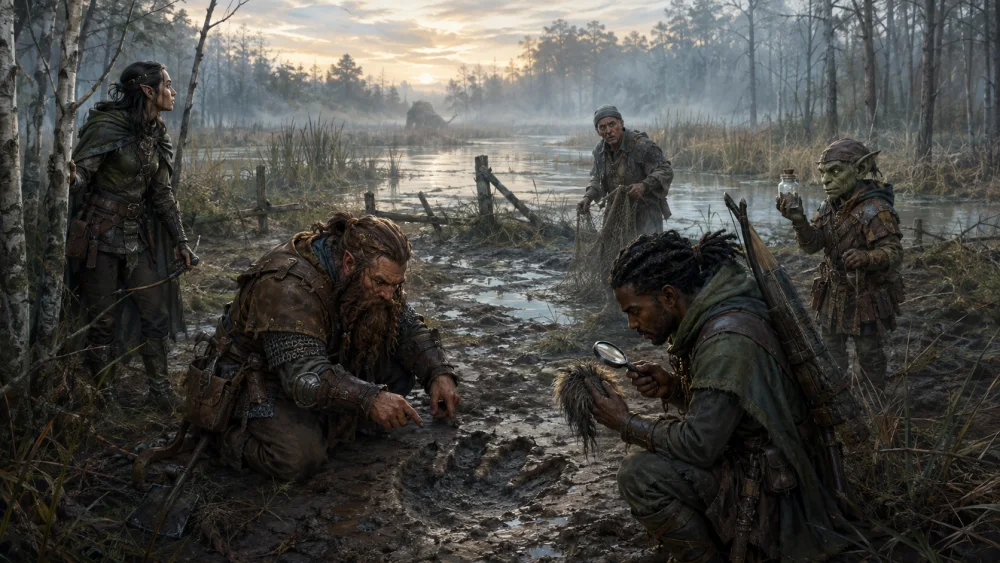
Introduction
Runesmith is the PF2e class for the player who wants a weapon, a shield, and a little battlefield handwriting to matter on the same turn. You prepare lasting marks on allies or gear, sketch temporary marks when a fight gives you an opening, and cash in one or two marked targets with an invocation when the timing is right. It is an Intelligence-based martial support and controller, not a spellcaster wearing an apron.
Pick Runesmith if you enjoy setting up a position before combat, watching several allies and enemies at once, and turning a good board state into a sharp two-target moment. Skip it if you want every round to be a fixed personal damage routine. The class can hit with martial weapons, but its best turns often belong to the whole party.

Disclaimer
This guide summarizes and evaluates the Runesmith from Impossible Magic. It does not reproduce the class table, rune entries, feat text, or invocation text. Ratings assume a tactical PF2e Remastered campaign with ordinary treasure, maps that matter, and a GM who lets enemies move, retreat, grab people, and make your careful diagram look rude. Check the book version and current official errata your table uses before relying on a rules interaction.
For detailed rune selection, invocation timing, and diacritic packages, use the Runesmith runes-and-invocations guide. For level-by-level class-feat selection, use the Runesmith feat guide. This page explains how to make those choices fit a character rather than treating every line of a sourcebook as a separate homework assignment.
Rating Legend
| Rating | Meaning |
|---|---|
| ● | A strong default that supports the class's normal loop. |
| ● | Good when your party, map, or equipment plan supports it. |
| ● | Useful in a narrow campaign or when you know why you want it. |
| ● | A poor blind pick, or a plan that spends more actions than it returns. |
Class Snapshot
| Feature | Runesmith |
|---|---|
| Source | Impossible Magic |
| Key attribute | Intelligence |
| Hit Points | 8 plus Constitution modifier |
| Weapons | Simple and martial weapons |
| Armor | Light and medium armor |
| Signature engine | Etch or trace runes, then Invoke Rune |
| Core resource | A growing runic repertoire and limited lasting etched runes |
| Early defense | Shield Block at 1st level |
| Complexity | High |
| Best party jobs | Frontline support, battlefield control, weapon pressure, gear-aware utility |
What A Runesmith Does
A Runesmith puts magic on things already involved in the fight. An ally, enemy, weapon, armor, shield, or useful square can carry a rune if that rune permits it. The mark produces a continuing benefit or problem, then its invocation provides the moment where the line becomes important. Some runes support a bearer before they are invoked. Some wait quietly until you turn a creature's position, equipment, or bad save into a problem. The class rewards you for recognizing which one is which.
That makes Runesmith more like a tactician with a small prepared kit than a caster with a large menu. You have a runic repertoire, not a spell list. You do not spend slots. You do not need to prepare a different collection every morning. But you do decide which few lasting inscriptions deserve your limited etched capacity, where your martial body needs to stand, and whether a temporary combat mark is worth the action it takes to place.
The best mental model is a three-stage loop.
| Stage | What you do | What can go wrong | Better question |
|---|---|---|---|
| Prepare | Etch a lasting rune during daily preparation or exploration | Etching a clever effect onto someone who will not be present | Who will definitely be part of the next fight? |
| Place | Trace a short-lived rune or keep fighting with an etched one | Spending actions on a target that will leave your range | Can I invoke this before the end of my next turn? |
| Convert | Invoke one or two runes within range | Firing one harmless effect because it is technically available | What changes if I consume both marks now? |
The class is not secretly a full caster. Runes are magical effects, and some can take a tradition trait when you have the matching training, but they are not spells. That distinction matters because you do not build around spell slots, casting proficiency, or a tradition spell list. It also does not make you immune to every anti-magic or anti-spell complication. The source notes that restrictions on casting spells and protections against spells can still matter when you trace or invoke. Read the specific table rule, then ask the GM before the climactic scene turns on a technicality.
A Runesmith who spends a round placing two temporary runes for one modest invocation is usually playing a slow Magus. The class shines when one mark was already useful before the invocation, and the second converts the whole board at once.
The Rune Loop
Runes Are Setup, Not Ammunition
The first trap is treating every rune as a grenade with an awkward fuse. Many runes give a bearer a useful ongoing effect before you invoke them. That means an etched mark on the right ally can earn its place through several encounters even if you never trigger its final effect. A weapon or shield rune can support the person who already uses that gear every round. A protection or movement mark can make a frontline ally easier to position. A control rune on an enemy can make their next choice worse before you cash it out.
An invocation is powerful because it ends the rune. That is a cost, not a free bonus. If the ongoing effect is carrying a fight, leave it in place. If the fight has reached the turn where a burst of damage, movement, defense, or disruption prevents a disaster, invoke it. You are not failing the class by keeping a rune unspent.
You Can Invoke Two, But You Do Not Have To
Invoke Rune is a one-action payoff that can invoke up to two of your runes within 30 feet. The two-rune ceiling gives the class a satisfying tactical ceiling: a frontliner and an enemy can both be marked; two allies can turn a defensive moment into a swing; two enemy positions can become a problem at once. Duplicate copies on the same creature do not stack into a loophole, so variety matters more than repeatedly applying the same mark.
Two is not a quota. A single invocation can be correct when it saves an ally, breaks a dangerous positional pattern, or turns a strong passive benefit into the action that ends the encounter. Do not hold a lifesaving effect hostage because the second target has not auditioned yet. The Runesmith is about timing, not getting a perfect screenshot of two glowing circles.
Your Weapon Still Has A Job
The runic engine does not replace martial turns. You are trained in martial weapons, begin with an 8 HP chassis, and gain better weapon proficiency as you level. Your weapon keeps pressure on an enemy while you wait for the map to offer a better rune moment. It also gives you a credible turn when a creature is immune, protected, too far away, or simply not worth spending a temporary mark on.
For most builds, use a weapon that makes your normal turns comfortable. A shield-and-one-hand setup is the easiest default. A two-handed weapon spends less on defense and asks you to be more certain about positioning. A ranged weapon turns tracing at distance into an easier conversation, but it does not erase cover, line of effect, or the two-action cost of a ranged trace. Choose the weapon first for its normal Strike pattern, then choose runes that make that pattern more useful.
The Runesmith's Information Burden
The class has more visible state than a simple martial. You need to remember which runes are etched, which temporary runes expire at the end of your next turn, who bears each mark, whether a target is inside 30 feet, and whether invoking would remove a benefit you still need. That can sound like too much. In practice, a small table note solves it.
Use tokens, a dry-erase card, colored clips, or a short list beside the character sheet. Write only the facts that change decisions: target, rune job, and expiry. For example, "shield: defense, etched" and "ogre: control, expires after my next turn." Do not write the entire rule text. You already have the book or character builder for that. The table note exists so you do not accidentally plan around a mark that faded ten minutes ago.
Tell the GM and other players what the marker means if you use minis or virtual tokens. This is not bookkeeping theater. Clear state lets an ally choose to stay near your range, reminds the GM that a visible effect exists, and makes it easier for everyone to understand why your one-action invocation matters. The class gets smoother when the information is shared instead of trapped in one player's memory.
A Turn Does Not Need Every Class Feature
Early in a campaign, Runesmith players sometimes feel they have failed if they did not etch, trace, invoke, Strike, raise a shield, and use Crafting all in the same encounter. You cannot do all of those things every round, and you should not try. Your class abilities are tools. A good turn might be "Stride, Strike, raise shield" because that keeps an enemy in the square where your etched ally mark becomes relevant next turn. Another good turn might be a two-rune invocation followed by a Step because the conversion already did the work.
This is one reason the class rewards experience. The question is not "what feature have I not used?" It is "what action makes the current board worse for the enemy and better for the party?" Sometimes that action is a rune. Sometimes it is a normal martial action that preserves the rune opportunity.
Etched Runes And Daily Preparation
Start With The People Who Will Be There
At 1st level, you can sustain two etched runes. They last until expended, removed, or displaced by new etching beyond your capacity. You can apply them during daily preparation or by spending time in exploration. That is a generous duration paired with a strict cap. Your early choices should favor dependable targets: your own shield or weapon, the party's primary frontliner, the ally who always scouts ahead, or a piece of gear that sees every encounter.
Avoid using both marks on extremely situational plans just because the sourcebook gave you an interesting sentence. The party's travel arrangement is more valuable than a theoretical combat combo. If the ranger always starts at range, a rune that needs a nearby melee target may be a poor daily anchor. If the champion always raises a shield, a shield-facing plan has a stable home. If the party changes composition every session, put one durable mark on yourself and leave the second flexible.
Etching During Exploration Is A Real Tool
Daily preparation is not the only time you can make a lasting mark. When a party learns the next room's danger, takes a ten-minute pause, or changes from travel to siege work, exploration etching lets the class adapt. That should influence your group conversation. Tell the party what kind of target you want, then ask whether anyone expects to lead, carry, climb, or stand in a doorway.
Do not turn this into a twenty-minute pre-fight ritual every time a goblin looks suspicious. The group still needs to move. The practical use is between scenes: after scouting, before a known boss room, during a safe rest, or whenever the party already has a reason to adjust gear. The class gives you tools for deliberate preparation, not a license to halt the campaign for decorative calligraphy.
A Simple Early Preparation Template
| Party situation | First etched rune target | Second etched rune target | Why it works |
|---|---|---|---|
| One clear frontliner | Their shield, armor, or body | Your own weapon or shield | Both marks stay in the portion of the map that matters. |
| Two melee allies | One durable ally | The ally who triggers the most reactions or maneuvers | You can support two distinct jobs rather than doubling one effect. |
| Ranged-heavy party | Your own gear | The ally most likely to be threatened | You keep one reliable target while reserving the other for the person who may need rescue. |
| Exploration or dungeon day | Your own gear | A utility-facing party member | Lasting effects remain useful before initiative. |
| Unknown party plan | Your own shield or weapon | Hold the second mark until the first safe exploration pause | The best default is the target you can control. |
The exact rune names change with access and level. The target logic does not. Put lasting marks where they create value before the invocation and where you can actually reach them with a 30-foot payoff.
Tracing, Invoking, And Action Economy
One Action Up Close, Two At Range
Trace Rune has two practical modes. Adjacent tracing costs one action. The ranged version costs two actions and can reach a target within 30 feet. A traced rune lasts only through the end of your next turn. That clock is the class's most important action-economy rule.
An adjacent trace often produces a clean turn: Stride into place, trace a rune, then use a weapon action or defensive action if the board allows it. Or keep an etched mark on the frontliner, trace an enemy beside them, then invoke both on the next turn. You may not always get that exact sequence. Enemy movement, reactions, and a missed Strike are part of the game. But it is the sequence you should be trying to make possible.
The two-action version needs a higher bar. It is best when moving adjacent would be unsafe or impossible, when the target's position itself creates a major opportunity, or when the team will immediately exploit the resulting invocation. It is not a default substitute for walking ten feet. If you spend two actions at range and then cannot invoke until after the rune expires, you bought a diagram and received no magic.
The Basic Two-Turn Pattern
Here is the class's most reliable early combat rhythm:
- Start with one or two etched runes on dependable party targets.
- When an enemy commits near those targets, trace a compatible temporary rune adjacent to it or another nearby target.
- On the next turn, invoke the temporary rune and one existing rune if both effects matter.
- Resume normal martial pressure while deciding whether to rebuild the temporary layer.
This is not a script. If an ally is in danger, invoke now. If no enemy gets close, Strike, raise your shield, reposition, or use a skill. If a temporary rune creates enough immediate value, you can trace and invoke without waiting for a second turn. The point is that the class has a cadence: durable support creates the floor, tracing creates the short window, and invocation chooses the peak.
The Range Problem Is Usually Positioning
Thirty feet sounds generous until one ally is on a balcony, an enemy is behind a wall, and the fighter just shoved the target into a different room. Your invocation range measures from you to the runes, not from one rune to another. A Runesmith should stand where at least two likely rune-bearers remain reachable, not where every possible enemy looks equally distant.
The three-action economy guide helps here because movement is never just movement. Striding toward the center can preserve a two-rune invocation next turn. Stepping out of a flank can protect a shield reaction. Holding one action for a Strike may be worse than putting yourself inside your own 30-foot network. Make the movement decision with the coming invocation in mind.
A Quick Decision Check Before You Trace
| Question | If the answer is no | What to do instead |
|---|---|---|
| Can I invoke this before it expires? | The mark is unlikely to pay off | Strike, raise a shield, move, or use a skill. |
| Is the target likely to stay within 30 feet? | Your payoff may walk away | Reposition first or choose a different target. |
| Does this rune help before invocation? | You are taking a pure setup action | Require a stronger two-rune payoff. |
| Does a second rune create a separate result? | The double invocation may be wasteful | Save one mark for later. |
| Would an adjacent trace do the job? | Two-action tracing is overpaying | Move into range and preserve an action. |
Choosing A First Rune Package
Choose Jobs, Not A Shopping List
At 1st level you know four runes, and your repertoire grows as you level. That is enough to make a meaningful kit and not enough to cover every problem. Your first selections should cover jobs that your own party actually needs: damage pressure, defense, movement, control, or utility. A party with a champion and a fighter may value enemy control or a ranged ally package more than another defensive mark. A fragile caster group may want the ability to buy one bad turn of safety.
The source offers early rune themes such as fire, bravery, perplexity, whetstones, ramparts, appeal, frost, impact, cowards' bane, illumination, thunder, bestial might, preparedness, corrosion, vocabulary, and homecoming. Do not read that as a recommendation to memorize every entry. It is evidence that a Runesmith can build around several roles. Start by deciding the role, then read the eligible rune entries at your table.
Weapon Pressure - Blue
Pick a weapon-facing package when you want your Runesmith's normal Strikes to remain relevant and when at least one party member reliably attacks with a weapon. A whetstone or elemental-facing mark can make a martial turn better before it is invoked, and weapon equipment gives you a natural target that is not going to sprint out of your range. This lane is especially comfortable for a Strength build, a sword-and-board Runesmith, or a party that already creates off-guard targets.
The tradeoff is that weapon support rarely solves every encounter. Flying enemies, social scenes, and opponents who punish melee movement still require a second job. Pair a weapon selection with movement, defense, or utility rather than making all four known runes different versions of "hit harder."
Shield And Defensive Support - Blue
Shield Block arrives at 1st level, light and medium armor are part of the chassis, and the rune list supports protective and rampart-like ideas. That makes shield support the cleanest default for a player who wants to hold a line. Your own shield is a reliable etched target. A shield-bearing ally is another. The result is a class that can stay close to the part of the map where a temporary enemy mark is easiest to apply.
Defensive packages have a quiet strength: they make poor turns less costly. You may not always get the two-rune invocation you imagined. But a shield, medium armor, and a helpful lasting mark keep the Runesmith present long enough to find the next opportunity. That is often more valuable than squeezing out a minor damage edge on a turn where the party is already safe.
Enemy Control - Green
Control packages suit a player who enjoys positioning puzzles. Look for runes that punish movement, alter a target's choices, create difficult ground, pull creatures, or otherwise make the enemy's map worse. Trace these when a monster has already committed to a square that matters. A rune that is unpleasant on a creature next to the rogue can be much better than the same rune on a creature across the room.
The risk is overplanning. Control has to respond to the battlefield, not force the battlefield to obey your character sheet. If the enemy has no reason to approach, a close-range control setup may never turn on. Carry a reliable weapon or ally-facing plan so the encounter does not become a negotiation with a monster that refused to stand in your preferred circle.
Ally Mobility And Rescue - Green
Movement and rescue packages are best in parties with a frontliner who gets isolated, a rogue who has to cross dangerous ground, or a GM who uses vertical maps and active objectives. The value is not always damage. It is putting the right person on the right side of the hazard before the enemy gets another turn.
This lane asks you to track allies more closely than an offense package does. Tell the table that you can help someone reposition, then let them tell you when their turn needs it. A Runesmith should not surprise-teleport or reposition a teammate without coordination just because the button looks clever. The strongest mobility abilities reward shared intent.
Utility And Exploration - Green
Some rune choices speak to illumination, language, preparation, return travel, or other noncombat problems. They make the class feel like a scholar-craftsperson instead of a green-light damage dealer. Pick one if your campaign spends time in ruins, politics, travel, or investigation and the rest of the party lacks that answer.
Utility is most valuable when it prevents a constraint. A convenient mark that saves the group from wandering in darkness, failing a language barrier, or losing a return route can be better than a narrowly higher combat number. The price is opportunity cost. Your first four known runes still need at least one dependable encounter job.
Ability Scores And Skills
Intelligence Is Not Optional
Intelligence is the Runesmith's key attribute and supports your class DC for save-based rune effects. Begin high. A Runesmith who neglects Intelligence to chase a slightly prettier weapon modifier makes their signature magic easier to ignore. Your martial weapon plan still matters, but it should support the class rather than replace it.
Strength is the clean pairing for a melee weapon, Athletics, and heavier physical presence. Dexterity supports finesse or ranged weapons, Reflex, and a lighter positioning style. Constitution matters because 8 HP is workable, not luxurious. Wisdom helps Perception and Will-adjacent table play, while Charisma is a valid roleplay choice but rarely earns priority from the class chassis alone.
| Build lane | First priorities | Useful secondary scores | What it gives up |
|---|---|---|---|
| Shield frontliner | Intelligence, Strength, Constitution | Wisdom | Less room for high Dexterity or social focus. |
| Mobile weapon user | Intelligence, Dexterity, Constitution | Wisdom | Lower Athletics pressure unless boosts support it. |
| Ranged rune thrower | Intelligence, Dexterity, Constitution | Wisdom | Less control over adjacent trace opportunities. |
| Crafting and utility | Intelligence, Constitution, weapon score | Wisdom or Charisma | Do not let skills replace a usable combat stat. |
Skills Should Match The Character's Job
You begin trained in Crafting, choose one magical tradition skill, and gain additional skills from Intelligence. That is a strong foundation. Crafting is obvious because Runic Crafter later grants Magical Crafting and formula access for stated fundamental runes. The tradition skill is both a lore choice and a way to support relevant magical framing. The rest should make the character useful when no one is bleeding.
Arcana suits magical theory, constructs, and arcane traditions. Occultism fits hidden lore and mental mysteries. Nature supports primal-facing stories and wilderness exploration. Religion supports divine themes. Athletics works for a Strength build that wants to trip, shove, reposition, or grapple. Acrobatics protects a Dexterity character's movement. Diplomacy, Intimidation, Society, Thievery, and Medicine all depend on the campaign and party gaps.
Do not train every Intelligence-flavored skill because you can. Choose a few you are willing to use at the table. A Runesmith with Crafting, Arcana, Athletics, and Society has a clear identity. A Runesmith with eight skills and no answer for which check to roll has purchased anxiety in bulk.
Weapons, Armor, Shields, And Crafting
A Shield Is A Default, Not A Command
Shield Block at 1st level makes a shield attractive immediately. It gives an 8 HP martial class a way to turn gear into durability and puts you beside allies or enemies who are convenient rune targets. A one-handed martial weapon plus shield is the easiest way to learn the class because it leaves your turns legible: protect space, trace nearby, Strike when the opportunity is ordinary, and invoke when it is not.
Read the shield and Shield Block guide before buying your first serious shield. The class can use the reaction; that does not mean every shield can absorb every hit forever. A reinforcing rune, repairs, and whether your shield is raised still matter.
Weapon Choice Should Survive A Boring Round
Use the weapon guide for traits and weapon groups, then choose something you are happy to Strike with when no rune combo appears. One-hand weapon and shield is stable. Reach weapons create slightly different adjacent-trace geometry but cost shield comfort. Agile options can help a Dexterity build, though the class is still paying attention to Intelligence. Ranged weapons are viable when the campaign rewards distance, but they make the one-action adjacent trace less available.
The source's runic optimization at 7th level adds damage when you wield a weapon with a striking rune, with larger benefits as the fundamental striking rune improves. Greater runic optimization later increases that support again. That is a loud mechanical reminder that fundamental weapon runes are part of your class progression. A Runesmith who delays weapon potency and striking upgrades is not being a pure support character. They are leaving a class feature on the shelf.
The fundamental rune guide is the equipment page to keep handy. Your class is called Runesmith, but its class runes and standard equipment runes are different systems that happen to share vocabulary. Explain that distinction to new players before shopping. One set improves a weapon or armor under the game's item progression. The other is your class magic, applied and invoked through your own repertoire.
Medium Armor Is A Positioning Tool
Medium armor does not require you to play a stationary wall, but it gives a frontline Runesmith room to stand where the runic network works. You gain better medium armor proficiency as you advance. Decide early whether your Dexterity target and chosen armor cooperate. An armored character who cannot use their preferred movement and an unarmored character who keeps getting dropped both lose the action economy the class needs.
Armor is particularly valuable because traced runes have a short window. If moving adjacent to place one exposes you to a dangerous reaction or leaves you in a bad square, a small defense edge can make the difference between a usable plan and a plan you never dare to use. Do not confuse this with permission to face-tank every boss. It means armor lets you make more informed risks.
Crafting Is Support, Not A Tax
At 2nd level, Runic Crafter grants Magical Crafting and stated formula access for fundamental armor, shield, and weapon runes as you reach the appropriate level. Later features improve your comfort crafting permanent runes in downtime and offer property-rune formula access at regular intervals. That is useful, especially in campaigns with downtime, limited shops, or a party that trusts one person with its gear economy.
It is not a demand that you become the party's unpaid magic-item warehouse. Crafting takes time, materials, campaign access, and table coordination. If the campaign has no downtime, the feature still means you understand the item game and can identify good purchases. If the campaign does have downtime, talk to the party about priorities: the fighter's weapon, the champion's armor, your shield, and the group's next expedition each have a claim on resources.
A Free Character Builder for Pathfinder 2e Is Coming
Get notified the day it is live, and grab our current character-building guides while you wait.
No spam, unsubscribe anytime.
Diacritics And Later Runes
Diacritics Change A Plan You Already Use
Diacritics arrive as a separate layer of rune design. They modify a base rune, cannot stand alone, and a base rune can have only one at a time. The important part is not their names. It is the build question they ask: which existing rune deserves to become more specialized?
At the first diacritic tier, the source includes directions that can broaden a damaging effect, share a non-damaging effect with the Runesmith, soften damage into a less-lethal package, continue a rune to a new target, rebuild it on the same target, change an elemental damage type, or intensify damage. Those are not seven unrelated toys. They are several answers to the same question: do I want this base rune to spread, persist, change target, change damage, or become more reliable for a particular table problem?
The correct first diacritic is usually the one that makes your most frequently useful rune better in the kind of fight you actually have. A damage-heavy party might want better propagation or intensity. A support-focused party might prefer continuity or preservation. A campaign with damage-type problems may value elemental flexibility. Do not choose a modifier for a rune you never have time to trace or a target you never get within range of.
Later Runes Widen The Map
As the repertoire grows, the source adds options around water movement, leeching, gravity, partnership, observation, dragon fury, insulation, language disruption, transposition, sorrow, restraint, shield support, contingency, holy or unholy treatment, teleportation, terrain, and high-level battlefield effects. This is where the class becomes less about "which early effect is best" and more about which map problem your party needs solved.
The high-level Runesmith does not need to be a damage specialist to feel powerful. A rune that gets the party through water, interferes with an enemy's language-dependent turn, moves a creature, protects a vulnerable character, or changes where the fight can happen can be decisive. Your class DC grows through expert, master, and legendary stages, so save-facing and control-facing choices deserve a fresh look as your proficiency improves.
Keep The Repertoire Coherent
| Repertoire role | What it covers | Why it belongs |
|---|---|---|
| Reliable ally or gear rune | A target you can etch before a fight | Gives your prepared capacity a consistent use. |
| Enemy-facing rune | A temporary problem for the creature in the wrong square | Makes adjacent tracing worth learning. |
| Movement or rescue rune | A response to map pressure | Prevents the class from becoming stationary. |
| Utility or exploration rune | A way to matter outside initiative | Uses Intelligence and craftsmanship in the rest of the campaign. |
| Higher-level specialization | A diacritic or major effect tied to a known job | Builds on a working plan instead of replacing it. |
Build Paths
Shieldwright Lineholder - Blue
This is the best first Runesmith build. Carry a one-handed martial weapon and a shield, invest in Intelligence, Strength, and Constitution, and put your lasting marks where the front line already lives. You are close enough to use the one-action trace, sturdy enough to survive the square that makes invocation range work, and equipped to protect yourself while waiting for the right conversion turn.
Your daily preparation usually begins with your shield or weapon and the gear or body of the party's other dependable frontliner. In combat, prioritize one enemy-facing temporary mark when that enemy commits. Raise the shield when you expect pressure. Strike when the map has no obvious rune decision. Invoke when a second existing mark gives the action real weight.
This lane is less flashy at long range. It also has fewer turns where you wonder whether you did anything useful. That steadiness is why it is Blue.
Rune Thrower - Green
The rune thrower uses Dexterity, a ranged or thrown weapon plan, and movement to support allies without standing in the first doorway. The source even frames a sample character around rune-covered knives, which is a useful signal that a mobile ranged interpretation is intentional. Your problem is that the convenient one-action trace is adjacent, while your preferred weapon range is not.
Build this lane only if you like managing that tension. Use your distance to keep a network of etched allies in 30-foot invocation range, then accept that a two-action ranged trace must earn its price. A ranged trace that immediately enables a meaningful invocation can be excellent. A ranged trace followed by a distant bow shot and a hope that the enemy stays still is not a plan.
This build gets better on large maps, in parties with multiple mobile allies, and in campaigns where approaching every danger is a bad idea. It gets worse when the group expects you to be the only person holding the door.
Engraver Of The Line - Green
This control-first lane uses a martial weapon, medium armor, and positioning to turn enemy movement into trouble. You choose runes that make a square, creature, or group formation awkward, then wait until the enemy commits. Your best play may be a control effect that lets the fighter stay put, a movement answer that saves the rogue, or a two-rune invocation that turns a choke point into a serious decision.
The danger is picking control because it sounds smart rather than because the campaign offers control targets. Ask the GM's past maps a simple question: do enemies charge, flank, climb, retreat, grab, and contest objectives? If yes, this lane has material. If fights mostly happen in empty rooms with one static monster, use more weapon pressure or ally support.
Expedition Scribe - Green
The expedition scribe leans into Intelligence, Crafting, a chosen magical tradition skill, and utility runes. They can still fight, but their signature is making the party better prepared for travel, investigation, ancient sites, and magic-item decisions. Pick a reliable defensive or weapon rune for your own survival, then use the rest of the repertoire to cover problems that the party keeps meeting outside combat.
This lane is strongest in a campaign that honors exploration turns and downtime. It is weaker in a pure arena game. That is not a flaw in the build; it is a campaign fit check. Ask the GM whether travel, research, gear crafting, and noncombat obstacles are regular parts of play before turning every early selection toward utility.
Two-Handed Runebreaker - Orange
A two-handed Runesmith can use the class's martial proficiency and later weapon-rune support to apply real Strike pressure. This works when another character handles the shield-and-reaction job, when your party needs a sturdier second striker, or when your concept cares more about a particular weapon than a defensive hand.
The cost is clear. You lose the easy Shield Block package and must choose adjacent tracing positions more carefully. You are also tempted to play like a straightforward Fighter, which leaves your runes unused until the table remembers why you chose the class. Take this lane if you have a concrete reason, not because a big weapon makes the character sheet look decisive.
Level Milestones
Levels 1-4: Learn The Clock
Early Runesmith is about learning that etched and traced marks are not interchangeable. You know a small repertoire, sustain two lasting marks, have Shield Block, and gain Runic Crafter at 2nd level. Choose an early pair of durable targets. Learn exactly how often your party gives you a safe adjacent trace. Practice declining a trace when a Strike, shield raise, or Stride is simply better.
This is also the time to settle weapon comfort. Do not wait until a major encounter to discover that your preferred weapon leaves you with no action for defense or that you have placed every useful rune on characters you cannot reach. A simple shield build teaches the class cleanly.
Levels 5-8: Expand The Network
At this stage, the repertoire and etched capacity improve in the class's regular growth pattern, weapon proficiency rises, and expert rune proficiency arrives. You have more room to assign lasting jobs before combat and more reason to inspect save-facing options. Diacritics enter the conversation. Choose them to improve a rune you already use, not to create a separate subsystem you are now obligated to remember.
This is the level band where a Runesmith starts looking ahead one turn. The party knows your usual targets. You know which monster behaviors create a trace opportunity. Your positioning becomes less reactive because you have seen the basic problems before.
Levels 9-14: Make Gear Part Of The Plan
Crafting support improves, your lasting runic network grows again, and medium armor and weapon progression make your physical presence more reliable. A weapon with its expected fundamental runes now interacts with runic optimization, so equipment catches up to the class concept. You should have a clear answer for how your character contributes if no perfect invocation appears: Strike, defend, maneuver, aid, use a skill, or support an ally's position.
This is a good band to revisit the party's needs. An early defender may become a more mobile controller. A rune thrower may discover that the group needs one durable frontliner. The repertoire is broad enough that changing one or two choices can reflect how the campaign actually plays rather than how it looked at session zero.
Levels 15-20: Pick The Encounter You Want To Solve
At high levels, class DC proficiency reaches master and then legendary, major rune effects become available, and greater runic optimization makes a properly upgraded weapon matter. Your choices can address mobility, terrain, rescue, powerful defenses, and high-stakes control alongside weapon damage. The important decision is no longer whether a rune is generally good. It is whether it solves the encounter type your campaign keeps presenting.
Keep the fundamentals. A legendary class DC does not rescue a poor target. A dramatic two-rune invocation does not undo three rounds spent out of range. High-level Runesmith rewards a player who has learned the same early discipline: make the network useful first, then consume it when the conversion changes the fight.
How To Play Runesmith At The Table
Before Initiative
Tell the party what your etched runes do in plain language. They do not need a paragraph from the sourcebook. They need to know that their shield, weapon, armor, or body carries something you might invoke and that staying within your reach matters. Ask the frontline player whether they plan to hold a corridor, rush a target, or peel for the back line. That answer tells you where a lasting mark belongs.
When exploration gives you ten minutes, reassess. A known climb, flooded tunnel, cursed ruin, or boss room may change your second etched target. The class gets better when the group treats preparation as shared information instead of a private character-sheet ritual.
On Your First Turn
Do not begin every encounter by tracing. First ask what the enemy and allies have already done. If the opponent is far away and the party needs to cross the room, move with purpose. If an ally is already threatened, a defensive action or immediate invocation may be more valuable. If the enemy committed beside a marked ally, that may be the opening your temporary rune wanted.
The first turn should create a position you are willing to occupy next turn. That often means a shield up, a useful square reached, or one temporary mark that can be converted before it fades. A Runesmith is patient, but patience does not mean standing forty feet away while the fight happens somewhere else.
When To Invoke
Invoke when it changes a decision. Good reasons include stopping an ally from falling, turning an enemy's location into a weakness, giving the party a clean escape route, breaking a formation, answering a damage type, or turning two separate useful marks into a larger swing. "I have two runes and one action" is not a reason by itself.
If the ongoing benefits are still doing their job, leave them. The party can win a long fight through a strong board position. Runesmith has a payoff button, not a rule that every good setup must be sacrificed immediately.
Between Fights
Use Crafting and your repertoire to keep the character present in the campaign. Identify gear priorities. Study inscriptions. Ask about ancient scripts. Offer a practical plan for the next room. A Runesmith's out-of-combat identity should feel like a person who understands how things are made and what magic is trying to say, not a martial character waiting for the next initiative roll.
Three Tactical Situations
The Doorway Fight
The champion holds a doorway, the rogue has room to work behind them, and two enemies want through. This is the Runesmith's comfortable problem. An etched mark on the champion's shield, armor, or person has a dependable bearer. You can stand near the line with your own shield raised, place a temporary enemy-facing rune on the creature that commits, and keep both targets in invocation range.
Do not race past the champion to tag a farther enemy unless the effect has a clear reason to matter more. The doorway already turns the enemy's movement into a constraint. Your job is to make that constraint cost them something. If the near enemy disengages, you have not wasted the fight. You helped hold the line and preserved an invocation for the next creature that decides to be first.
The Split Map
The party is scattered: one ally chases a caster, one is pinned near a hazard, and the enemy's heavy hitter stays in the center. The wrong response is to trace at range automatically because everybody looks far away. First decide which two locations must be connected by your next invocation. Move toward the middle if it keeps both in 30 feet. If one ally has an etched rune and the pinned ally needs immediate help, use the existing network rather than trying to build a new one on the remote enemy.
This situation is why movement and rescue options belong in a balanced repertoire. Damage is easy to value when all targets stand together. A Runesmith earns their place on the split map by letting the party recover a position it could not otherwise recover.
The Boss With Minions
One dangerous creature and several smaller enemies make a two-rune invocation tempting. Resist the urge to spend both marks on minions if the boss will take a devastating turn before you can rebuild. Put lasting value where it will survive the fight, then trace only when an enemy's placement creates an actual compound result. A control mark on the boss plus a support mark on the frontliner may beat two small damage effects, especially when the rest of the party can clear minions with ordinary actions.
The converse is also true. If the minions are blocking escape, threatening a fragile caster, or carrying the encounter's action economy, they are not decorative. Invoke for the board state, not for the monster with the largest portrait.
Common Mistakes
Treating Runes Like Spells
The name similarity invites this mistake. You are not a prepared caster, and you do not need to evaluate every rune through spell-slot efficiency. You have a repertoire, lasting marks, temporary marks, a class DC, and a one-action invocation. Play the actual engine. Use the PF2e feat guide hub and PF2e archetype guide for build expansion, but do not try to rebuild yourself as a Wizard with a shield.
Spending Two Actions To Trace At Range By Habit
The ranged form is valuable because it gives the class an answer when adjacency is unsafe or unavailable. It is expensive because it consumes most of a turn. Use it when the target, timing, and likely invocation justify it. Otherwise, move, protect yourself, or use the one-action version later.
Etching Marks With No Owner
An etched rune is limited early. Put it on a target with a recurring job. A rune on the ally who always scouts or the weapon that always Strikes has an owner. A rune on a temporary summon, a party member who leaves the scene, or an object nobody uses may have an interesting paragraph and no game impact.
Forgetting The Weapon Upgrade Path
The class gets direct benefit from a weapon carrying a striking rune and later benefits more as that fundamental item progression improves. A support player can still buy weapon upgrades. The party will appreciate your control more when you can threaten an enemy on the turns where control is not the right answer.
Building Around A Diacritic Before A Base Rune
Diacritics modify a base rune. They are exciting because they make combinations visible. They are a trap when they become the whole character concept before you have a base rune, target, and combat rhythm that earns the modification. Start with a useful rune. Add a diacritic when it sharpens a job you are already doing.
Hot Takes
- A Runesmith earns its turn when one mark was already useful and the next invocation changes the board. Two temporary runes for a modest payoff is usually just a slower version of somebody else's plan.
- A shield is not a defensive detour. It gives the class a reliable surface, a reason to stay near the fight, and a clean answer when tracing is not the best action.
- The strongest invocation is usually the one that changes two jobs or positions at once, not merely the first effect available.
Final Verdict
Runesmith is a strong, demanding martial support class for players who enjoy seeing a battle as a network of targets, gear, positions, and delayed payoffs. Its best feature is not a single rune name. It is the decision of whether to leave a useful mark in place, add a temporary mark, or invoke two effects at the exact moment the party needs the board to change.
Start with a shield-and-one-hand weapon, two reliable etched targets, one enemy-facing rune, one utility or movement answer, and a high Intelligence score. Once the rhythm feels natural, move into a ranged thrower, control engraver, expedition scribe, or two-handed variant. Keep your fundamental equipment current, keep your invocation range in mind, and let the party know what their marks are for. The character will feel less like a wizard with a stylus and more like the person who made the fight go your way before anyone noticed the line was there. undefined undefined