Introduction
The 2014 Player's Handbook has four separate ways to fight alongside a non-player creature, and they don't share rules with each other: Find Familiar (a Wizard-list spell available to any class that can reach it), Pact of the Chain (a Warlock-only Pact Boon), Beast Master (a Ranger subclass), and Wild Shape (a Druid class feature). Each does a different job, and mixing them up at the table is one of the most common rules confusions in the game.
This guide covers Find Familiar and Pact of the Chain in full, since they're spell-based and don't have a dedicated home elsewhere in the library, then compares all four systems side by side so you know which one your build actually has access to.
The Four Companion Systems, Compared
| System | Class | Can Attack? | Durability | Scope |
|---|---|---|---|---|
| Find Familiar | Wizard (base list), any class with spell access | No | Low, fixed to its base form | Scouting, communication, touch-spell delivery |
| Pact of the Chain | Warlock only | Yes, by forgoing your own attack | Low, but combat-capable forms | Combat support, scouting, spell delivery |
| Beast Master | Ranger (subclass) | Yes, independently | Scales with Ranger level | Full combat companion |
| Wild Shape | Druid | Yes, as the Druid themself | Scales with Druid level and CR access | Full transformation, not a companion |
| Strixhaven Mascot | Any class (feat, requires 4th level + a prerequisite feat) | Yes, by forgoing your own attack | Low, fixed to a college-mascot form | Scouting, combat support, a 60-foot teleport swap |
Find Familiar and Pact of the Chain are covered in full below. For Beast Master, see the companion rules inside the Ranger class guide. For Wild Shape, see the Druid class guide: both are already covered there in full and aren't duplicated here. For Strixhaven Mascot, see the Strixhaven Mascot feat guide: a two-feat investment that gets a non-caster the closest thing to Pact of the Chain's attack-sharing option without multiclassing.
Find Familiar
Find Familiar is a 1st-level ritual conjuration spell that summons a small spirit companion in an animal form: bat, cat, crab, frog, hawk, lizard, octopus, owl, poisonous snake, fish (quipper), rat, raven, sea horse, spider, or weasel. Cast as a ritual, it costs no spell slot, just an hour of time and 10 gp in consumed components.
The familiar acts on its own initiative but always obeys your commands. It cannot attack. Its value is threefold: telepathic communication within 100 feet, the ability to see and hear through its senses as your action, and delivering a touch-range spell you cast as if the familiar had cast it itself.
Hot Take: Find Familiar is the best 1st-level spell in the game that most players underrate. It costs no spell slot, and the free scouting alone (an owl checking a room before your party walks in) prevents more damage than most 1st-level combat spells deal.
For the full spell mechanics, stat block, and tactical notes, see the Find Familiar spell guide.
Build Your Dungeons & Dragons (5e, 2014) Character
The Dungeons & Dragons (5e, 2014) character builder is live - build a Beastkin, a Kobold, or whatever your table is missing, free, right now.
Start BuildingPact of the Chain
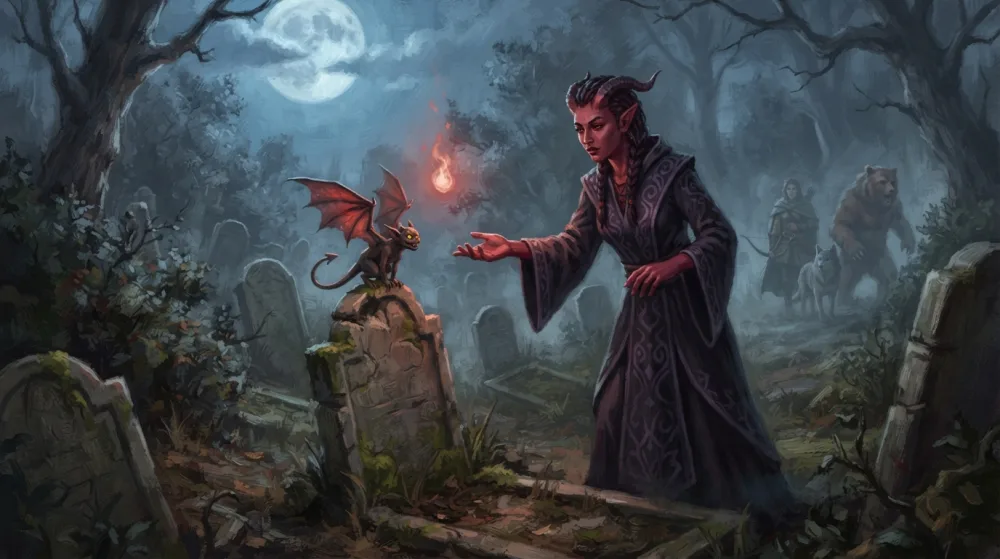
Pact of the Chain is one of three Pact Boon options a Warlock chooses at 3rd level, alongside Pact of the Blade and Pact of the Tome. Choosing it grants Find Familiar automatically, cast as a ritual, without it counting against the Warlock's spells known.
On top of the standard Find Familiar form list, a Pact of the Chain Warlock can choose one of four special forms: imp, pseudodragon, quasit, or sprite. All four have stronger stat blocks than the standard options, several with flight and useful special senses.
The defining feature of Pact of the Chain: when you take the Attack action, you can forgo one of your own attacks to let your familiar make an attack of its own. This is the only companion-creature option in the 2014 PHB that turns a Find Familiar-derived creature into a real combatant, at a real cost (one less attack from you that turn).
Best for: any Warlock who wants a scouting and combat-support tool without competing with their limited Pact Magic slots. Fiend and Genie patrons in particular benefit from the extra action-economy flexibility a Chain familiar provides.
Beast Master and Wild Shape: Where to Look
Ranger's Beast Master companion is a full combat companion, CR 1/4 or lower, that gains the Ranger's proficiency bonus on its attacks, saving throws, and AC, and generally needs a bonus action to command on your turn. This is a much stronger and more durable option than a standard familiar, but it's locked to the Beast Master archetype specifically, not available to every Ranger. Full mechanics, companion selection, and tactical notes are in the Ranger class guide.
A second Ranger subclass, Drakewarden (Fizban's Treasury of Dragons), also grants a companion creature: a drake that shares your initiative and acts on its own turn, needing only a bonus action to direct rather than your full action. It solves Beast Master's core weakness directly. See the Drakewarden guide for the full breakdown.
Druid's Wild Shape isn't a companion at all: it's a full transformation. The Druid uses the beast form's game statistics while retaining their own mental ability scores, and generally can't cast spells while transformed. It replaces the Druid's own body rather than adding a second creature to the fight. Full mechanics, CR limits, and build notes are in the Druid class guide.
Final Verdict
Four systems, four different jobs. Find Familiar is the cheapest, most broadly available option and the right pick for scouting and utility. Pact of the Chain is the only path to a familiar that fights. Beast Master gives a Ranger a real second combatant. Wild Shape turns the Druid themself into the combatant. Confirm which system your class actually has before building around any of them; they don't substitute for each other.